Proposals to pedestrianise Oxford Street — a major shopping thoroughfare in central London — have been mooted since the 1960s. In 2026, the vision will finally see the light of day — in part, anyway. Here's our explainer on what will be a substantial shake-up to one of the city's most famous streets.
Is the Oxford Street pedestrianisation actually happening?
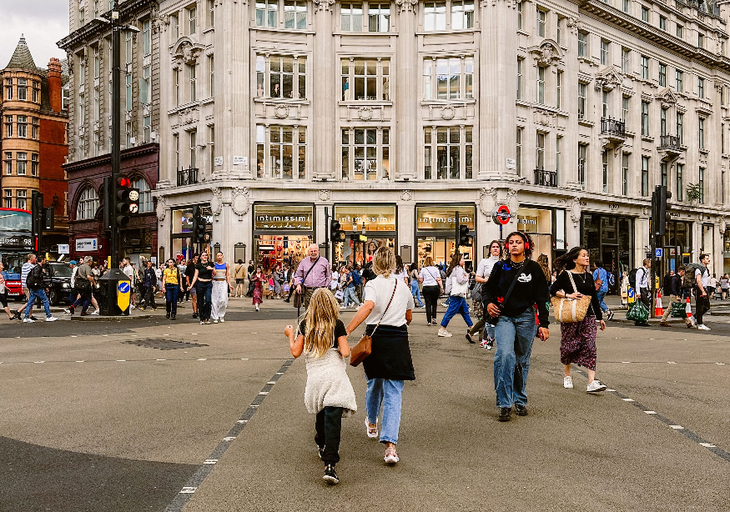
Plans to remove cars and other vehicles from Oxford Street have been rumbling on for so long, you'd be forgiven for thinking it's some pie-in-the-sky pipe-dream. But yes, it's actually happening: a section of Oxford Street will soon be permanently closed to vehicles (with the exception of emergency access), leaving the world-famous shopping street part-pedestrianised.
Who's in charge of the Oxford Street pedestrianisation?
As of 10 August 2026, an organisation called the Oxford Street Development Corporation (OSDC) — established by the Mayor of London, Sir Sadiq Khan to work on his behalf — has taken on planning powers which were previously held by the London Borough of Camden and Westminster City Council (Oxford Street sits within both of these local authority areas).
This means that new planning applications within the OSDC area must be submitted to and determined by the OSDC. The area covered by the OSDC is marked on this map.
Which part of Oxford Street is closing to cars?
Initially, the section between Orchard Street (the road immediately to the west of Selfridges) and Great Portland Street (the road to the east of IKEA) will be pedestrianised, as shown in red on the above map. This is a stretch of around 0.6 miles (0.9km), and includes the busy Oxford Circus junction where Oxford Street and Regent Street cross.
It's worth noting that although vehicles will no longer be allowed to travel east-west (or vice versa) along Oxford Street, they will still be able to travel north-south (or vice versa) on roads running perpendicular to Oxford Street, so vehicles will still cross Oxford Street at these points:
- Duke Street (for traffic heading northbound only)
- Davies Street and Stratford Place
- Vere Street and New Bond Street (for traffic heading southbound only)
- Holles Street and Harewood Place (for traffic heading northbound, and TfL proposes to also provide a contraflow cycle lane here for cyclists to travel southbound)
Access for emergency vehicles, street cleaning and refuse collection will be maintained, so the street won't be completely sealed off to vehicles.
When is Oxford Street being pedestrianised?
Pedestrianisation was finally given the go-ahead in February 2026, with the intention of implementing it from September 2026. That's now been slightly pushed back to Monday 26 October 2026.
For a few months, the new set-up will be in a live testing phase (also known as the 'transition scheme'), with local businesses and visitors able to give real-time feedback, before permanent changes are installed towards the end of 2027.
Will buses still be able to go down Oxford Street?
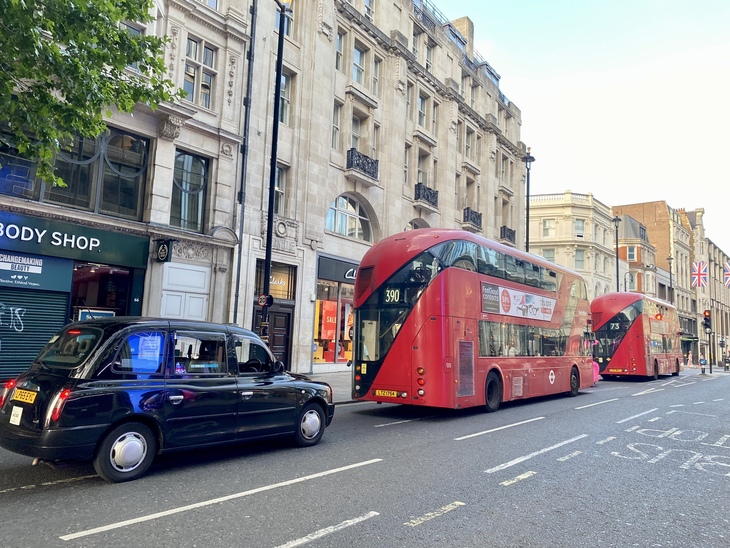
The initial scheme will see this stretch of Oxford Street closed to private motorised vehicles, buses, taxis and private hire vehicles, cycles, scooters and pedicabs.
So no, buses will no longer run the length of Oxford Street, and existing routes will instead either be diverted via alternative routes nearby, or terminate early.
Oxford Street closure: which bus routes are changing?
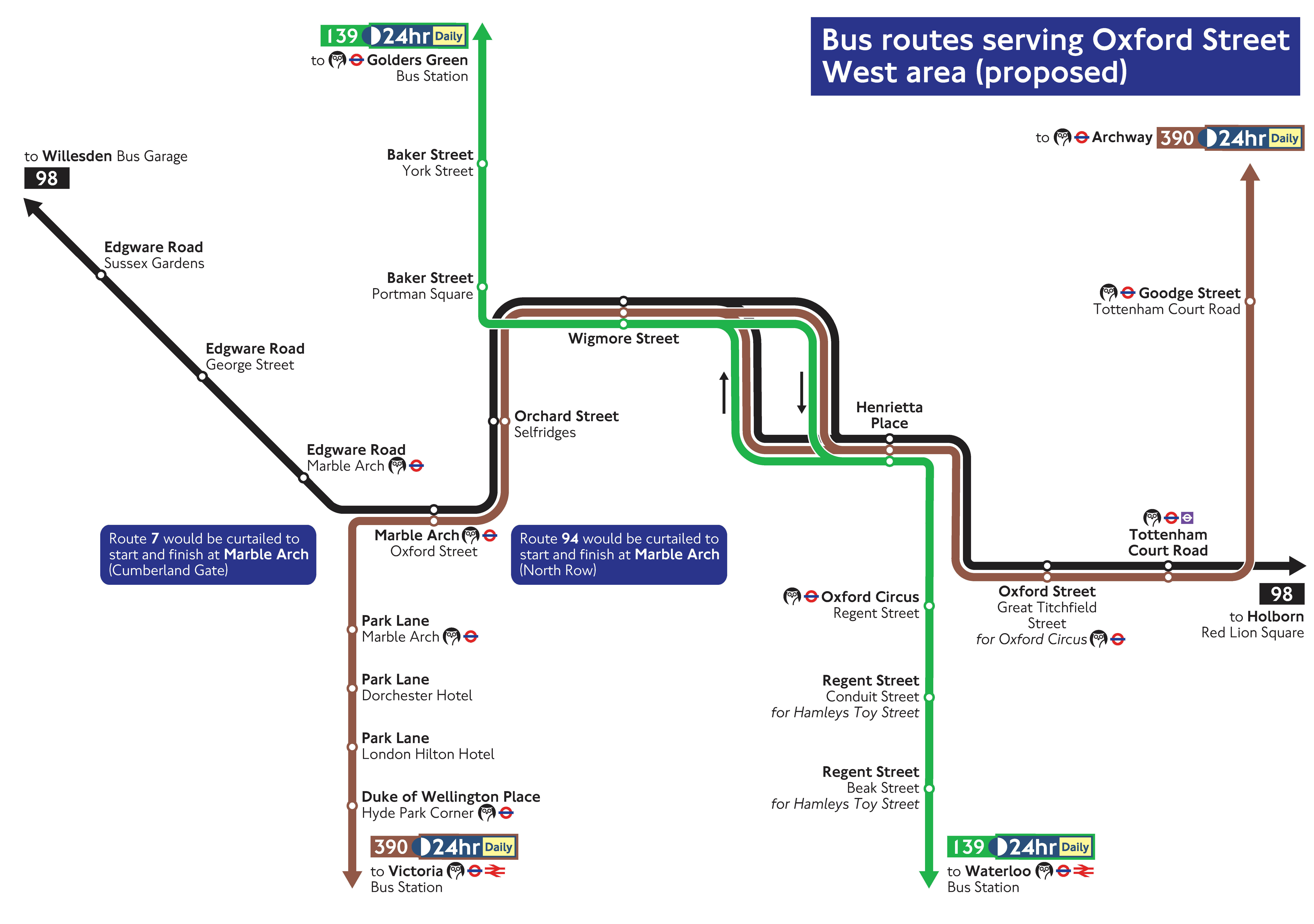
In its 2026 consultation, TfL identified several bus routes which will be affected by the closure of Oxford Street. Daytime routes affected are: 7, 94, 98, 139 and 390. Night routes affected are: N7, N98, N113, N137 and N207.
The consultation showed how TfL planned to deal with these routes (daytime services here, night services here), and the above map shows the changes which will happen to daytime routes, while the map below shows the changes to night routes: some will be terminated early, at Marble Arch or nearby, where passengers can connect with another route to complete their journey. Others will be rerouted via Wigmore Street and Henrietta Place, with new stops installed along these roads.
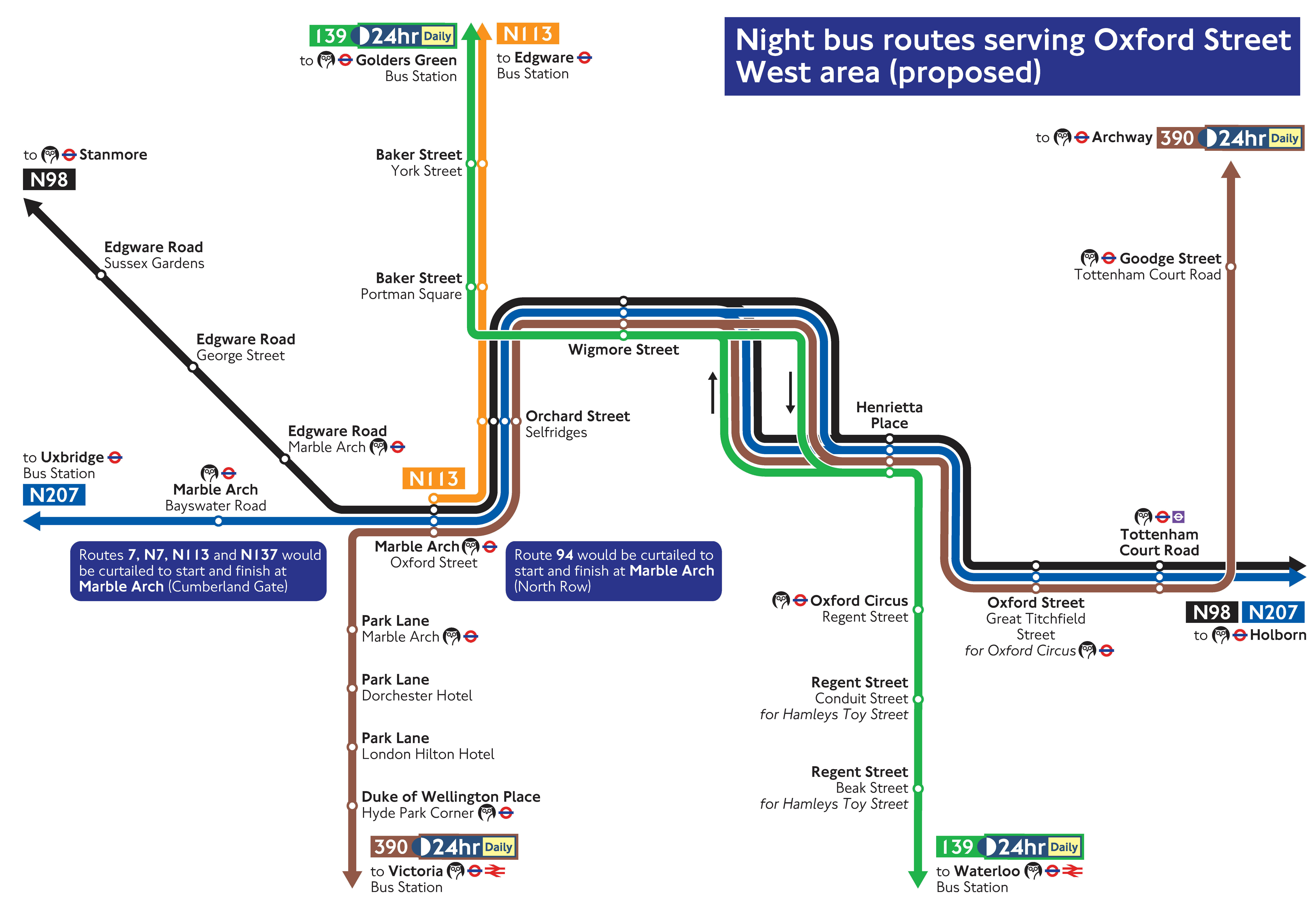
Also worth noting: eastbound buses will follow a temporary route via Wigmore Street and Regent Street until future development work on Henrietta Place is completed, which can only happen once the Cavendish Square development works are complete.
New bus stops have already been installed in preparation for these changes, and further works are ongoing to make the new bus routes safe for everyone.
According to TfL, people wishing to access Oxford Street West by bus will have to walk a short additional distance to and from their bus, with new stops located approximately 100m to 200m from Oxford Street.
Will bikes be exempt from the Oxford Street vehicle closure?
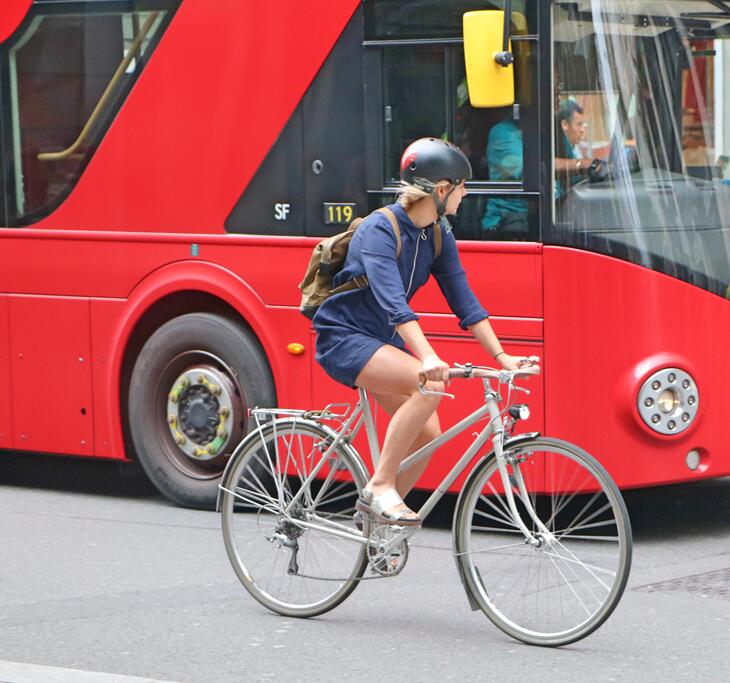
No. As above, bicycles will be banned from Oxford Street, with cyclists rerouted down neighbouring streets, such as Wigmore Street, Henrietta Place or Margaret Street which run roughly parallel to Oxford Street.
Many cyclists have been using these as a quieter alternative to Oxford Street for several years, so the increase in traffic as a result of the Oxford Street closure may have an adverse impact on them, as the routes suddenly become busier.
Will all of Oxford Street eventually be pedestrianised?
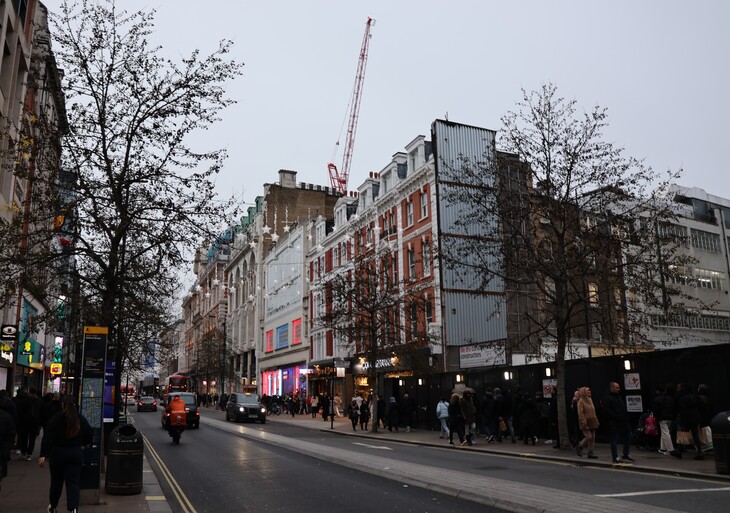
Oxford Street runs all the way from the traffic triangle at Marble Arch in the west to Tottenham Court Road in the east, a distance of around 1.2 miles. Beyond that, New Oxford Street runs further east, to the junction with High Holborn, an additional 0.4 miles.
The initial pedestrianised area, as mapped above, runs from Orchard Street to Great Portland Street. Back in 2016, when the transformation was due to be complete by 2020, the plan was for pedestrianisation to eventually apply all the way from Marble Arch in the west to Tottenham Court Road in the east.
In August 2026, the OSDC told Londonist:
Regenerating the whole of the street is important to the Mayor and OSDC. The first phase of transformation works will see almost one kilometre of the street go traffic free (from Orchard Street to Great Portland Street) as well as some improvements to the whole street to make it cleaner and more welcoming. We are also exploring the potential for further change beyond this first phase, with any further traffic management proposals being subject to consultation and necessary consents.
So the pedestrianisation may, or may not, be extended in the future.
There are no plans — and as far as we know, there never have been — to pedestrianise New Oxford Street.
Is the Oxford Street pedestrianisation a good thing?
That depends who you ask. People in support of the removal of vehicles from Oxford Street cite benefits such as improved air quality and pedestrian safety. The Mayor of London has already proved significant success cutting emissions via ULEZ, with independent analysis from Imperial College London showing that, between 2019 and 2024, estimated air pollution-related deaths in the capital were reduced by circa 40%.
Others say that forcing traffic to use nearby side streets as an alternative only pushes these issues onto other areas, and that it makes using the shops harder for people with accessibility issues, with bus stops moved further away, and taxis no longer able to drop people off nearby.
What about the Oxford Street Christmas lights?
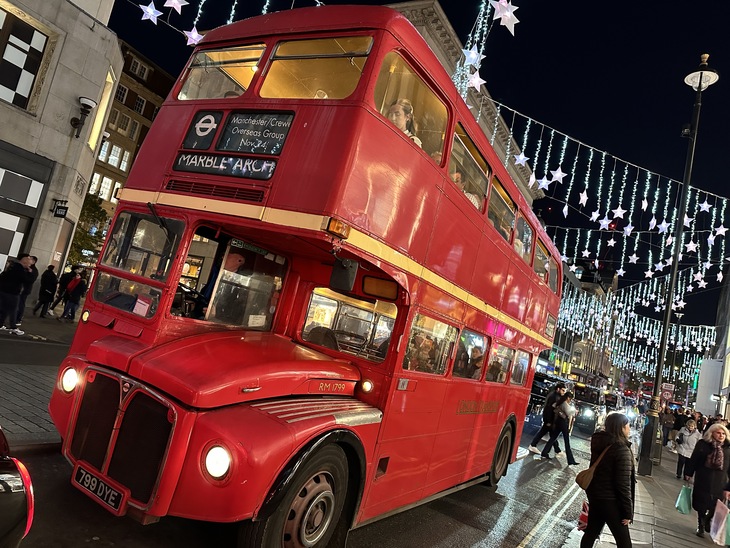
One thing we'll personally miss? Riding a TfL bus down Oxford Street at Christmas to get the best views of those Christmas light displays. Several tour companies have operated festive bus tours down Oxford Street for many years too, so they'll be facing changes this winter.
On the plus side, the lack of traffic should make it easier to gaze up at the Christmas lights from below, and snap a festive photo or two without having to dodge traffic — though as we said earlier, emergency vehicles will still have access to the entirety of Oxford Street, and traffic will still intersect the street at certain points, so you'll need to keep your wits about you.
The OSDC told Londonist:
OSDC are working closely with New West End Company who are leading on the Christmas lights to ensure that this Christmas is a very special one.
Details on the 2026 festive plans will be shared in due course.
Oxford Street pedestrianisation: a timeline so far
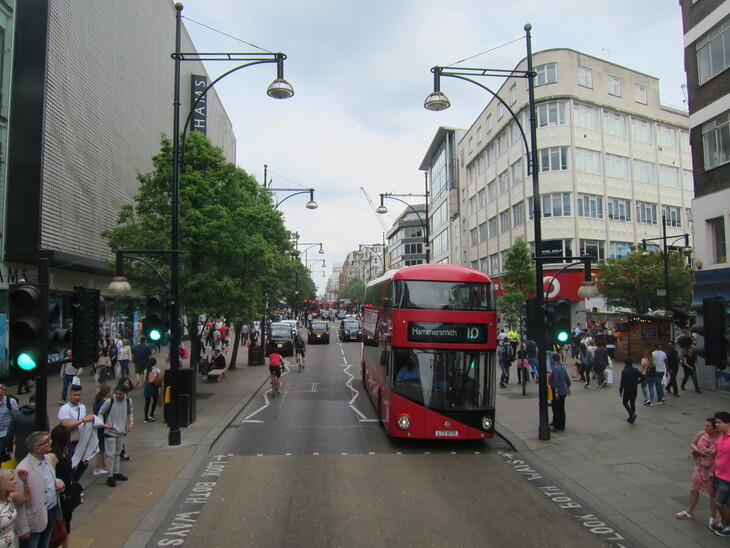
A quick catch-up on the story so far:
1960s: The Society for the Promotion of Urban Renewal floats the concept of 'High Oxford Street' in 1961, involving an elevated walkway with a travelator. This is followed in 1963 by a similar proposal, whereby pedestrians would access shops on the first floor, via an elevated deck. Neither plan goes far.
1971: The Oxford Street Action Committee is formed, calling for the ban of traffic on Oxford Street, but nothing much happens, apart from a demo and 22 arrests.
1983: Plans are put forward for an Oxford Street flyover, also featuring an elevated pedestrian walkway. No dice.
April 2004: Liberal Democrat mayoral candidate Simon Hughes pledges to pedestrianise Oxford Street, should he oust incumbent mayor, Ken Livingstone. He doesn't.
February 2005: Ken Livingstone, the first Mayor of London is reported to have complained about how hard Oxford Street is to navigate as a pedestrian, with too many buses and narrow pavements. "One of my priorities in my second term is to determine what is going wrong at Oxford Street," he says. The following year, Livingstone announces plans for an Oxford Street tram, but that idea quickly vanishes.
November 2005: There is talk of creating more pedestrian areas in the West End as a whole (Oxford Street isn't the specific focus), with the New West End Company highlighting "the importance of the West End as a destination of choice, not a thoroughfare".
December 2008: Oxford Street and neighbouring Regent Street go traffic-free for a special shopping day, leading to calls for permanent pedestrianisation.
2009: The diagonal crossing at Oxford Circus is installed and opens in November (having been proposed a year prior), showing that improving the pedestrian experience on the street was already a consideration. Then-Mayor Boris Johnson describes it as "a triumph for British engineering, Japanese innovation and good old fashioned common sense".
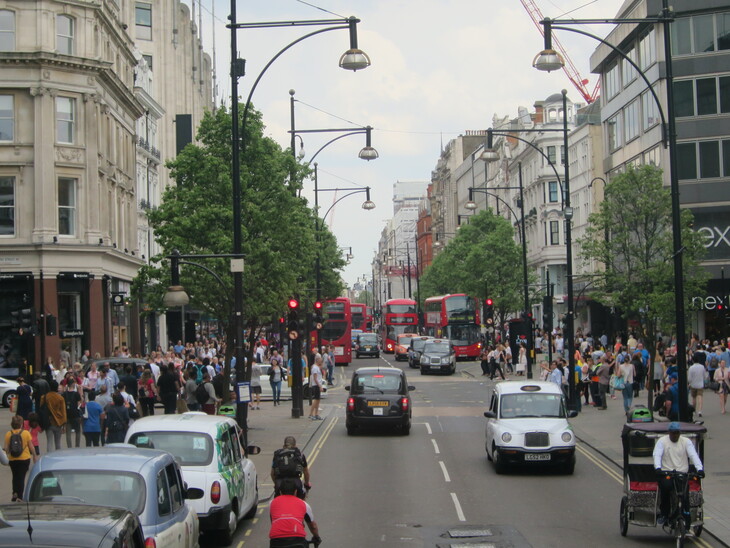
July 2010: The New West End Company releases a vision of what it would like its jurisdiction to look like 10 years hence, in 2020. Plans pertaining to Oxford Street include a reduction in bus traffic, with green shuttle buses linking Marble Arch with Tottenham Court Road; a public pavilion outside John Lewis; and a second diagonal crossing installed at the Tottenham Court Road crossroads. Little do they know that Oxford Street will be practically deserted for large parts of 2020, its world-famous shops shuttered for months on end...
2012: In part of his manifesto to run for Mayor of London, transport-journalist-turned-political-candidate Christian Wolmar name-checks Oxford Street as "an obvious candidate" for part-pedestrianisation. Wolmar has been highlighting the dangers of Oxford Street as far back as 1992, including calling out then-Major Boris Johnson for his lack of interest in such a scheme in 2008.
July 2016: Within two months of taking office, new Mayor of London Sadiq Khan lays out plans for Oxford Street to be pedestrianised by 2020, citing air quality as the main motivation. It isn't clear what pedestrianisation might look like, or whether it can even be done.
April 2017: A TfL public consultation ahead of Crossrail's (planned, but later delayed) 2018 opening asks for people's thoughts on the future of Oxford Street, including whether it should be partly or completely pedestrianised.
October 2017: The results of TfL's public consultation reveals that 62% of respondents support plans to transform Oxford Street, though 19% of those in support says they have some concerns about the planned changes.
November 2017: Sadiq Khan's 2016 plan for pedestrianisation by 2020 becomes old hat, as he announces ambitious plans for a pedestrian boulevard to be in situ on the street as early as 2018 (again: Crossrail was due to open at the end of 2018, so it all would have tied in nicely). It encompasses a half-mile stretch between Orchard Street and Oxford Circus being closed to all traffic.
March 2018: The results of a further consultation reveal that around two-thirds of respondents once again back the idea of pedestrianising Oxford Street — though the survey also identifies around 700 issues that need to be ironed out before it can progress.
June 2018: Westminster Council blocks the plans, saying that the pedestrianisation of Oxford Street is "off the table for good".
October 2018: Further proposals for switching things up on Oxford Street are revealed, though they have an air of chucking everything at it and seeing what sticks. Case in point: the suggestion of inserting a public piazza space somewhere in Oxford Circus while also keeping it fully open to traffic.
February 2025: TfL and the Mayor of London launch another public consultation into pedestrianisation plans, including setting up a new Mayoral Development Corporation (MDC) to oversee Oxford Street, which will have the necessary powers to support the transformation of the area. The logistics of pedestrianisation remain vague at this point, with further consultations promised at a later date.
June 2025: The results of the public consultation show that around two-thirds of people want to see Oxford Street pedestrianised, similar figures to the consultation which ran back in 2018 (though at this point you have to wonder if people are just saying that to get the whole thing over and done with). Khan pledges to push ahead with the plans.
February 2026: Following the 2025 public consultation, final approval for the pedestrianisation scheme is given, with the expectation that it'll be implemented from September 2026.
May 2026: The Westminster Conservatives group criticises the Mayor of London and TfL's plans to pedestrianise Oxford Street, planning to take legal action to block the changes. It backs down a few days later.
August 2026: The new Mayoral Development Corporation (MDC) which featured in the 2025 consultation takes control, suggesting we might finally be getting somewhere. It's the Oxford Street Development Corporation (OSDC), more on which above.
October 2026? Oxford Street is finally (part) pedestrianised.