London can be a grey place but, argues Matt Brown, things are gradually brightening up.
Here's a London crowd in 2017, attempting to exit Aldgate underground station. What do you notice?
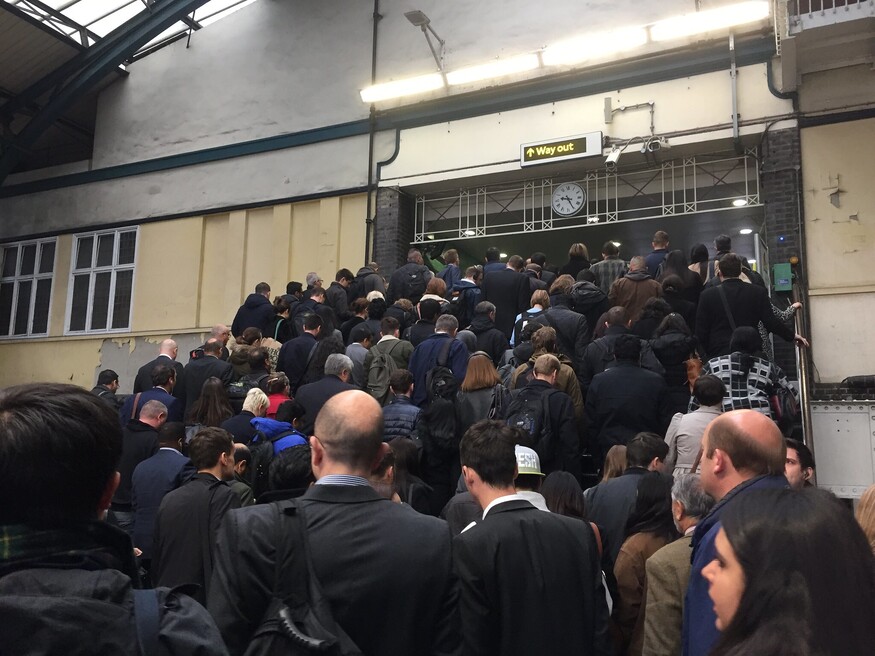
Almost every person in that photograph is wearing black, or else a very dark shade of blue. You'd perhaps expect this in the City, with its high proportion of suits, but similar scene play out across London, particularly during the cooler months. The Londoner's winter plumage is overwhelmingly black.
Our buildings, too, are usually monochrome. Much of central London is built in Portland stone, concrete or plate glass. When brick intrudes, it's often the dark brown of Georgian and Victorian terraces. All very stately and smart, and to many people's tastes.
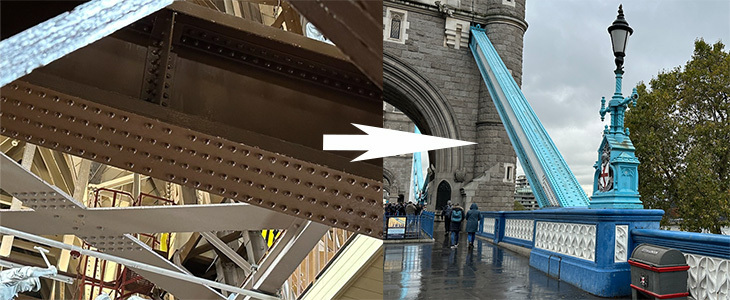
London does flirt with colour, of course, even if it seldom embraces it. Think of all those red buses, phone kiosks, post boxes and the like, which have become icons of the city, along with the red, white and blue of the Tube. The biggest icon of them all, Tower Bridge, was once an uninspiring brown; since Elizabeth II's Silver Jubilee, its hues are blues. It joined the striking red of Blackfriars Bridge and the peculiar green-yellow combo of Southwark Bridge.
And, very occasionally, our traditional housing stock has its colourful moments. We've all seen (and probably Instagrammed) that row on Portobello Road, but small pockets can be found elsewhere:
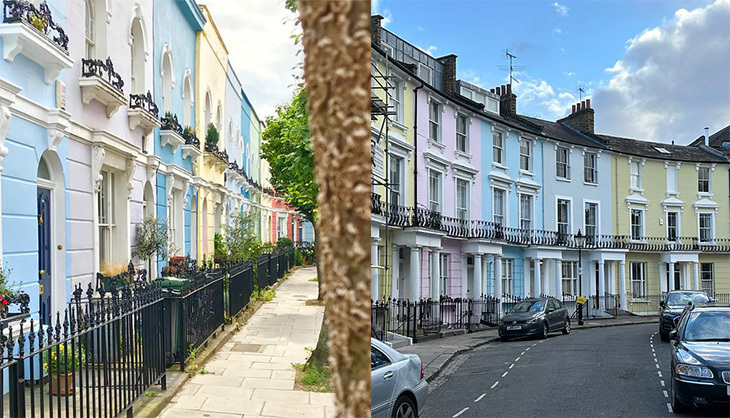
Such places seem very popular. They must be photographed dozens of times a day (admittedly, the Primrose Hill one also has Paddington Bear connections). If such streets are so universally admired, why don't more posh people paint their terraces this way? Probably because they don't want hoards of photographers on their doorstep, which is fair enough.
These exceptions notwithstanding, London's historic buildings have rarely flaunted much colour. Until recent times, they were typically grey or even black, caked in layers of soot from the 'Big Smoke' of a million hearths and factories. Look how grubby St Paul's was in the 1950s.
With the advent of Clean Air Acts in the 1960s, the city was gradually cleaned up, yet it remained a place of muted colour. Then a few exceptions began to creep in, such as the funky rubber paving in Carnaby Street from 1973 and the rich mix of Neal's Yard in Covent Garden. The first big wave of colour came in the 1980s, with the arrival of postmodern architecture. Here we saw the use of big, bold colour, not just on a building's facade, but also in its services.
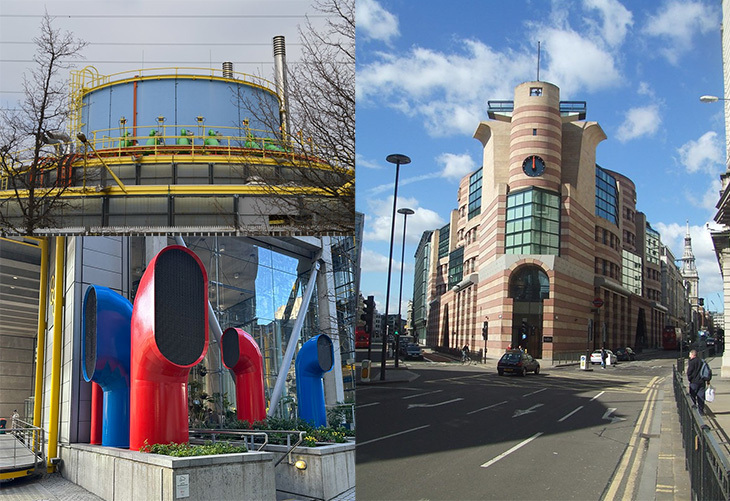
Richard Rogers, in particular, was a champion of primary colour. Most of his buildings feature bright reds, blues and yellows on ventilation pipes, support frames and lift machinery. It's all over town, from the cranes on top of the Lloyd's building to the 'tent poles' of the O2 dome.
Les Nouvelles Couleurs
Recent years have seen a notable rise in colourfulness, never witnessed in the capital before. The charge was led by Renzo Piano's Central St Giles development, completed in 2010. This wasn't so much as splash of colour as a defibrillator shock of energy.
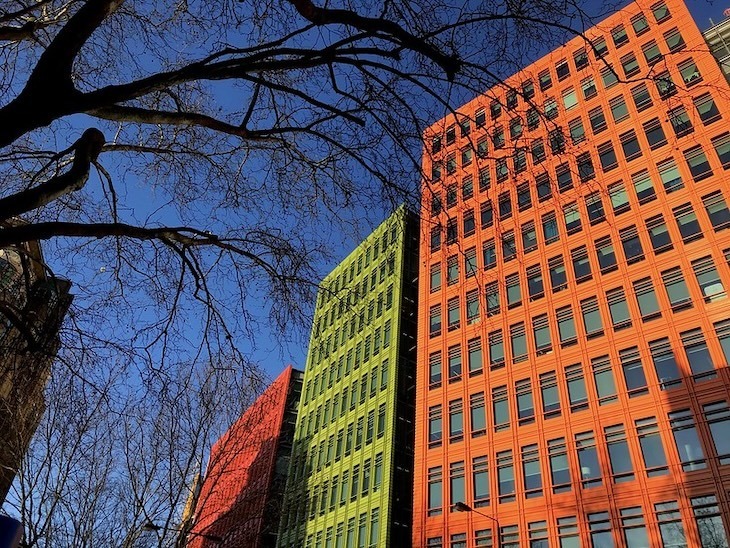
I have to admit, I was a little sceptical at first. It felt a bit too much. Over time, though, I've come to really admire the building (or, rather, the architect) for trying something different and injecting new wavelengths into a samey streetscape. I'd never advocate for such chromatic bombshells everywhere but, as a one-off, it wins my approval.
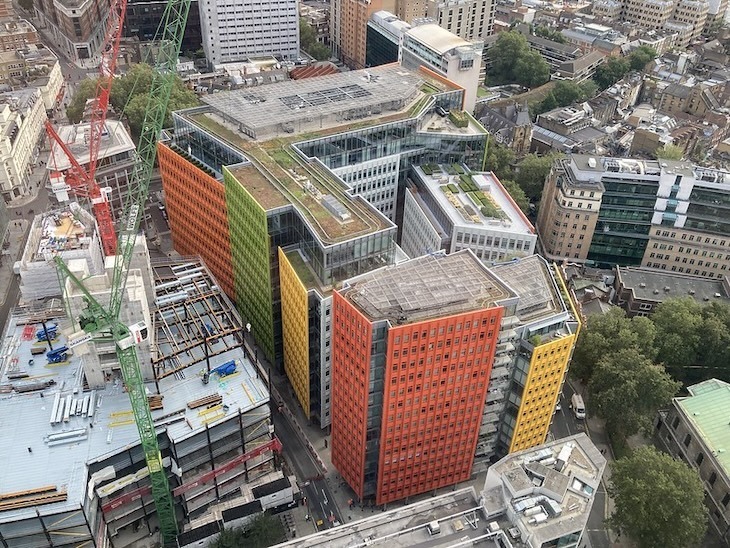
Central St Giles remains the most audacious use of colour in the central London streetscape. It has, however, been joined by countless further examples across the city. Many new residential developments and office blocks, when not cladding themselves in fake brickwork, now opt for colourful outer shells. We see this not just in the centre, but also the suburbs.
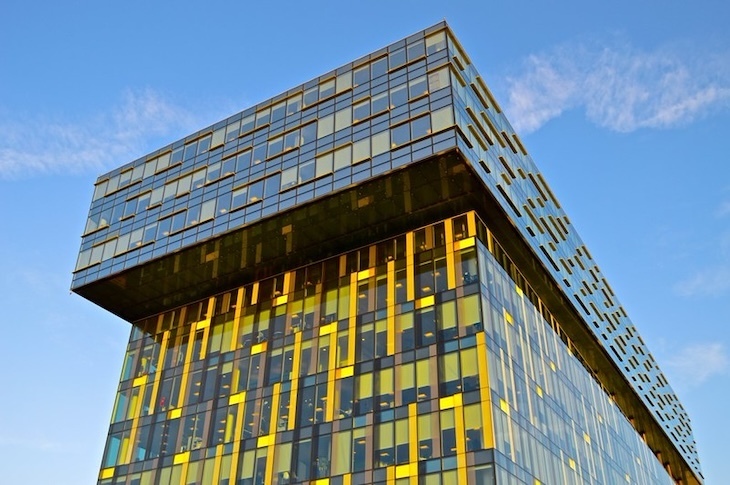
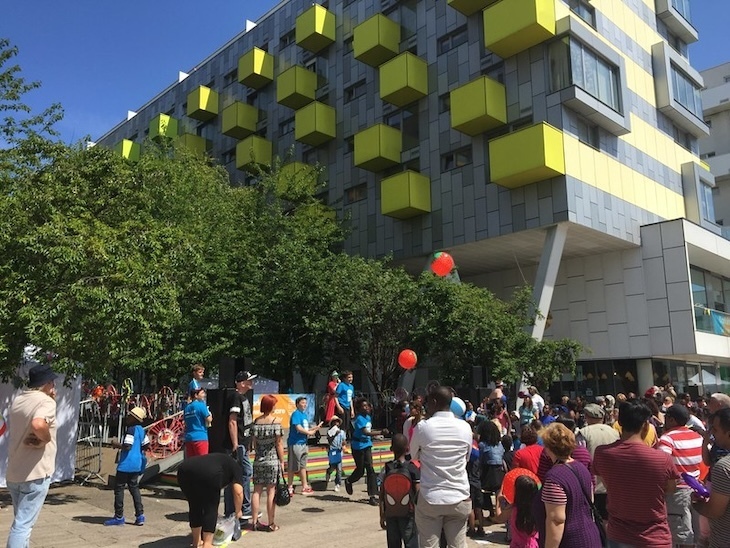
It's not hard to find further examples of new-builds piling on the colours, but we're also seeing plenty of vibrant facelifts on older buildings. Leading the way here is the singular example of Camille Walala, whose patterned wraps and paintwork have transformed more than a few pockets of London.
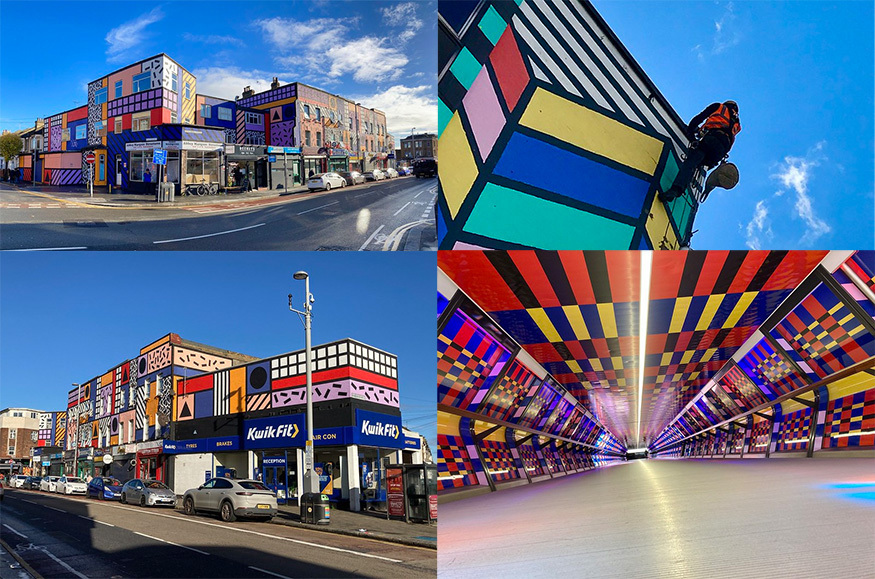
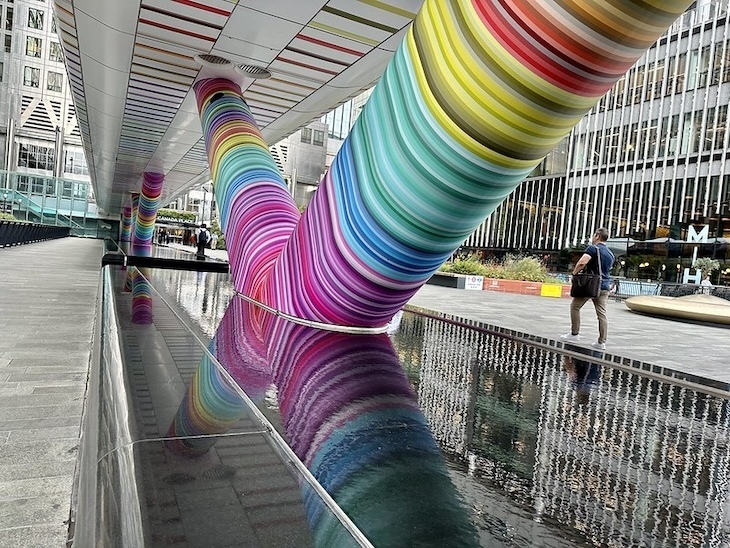
Yinka Ilori, too, has brightened our city with colourful street crossings, murals, bridges, and other joyous interventions. At Canary Wharf, where the blue skies were long-ago filched by high-rise, at least the street level is bathed in colour thanks to Adam Nathaniel Furman's 'Click Your Heels Together Three Times':
Most of London's central bridges now glow fetchingly by night, thanks to the Illuminated River programme. Multistorey, multicolour murals decorate the sides of the Megaro Hotel on Euston Road and the NYX hotel on Southampton Row. LGBTQ initiatives have added their own rainbows of love to the streets of London.
And then we have 'that tunnel' at King's Cross, which has brought so much joy to so many passers-by.
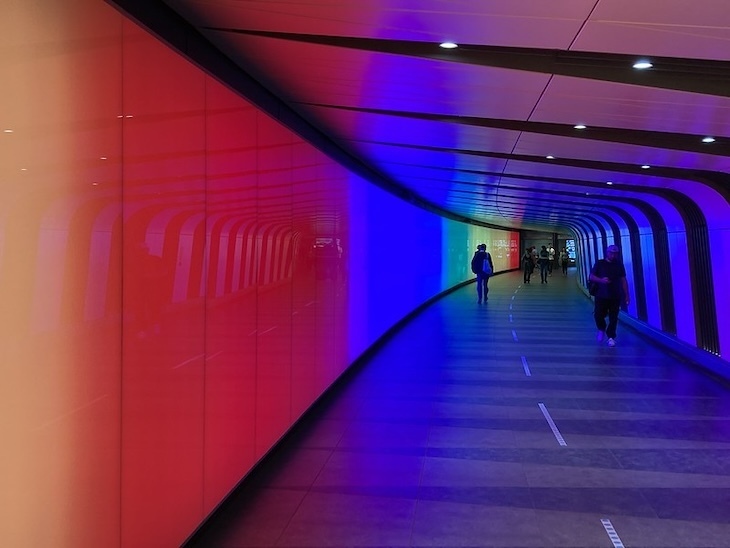
Such examples (and there are dozens more) do not quite add up to a revolution, but they are, perhaps, a groundswell. Colour is on the rise. It's more acceptable on the streets than ever before, and I'm here for it. More of this kind of thing, please. Much more.
Of course, there is a backlash. Post any of these images on Facebook and you're guaranteed comments like"What an eyesore!" and "It looks childish."
Fair enough, some people really do have a negative reaction to bright colours and we should, on the whole, respect their needs for a coherent, calm, consistent streetscape. But we should also find space for playfulness. What, after all, is wrong with a bit of childishness? About a quarter of Londoners and visitors are children. Shouldn't the built environment serve them, too? And who said bright colours have to be the preserve of children anyway? That's just stuffy British tradition.
So bring on the full colour wheel. Turn our grey spaces pink and yellow and cyan. Let's find a new and optimistic palette for London. And let's start by swapping our winter coats for something a little cheerier.