London's lunar legacy explored.
Humans are returning to the Moon. NASA's successful Artemis II mission marked the first time we've left Earth's orbit since 1972. The groud-breaking mission took humans further from Earth than ever before, and included the first woman (Christina Koch) the first person of colour (Victor Glover), and the first non-American (Jeremy Hansen, Canadian) ever to leave low-Earth orbit.
To mark the historic mission, we took a look at London's many surprising connections to the Moon, including unexpected memorials and even an early design for a lunar lander. Let's see what's out there...
Moon rock
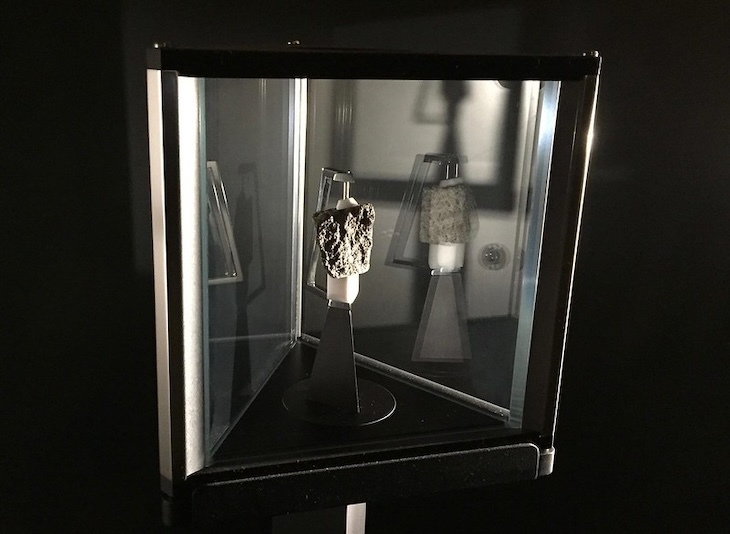
We're lucky enough to have a few actual piece of Moon right here in London.
Moon rock is precious and scarce on planet Earth. Just 381 kg were brought back by the six Apollo missions, supplemented with much smaller amounts from Soviet and Chinese probes. Add to this about 370 meteorites thought to come from the Moon, and it still adds up to not very much.
Fragments of our neighbour can be found in the Natural History Museum (alongside a Union Flag taken to the Moon on Apollo 17), as well as the one pictured in the Science Museum's new space gallery.
Other Apollo relics
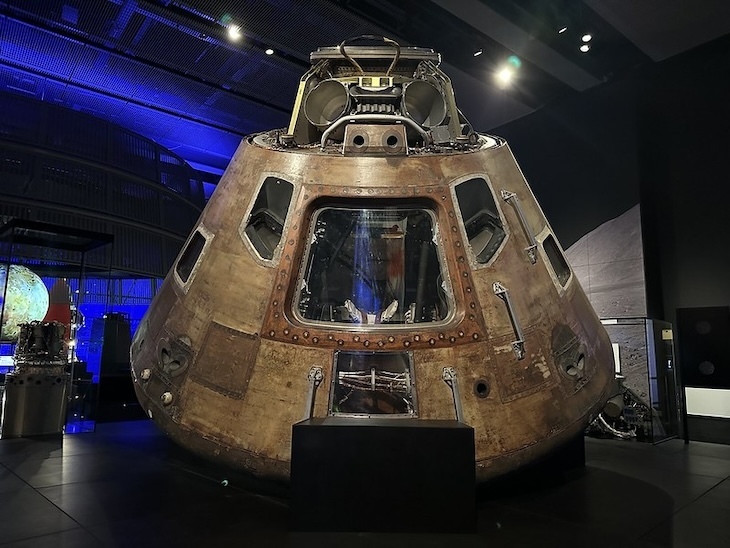
The Science Museum also holds a space capsule that flew humans around the Moon. The Apollo 10 Command Module was used on the 1969 'dress rehearsal', shortly before Neil Armstrong and Buzz Aldrin's historic landing. We're very lucky to have such an historic space vehicle in London.

The same gallery holds a few other Apollo keepsakes, including Neil Armstrong's emergency radio and other comms gear. You'll also find a prototype for a miniature nuclear reactor, designed for use on a future Moon base.
Lunar craters
There are at least 70 Londoners on the Moon. Well... craters named after prominent Londoners. These include Geoffrey Chaucer, optician John Dolland, computer pioneer Charles Babbage and astronomer Mary Somerville. We've covered this in a previous article, including links to their position on the lunar map.
Astronaut trees
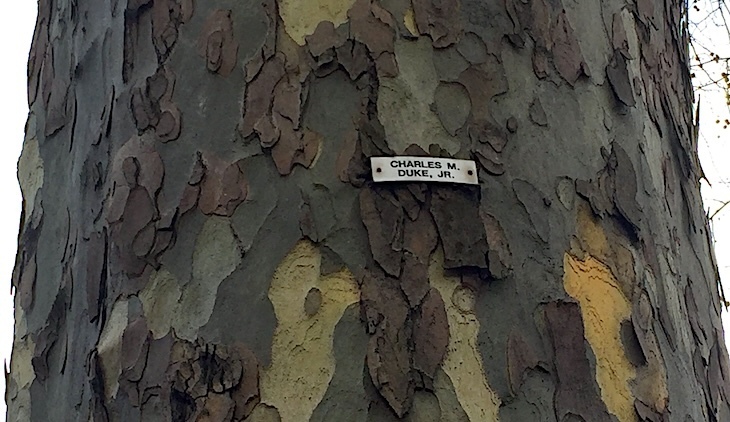
Next time you walk along the western side of Kennington Road, pay close attention to the trunks of the plane trees. Many contain labels bearing the name of an Apollo astronaut. The labels have been up there for decades. The leading theory is that the labels were placed there by the British Interplanetary Society, located nearby. Speaking of which...
The British Interplanetary Society
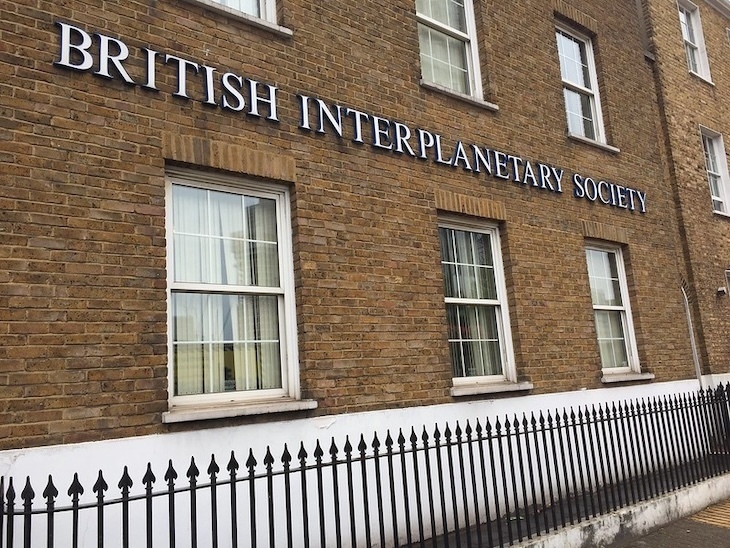
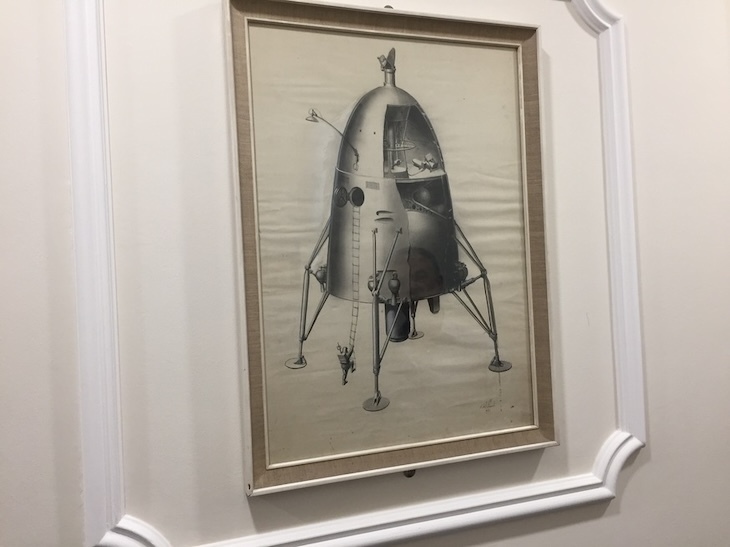
The British Interplanetary Society was an advocate of Lunar missions long before NASA existed. This wonderful members' organisation in Vauxhall drew up plans for the conquest of the Moon in the 1930s. These included a lunar lander not entirely dissimilar to the ones used by the Apollo missions three decades later.
The society is still going strong today. It possesses a large library of books relating to space exploration, and puts on regular events, often with a lunar theme.
Lunar namesakes
London contains various places named after our natural satellite. One of the streets leading from Piccadilly into Mayfair is called Half Moon Street. If memory serves, this was briefly home to space tourism company Virgin Galactic. The street is eclipsed — in name if not history — by a short residential row in Islington called Moon Street.
Half Moon Street was named after an old tavern, and many watering holes have celestial names to this day. Most famous, if only because of its prominent location in Leicester Square, is the Moon Under Water. It's a name adopted by several Wetherspoons pubs, all taking their lead from George Orwell, who wrote an essay about his ideal pub under that name.
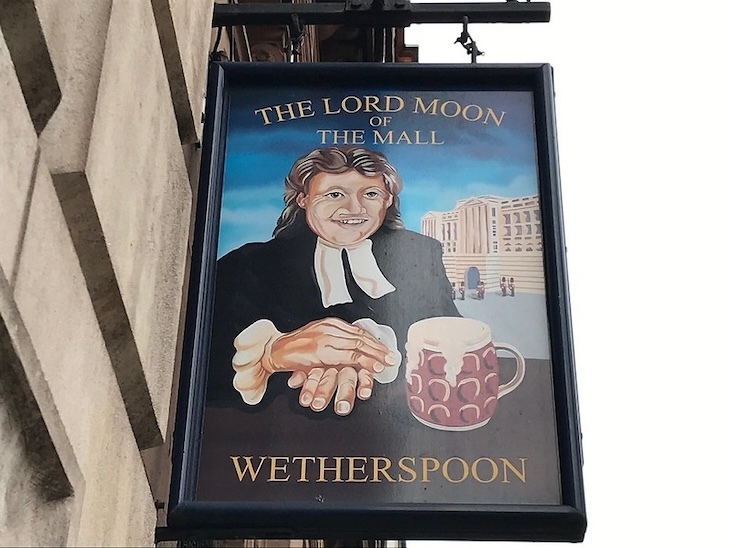
London also contains a handful of Half Moon pubs, the pick of which has to be the landmark boozer in Herne Hill. It's also a hotel, and each of its boutique bedrooms is named after one of the 12 moonwalkers.
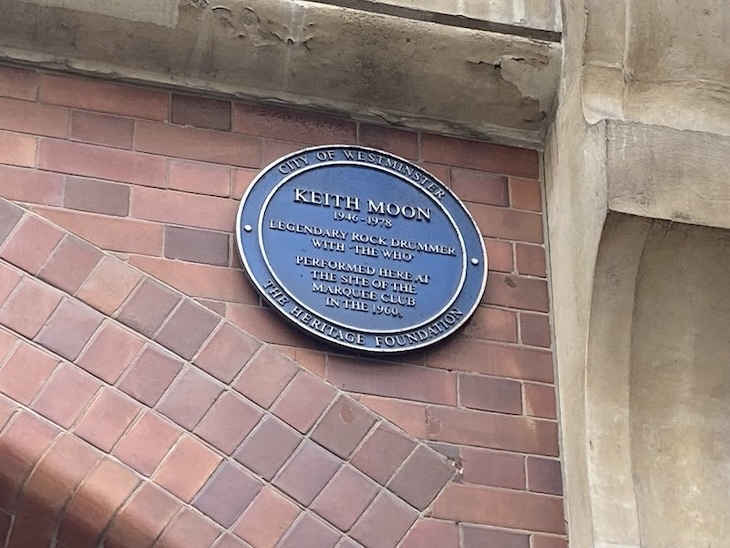
Keith Moon
OK... nothing to do with the actual Moon. But The Who drummer led a very London life... and death. His talents are remembered with a heritage plaque on the site of the Marquee Club in Soho (above). His death in Mayfair is not memorialised, but it is well remembered. Moon died at in a flat at 9 Curzon Place aged 32. This was the same flat where Mama Cass Elliot of the Mamas and the Papas died a few years earlier... also aged 32. It was also just metres from the aforementioned Half Moon Street.