This feature first appeared in September 2024 on Londonist: Time Machine, our much-praised history newsletter. To be the first to read new history features like this, sign up for free here.
“Did you know that the City of London has no street lamps? They’re all cantilevered out from the buildings.”
So bombshelled my friend and fellow London explorer Ian Visits, over a recent pint. I was gobsmacked. I thought I knew the City reasonably well. I am especially hot on street furniture. But here was a major oddity I’d totally overlooked.
Ian went on to tell me that the lighting is elevated to cut down on “street clutter”, and make the pavements more open. No bleedin’ bins, either — as I rediscover every time I finish an apple while wandering around the City.
Ian’s trivial revelation is not quite true. I’ve since found some 100% real lamp posts near Petticoat Lane, while others decorate the central reservation along Upper Thames Street. But to a close approximation, he’s right. Very few streets in the Square Mile harbour a lamp post. No other city can say that.
I live for facts like this. I have a head full of them. Knightsbridge boasts six consonants in a row. New Cross was called Hatcham for most of its history. The silvery piers on the Thames Barrier are actually made from pine wood. There is a crater on Mars named after Tooting. More people were executed in the Tower of London in the 20th century than all preceding centuries put together. There is no Bond Street.
That kind of stuff.
Such learning will not help me fix a leaky tap. I can’t organise a children’s party by knowing that 152 Lord Mayors of London were called John, while only two women, of any name, have held the position (a third is now on the way). I will never negotiate a better mortgage by explaining that Lambeth Bridge is red to match the House of Lords, while Westminster Bridge is green for the Commons (especially if I mention that it also casts penis-shaped shadows). My map of Edward VIII postboxes will not speed up a delivery.
This is all deeply useless stuff. But I love it. And so do many people, I suspect.
The most deeply useless thing you can do with deeply useless stuff is to break it down into deeply useless sub-categories. This is my attempt at a taxonomy of trivia:
Wordplay trivia: Here I’m thinking of the Knightsbridge nugget, or that hoary quiz question about St John’s Wood being the only Tube station to contain none of the letters of ‘mackerel’. (Incidentally, only one Tube station contains none of the letters of ‘Londonist’. See if you can work it out.) Finsbury Park, said backwards, is Krapy Rubsnif. I could go on…
…And I will. Only two Tube stations contain all the vowels: Mansion House and South Ealing. Whitechapel is the only place where the Underground goes over the Overground. And Swiss Cottage is the only station to be named after two types of cheese. Actually, that last one is full of holes.
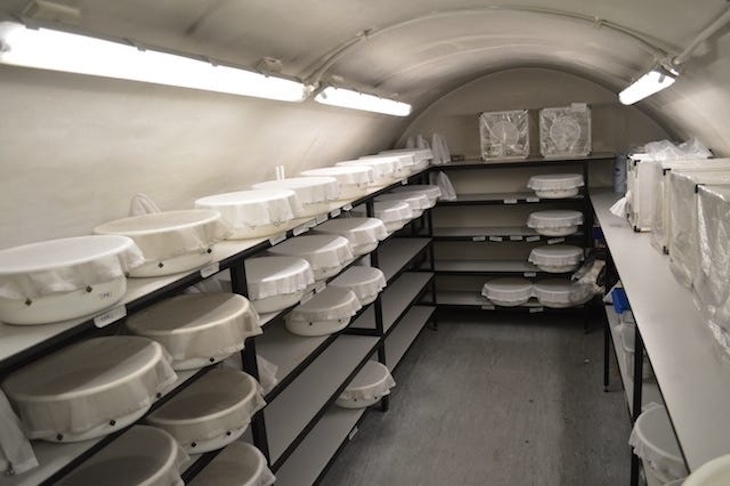
Straight-out trivia: The most common form of trivia is the simple, one-sentence factlet. If we return to Mansion House Tube station, for example, we can observe that it is only the third closest Tube station to the Mansion House. There are people alive today who are older than the place name “Fitzrovia”. Croydon means “valley of the crocuses”. The Shard is the tallest structure in London, but only the 10th tallest in England (think radio masts). And the itchiest fact of all: every time you walk along the eastern side of Gower Street, you’re passing directly over this room containing tens of thousands of mosquitos 👇.
Unlikely coincidence trivia: Mama Cass from the Mamas and the Papas died in the same Mayfair bedroom as Keith Moon from The Who (in different years). They were both borrowing the apartment from singer-songwriter Harry Nilsson. Both were aged 32. Isn’t that something?
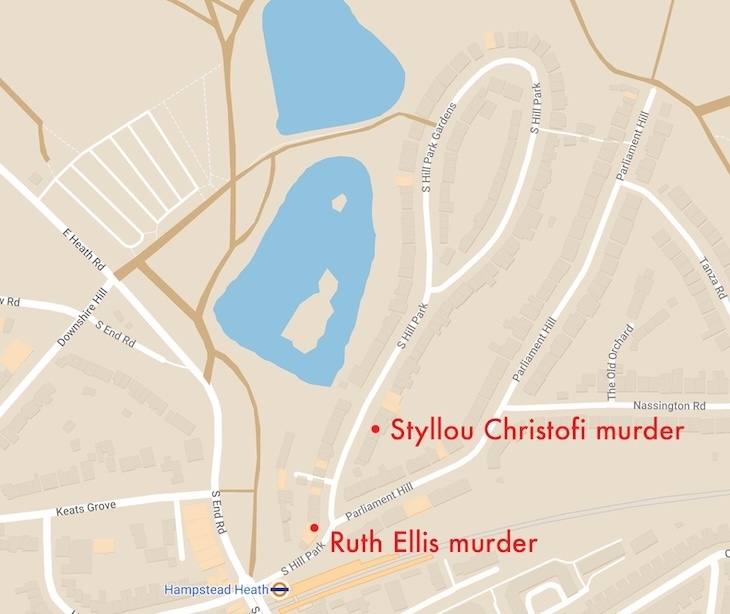
It is a bit weird. Stranger still, though, is the one about Ruth Ellis, the last woman in the UK to be hanged (1955). Ellis was sentenced to death for shooting her abusive boyfriend outside the Magdala pub on South Hill Park in Hampstead. That much is well know. Less familiar is the story of Styllou Christofi, the second-to-last woman to be hanged in the UK (1954). She, too, committed murder, strangling her daughter-in-law. The crime took place at her home at number 11 South Hill Park… about 100 paces from the Magdala.
The UK contains around 800,000 streets. The odds of two unconnected murders occurring on the same street, just a few months apart, and both by women, are very long indeed.
Most of us find unlikely coincidences compelling. They not only connect dots, but also invite us to speculate on the nature of coincidence, probability and fate. The ultimate example — more death, I’m afraid — relates to Aldous Huxley and CS Lewis. These two giants of British literature both died on the same day, 22 November 1963. But their passing went largely unnoticed thanks to the assassination of JFK on that same day. (Incidentally, all three narrowly missed the first episode of Doctor Who, which was broadcast the next day — 23 November 1963. If I were the show-runner, I’d commission an episode that builds a conspiracy theory around the triple expiration.)
Trivia as an extreme sport: The most rewarding trivia is the hardest-won. Take, for example, the fact that Charles Dickens does not mention a single railway station by name in any of his novels. There are two ways to elucidate this. You could feed a list of every train station that existed in Dickens’s time into an algorithm, which would then search the plain text of every novel for occurrences. That would be the easy way. I chose the hard way, which was to physically read every Dickens novel, then make a map of every location he mentions. I learned so much from this two-year project — most pressingly that I should give Victorian novelists a break for a while — but I’m especially proud of discovering the railway station fact. I’m not saying I deserve an honorary PhD or or anything, but I probably do.
Some other examples of performative trivia (I put the work in, so I’m damn well going to shout about it): mapping a thousand fictional locations in London to discover that George Smiley and James Bond were neighbours. Using a knitting needle and Marks & Spencer’s biscuit selection to find the true centre of London. And counting every nipple and genital region in the National Gallery’s collection to uncover which nationalities most enjoy nude paintings.
And finally… Wrong trivia: How many times have you heard people say that the statue in Piccadilly Circus is not Eros but his brother Anteros? This is a really catchy bit of trivia because it allows its possessor to correct the ignorance of others. But we should be careful. Hunt though I have, I can find no evidence that the statue was ever officially named Anteros. In fact, I can find no reference to Anteros before the 1980s.
In 1914, the Daily Record asked a pool of Londoners what they thought the statue was called. 42% answered Mercury; 29% had no idea; 13% reckoned it was 'some kind of genius loci’ or some-such; 11% thought the statue was 'a female', without further elaboration; and only 5% said 'Eros'. Nobody mentioned Anteros. The original sculptor Alfred Gilbert did not call it Anteros (or Eros), so far as I’ve ever discovered. The best we’ve got is modern interpretation of Gilbert’s intent. This may well lean towards Anteros, but that does not make it an official identity, despite what Wikipedia, QI and a thousand copycat websites would have you believe.
That’s one notable example of “wrong trivia”, when people repeat received wisdom without properly looking into it. Another is the oft-reported assertion that the entrance to the Savoy is the only place in the UK where you must drive on the right. It’s not. A hundred other examples can be found in my book on the subject: Everything you Know About London is Wrong.
And that shameless plug brings us to the crux of all this. Trivia is not valueless. Clearly. If facts like these were without merit, then no publisher would be interested in bringing out such a book. In fact, dozens of trivia-led titles are printed every month. The QI television show has evolved into an empire of ‘quite interesting’ facts, with spin-off podcasts, books and stage shows. The Trivial Pursuit board game had sold in excess of 10 million copies when figures were last declared 10 years ago. That is far from trivial. If you’ve read this far, then you, too, are presumably infatuated with trivia.
Like so many of the best things in life — rainbows, oak trees, Bluey, bubble wrap — trivia brings an inner cheer. It enriches the day. It gives us an unusual nugget of information to pass on to friends and family, with whom we can revel in the absurdity and singularity of existence. Trivia is the shiniest button on the overcoat of life, the thinking-person’s endorphin trigger.
And it’s all around us, in our Tube stations, lamp posts, place names and monuments. Trivia lurks, waiting to be discovered, in every street corner, bridge and bodily crevice. I’ll leave you with one final example concerning London poo (which, like the constipated mathematician, I worked out with a pencil):
If laid end-to-end, all the turds deposited in London each day would stretch to 800km. This would be enough to construct a 'soft shoulder' of biosolids four times around the M25, every day… assuming we could find a contractor willing to fulfil such a ghastly project.
I think we’ve reached the bottom.