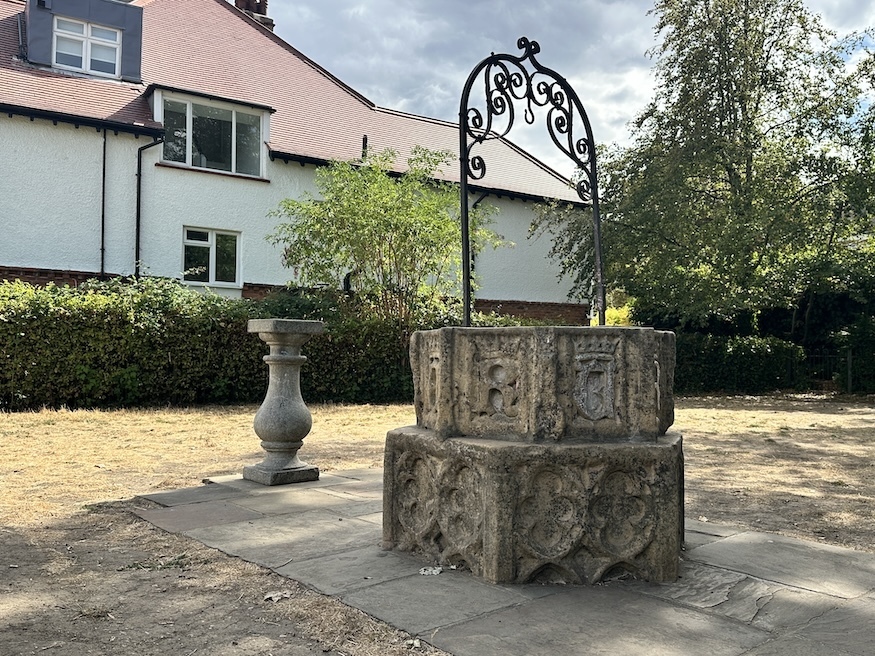
Antrim Gardens in Belsize Park holds two fragments of old London...
One does not simply stumble across Antrim Gardens. To find this tiny park, you must turn down a side street from Haverstock Hill, and then enter a heavily fenced area that seems to be nothing but a toddler's playground, leading on to allotments.
This local amenity, though, hides a pair of historic secrets. Right beside the play equipment — and no doubt considered to be play equipment by the park's preschool clientele — are two items of architectural salvage, side by side.
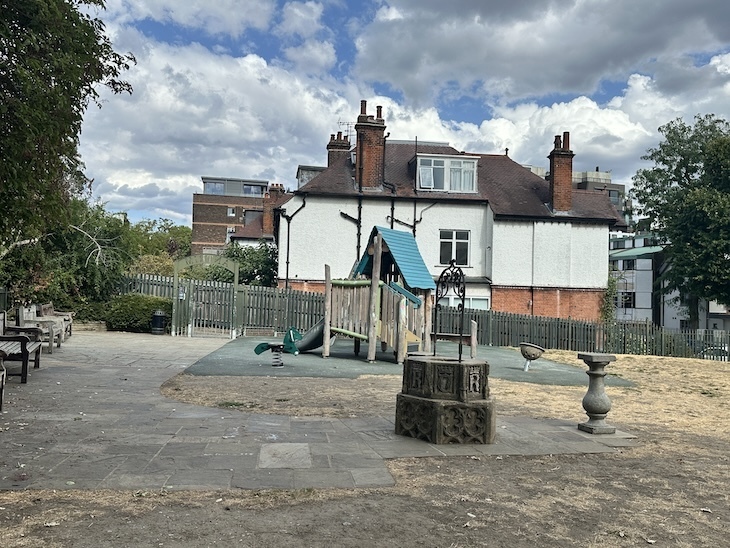
One is a baluster from the Old Waterloo Bridge, which was dismantled from 1936 and then distributed all over the world. The other is a structure from the old House of Commons, burned down in 1834.
The baluster seems to have served as a sundial, though all trace of gnomon has long been eradicated. The stepped structure, meanwhile, is described on its plaque as a 'well head', though if it ever did serve that purpose it only goes down about half a metre today.
The plaque also reveals that the items were 'presented by Mr & Mrs Lionel Barnett' in 1945. ('Mrs Lionel Barnett' was actually called Hilda Barnett.) Further poking finds that only the well head arrived in that year, with the baluster coming along in 1952, perhaps as a marker of Elizabeth II's Coronation. The Barnetts are described as living at Avenue Lodge, St John's Wood.
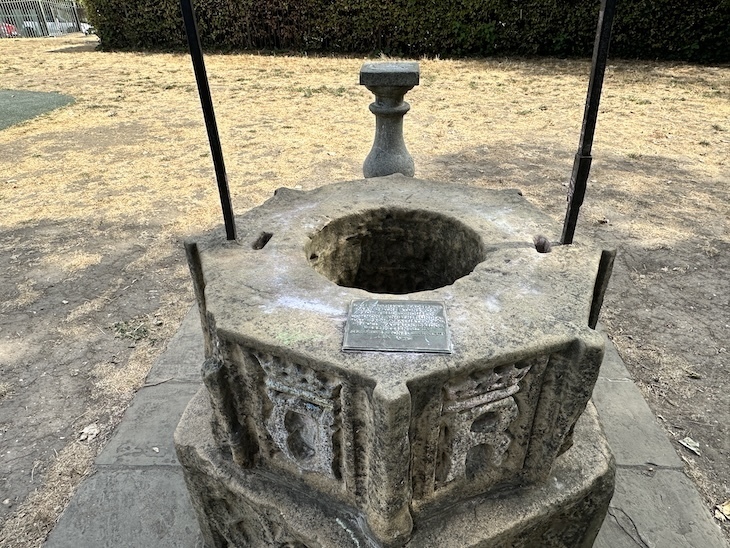
The well head is carved with weathered letters. London Remembers suggests that these are 'VR', the initials of Victoria Regina (Queen Victoria), which would date it to the rebuilding after the fire of 1834. However, the lettering more closely resembles a 'GR' to my mind, which would push the stonework back to the Georgian era — perhaps to the works on the chamber by James Wyatt around the turn of the 19th century. Indeed, the objects' provenance is somewhat mysterious. Did the Barnetts who donated it have good evidence that it came from the House of Commons and not some adjacent building?
David Fletcher has taken a 3-D scan of the 'well', which you can play with here (click the '3D' label in the corner of the photo).
Here's a map of how to get to the gardens, if you'd like to go see for yourself.