
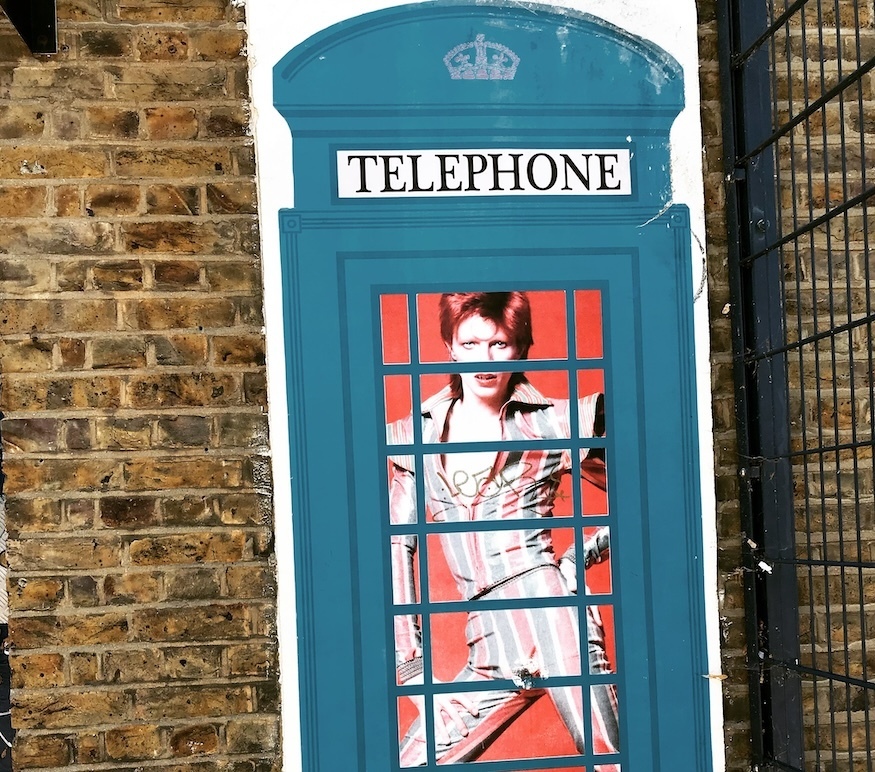
Did you know that part of the Great Train Robbery money was recovered from a London phone box... as well as a wax dummy of the Queen's brother-in-law?
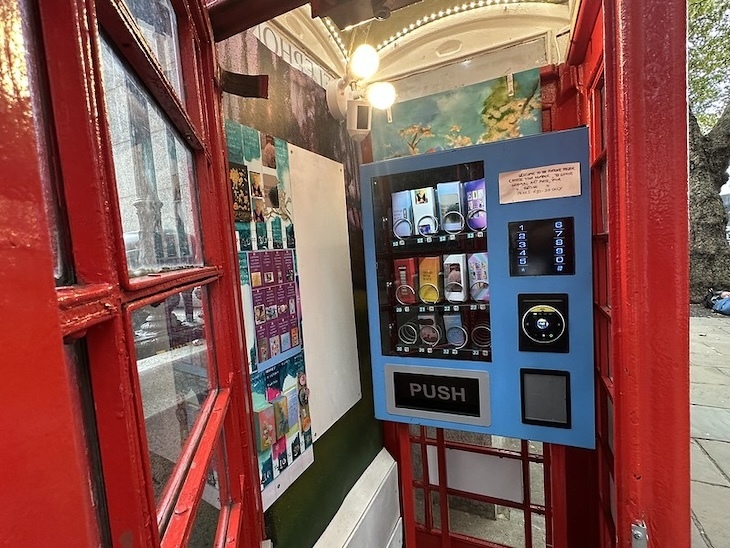
Today, it's not uncommon to find unusual items in phone boxes, as the moribund kiosks find new purposes. Book swaps, defibrillators, cash machines (themselves slowly becoming obsolete), miniature coffee shops... the one outside the British Museum even has an art-dispenser:
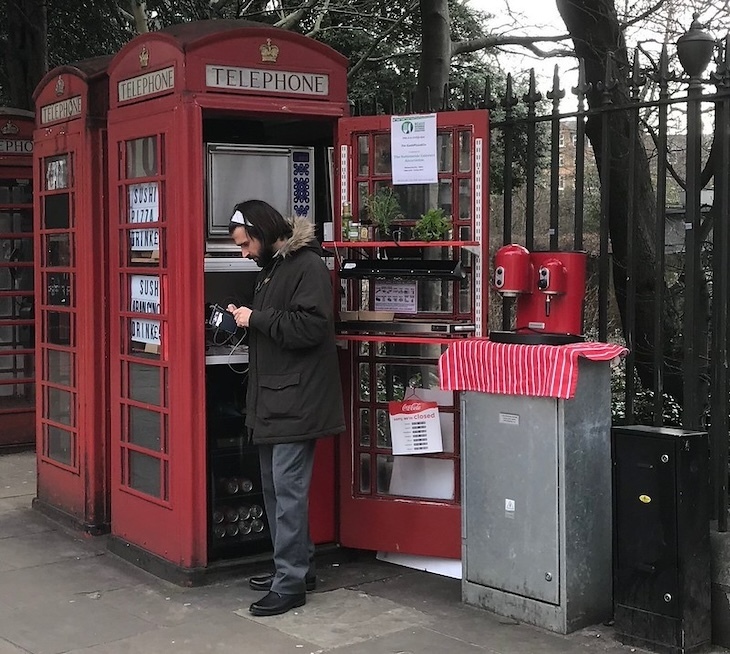
We've looked before at such repurposing. But phone kiosks have a much longer history as repositories for unwanted items. Here, we present some of the more curious booth-based discoveries in London's history.
1939, BOMB: Shortly before the outbreak of the Second World War, two telephone kiosks in central London were wrecked by bombs. One exploded on the Hampstead Road, and the second nearby on Euston Road directly opposite what is now the Wellcome Collection. One man was injured, and a woman had to be treated for shock. The blasts were later attributed to the IRA. It's an early example of the kind of attack that would become all-too-common later in the century.
1952, FORGED BANKNOTES: Seven crumpled $100 bills were discovered outside a telephone kiosk at an undisclosed London location. The notes were found to be forgeries from a large batch that was then flooding European countries. The notes were traced to a Daniel Green, who'd dumped them after realising he was being followed by police. Curiously, Green was the former husband of "Black Rita" Green, who'd been murdered in her flat on Rupert Street, Soho five years before. That case has never been solved.
1954, RICHARD ATTENBOROUGH: David's theatrical brother starred in a 30-minute television drama called 'Box for One', set entirely inside a London phone box.
1957, AVIATION TROPHIES: Three solid-silver tankards and a commemorative cup were discovered in a Putney telephone kiosk. They were traced to test pilot Neville Duke, who had reported the missing trophies a few days before. "But the ones we value most are still missing," Mrs Duke told the Press. One of those not recovered was a trophy given to Duke for breaking the Air Speed Record. In 1953, the air ace had been the fastest man on the planet for all of 19 days, when he got his Hawker Hunter up to 727 mph.
1957, A PUP: Goldie, a five-week-old Labrador, was discovered in a phone box on Whitehall. After reports appeared in the newspapers, the RSPCA received some 2,000 letters and calls from people wanting to take the pup home.
1960, QUEEN'S BROTHER-IN-LAW: In May 1960, Antony Armstrong-Jones (later known as Lord Snowdon) married Princess Margaret, Queen Elizabeth II's sister. A month later his wax effigy was stolen from Madame Tussauds. It would turn up after a few days in a phone box on Savoy Hill, where it had presumably confused passers-by.
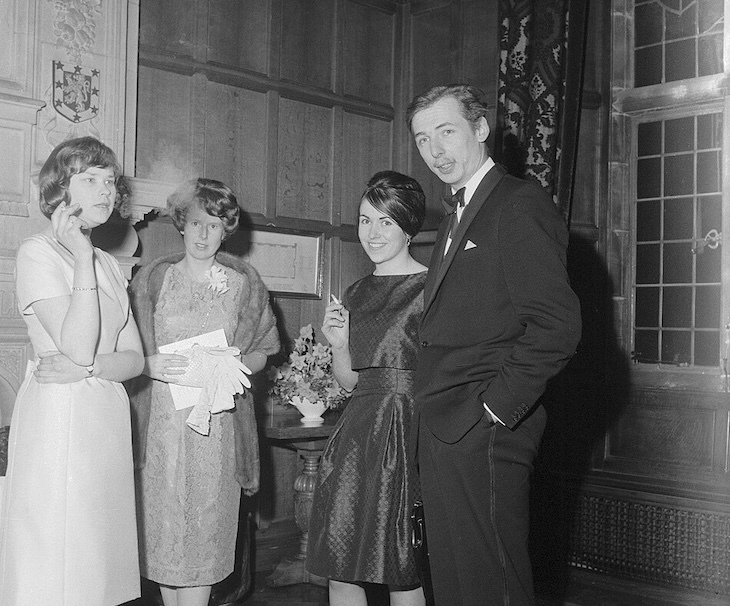
1963, GREAT TRAIN ROBBERY CASH: Arguably the most famous phone-box recovery occurred in December 1963, when police were tipped off to a stash of £47,245 in a kiosk on Great Dover Street, Borough. The cash had been returned by one of the Great Train Robbers, under circumstances that still remain mysterious (possibly under a deal struck between one of the robbers and a police officer). The location, opposite Black Horse Court, retained a modern phone box until 2024.
1967, NEWBORN BABY: Unwanted babies and infants were a depressingly common discovery in phone kiosks. In March of this year, a newborn was discovered in a plastic bag, inside an east-London kiosk. In the absence of any identification, he was named Edward Larksville: Edward after the Whipps Cross ward he was sent to, and Larksville after the local telephone exchange. Oddly, I can't find any other reference to an exchange of that name, and it was presumably a mistaken form of Larkswood exchange in Walthamstow.
1970, OLD/NEW MASTERS: Paintings worth £36,000 were dumped by thieves in a Battersea telephone box. After a tip-off to Scotland Yard, police recovered paintings from Renoir, Picasso, Van Dyck, Lautrec, Lowry and Pissarro from the box on Albert Bridge Road. The prized works had been stolen from a number of Mayfair galleries and had presumably become too hot to handle.
1970, GOVERNMENT FILES: A cache of top-secret government files was recovered from a kiosk outside Ravensbourne station in Lewisham. The documents reportedly contained details of the pay packets of senior military figures and civil servants.
1973, MORE BOMBS: A kiosk on Chenies Street in Marylebone was targeted with a fire bomb in March, causing slight damage. Another incident that year saw a bomb explode in a kiosk at Sloane Square station. Nobody was injured.
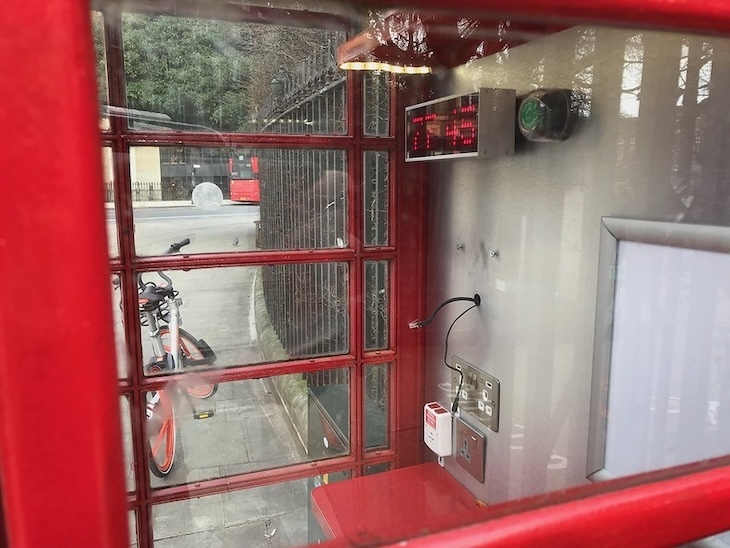
1982, ANOTHER BABY: A day-old baby found in a kiosk at the corner of Epsom Road and Waddon New Road in Croydon was named 'Rufus Waddon' by nurses: Rufus for the red colour of the phone box, and Waddon for the location. (Though nobody of that name can be found on Google, so presumably he took on another name from whoever welcomed him into the family.)


.jpg)