Adapted from a feature that first appeared in October 2025 on Londonist: Time Machine, our much-praised history newsletter. To be the first to read new history features like this, sign up for free here.
Somewhere out there, in the infinite folds of the multiverse, is a London where you can zip along from Charing Cross to London Bridge on an elevated, Thames-side railway.
The Victorians (and predecessors) drew up numerous schemes to embank the river and build roads, railways and promenades on top. It did eventually happen, of course, but had history shifted differently then we might have got an elevated rail system — not dissimilar to the Docklands Light Railway — as far back as the 1840s. Here it is:
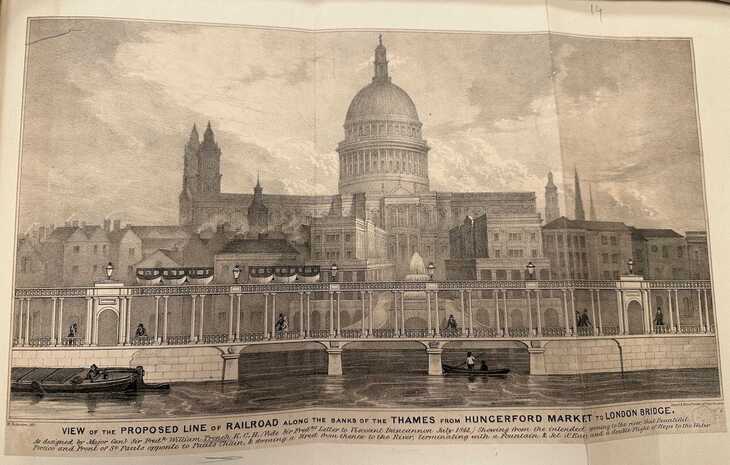
At first glance, it’s a standard portrait of St Paul’s, sketched with the smoking chimneys and attendant steeples that still defined the City skyline when the print was made in 1841. Look closer, though, for there’s much of interest in the foreground.
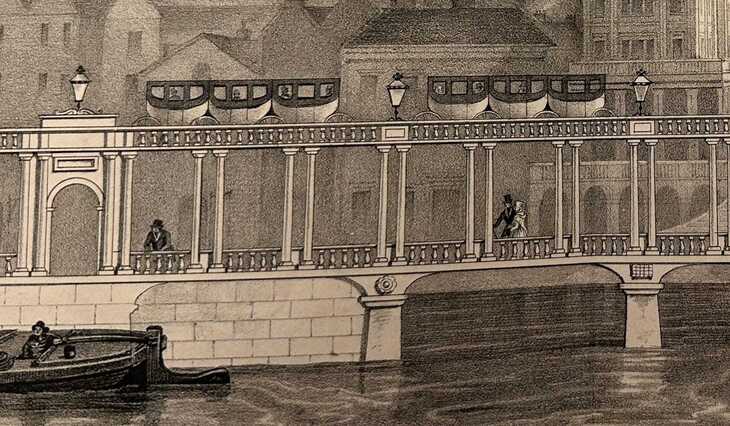
The first novelty is the walkway. The Thames lacked proper embankments in 1841. With the exception of occasional terraces, such as that of Somerset House, the river could only be accessed from industrial wharves and jetties. Yet here we see fashionable ladies and gents promenading beside, and indeed over, the murky, cack-ridden Thames.
The whiffy walkway is secondary, though, to what’s going on above. Here, six carriages, joined together into two trains, pass along a viaduct. We’re looking at an elevated railway — over the Thames — in the early years of Victoria’s reign. (It’s not technically a monorail, but fans of The Simpson’s are welcome to sing at this point.)
The legend beneath the image gives further information. “View of the proposed line of railroad along the banks of the Thames from Hungerford Market to London Bridge.” (Hungerford Market was where Charing Cross station stands today.) I measured the proposed route it in Google Maps. We’re effectively looking at a 1.5-mile (2.5km) bridge, built over the water and tracking the north bank.
This might seem like a fanciful way to get people across town — especially in 1841, when railways were still in their infancy. But the scheme has the significant advantage of bypassing all the buildings. No compulsory purchase and demolition needed, except, perhaps at the termini.
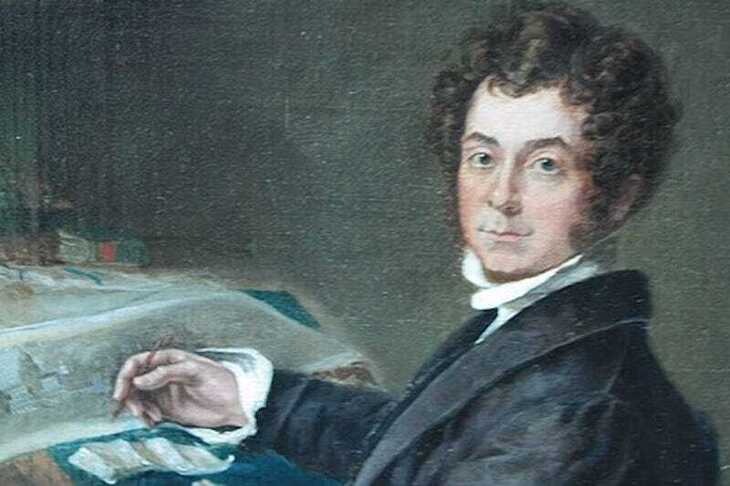
The Thames railroad was the brainchild of Colonel Frederick William Trench (?1777-1859), a former army officer turned MP. He sounds like quite the character. The History of Parliament described him as “a verbose and egregious Irishman”, while author Felix Barker paints him as “an irrepressible busybody”. Here’s our man, in all his bright-eyed pomp.
Trench was indeed irrepressible. He’d first proposed a Thames embankment scheme as early as 1824 and never let go of the idea. In his era, the river washed up against the land in a confusing morass of wharves, jetties and inlets. An embankment would effectively declutter the riverside, aiding navigation and commerce. It would also reclaim land from the Thames, to provide a new vehicle and pedestrian route above, and thereby relieve the Strand. Such things had been proposed before. Christopher Wren, for example, had wanted to consolidate the quayside during rebuilding after the Great Fire. John Nash had a go, too. But Trench went further in planning and publicising his ‘Thames Quay’.
The charismatic man, often described as a dandy, was able to drum up considerable support. Numerous wealthy bigwigs, including the Duke of York, the Duchess of Rutland, the Lord Mayor, and the future PM Lord Palmerston, were all keen. They even joined Trench on a jolly down the Thames — in the state barge of the Merchant Taylors’ company, no less — where the plans were first discussed. Following the riverine conference, a working committee was established to take the scheme forward.
Not everyone was delighted at the idea, however. The barristers of the Temple complained that the viaduct would spoil their view of the Thames. The Dukes of Northumberland and Norfolk, whose houses fronted the river, objected for similar reasons. Meanwhile, the shopkeepers of the Strand feared that their trade would diminish if everyone was down by the river. No small number of wharf proprietors also feared loudly for their livelihoods.
The plans were delicately poised, then, with strong voices for and against. Sadly, two of the key backers died with unfortunate timing and, amid growing opposition, Trench’s scheme was retired. There would be no embankment for the time being.
Trench’s other tricks
Trench was very much an ideas man. Throughout his parliamentary career, he put forward various grand schemes for the capital. His most famous, coming in 1815, would have seen a colossal pyramid constructed on the site of Trafalgar Square, a memorial to victories over the French. Imagine stepping out of the National Gallery and seeing this, rather than Nelson’s Column:
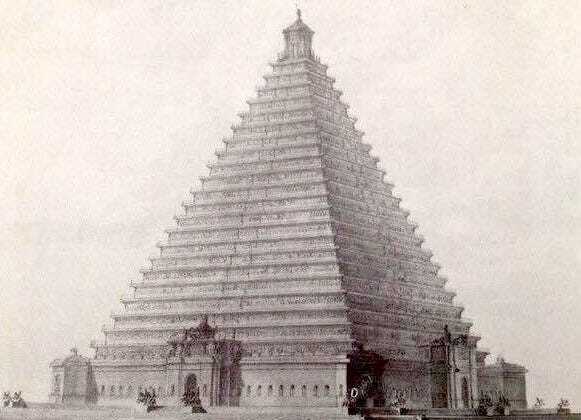
Actually, you wouldn’t have been stepping out of the National Gallery in the first place. The proposed pyramid would have been the length and height of St Paul’s Cathedral, and would have eaten up most of the land later used for the gallery. Needless to say, it didn’t happen.
Trench’s grands projets also included an optimistic pitch to King George IV. In 1825, just a year after the embankment idea, Trench set out his ambitions to build a monumental royal palace in Hyde Park. This would have been accessed via a two-mile long, 200-foot-wide grand avenue direct from St Paul’s. Trench’s trench would have ploughed through the Temple, Covent Garden, Soho and Mayfair on very similar dimensions to a Heathrow runway. The idea seems far-fetched today (and even Trench admitted it was ambitious), but London had recently seen the construction of the canyon-like Regent Street on a north-south axis. Happily, this horizontal sequel never gained momentum.
Dry me a river
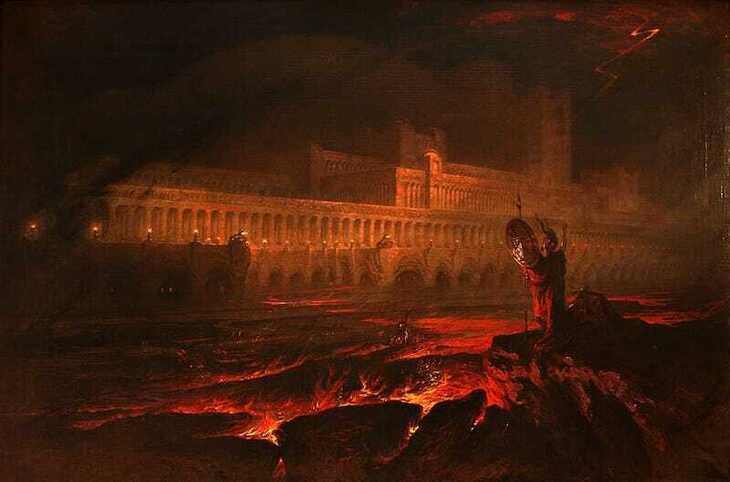
Meanwhile, the idea of embanking the Thames would not go away, and other people took up the cause. One well known advocate was John Martin, the painter of dramatic landscapes and glorious apocalypses. Between bouts of doomdaubing, Martin worked on embankment plans even more elaborate than those of Trench. His 1832 proposal would see the Thames lined with a grand terrace. It would encrapsulate an enormous sewer, which would prevent the fouling of the river and carry ready-made fertiliser east towards the fields of Essex.
It was a simple but expensive idea, which sadly failed to gain traction. Martin was despondent, but he was able to realise part of his scheme on canvas. The 1841 eye-popper called Pandemonium features a hellish simulacrum of London, complete with a colonnaded embankment transposed from the artist’s stillborn blueprints.
As Martin was adding the final brimstone flourishes to his painting, Frederick Trench popped up again. It had been 17 years since the now-ageing visionary had first proposed an embankment carriageway. A lot had happened in those years. Notably, London was now in thrall to the railways, with lines running into London Bridge, Euston, Paddington, Nine Elms and Bishopsgate, and more on the way. Trench sensed a bandwagon. He dusted off his embankment plans and reworked them to include an elevated railway.
His trains would not be drawn by steam engines but would instead be pulled along by a cable. This technology was fairly common during the early years of the railways. Trains out of Euston, for example, were pulled by a cable, which helped them master the incline to Camden Town. Trench also incorporated another emerging technology of the age: the electric telegraph. Cooke and Wheatstone’s pioneering message-sending kit had been successfully trialed along the Euston line four years earlier. The Thames-side railway would support a conduit for an Admiralty telegraph.
Once again, though, our man was rebuffed. His plans were rapidly shouted down as financially unworkable. Trench could not retrench and the scheme was once again retired.
Others would make further proposals in the coming years, among them WH Smith of newsagent fame, and another scheme of 1852 to run a viaduct railway along the midline of the Thames. Nothing of the sort was ever constructed.
It took the singular genius of Joseph Bazalgette, with the clout of the Metropolitan Board of Works behind him, to finally build an extensive Thames Embankment. It would be realised in the 1860s and 70s, half a century after Trench’s first stab at the problem. Bazalgette’s embankment was a triumphant compromise of the previous plans. Martin’s sewer was down there, intercepting the combined turds of north London. A wide carriageway and promenade, easing the traffic of the Strand, was built above. And just below trundled the underground railway — now the Circle line. Its stations at Embankment and Monument almost mirror those proposed by Trench, albeit beneath the carriageway rather than propped up on stilts. Sadly, neither Trench nor Martin lived to see this transformative development.
Yet another aspect of Trench’s 1841 scheme would see fruition in our own age. Look again at the original image and you’ll notice that the viaduct railway stands out in the water, rather than hugging the banks. Behind can be seen a further expanse of water, leading to a pair of staircases. These sweep up to a grand avenue bound for St Paul’s. Meanwhile, an ornamental fountain gushes high into the air.
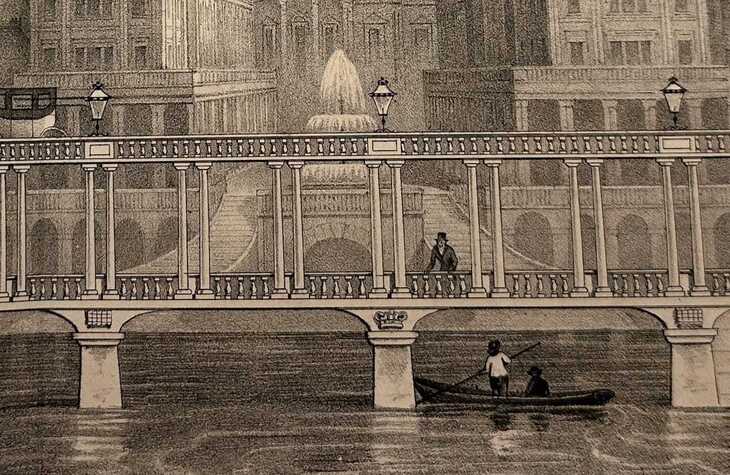
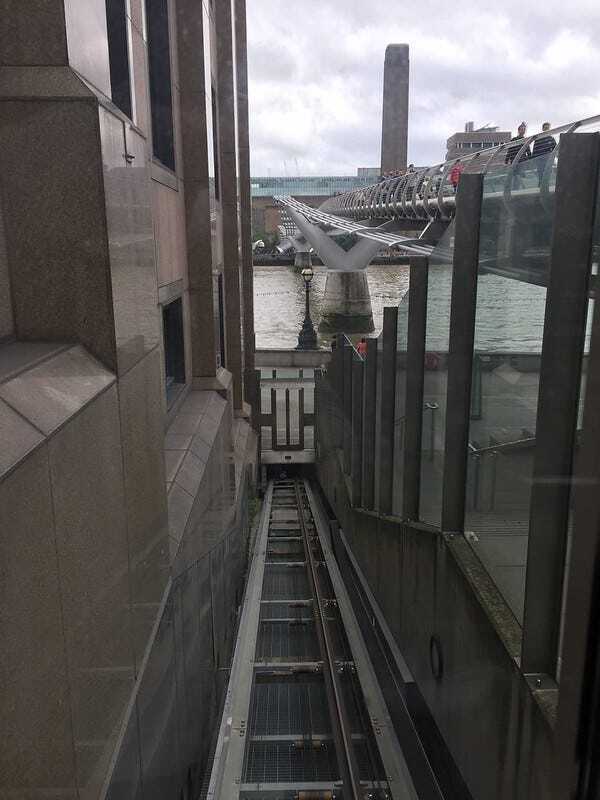
On this precise spot today is the northern bridgehead of the Millennium Bridge. It’s an entirely pedestrian walkway, just like the promenade in Trench’s plan, and its construction knocked through an avenue connecting the river and St Paul’s. Beneath the bridge, twin staircase splay out towards the Thames — not as elegant as Trench’s, but at least they have handrails.
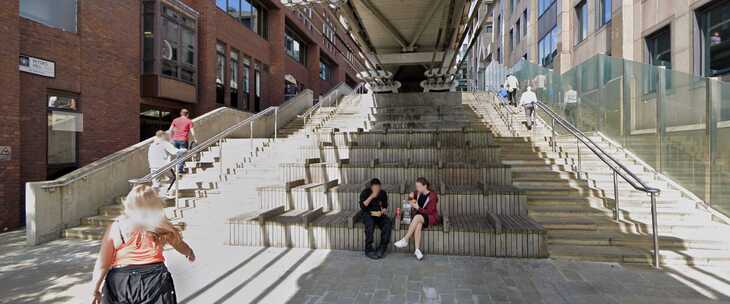
The bridgehead even came with its own cable-pulled railway, albeit on a different axis and scale to the Trench plan. Look to the right of the steps in the image above and you’ll see a tall glass partition. Behind it ran a species of funicular railway known grandiloquently as the ‘Millennium Inclinator’. This was, basically, a diagonal lift, to help those with mobility needs get up to bridge level. Sadly, it was recently removed following a catalogue of breakdowns.
All the essentials of Trench’s scheme did eventually get built, then, albeit in different configuration. And though it was never a direct inspiration, we today enjoy many miles of elevated, waterside transit in the form of the Docklands Light Railway.
And so, as the Rolling Stones shrewdly observed, “you can’t always get what you want, but if you try sometimes, you just might find, you get a reshuffled, reworked version of your initial vision. With a sewer.”