This feature first appeared in September 2024 on Londonist: Time Machine, our much-praised history newsletter. To be the first to read new history features like this, sign up for free here.
Here by dragons. And giants. And mermaids, minotaurs and pegasi. London is a living bestiary of mythological creatures. They pop up on flags, gateposts, sculptures and even our bollards.
Welcome to our cryptozoological guide to the capital, with historical notes on each monster.
Note: Museum stuff is not included (e.g. the centaurs on the Parthenon marbles); the list would become more tangled than a medusa in a cement mixer.
Dragons
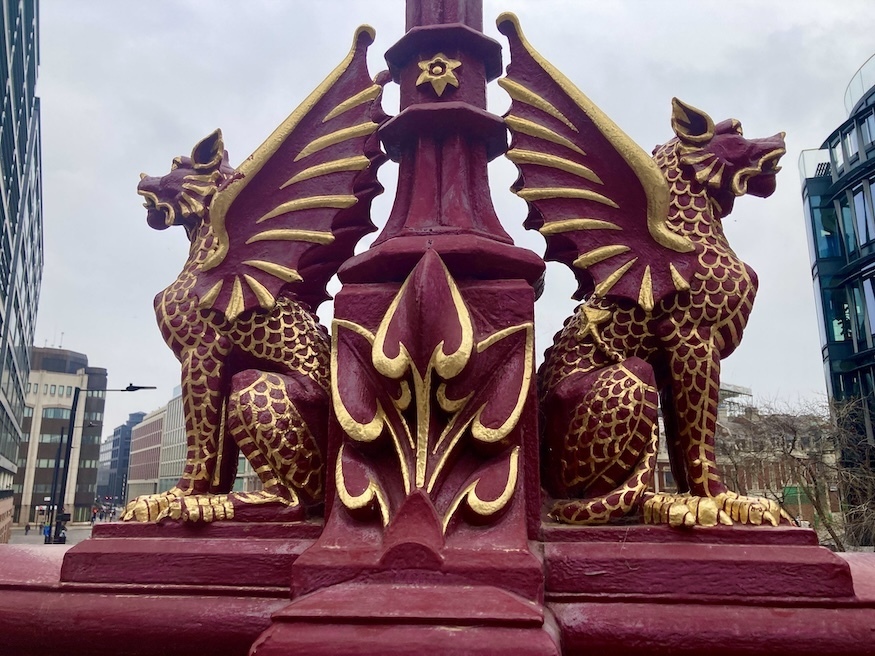
Scaly beasts can be found all across London, but the Square Mile is a particularly notorious dragons’ lair. The fearsome creatures have been considered guardians of the City since at least 1609, when they first appeared on the City Shield. You will find them perching upon Holborn Viaduct, clinging to the corners of the Monument, propping up the roof of Leadenhall Market and, most famously, watching over the boundary roads.
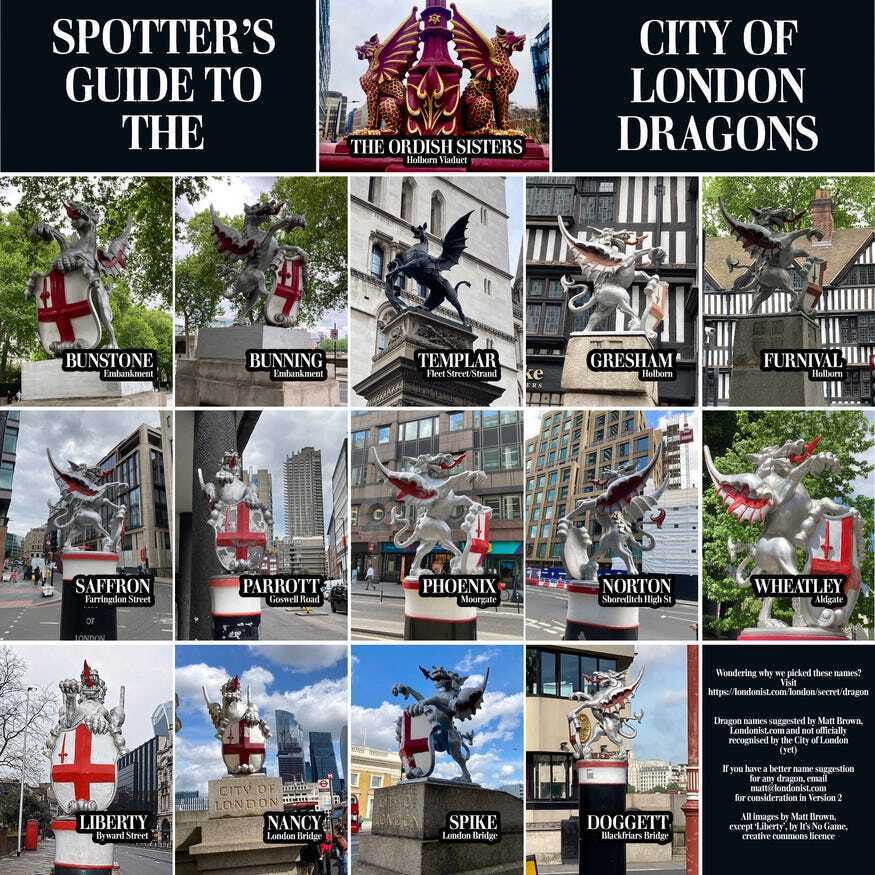
What not many people know is that all of the 14 boundary dragons have names. Or, rather, they all have names according to me. They are such handsome beasts, and should not remain anonymous. Next time you’re walking around the City, say hello from me.
Enfields
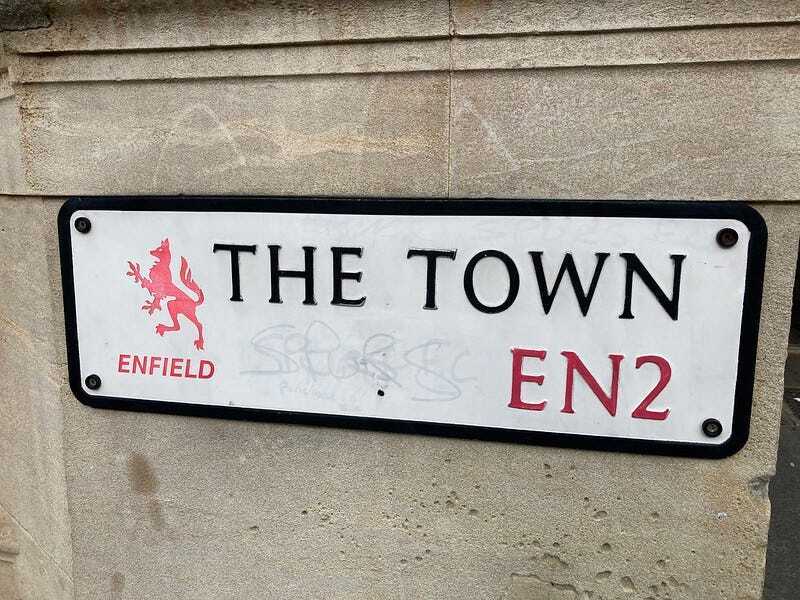
“The Enfield,” Wikipedia informs me, “has the head of a fox, forelegs like an eagle's talons, the chest of a greyhound, the body of a lion, and the hindquarters and tail of a wolf. It is occasionally portrayed with wings.” This bizarre refugee from Frankenstein’s Zoo also happens to be the symbol of the London Borough of Enfield, which proudly appends the creature to its street signs.
The heraldic device is of medieval Irish origin, but nobody knows who originally came up with it, or what they were smoking. It’s name, the ‘Enfield’, is first attested in the 16th century and is thought (somehow) to have derived gradually from the older Gaelic name for the beast, Onchu.
Enfield in London, meanwhile, has no historic connection to the creature, but is ultimately named after an Anglo-Saxon family. The creature was placed upon Enfield District’s crest in 1946, and carried over onto the arms of the London Borough of Enfield in 1965.
Fairies (and gnomes and elves)
My eight-year-old daughter recently informed me that she no longer believes in fairies. This makes me sad. I will always remember fondly the times we spent hunting for “fairy doors” at the base of woodland trees (Barnet has a particularly fine collection).
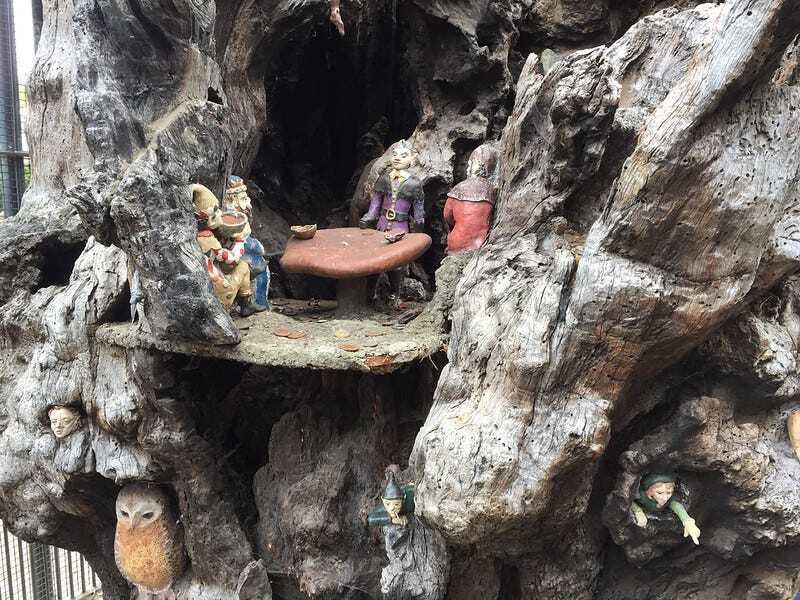
These are recent additions to London’s fairy lore. But our city contains a much more venerable tree of “little people”. This is the Elfin Oak, which can be found close to the playground in Kensington Gardens. The dead stump belonged to a 900-year-old oak that originally grew in Richmond Park. It was transported to Kensington in 1928, where the illustrator Ivor Innes set to work, carving a miniature population of “fairies, gnomes, elves, imps, and pixies”. It is, I’m confident in asserting, London’s very best Grade II-listed fairy tree.
GOBLIN
Mnemonical nickname for the Gospel Oak to Barking LINe. Happily, this branch of the Overground is now officially called the Suffragette line, meaning the goblins have been banished in favour of enfranchisement.
Giants
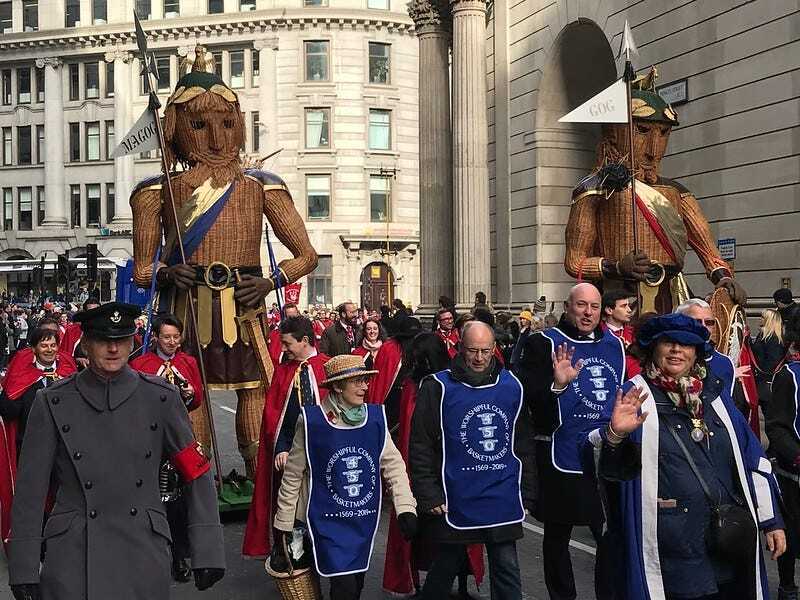
The City of London is well guarded. Besides the police and dragons and stuff, it also has two mythical protectors in the shape of Gog and Magog. These curiously flammable colossi are paraded through the Square Mile during every Lord Mayor’s Show. Who are they?
The names Gog and Magog crop up throughout ancient texts — including the Old Testament and the Qur'an — and in a variety of guises. They first appear in a British context in Geoffrey of Monmouth’s 12th century book Historia Regum Britanniae, a heady blend of myth and history. Here, Gogmagog is a single giant, who stands in the way of Trojan conquest of Albion. He is ultimately slain by Corineus, a mighty warrior who would give his name to Cornwall. By Tudor times, the myth had been transposed to London. Accounts of Elizabeth I’s coronation in 1558 speak of two effigies, representing "Gogmagot the Albion and Corineus the Britain".
The legend evolved over the centuries. Gogmagot became Gog and Magog, and they became protectors of the City of London, closely associated with the Lord Mayor’s office. Their effigies now stand inside the Guildhall, with wicker simulacra attending the Lord Mayor’s Show. Another pair of figures, traditionally described as Gog and Magog, decorate the clock on St Dunstan in the West.
Griffins
The City of London’s dragons are often mistaken for griffins. I’m not sure why. Griffins have eagle heads, whereas the City guardians clearly do not. (That said, the strange fish that curl around Embankment lamp posts are actually heraldic dolphins, despite having scales and massive eyes, so go figure.)
London does have at least one prominent Griffin, however, in the shape of Chiswick’s Griffin Brewery. Since 1816, this has been home to Fuller’s brewers, makers of the quintessentially capital pint, London Pride.
Mermaids
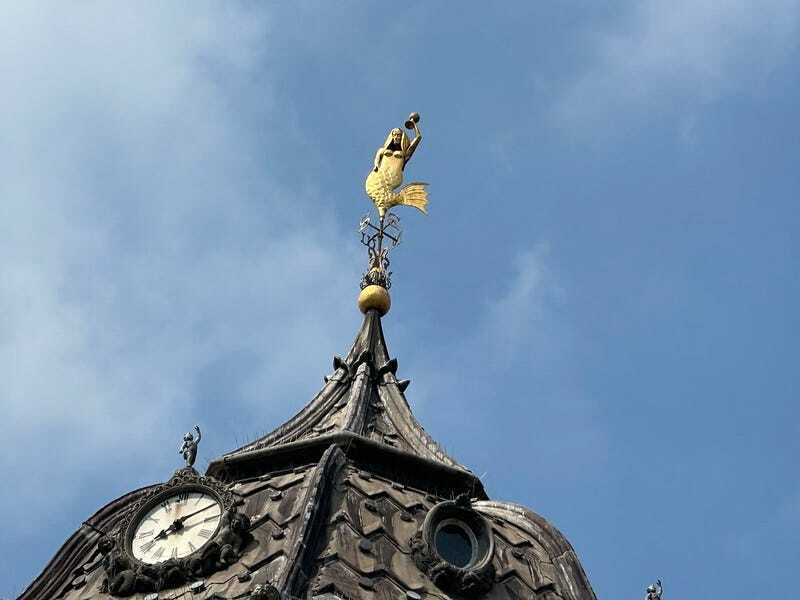
Copenhagen is the capital to visit if you seek a noteworthy mermaid. London has its own population of fishy maidens, but they tend to keep a lower profile. The best known is perhaps the former Mermaid Theatre, now a conference centre, in Blackfriars, which opened in the 1950s. Victoria Park also conceals a little-known mermaid. Look to the top of the Burdett-Coutts drinking fountain — surely London’s largest — and you’ll spy a gilded weather vane in the form of a mermaid. Finally, the Science Museum displays an actual biological specimen. The freakish miscreation is thought to be a ritualistic object from Java, formed by combining body parts of a fish and monkey.
Minotaurs
Name a part of London that feels like a labyrinth. The Barbican, you say? Well I’d agree. The vast, concrete residential complex is a three-dimensional jigsaw of walkways, courtyards, ramps and stairs. I’ve visited 100 times, at least, and even I still take the occasional wrong turn and end up trapped in a service lift, or the third sub-basement, or something.
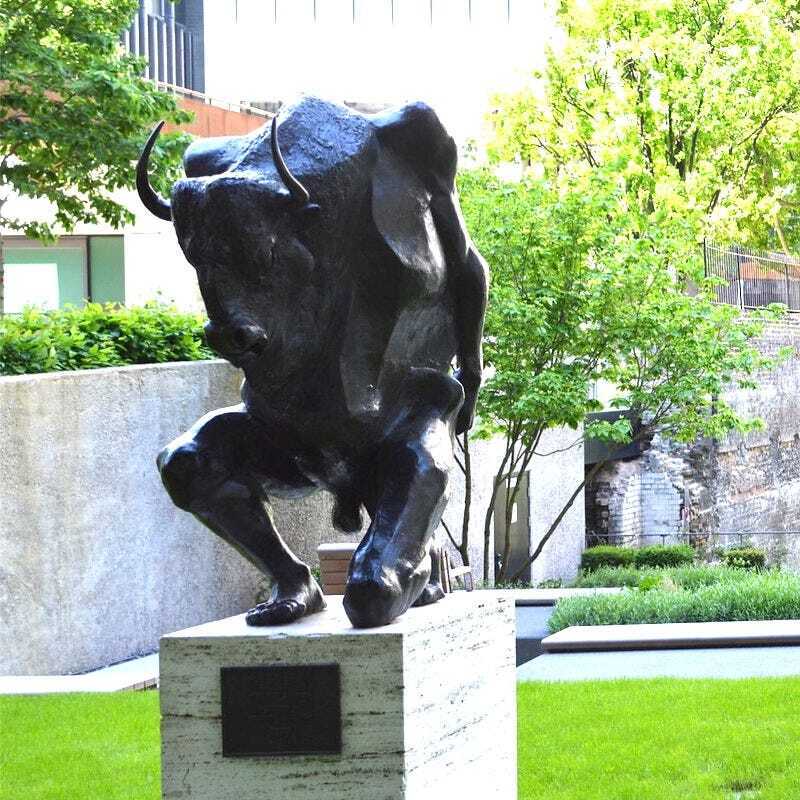
Eminently appropriate, then, that this brutalist labyrinth is watched over by its own minotaur. Part man, part bull, part monotesticle, this stocky chimera was sculpted by Michael Ayrton, and can be found beside the old city wall near Salters’ Hall. He’s not the only minotaur in town, as it happens. I’ve found others outside Tate Britain and cuddling up to a hare in Wood Wharf.
Ogres
I could write a paragraph about the Shrek Experience at County Hall, but I don’t think anyone would want to read it.
Pegasi
The winged horse of Greek tradition has long been the symbol of Inner Temple, one of the four “Inns of Court” that preside over the legal professions. It’s not entirely clear why the flying mount was chosen as the Inn’s emblem. One vague origin story pins it on Robert Dudley, who in 1561 starred in a Christmas play, “taking the the role of a constable-marshal of the Inner Temple, and patron of the Honourable Order of Pegasus”. They had classier Christmas plays in those days.
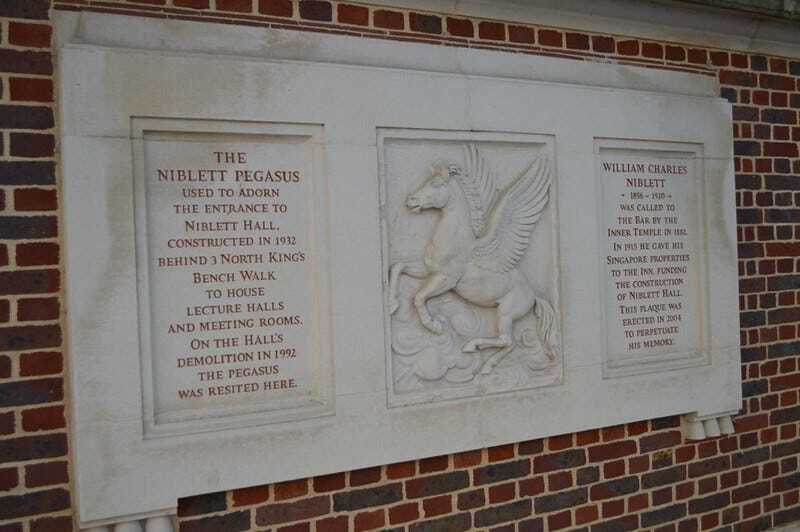
Wherever it came from, the Pegasus can be seen all over Inner Temple, including a weather vane, the railings, on various bollards, and in the name of the local restaurant. The most artistic is the wonderfully named “Niblett Pegasus” (I bet you just said it out loud), near Temple church.
Phoenixes
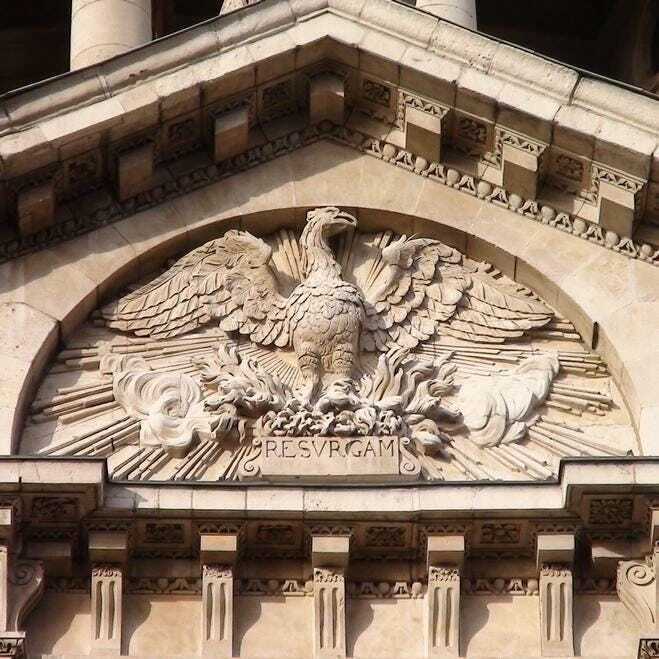
The resurrection bird can be found all over town. The Phoenix Garden in St Giles’s rose out of a World War Two bomb site. The nearby Phoenix Artists’ Club is a superb basement bar frequented by thesps. East Finchley’s Phoenix Cinema is one of the oldest in town. My favourite, though, is the carved phoenix on the south side of St Paul’s.
If phoenixes are known for anything, it’s rising up out of flames to live again (well, that and carrying the Sword of Gryffindor to Harry Potter, but that’s not important right now). The current cathedral rose from the rubble of the Great Fire, which destroyed its predecessor. Not many dots need joining to see why a great big phoenix was carved on its side.
Note another detail. The sculpted avian issues from a stone bearing the inscription RESVRGAM, which is Latin for “I shall rise again”. Christopher Wren supposedly stumbled across a piece of fire wreckage chiselled with this word, and took it as inspiration to build anew.
Unicorns
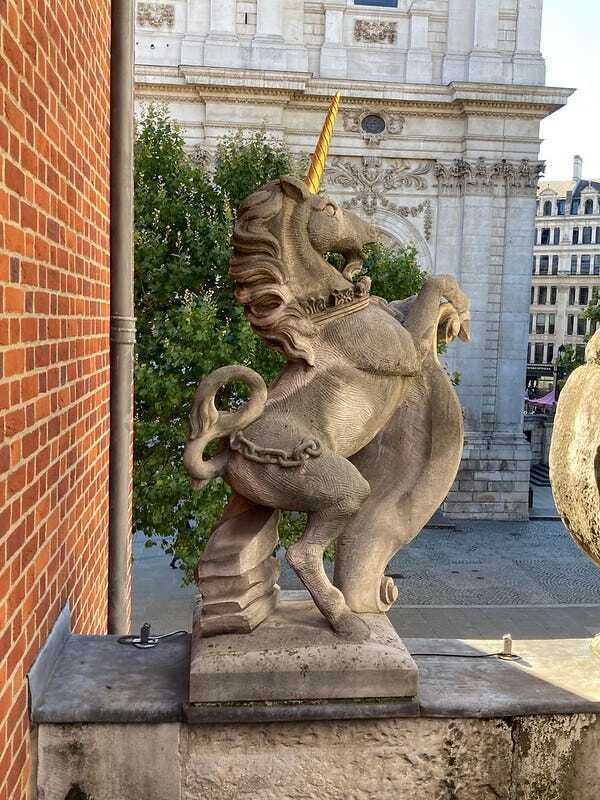
It’s easy enough to find a unicorn in London. The Royal Coat of Arms is displayed in many places, and it has featured a unicorn since the 17th century, as an emblem of Scotland brought in under the Stuarts. (They poked out the Welsh dragon, used by the Tudors.) Sculpted unicorns are a little harder to spot. One excellent example can be found on top of Temple Bar in Paternoster Square, where it’s joined by an heraldic lion to again denote a royal connection.