This feature first appeared in December 2024 on Londonist: Time Machine, our much-praised history newsletter. To be the first to read new history features like this, sign up for free here.
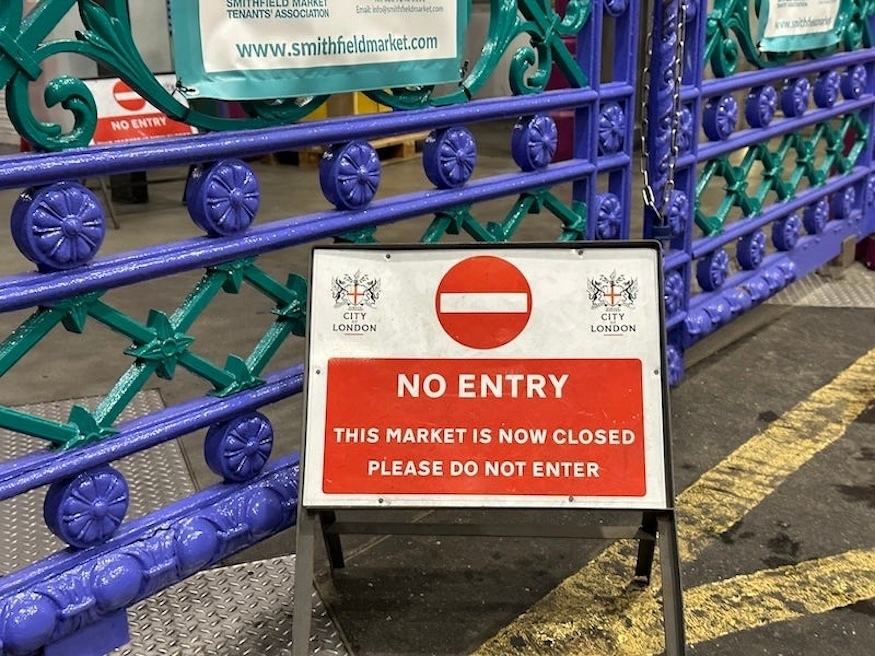
Smithfield’s days are numbered. In November 2024, the City of London Corporation announced that the ancient meat market will close, along with Billingsgate fish market, as soon as 2028. It initially looked like the end for the markets, but we now know that a new site in the Royal Docks is being mooted.
Smithfield is not just any old market. It has existed for at least 850 years, and perhaps more than a thousand. Its closure is certainly one for the history books. Other publications have written in depth about what this means for the traders, the market buildings, the supply chain… and the very soul of London. Here, though, I want to dwell not on the end but the beginning. Where did Smithfield come from, and how did it develop?
Smithfield: How it all Began
In the beginning was the field, and it was smooth.
The Smooth Field. The Smeeth Field. The Smith Field. The unblemished grassland sat just outside the city walls, almost surrounded by water. To the west, the land bowed down towards the sunset and the deep valley of the River Fleet. Northwards lay the Fakeswell, a minor tributary of the Fleet that marked the City’s northwest boundary. And, to the south, the old ditch around the Roman walls presented a further watery barrier. The Smooth Field offered plentiful grazing, fresh water and wide-open space, all within a stone’s throw of the medieval centre. This was the ideal place to muster the city’s walking food supplies.
Nobody knows when animals were first traded on the Smooth Field. The earliest record comes from the 12th century.
“Outside one of the gates there, immediately in the suburb, is a certain field, smooth field in fact and name. Every Friday, unless it be a higher day of appointed solemnity, there is in it a famous show of noble horses for sale. Earls, barons, knights, and many citizens who are in town, come to see or buy. In another part of the field stand by themselves the goods proper to rustics, implements of husbandry, swine with long flanks, cows with full udders, oxen of bulk immense, and woolly flocks.”
So recorded the quill of cleric William Fitzstephen in 1174. Not quite like that. He wrote in Latin, and this is one of several translations online, each slightly different. They all agree, though, that Smithfield was by this point a celebrated place of trading in horses and livestock.
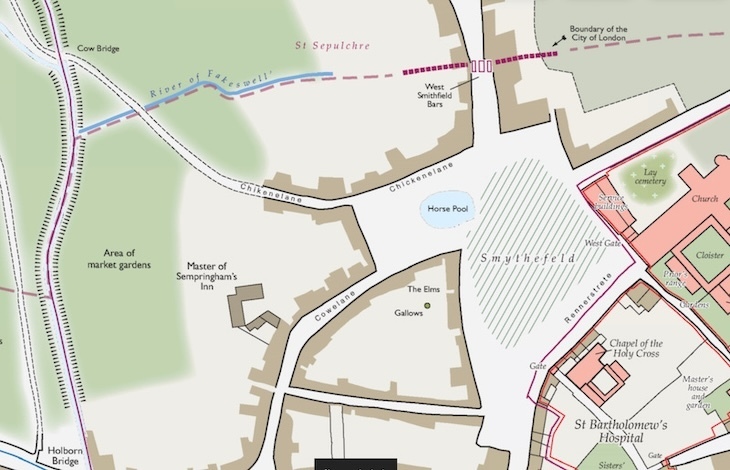
I wouldn’t be surprised if Smithfield’s meatiness dates back still further. The City as we know it began in 886, when King Alfred re-established a settlement within the old Roman walls. (Londinium had stood largely abandoned for four centuries, by Alfred’s time.) This new settlement grew up at the western end of the old city, so it makes sense that the meat supplies gathered here, too. Animals could not be brought from the south without the difficulty of crossing the Thames, so drovers’ routes became established to the north. Hence, the north-west corner of the City would be a natural place to set up a market, made all the more attractive by the smooth field and clean water sources. If that hunch is right, then Smithfield might have been London’s main distributor of meat for over 1,100 years.
Whatever its origins, by Fitzstephen’s time the market had become an established, well-organised weekly event, though still somewhat “grassroots” in nature. Smithfield had to wait until 1327 to gain official sanction. In this year, Edward III granted a charter to the City of London, giving them permission to run (and collect tolls from) the meat market. It’s sad to think that the 700th birthday of this charter may also mark the final year of the market’s existence.
The market grows
The 14th century was a turbulent period for this small patch of land. All of the following happened within the compass of one long lifetime. Imagine living beside the market and witnessing all this:
1305: Scottish patriot William “Braveheart” Wallace is hanged, drawn and quartered in Smithfield.
1327: Smithfield Market receives its charter from the King. It’s now officially a ‘thing’.
1348: The Black Death devastates England. Many of the London victims are buried a little north-east of the market, below what is now Charterhouse Square.
1371: The London Charterhouse is founded right next to the plague pit. Originally a Carthusian priory, the institution would become an important school and alms houses, still in operation today.
1375: Edward III holds a seven-day tournament at Smithfield to impress Alice Perrers, his young mistress less than half his age.
1381: Richard II rides to Smithfield to address the ringleaders of the so-called Peasants’ Revolt. The confrontation ends with the death of Wat Tyler, seemingly stabbed by the Lord Mayor himself.
1390: Richard returns to hold one of the most magnificent tournaments in Europe, with sumptuous nightly banquets, and 60 knights taking part in the joust.
All this within an area you could walk across in five minutes. 14th century Smithfield was where all the big stuff happened. And that’s without mentioning the raucous Bartholomew Fair, which took over the area every August. Nor the rapidly growing St Bartholomew’s Hospital, which dominated the south-east of the market.
Among all these competing distractions, the area’s defining feature was always the meat market. Smithfield was, and remains, a metonym for the industry, much as Fleet Street became shorthand for “the newspaper business”.
This long association between place and trade has worked its way into the street pattern. Look at any map of the area, ancient or modern, and you’ll see that numerous roads converge upon Smithfield. This is as you would expect of a location attracting animals, drovers and customers from all compass points. Many of these streets have telltale names. Cowcross Street leads from Smithfield to Farringdon station. Cock Lane still stands proud to the west. The John Rocque map of 1746 shows the now-lost Duck Lane, Pheasant Court and Cow Lane. The area has meat consumption encoded into its very geography.
A second beginning
For most of its history, Smithfield was London’s principal livestock market; that is, a place where live animals were sold to butchers and dairy farmers. Some would be penned here for days, recovering from long journeys, and fattening up ahead of the butcher’s knife. It must have been chaotic, with hundreds if not thousands of animals crowded in. Some sanitary improvement arrived in 1614, when the filthy field was paved over, but it would still have been a noisome, noisy place.
Here’s a view of the market from 1811 looking south, with the dome of St Paul’s and the still-extant gateway to Bart’s hospital at centre-left.
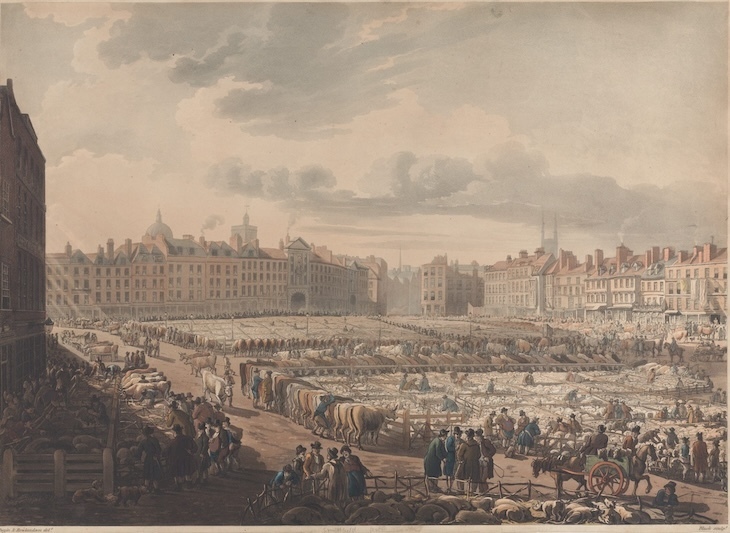
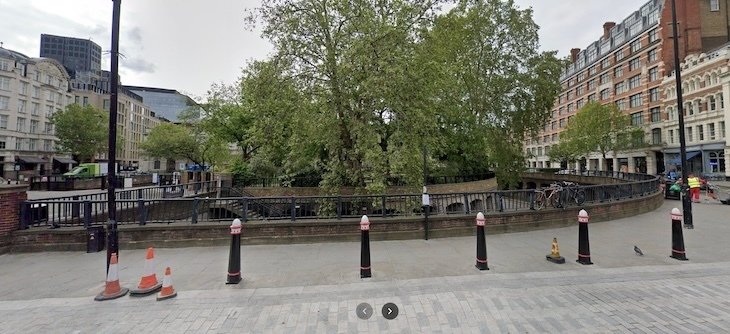
Almost every pixel beneath the line of the buildings is animal. Thousands of creatures are penned in. It is a scene utterly alien to a the modern eye; so many animals right beside one of the city’s most important hospitals. It beggars belief, really. Especially when you see the same view today:
Dickens, as ever, describes the market best. In Great Expectations, set in the 1820s not long after the illustration above, he recalls: “the shameful place, being all asmear with filth and fat and blood and foam [which] seemed to stick to me.”
And in Oliver Twist:
“It was market-morning, the ground was covered nearly ankle deep with filth and mire a thick steam perpetually rising from the reeking bodies of the cattle and mingling with the fog which seemed to rest upon the chimney-tops hung heavily above the whistling of drovers, the barking of dogs, the bellowing and plunging of oxen, the bleating of sheep, the grunting and squeaking of pigs, the crowding, pushing, driving, beating, whooping and yelling, the hideous and discordant din that resounded from every corner of the market.”
It was a wretched place to linger; especially if you were an animal. Most of these beasts would be slaughtered on site, or else sent around the corner to Newgate Market where the fatal deed would be done. The slaughterhouses were not large chilly sheds like today. Most were in mean buildings or cellars, with poor hygiene and zero regard for animal suffering. Here is just one account from the early Victorian era:
“The access to these cellars is by steps, over which a board is occasionally placed, to act as an inclined plane, for the animal to slide down; more frequently a much more summary process is had recourse to, the animal is seized by the butcher, and pitched headlong into the cellar by main force, where, unable to rise from broken limbs, or other injuries sustained by the fall, they lie awaiting their turn to be slaughtered.” — London Exhibited, by John Weale (1852)
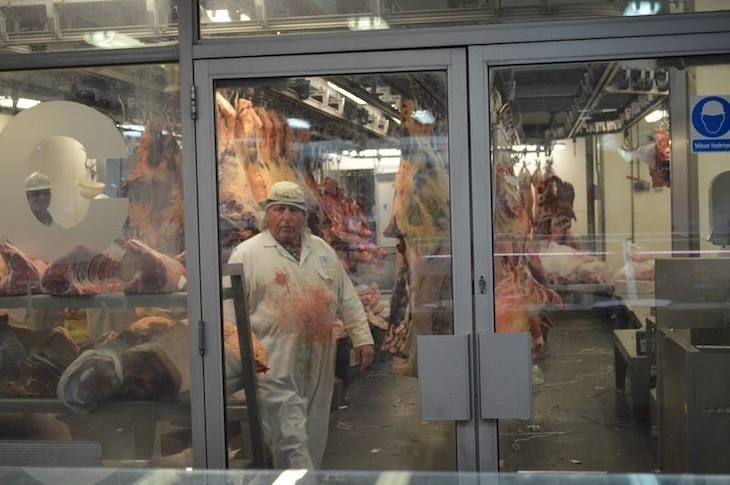
The biggest shift in market history also came in 1852. The regular parading of cattle, pigs and sheep through the London streets had long been an obstruction to the city’s other business. In this year, the livestock market was moved to Copenhagen Fields in Islington — well away from the population centre. It was replaced with a wholesale market, trading in meat, poultry and offal, rather than the living animals.
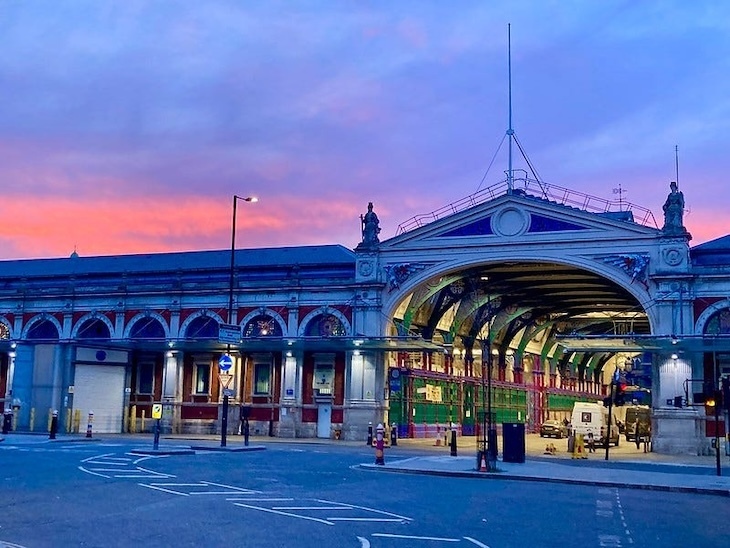
This, essentially, is the market that exists today. Its fabulous, multicolour iron halls were designed by Horace Jones, who also gave us Leadenhall Market and Tower Bridge.
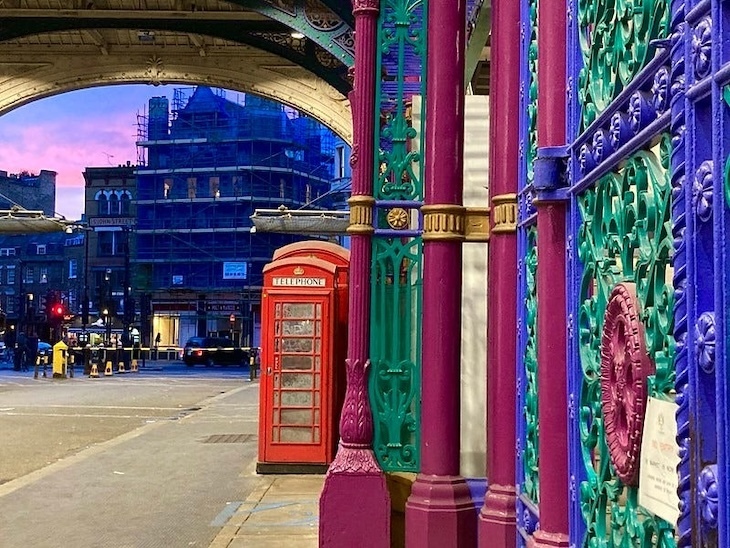
Those market buildings are safe, by the way. The closure of Smithfield Market will turf out the trade, but the structures themselves will almost certainly be preserved. They are Grade II-listed and a cherished part of the London streetscape. They will have to find another use, however.
My suggestion would be a huge, London-themed play centre, perhaps called “The Meet Market”, to go alongside the new London Museum (which is being constructed in separate buildings to the western end). The City has no proper playgrounds. Not one. Yet thousands of children visit every day, and many more will come when the museum opens. So why not turn the old market into central London’s biggest play park, with trampolines, softplay, VR, climbing walls etc — all London-themed — and a traditional playground where all the equipment resembles London landmarks (Tower Bridge see-saw, slide down the Cheesegrater, bounce on the Dome, etc.).
But, of course, it’ll probably end up as offices.
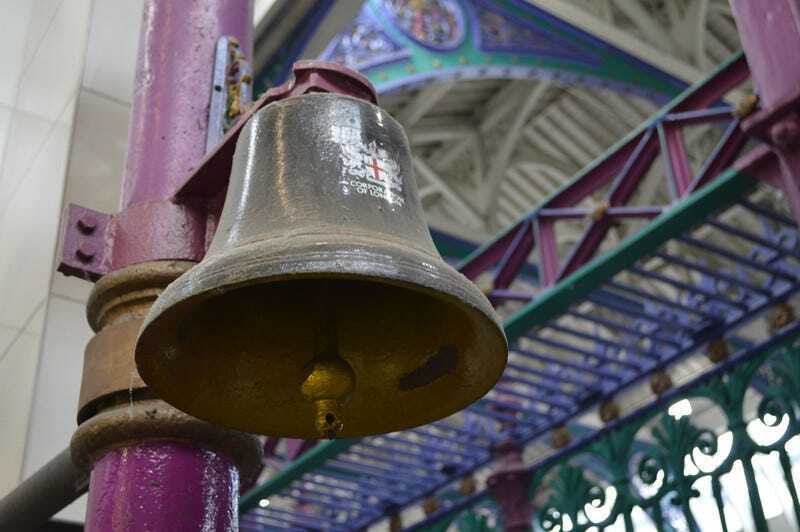
There is so much more to say about Smithfield, that dizzy tombola of history. The ancient church, the hospital, the nearby Charterhouse; the dozens of people condemned to burn here, simply for differing with the monarch over the nature of God. The quashing of the Peasants’ Revolt, and of William Wallace. The buried river; the world’s first underground railway; the 100 people killed by a rocket while queuing for meat; and the aircraft carriers made of ice (for real). Each could fill a whole book, never-mind an article. But nothing has defined Smithfield for quite so long, or so strongly, as the meat trade.
When the market closes on this site in a few years’ time, it will bring to an end a tradition that probably stretches back further than the Tower of London or Westminster Abbey. The meat is to be chopped, and one of London’s founding features will pass into sunset.