Adapted from a feature that first appeared in September 2025 on Londonist: Time Machine, our much-praised history newsletter. To be the first to read new history features like this, sign up for free here.
“Ladies and gentlemen," said the hump-backed showman, "the Centrifiggle Railway is now to be seen.”
Had you walked along Great Windmill Street, Soho in 1842 then you, too, might have been approached by an old man singing the praises of the ‘Centrifiggle Railway’. The superannuated promoter wore a sandwich board over his weary shoulders. It depicted, as one newspaper put it, “some insane person tumbling out of an immense carriage, which, by some undiscoverable means, has fixed its wheels on the top of some prodigious hoop”.
Further enquiry would have led you to Dubourg’s Grand Saloon, a place of spectacle, entertainment and ‘moving waxworks’. Its latest wonder was the ‘Centrifugal Railway’. Today, we’d call it a loop-the-loop roller-coaster.
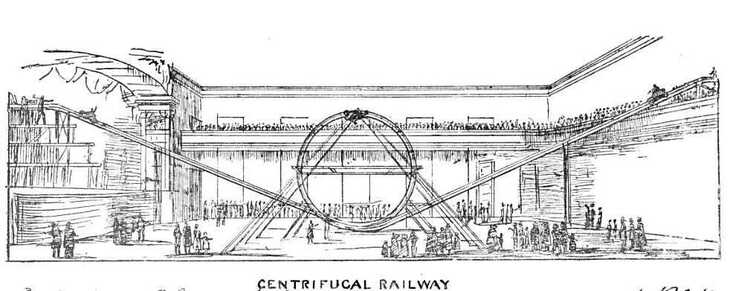
The mechanism was simple. You can deduce it from the picture. The unpowered car builds up speed on the down ramp, enough to carry it over the loop and part of the way up the other side. The single passenger, it is hoped, would not “tumble out”, but would be held in place by the centrifugal force. “It travels at the rate of a hundred miles an hour,” lied the tout, parroting an impossible speed that is repeated in newspaper advertisements.
A better illustration of the Great Windmill Street roller-coaster can be seen here, in a copyrighted image.
The best account of this marvel appeared in the syndicated press in December 1842. The anonymous journalist who pays the attraction a visit does not venture into the carriage himself, but looks on as “a heroic looking youth, all grease and long hair, seated himself in the machine, and performed the somerset more, apparently, to his own satisfaction than that of any one else”.
This is one of the earliest accounts of a ‘loop-the-loop’ anywhere in the world. A French inventor named Clavieres reportedly pioneered the concept in 1833, but never put it into practical purpose until almost a decade later. It’s not clear from the accounts I can find whether M. Clavieres was involved with this Soho venture, of if it’s a copycat.
The ride received mixed reviews. One anonymous correspondent, perhaps connected to the set-up, gushed about its virtues: “This ingenious plaything is well worthy of a visit. As a piece of curious and amusing machinery, it cannot fail of creating surprise and interest in the general spectator; whilst as an exemplification of the laws of gravity and motion, it must furnish delight and instruction to the man of science.”
Apparently, it could fail to create surprise and interest. “No more than a stone in a sling,” commented one unimpressed observer, “Or a glass of water in a hoop at Astley’s,” he added, referring to the famous circus in Lambeth. Another bemoaned its lack of utility: “It's all rig'lar rubbage, that centriffagle railway… for what's the use o't? Who the mischief is going from London to Birmingham, twirling half the time on their heads? I don't think it'll ever be useful.” (We still encounter his type today — the “complete waste of money” moaner for whom everything has to have some practical use, rather than simply being fun or amusing.)
Still, it attracted enough interest to last for at least a year. According to an advertisement in the Morning Herald, the ride counted many notable ladies and gentlemen among its white-knuckled patrons. If we can believe the advert (which we can’t, because it also cites the 100mph nonsense) then future Prime Minister Lord Palmerston was among them. As well as ending the Crimean War, abolishing the East India Company and securing independence for Belgium, Palmerston may also be the first Prime Minister to loop-the-loop.
(An adroit satirist might here note Liz Truss’s similar achievement: a short, expensive, nauseating ride downhill, the world turned upside-down, before the whole system grinds to a halt and she’s kicked out for the next person. Sadly, I’m not that kind of writer.)
The attraction had stupendously long opening hours (11am to 11pm). We should remember that Dubourg’s Salon had other draws, such as the waxworks and the opportunity to ride a ‘velocipede’ (early bike), which could satisfy large crowds who couldn’t all go on the centrifugal railway. The night opening, later reduced to 10pm, allowed working people to pay a visit. Admission cost a shilling for adults, and 6 pence for children. One advert from 1842 even includes the promotion “Schools half price”. I wonder if the offer was ever taken up. Think how improbable it sounds as a piece of trivia: “In the 1840s, kids could go on a school trip to ride a loop-the-loop roller-coaster… in Soho”. (If the QI Elves are reading this, please give me credit.)
For all its simplicity, the ride was not without its problems. One man narrowly escaped death after his cart left the track mid-loop. “Had the carriage, which weighs 200lb, fallen on the individual he must inevitably have been killed,” reckoned the West Kent Guardian.
Despite the occasional hiccup, the attraction persisted on Great Windmill Street until the summer of 1843. Similar rides popped up in various locations, including the nearby Egyptian Hall on Piccadilly, as well as in Dublin, Cork, Manchester (which predated the London one), Leeds, Bristol, Hull, Birmingham, Liverpool and Edinburgh. The last accounts come from the Scottish capital in 1846, after which the diversion seems to have ran out of favour.
An earlier loop-the-loop in London?
And now something of a mystery. All sources I can find (including Guinness World Records) suggest that the ride first appeared in London in 1842, as essayed above. However, we may have an earlier date. In a previous article, I published the recollections of Ion Codru Drăgușanu, a Romanian traveller and the first of his nation to leave a detailed account of London. After my newsletter, Drăgușanu’s translator, Mihai Risnoveanu got back in touch to say that he’d found another paragraph, excised from the first version. Here it is:
Sogno (the guide) took me from here to the “Centrifugal-railway”, a new mechanical wonder. An iron railway, arranged on a gentle incline from one end of a hall, has a circular twist in the middle of it and, as gently as before, goes upwards from that side to a certain height. One sits down in a cart which is uncovered in middle and is forced to start spinning with the head hanging downwards without falling, since the speed removes any danger [of it].
This sounds identical to the apparatus described above. However, Drăgușanu visited in 1840, two years before the Great Windmill Street phenomenon. I’ve done some more digging, and it sounds like a similar contraption was set up in the Royal Polytechnic Institution on Regent Street in 1840. The following is taken from Herapath’s Railway Journal, in December of that year:
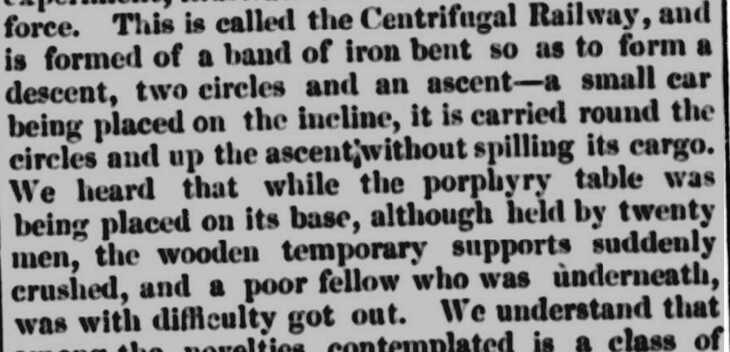
This is the only news account I can find from 1840 that describes the system in action. The difficulties it mentions offer an explanation as to why the ride didn’t make a splash for another two years. Drăgușanu, however, suggests that humans were riding it (“One sits down in a cart…”). But perhaps he was talking hypothetically.
The site today
In the absence of further information, then, the Great Windmill Site seems to be the first place in London where the public could loop-the-loop. I’ve traced the site of Dubourg’s centrifugal railway in trade directories to number 8 Great Windmill Street, at the Haymarket end of the road. The location is now occupied by one of those large Edwardian buildings that line Piccadilly Circus, Coventry Street and Haymarket. It’s currently undergoing redevelopment.
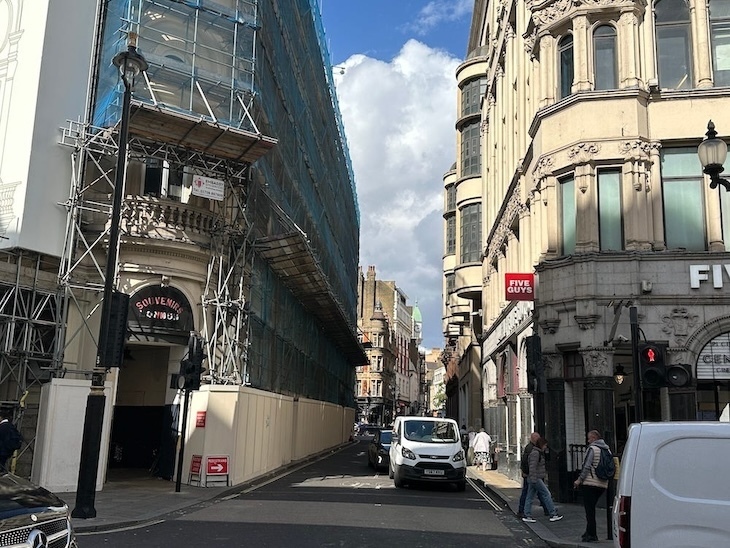
The building just so happens to be the old London Trocadero. From the 1980s until it fizzled out in the Noughties, this was a teen’s paradise of rides and attractions, including small roller-coasters. How incredible is that? Central London has been home to very, very few roller coasters over the years, but here we have two, unrelated examples on the same footprint... and on a road (Great Windmill Street) named after a structure that turns through 360 degrees. Peter Ackroyd would love the ‘continuity of place’.
It just goes to show, what goes around comes around… unless it falls off the rails first.