Adapted from a feature that first appeared in August 2025 on Londonist: Time Machine, our much-praised history newsletter. To be the first to read new history features like this, sign up for free here.
9 December 1868 is a doubly important date in world history. In the city of Breslau in Prussia, Fritz Jakob Haber vacated his mother’s womb and settled down for his first feed. 40 years later he would develop the ammonia-producing Haber process, which now feeds half the planet (through fertilisers), and kills vast numbers of people (through explosives). Haber was, arguably, the most consequential scientist of all time.
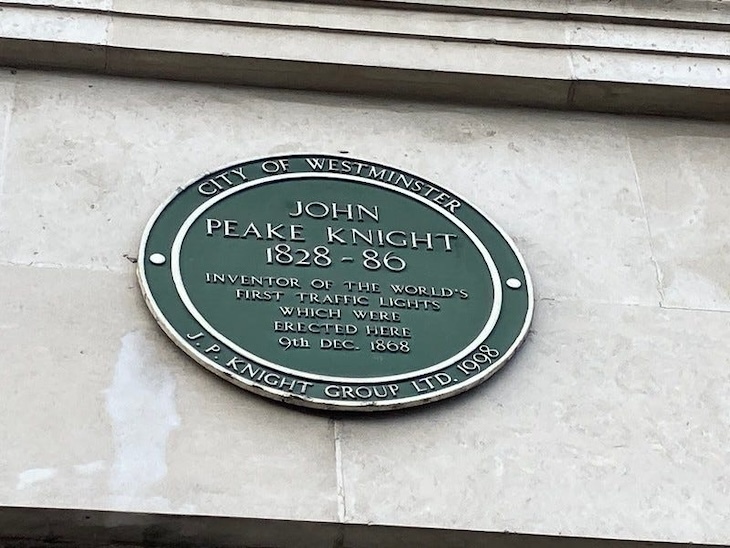
On the same day as his birth, the world’s first traffic light was unveiled in Westminster.
It was a spectacle. The contraption behaved like a railway signal, but towered six metres (20 feet) over the carriageway, with a trio of four-foot arms and a glowing headpiece, “like a dovecote”. Here’s a press image from the time:
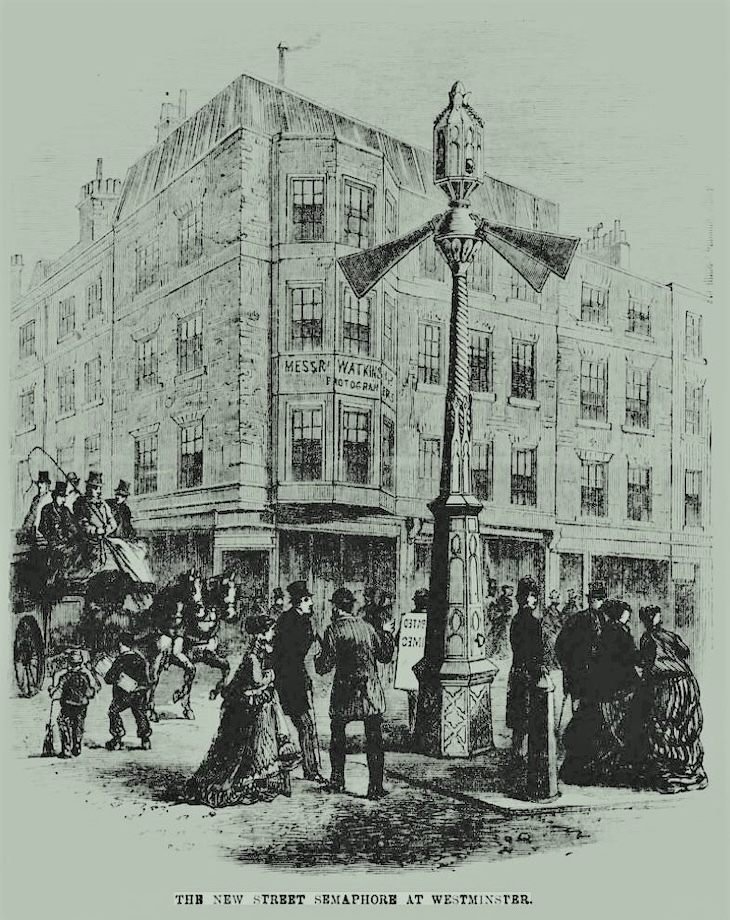
This “frightful monument,” as one letter-writer saw it, was quite alien, like something from the pages of HG Wells (though not yet; he was currently toddling around his parents’ china shop a few miles away in Bromley). It might have been a “gratuitous hideousness” (another letter-writer), but the street semaphore was sorely needed.
Victorian London was a crazed clopjumble of horse-drawn traffic, all vying for progress along the ill-paved streets. The rules of the road had yet to be codified. Nobody indicated. Nobody had assumed priority. It was a dung-scented free-for-all.
Well, not quite. The busier junctions enjoyed the superintendence of a policeman. The short arm of the law would bend, stretch, and beckon, to let drivers know when it was their turn to proceed. It must have been a hellish job. Many policeman were injured amid the vehicular maelstrom.
One junction had a particularly bad reputation. This is the one where Parliament Street runs into Parliament Square and the approach to Westminster Bridge… the junction nearest Big Ben. It’s still a wretched grimfest today, but back in the 1868 it was a right old snarl up. Two Members of Parliament had recently been injured trying to cross on foot, while a traffic policeman had been killed earlier in the year. The spot was chosen, then, for Britain’s (and the world’s) first traffic lights.
A “dreadful portent”
The brains behind the scheme was John Peake Knight, a respected superintendent on the South Eastern Railway. Knight had a simple idea: that signals like those used on the railways might also tame London’s road traffic.
His experimental apparatus was duly installed at the Westminster junction, roughly where the Winston Churchill statue stands today. It did not look much like a modern traffic light. For daytime operation, a semaphore system could start and stop the traffic by the raising or lowering of mechanical arms. Only at night, when red- and green-filtered gas lamps were used, did the system look the part. None of this was done automatically, of course. A policeman still had to stand on the island and operate the device, and he was usually backed up by more than one colleague to help further manage the flow with gesticulations.
Should you accidentally ‘quantum leap’ into the body of an 1860s coachman, then you’ll need to know how to understand the signal. Happily, this contemporary information sheet has survived in the archives:
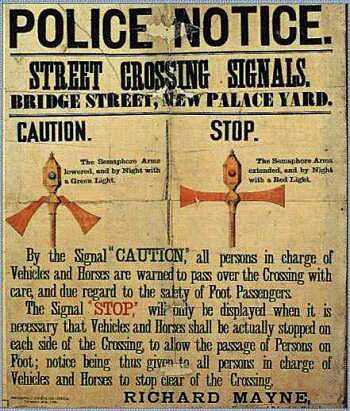
Simply put, you were free to guide your vehicle forwards unless both arms were in the horizontal, or the red signal lamp was illuminated. Notice that the sign mentions a pedestrian crossing. This was actually the whole point of the exercise. This first traffic light was a binary: either it was on to all vehicles or off to all vehicles. The arms could not be moved independently. During the ‘stop’ phase, all traffic halted and pedestrians were able to cross (in all directions) safely. During the ‘go’ phase, traffic would proceed in all directions, with some orchestration from a policemen. You’d be mad to try and cross on foot.
The traffic lights had some initial success. "The regular town drivers are fairly, and to quite an unexpected extent, amenable to the signals," thought the Illustrated Times, soon after the lights were installed.
Others were more skeptical. One commentator, on approaching the “Dreadful Portent” from Westminster Bridge, asked his driver what it was. “Another o' them fakements put up to wex the poor cabbies,” came the reply. A more serious limitation was the manpower needed. The signal still required a police presence. The lights and semaphore reinforced the hand gestures of the constabulary, but didn’t replace them.
Appearances aside, these early traffic lights were simply not good enough. Many drivers did not understand what the angled semaphore blades were supposed to indicate. Others ignored them. The technology often broke down. In January 1869, a gas leak caused an explosion at the base of the semaphore, badly burning the face of the police operator.
The lights lingered on for a few more months, but constant breakdowns and general ineffectiveness led to their removal by the end of the year. Semaphore systems were adopted elsewhere, but London would not see further signalling for many decades. The roll-out of traffic lights in London was proving to be a stop-start affair.
The first electric traffic lights
Regular readers may recall that London’s first traffic island was supposedly installed at the top of St James’s Street in 1864. Remarkably, London’s first electronic traffic lights were anchored to that very same spot.
Eight sets of lights were placed along Piccadilly — between the Circus and Clarges Street. They were switched on on 3 August 1926, to coincide with the remodelling of traffic flow in Piccadilly Circus. Much as today, London’s first lights had three colours: green to go, red to stop, and amber to be ‘ready for a change’. This time, London was behind the curve. Electric traffic lights had been in limited use in the United States for over a decade by this point, and numerous European cities had also dabbled.
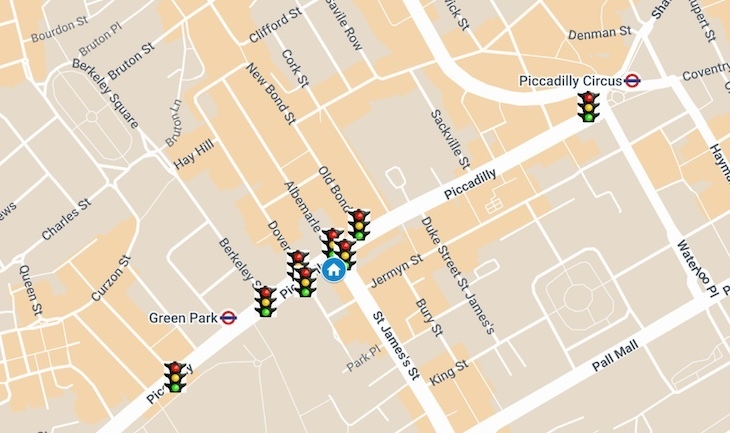
Circuitry wasn’t yet reliable enough for an automatic system. Rather, the lights were overseen by “a perspiring policeman in full uniform, including helmet,” perched inside a grey, glass-fronted booth on St James’s Street. The poor fellow would sit there squinting down the road, pushing buttons for hours on end, and sequentially scrolling through the phases on each signal.
These light signals were not for the direct benefit of drivers. Rather, they were intended as cues for the regular traffic police, who were stationed at each set of lights, to perform the customary gestures. This was, after all, an experimental system, and motorists had no previous experience at obeying coloured lights. The chief benefit was that one man could now coordinate the entire street, rather than the existing anarchy of independent junctions.
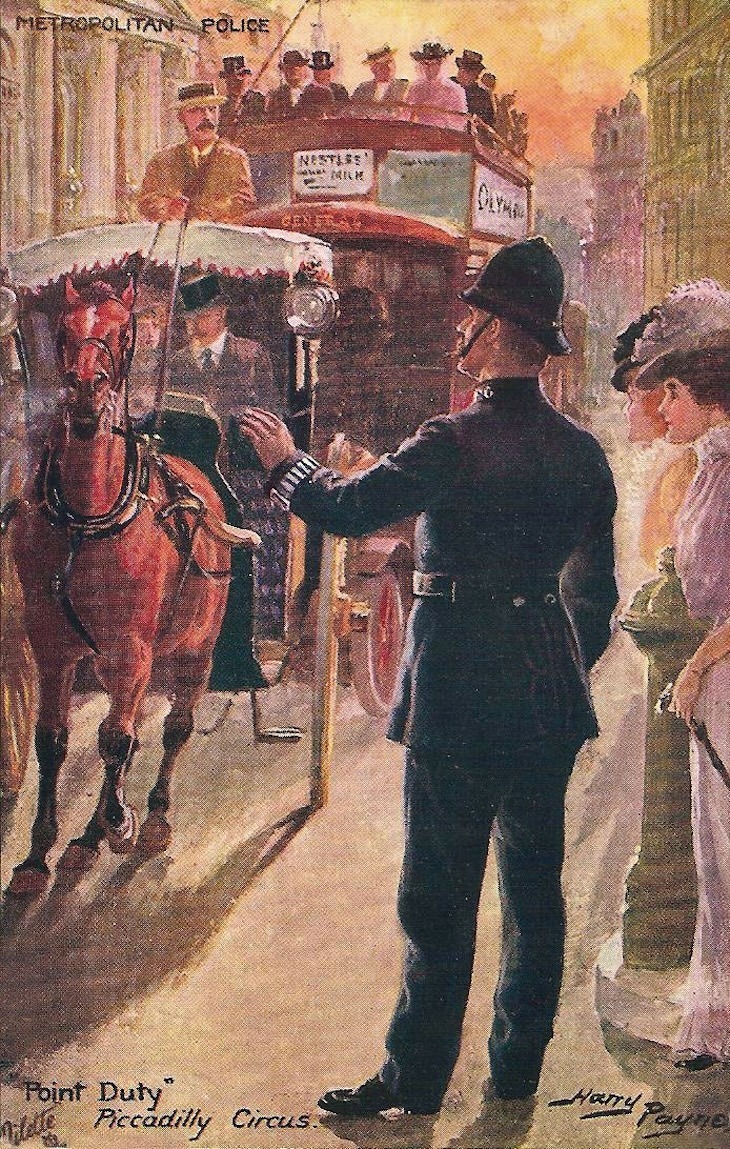
The Piccadilly lights were of limited success. Traffic flow was judged to be improved, but the mixture of a beckoning human and a guiding light caused confusion. The police on point duty could not always see their lights, which then as now were hooded. “A hundred times a day, drivers are waved out of Bond-street into Piccadilly be the policemen on point duty, although the signal at the corner is set to danger," reported the Evening News one month into the trial. “Similarly, a hundred times a day drivers see the green and think all is well for straight ahead, and find that the policeman will not let them pass”.
These mixed messages, and the sheer cost of employing so many members of His Majesty’s Constabulary on traffic duties (around 1,300 across town at any given time) meant that moves towards a fully automatic system were inevitable. London was again slow to adopt such a system. Detroit had automated lights as early as 1921, and the technology was widespread in North America by the end of the decade. Meanwhile, various towns across the UK, including Hastings and Wolverhampton, held their own trials before London.
The first large-scale system in central London was installed in Trafalgar Square in 1933. It was surprisingly sophisticated. The lights were informed by pressure sensors on the road surface, which relayed information about traffic levels on different approaches. Drivers were even given filter arrows, which allowed traffic to turn from the National Gallery onto Charing Cross Road, even though other directions were on ‘red’. These pioneering lights had their teething issues, but were quickly deemed a success. 14 police officers were reassigned from traffic duty.
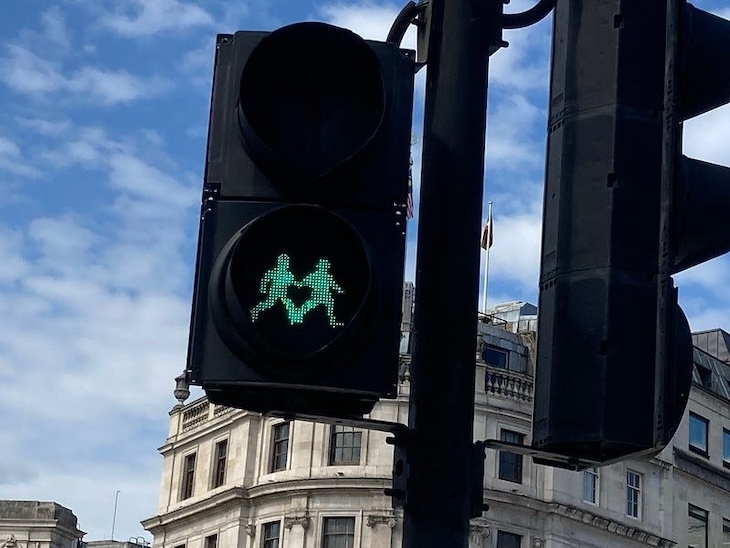
Automatic lights enjoyed their finest hour in November 1937, when “the biggest unit of traffic signals in the world” was installed at Piccadilly Circus. The “robot master mind” controlling the junction was officially named “Little Eva”. This box of wonders received signals from nine detectors on approach roads, and could vary the phase times according to demand. It was estimated at the time that Little Eva would save some £3,600 a year on police time, and provide a smoother flow as well. Pedestrians were an after-thought. According to one news report: “The loud speakers of a police car continually barked: "Use the subways, they are safer!" but few people did so.”
From that point on, it was a big green GO for traffic lights in London. They spread across the city and country like a tricoloured rash, and remain a key part of road infrastructure today.
Now, there’s an unwritten rule of feature writing that your final paragraphs should always include a call-back to the opening paragraphs. How on earth am I going to pivot back to Fritz Haber? Well, watch this manoeuvre…
Another of those early traffic light set-ups was placed at the corner of Southampton Row and Russell Square at some point in 1932-33, during measures to disentangle an experimental one-way system. It was at precisely this time that Fritz Haber made a series of short visits to London. He almost certainly stayed in the Russell Hotel, right next to the traffic lights.
Long-time readers of this newsletter will know how important this particular set of traffic lights proved to be. It was here, also in 1933, that one of the most important thoughts in human history took place. While on his way to the Russell Hotel (the same one Haber used), the physicist Leo Szilard paused at the crossing to wait for the traffic to stop. It was then that he had a ‘Eureka moment’ in which he conceptualised the nuclear chain reaction — the process that would lead to both nuclear power and nuclear weapons. Szilard is therefore a rival to Fritz Haber as the most consequential scientist who ever lived. One was born on the same day as the traffic light, and the other was inspired by one. Like the road-traffic control network, everything is connected.
After that unhinged conclusion, I’ll sign off with some music. Behold, this uplifting ode to traffic lights by Monty Python: