Adapted from a feature that first appeared in September 2025 on Londonist: Time Machine, our much-praised history newsletter. To be the first to read new history features like this, sign up for free here.
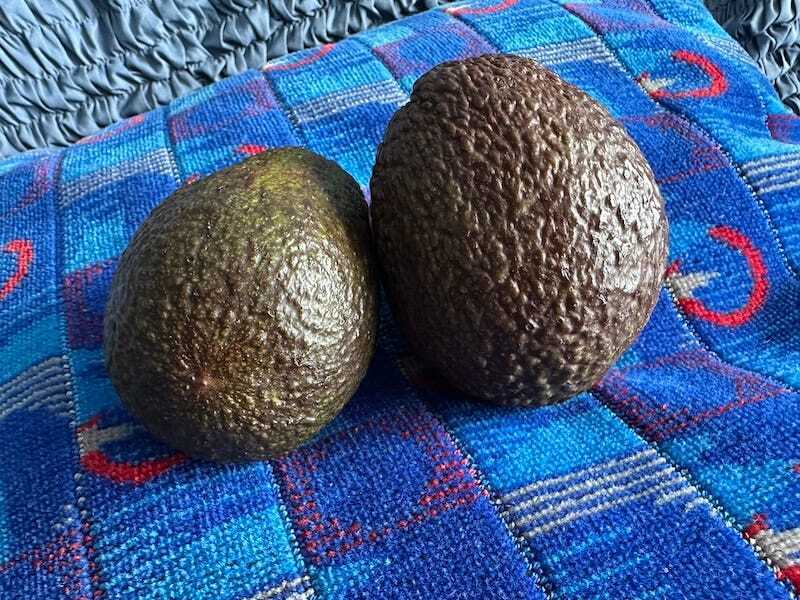
“When you get money you get a taste in food as well; instead of eggs and beans and steak, you branch out into the avocado scene. I never dreamed I would like avocado pears. I thought it was like eating bits of wax when I saw people shoving it down.”
George Harrison, there, with an accidental Partridge to the Daily Mirror in 1966. If John Lennon was the self-described Egg Man of the Beatles, then his bandmate favoured a more exotic ovoid.
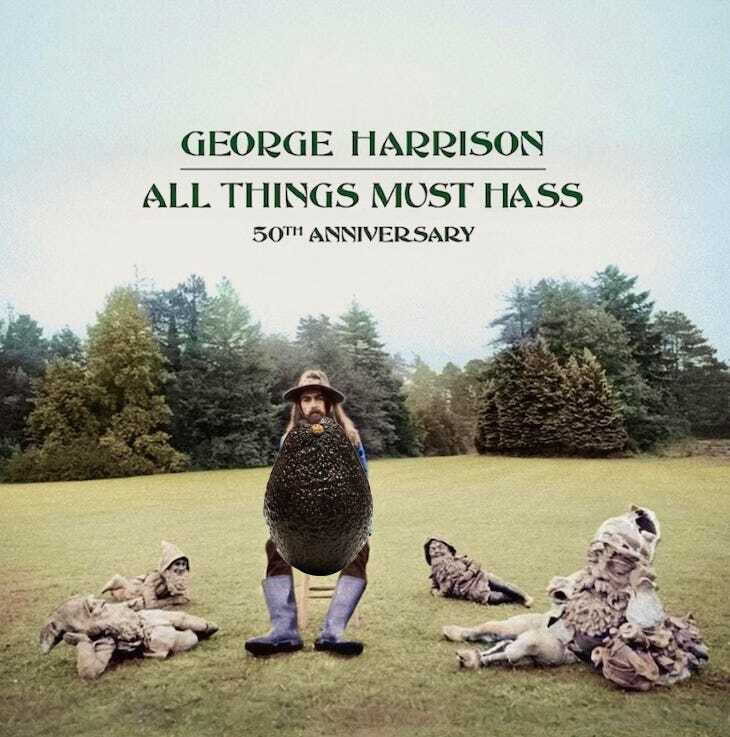
Lots of people had a thing for avocados in the 1960s. The exotic produce had been a greengrocer’s novelty for decades, but it was the Swinging Sixties that ushered in Britain’s first mass market. Today, of course, it’s ubiquitous, with avocado toast serving as the mushy mascot of the Millennial generation. I just had some for lunch as it happens.
Yet avocados had reached these shores long before Harrison be-slimed his plectrum fingers. They arrived two centuries ago; tentatively, sporadically, with little fanfare. And it was, of course, to London that they came.
The first known reference to an avocado in the English language comes from the pen of a well-known Londoner. You’ve probably heard of him: Mr Hans Sloane (1660-1753). This long-lived gentleman is endlessly notable. He founded the British Museum, and thereby the British Library and Natural History Museum. He’s also credited with bringing drinking chocolate to Britain. Half of Chelsea is named after him (including Sloane Square Tube station). Unfortunately, he was also a slave owner.
Sloane spent 15 months in Jamaica, initially as the personal physician to the Governor, and later gaining possession (through marriage) of lucrative sugar plantations. While there, he developed in interest in the local flora, which culminated in the 1696 publication of a catalogue of Jamaican plants. This included the avocado, whose fruit he described thus:
“The pulp is of a pretty firm consistence, and has a delicate rich flavour: it gains upon the palates of most people, and becomes soon agreeable, even to those who cannot like it at first; but it is so rich and mild, that most people make use of some spice or pungent substance to give it a poignancy; and, for this purpose, some make use of wine, some of sugar, and some of lime juice, but most of pepper and salt. Most sorts of creatures are observed to feed on this fruit with pleasure; and it seems equally agreeable to the horse, the cow, the dog, and the cat, as well as to all sorts of birds”.
Just not my nine-year-old, it seems. Anyway, this was the first time that those four melliferous syllables — a-vo-ca-do — appeared in the English language. Sloane noted that the fruit was also known as the alligator pear, a name that would persist well into the 20th century.
Then, silence. Very little is said about the avocado for many decades. The plant did not travel well, and no accounts of any specimens fruiting in England can be found until the 19th century. Even then, it was grown almost exclusively by elite botanists and wealthy estate owners who had the resources and heated greenhouses to cultivate tropical plants.
One such was he Duke of Northumberland, who was well noted for growing exotic species in his greenhouses at Syon, near Brentford (then in Middlesex, now part of Greater London). His Grace, indeed, had a brand-spanking new conservatory, completed in 1827 by Charles Fowler. It’s still a highlight of the house today:
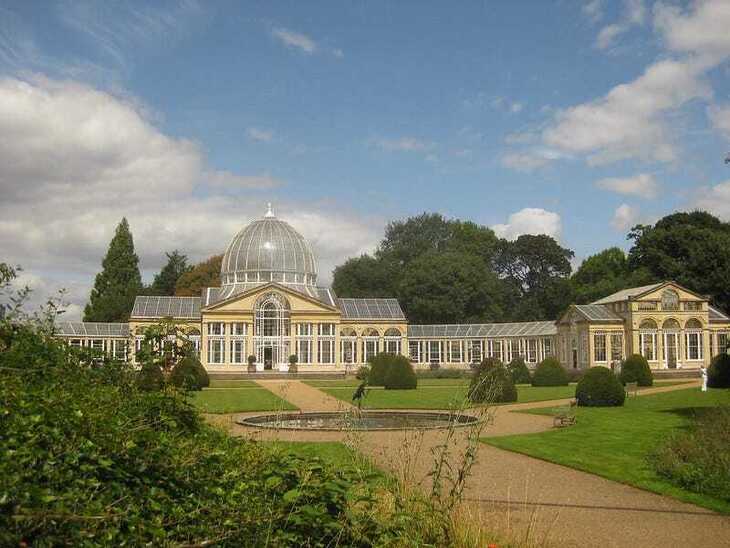
Among the Duke’s first experiments was the avocado plant. He had one flowering by the October of 1829, according to several newspaper accounts. A painting of the plant (which can be seen here) does not include the fruit, so we cannot say for sure whether His Grace ever tasted that rich flesh. But we can be fairly confident that this was London’s first living avocado plant.
The avocado next comes into view in 1867, when the Royal Botanic Society announced its successful cultivation at Kew, along with other tropical specimens. Two years later, the Royal Horticultural Society reported “the first time that such a tree has produced fruit in Europe”, noting that earlier efforts had flowered but not fruited. This apparent success took place in Byfleet, a little south-west of London in Surrey, in the autumn of 1869. If we are to believe this account, then Mr J. Carr, gardener to P.L. Hinds Esq, was the first person to grow an avocado fruit in British soil.
As the century moved on, avocado cultivation was attempted in the warmer parts of continental Europe such as Madeira, which eventually allowed export of the fruit to Britain. Transit would still take several days, and the avocados were sometimes kept fresh with wax seal. The first report I can find of avocados for sale at Covent Garden Market comes from 1884, when they are listed among exotic fruits at the Christmas market. Incidentally, they would have been sold under the glass-roofed market buildings, which had also been designed by Charles Fowler, of Syon House conservatory fame.
By 1896, the avocado was common enough that the Globe was able to run an opinion piece on its merits. We learn that the fruit was sold at ninepence a piece, and usually styled as the ‘alligator pear’. “Some people call it the most delicious fruit in the world,” reported the paper. “Others declare it to be the vilest.” It was most commonly eaten with a little salt, pepper and vinegar.
Avocados remained a rare, seasonal item in London, only available in larger markets and during autumn. A barrier to greater trade, besides the climate, was the problem we’ve all encountered with the fleshy fruit:
Day 1: Too stiff
Day 2: Too stiff
Day 3: Too stiff
Day 4 (2pm): Eat me now!! I’m just right.
Day 4 (5pm): Too late!
Early attempts at mass cultivation found the plant to be equally whimsical in the field, with different plants nearing ripeness at different times. Only from the early 20th century did horticulturalists manage to perfect a budding regime that would grow uniform plants, and thereby unlock mass trade.
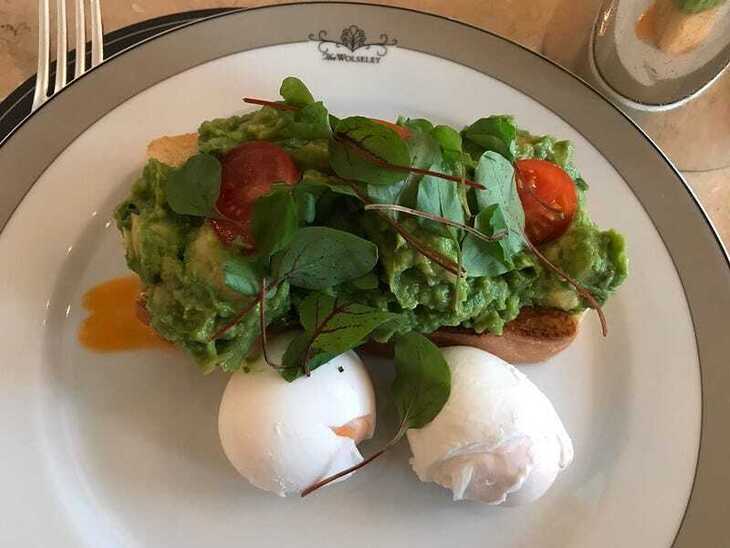
Improved crop yields and better transportation brought the avocado to a wider audience in the 1910s and 1920s. This was still an expensive indulgence, however. Commentators of the time describe it as “the aristocratic fruit”. By 1927, Scottish paper the Arbroath Herald ran a story called, straightforwardly, “Fruits you can get in London”, in which the avocado was described as “eaten in large quantities”. The paper notes that you will “meet it in many salads”, but that avocados “are seldom seen in the provinces”.
That same year, the Daily Express published a lengthy feature on the immigrant fruit, and in wholly glowing terms. It includes, as far as I can see, the first description of avocado toast in a British publications (the dish is described about a decade earlier in some American newspapers).
“Avocado Toast. -Mash the avocado, season with salt, pepper, lemon juice and, if liked, a little cinnamon, and spread thickly on toast. This makes either a breakfast, tea, or supper dish or hors d’œuvre.”
Imports increased as the decades went on, with the obvious gap during the war years. It was only in the 1960s that we see what might be termed ‘the first great avocado boom’. By now, the fruit was readily stocked in greengrocers, and even chain supermarkets such as Sainsbury’s and Marks & Spencer got the green bug. The latter introduced the more robust Hass cultivar in 1968, which is now the most common around the world. It was, incidentally, discovered by and named after the Californian Rudolph Hass, who most definitely should not to be confused with Deputy Führer of Nazi Germany, Rudolf Hess.
A cute article in the Peterborough Evening Telegraph’s “The Feminine Angle” column (10 March 1965) describes the puzzled looks one shopper got when taking a newly stocked avocado to the till. Neither the staff nor surrounding customers knew what it was, nor what it tasted like. The reporting journalist reassures us that avocados “have a delicious soft and soggy consistency rather like blotting paper, but not in any nasty way”. (I’m not old enough to remember what blotting paper was, exactly, but I’m pretty sure nobody ate it. Perhaps it was a Peterborough thing.)
Avocados were now easier than ever to get hold of, but they retained their “bit posh” reputation — hence George Harrison’s comments about the “avocado scene”. They were still relatively pricey, too. In 1966, cook Ellen Matthews became the first person on record to be arrested on suspicion of avocado theft. Matthews had allegedly swiped two specimens from the Premier Supermarket on King’s Road, Chelsea. Incredibly, the case not only made it to court, but Ms Matthews was tried by jury. Thanks to a lack of evidence, she was found not guilty of the micro-heist.
After the 1960s, avocados pootled along as a readily available if under-appreciated component of the London salad bar. Imports from Israel and South Africa brought the fruit to our shores all year round, and it lost its associations with Christmas. The 1970s saw ‘avocado’ launched as a “brand new colour”. Avocado bathroom suites became unfathomably popular, leveraging a shade that previously (and subsequently) might have been called ‘putrid green’.
The fruit itself remained rare ‘in the provinces’. I never encountered one throughout my entire (80s/90s) childhood in Lincolnshire. It was only on moving to London in 1998 that I gained my first mouthful, at the wonderful Jerusalem basement restaurant in Fitzrovia.
Now, of course, they’re everywhere. The boom here started around 2010, when London’s millennial population became stereotyped as brunch-craving avocado-on-toast addicts. The (debunked) idea set in that young people frittered all their money on green mush, leaving them unable to join the housing ladder. Someone created an avocado Tube map. Avocado ice cream became a thing. A friend of mine even suggested the avocado should become a totem of the anti-Brexit campaign: withdrawing from the EU, he reasoned, could dramatically increase the cost of avocado imports, stymieing brunch and ruining Millennial life. Or something.
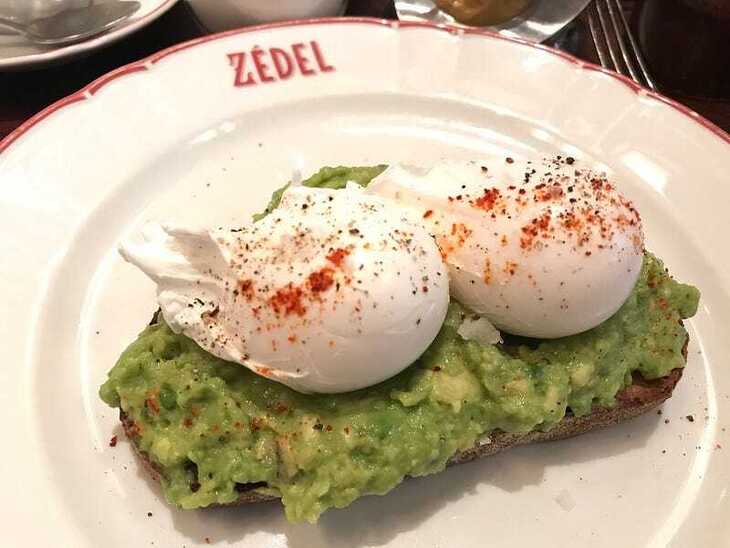
Brexit did not have a noticeable effect on avocado consumption. We still meet the curious comestible on every menu. The current worldwide harvest, dominated by Mexico, is around 11 million tonnes per year — enough, in theory, for each and every Londoner to receive over a tonne of avocados each Christmas. It’s a pity George Harrison never lived to see it.
Bonus joke for those who read to the bottom:
Q. Why are George Harrison and the rest of the Beatles like an avocado farmer?
A. They both leave the Stones in the shade.