This feature first appeared in January 2025 on Londonist: Time Machine, our much-praised history newsletter. To be the first to read new history features like this, sign up for free here.
Sing a song of London,
A pocket full of rhyme.
Four and twenty verses,
From another time.
When the songs are studied,
Much to our surprise,
They’re stuffed with London history,
To set before your eyes.
London lurks in the background of many nursery rhymes, though it is not always obvious. Below, I’ve chosen six well-known songs with particularly strong connections, and highlighted a few others in brief.
So, make yourself a cup of tea (Polly put the kettle on!), and let us begin.
1. London Bridge is Falling Down

London Bridge has fallen down more often than Cristiano Ronaldo. The Romans had a wooden span, which must have got damaged or washed away on several occasions. The Anglo-Saxons and Normans got through bridges at an embarrassing rate. The 13th century bridge was deleted in the early 19th century, and its replacement was taken down and partly shipped to Arizona in the late 1960s. Which bridge, exactly, is falling down in our song?
The origins of the nursery rhyme are quite nebulous and, I’m afraid, that will be a common theme in this article. It is first referred to in a comedy of 1657 called The London Chaunticleres, though its lyrics are not revealed. These were first printed in Tommy Thumb's Pretty Song Book in 1744, but have changed much across the generations.
These dates suggest that the song was composed during the tenure of the 13th century bridge, which lasted until the early 19th century. This bridge was badly damaged on numerous occasions, including a terrible fire in 1212 when the bridge was just three years old, and another in 1633, which wiped out many of the houses. Several arches collapsed in 1281, and again in 1437. Any of these events might have triggered the song. Perhaps it is even older, and is a folk memory of a supposed attack on London Bridge by Olaf of Norway in 1014. Another theory is that the song was imported. Similar ditties about collapsing bridges are recorded in France, Germany and Denmark at earlier dates.
We should remember that London Bridge was one of the most important and famous structures in England. People would have been making silly rhymes about it all the time. Perhaps it was simply woven from the imagination, as part of a childhood game, without any direct inspiration from real events.
2. Oranges and Lemons
Also first recorded around 1744, this familiar rhyme offers a melodic tour of London churches before ending with the threat of decapitation. Kids love that kind of thing. It’s appeared in numerous versions over the years, but the modern song has settled on six churches.
One can spend a fruitful afternoon tracking down the Oranges and Lemons churches. I’d make you a map, but someone’s already done so, and uploaded it to Wikipedia. Four of the identities are certain, and two are debated:
Oranges and lemons, say the bells of St Clement’s: probably St Clement Danes on Strand, which plays the tune on its bells; but possibly St Clement’s Eastcheap.
You owe me five farthings, say the bells of St Martin’s: either St Martin-in-the-Fields by Trafalgar Square or the vanished St Martin Orgar off Cannon Street.
When will you pay me, say the bells of Old Bailey: St Sepulchre-without-Newgate, the bell that would toll for executions, beside Old Bailey.
When I grow rich, say the bells of Shoreditch: St Leonard’s, Shoreditch.
When will that be, say the bells of Stepney: St Dunstan’s, Stepney.

I do not know, says the great bell of Bow: St Mary-le-Bow, Cheapside, the bell within whose sound all true Cockneys are born.
Why the song ends with a chopper to chop of your head is a bit of a mystery. Theories of child sacrifice or a reference to Henry VIII’s penchant for wife-slaying are probably fanciful. The bloodthirsty coda is not recorded until the 19th century, and was probably added for entirely whimsical reasons, perhaps as part of a children’s game.
3. London’s Burning
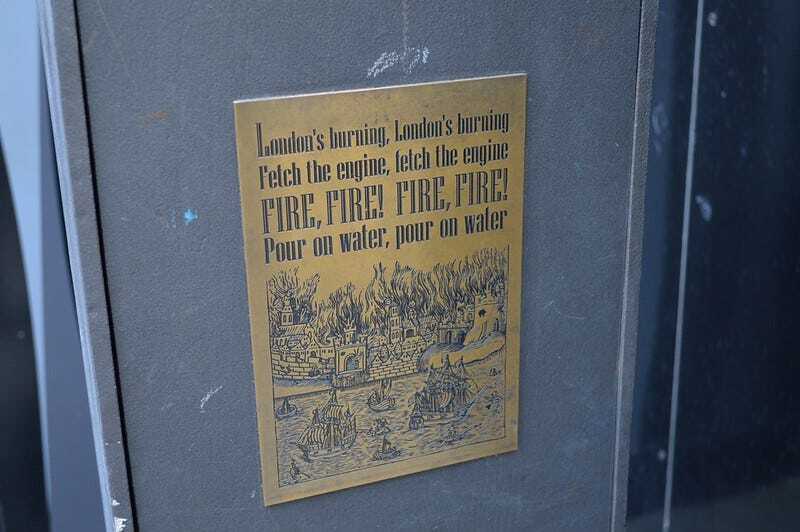
Arguably the least famous of our nursery rhymes. I base that judgement on my own ignorance. I’d never heard it in my life until someone started singing it at university for some reason. It goes like this:
London's burning, London's burning.
Fetch the engines, fetch the engines.
Fire, fire! Fire, fire!
Pour on water, pour on water.
So, not exactly TS Eliot. But then it’s meant to be sung as a round, like Row, Row, Row Your Boat.
The obvious place to look for an historical stimulus is the Great Fire of London of 1666. Indeed, someone’s stuck a brass plaque (pictured above) of the lyrics upon a water fountain next to the Monument — that lofty column that commemorates the Great Fire. The song, though, has many regional variants including Scotland’s Burning and a Dutch version that translates as ‘Fire in Amsterdam’. It is impossible to know when and where the original caught flame.
4. Pop Goes the Weasel
Is this a London song? Why, yes it is. The clue is in the very first line. “Up and down the City Road, in and out the Eagle.”
Lots of towns, I imagine, have a City Road. But how many have a City Road with a pub called The Eagle? London does.
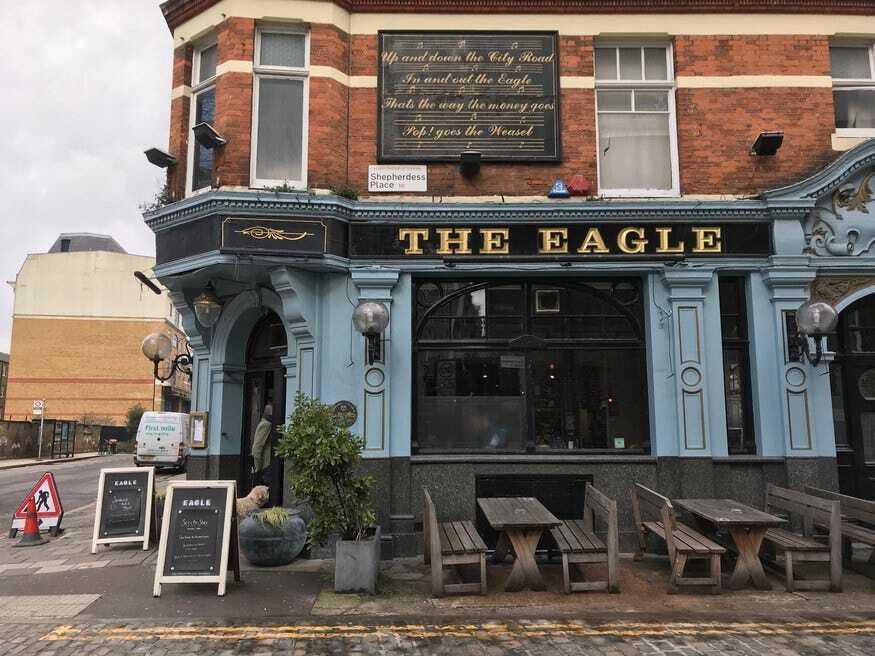
As you can see from my rather drab photograph, The Eagle carries a mounted board with the words to the nursery rhyme, and a frugal selection of notes from its tune. It is self-identifying as the Pop Goes the Weasel pub. But is it?
The earliest mentions of Pop Goes the Weasel come from a series of adverts from 1852 and 1853, to promote lessons in the 'highly fashionable' dance, as “introduced at her Majesty's private soiree”. The British Library holds a copy of a music sheet from 1853. It has a similar tune to today, though nobody knows who composed it.
It soon filtered down the social classes. Race horses were named after the song. Street musicians sang it on every corner. In 1854, the line 'Pop Goes the Weasel!' was described as an “idiotic exclamation so humiliating to the intelligence of our age and race”. Manufactured outrage is, it seems, nothing new.
As with many frivolous rhymes, the lyrics have chopped around a fair bit. One 1855 printing sets them forth thus:
In the Bird of Conquest, made
first by Romans famous,
Though "Grecian" my saloon was called
By some ignoramus.
Up and down the City-road,
In and out the Eagle,
That's the way the money comes,
Pop goes the weasel.
This is the version that pins the song to the pub. In the mid-19th century, the Eagle was a music venue and pleasure garden. It was nicknamed the Grecian Saloon and managed by a Mr Benjamin Conquest. It seems to have co-opted an already popular tune and made it its own.
As for why a weasel should go ‘pop’, here or in any other arena, was a mystery even in the 1850s. Theories advanced include a reference to a spinner's tool, rhyming slang for throat (weasel and stoat), the act of pawning silver plate, or the sudden movement of an actual weasel.
5. Do you Know the Muffin Man?
No? According to the song, he lives on Drury Lane, a famous old road near Covent Garden. The earliest written record of the nursery rhyme is from a manuscript of 1820 — or, at least, it is if you believe every online account that has rewritten Wikipedia. Actually, the song can be readily traced a year earlier.
A quick search in Google Books throws up manuscript of 1819 called Life High and Low, a curious tome that recounts some of the characters and ballads of the day. It includes a footnote about "The Dandy Muffin-Man of Drury Lane", and this prints the lyrics, much as they're still sang today. Still earlier ditties about muffin men can be found in the archives, but they bear little similarity to the familiar rhyme.
After 1819, the song took off in a big way and has been in popular currency ever since. In recent years, it played a prominent role in the first two Shrek films.
6. Ring a Ring o’ Roses
Urban myth time. This maudlin ditty is widely supposed to have been inspired by the Great Plague of 1665, which saw off around 100,000 Londoners. The ‘ring o’ roses’ are the red buboes, the pocket full of poses were to ward off bad smells associated with disease, while “a-tishoo, a-tishoo, we all fall down” is the all-too-common outcome (American’s, I’m told, sing “Ashes, ashes” in place of the sneezing, which could be a reference to mass cremation).
The pieces fit together neatly. Sadly, the association with the Great Plague seems to be a modern invention.
The first written references to the rhyme come from the 1840s and 50s — almost two centuries after the plague — and those have somewhat different lyrics to modern versions. The Germans have something loosely similar from the 1790s. Of course, the song might easily have been sung for generations before being written down. We have no evidence either way.
What does seem certain is that the link between the song and plague was not made until the mid-20th century. It’s a modern folk etymology — in the same way that the statue in Piccadilly Circus now seems to be accepted as ‘Anteros’ and not Eros, even though nobody made that identification until the 1980s.
And a few other possibilities…
Many other nursery rhymes have been connected with English royalty, which would arguably make them London songs. Note: in all cases, the meanings are speculative.
Mary, Mary, Quite Contrary is sometimes said to concern Queen Mary’s persecution of Protestants. Silver bells and cockleshells were nicknames for instruments of torture. The question “How does your garden grow?” could be a reference to Lord Chancellor Stephen Gardiner (whom Wolf Hall fans will know).
The Grand old Duke of York may refer to several individuals, but is often identified with Frederick, Duke of York and Albany, the son of George III. Frederick was a lifelong Londoner and is commemorated on the Duke of York’s column beside The Mall (the monument often mistaken for Nelson’s Column).

Jack and Jill might have something to do with Charles I’s taxation of alcohol. A ‘Jack’ was an eighth of a pint, and a ‘gill’ was a quarter pint.
Rock-a-bye Baby is sometimes linked to the calamitous reign and fall of James II and VII.
Sing a Song of Sixpence is endlessly reinterpreted. One popular explanation makes it a rhyme about the Dissolution of the monasteries under Henry VIII. The blackbirds baked in a pie are the unfortunate monks. The Queen is Catherine of Aragon, while the maid in the garden is Anne Boleyn.
There was an Old Woman who Lived in a Shoe may be an allusion to George II, who was sometimes nicknamed the ‘old woman’ because his wife Caroline was said to be the real power behind the throne. His “so many children” would be his unruly MPs.
So, as you can see, almost any British nursery rhyme has some kind of connection to London or else royalty, even if most of them are spurious.
I could go on with further examples, but you’ve already had three bags full. I’m off to mend my head with vinegar and brown paper… a remedy that’s always puzzled me.