Adapted from a feature that first appeared in July 2025 on Londonist: Time Machine, our much-praised history newsletter. To be the first to read new history features like this, sign up for free here.
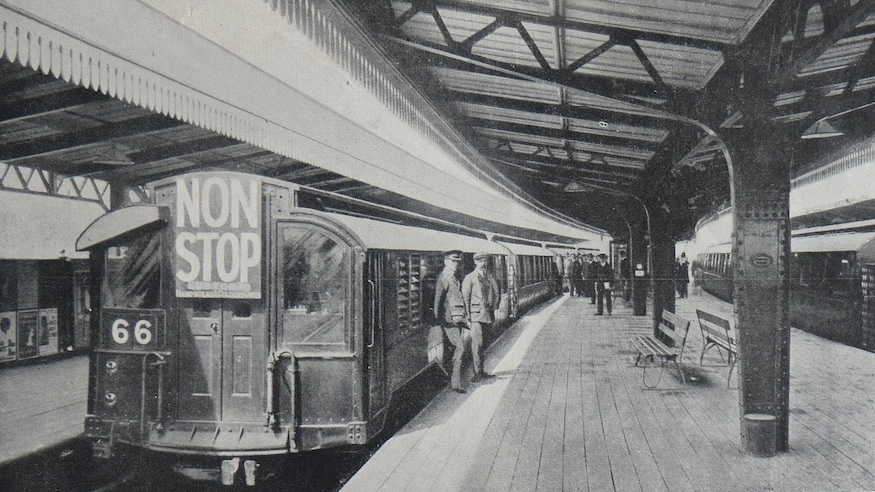
Let’s catch the Tube 115 years ago, through the eyes of a newcomer to London.
Kate Evelyn Isitt (1876-1948) cut her journalistic teeth writing for New Zealand newspapers, including a stint as the first editor of the women’s page on Wellington’s Dominion newspaper. In 1910, she moved to London and quickly established herself as a trusted journalist, working in this capacity until the 1940s. Her personal story would be a fascinating one to pursue (a bit more here), but today I’d like to focus on a barnstorming feature she wrote in 1911, concerning London’s Tube network.
She gives us a first-hand account of what it was like to catch the Tube all those years ago, when George V had just taken the throne, William Taft was US President, and the almost-complete Titanic had no word associations with icebergs.
Below, I’ve quoted and commented upon about two-thirds of that feature. The full version can be read on the British Newspaper Archive.
The Tube Travellers
You may be only a few minutes in London before you find yourself diving into the depths of the earth to get from the railway terminus to your suburb; you will hardly be a day in the city before making the acquaintance of this strange twentieth-century London, the underground city which extends from Hampstead Lane and Finsbury Park in the north to Hurlingham and Clapham Common in the south, and from Whitechapel in the east to Turnham Green in the west, lacing and interlacing its paths into a perfect labyrinth between these points.
114 years on, and this could read Barnet in the north to Morden in the south; Chesham in the west to Upminster in the east.
"To the trains" — the words and the pointing arrow stare you in the face, and to the trains you go, down slopes and stairs, round curves and corners, walking for a distance that often seems interminable, til at last you come to a long, narrow platform, in a tunnel lighted with electric lamps. A very nice tunnel it is, lined with white and coloured tiles that look cool and clean, emblazoned with advertisements, and, generally speaking, so light and airy that it is very difficult to believe that the streets and the sunlight are so far overhead. The ventilation, indeed, is so good that sometimes away down there you will meet with a very respectable young Wellington gale.
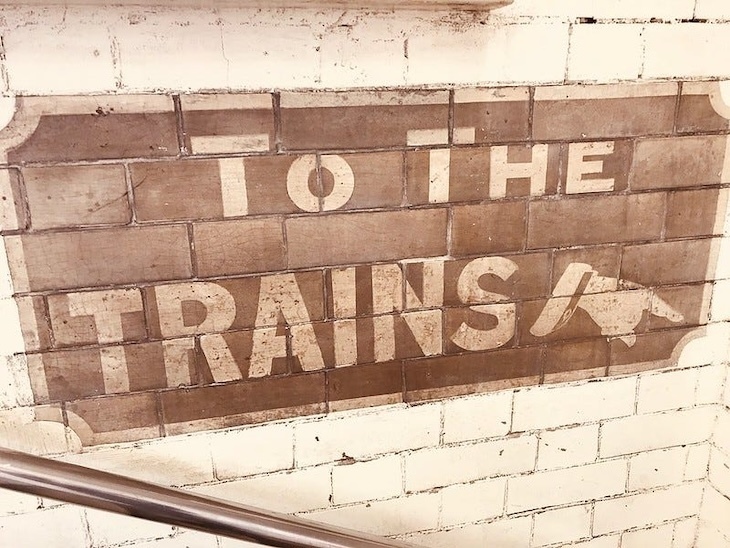
I’m not sure the modern commentator would describe the Tube as ‘light and airy’. Despite a recent graffiti surge, the network remains a clean place and very much ‘emblazoned with advertisements’. The white and coloured tiles have also been maintained through the decades, and are one of the most celebrated aspects of the Tube network. A ‘Wellington gale’ refers to the noted problem that Isitt’s home city has with wind, so to speak.
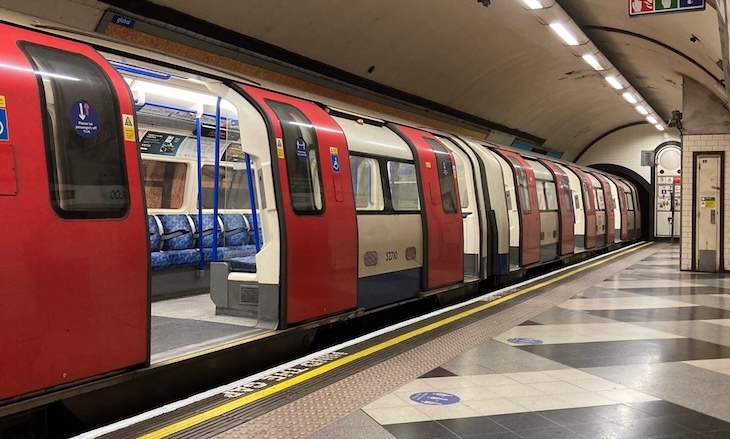
Before you have time to read more than one or two of the advertisements which decorate the walls, into the station will come rushing an engineless train looking for all the world like a headless caterpillar. As it stops the iron gates on the platform of each carriage fly open, the guard earnestly exhorts the waiting crowd to "let the passengers off please”, and while the train throbs with desire to rush off into the darkness again the passengers file out with a sad and funereal dignity.
Lots to unpack here (once we’ve got over the phrase ‘throbs with desire’). The ‘iron gates’ identify the train as the 1906 Stock. Passengers got on or off via metal gates at either end of the carriage, which must have taken a while during busy periods. The trains are noted as ‘engineless’, which we take for granted today, but would have still seemed quite novel in the early 20th century. Then, as now, the power came from electricity below rather than a hauling locomotive. The lack of an engine presumably prompted the ‘headless caterpillar’ comment.
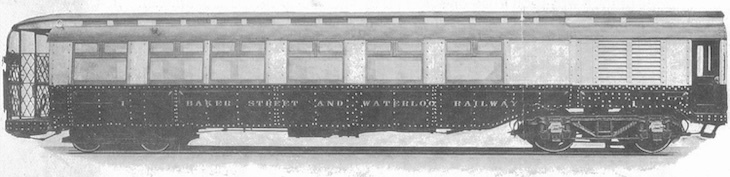
The other notable detail here is the presence of a guard. All trains had one. Indeed, they’d remain a permanent fixture until 1984, when the move to driver-only trains began. Some Underground trains would keep their guards right up until 2000.
At last you are allowed to enter, the gates snap shut once more , and the train runs round a curve from the bright station into a dark tube just large enough to let it slip through, but almost before you realise that you are really journeying it runs out into the light of another station.
Aside from the snapping of the metal gate, that description holds up pretty well today. Tube trains still enter a ‘dark tube just large enough’.
Fortunate is the passenger whose trip is made without a break, for it is the changing from one line to another, the walking along endless passages, or sometimes out into the street again from the station of one company to the adjoining station of another — for two companies divide this underground system between them — the riding up and down in lifts, that make a trip across London wearisome.
Today, we’re used to a unified, joined up system. Back in 1911, the various lines were controlled by different companies, making interchange and ticketing a confusing business.
Alighting from his train, the new arrival in London who is in a hurry races along the platform and up the stairs to the lift, with an idea that by hastening he will arrive the sooner at his destination, and then for all his pains he will have to wait with the liftman as his solitary companion, waiting for the laggard crew to toil up after him, an experience which, repeated several times each day, will at last teach him, too, to walk: very slowly. Because of those lift delays it is hardly worth while taking a tube for a very short journey or a brief trip with a break in it, if a motor ‘bus will serve one’s turn.
At the time of the article in 1911, all deep-level Tube stations were accessed by lift or stairs. (The first Tube escalators, at Earl’s Court station, would open later that year.) Lifts could take a while. They were slow to climb, and were operated by a liftman who could hold the lift back until it was full to his satisfaction. It was a job with its ups and downs.
The development of the system during the past five or six years has been rapid. Fifteen years ago there was an electric railway running partly underground and partly in the open from Euston round by the Bank, and down to Clapham, and the old District Railway, also underground for the most part, was electrified five years ago. It is about nine years since the first of the tube railways was opened, the one that runs from the Bank to Shepherd’s Bush, passing along somewhere beneath Cheapside, Holborn and Oxford Street, and in 1906-7 were opened the three lines which link the others up and especially serve the theatres, the Bakerloo, Piccadilly and Hampstead Railways.
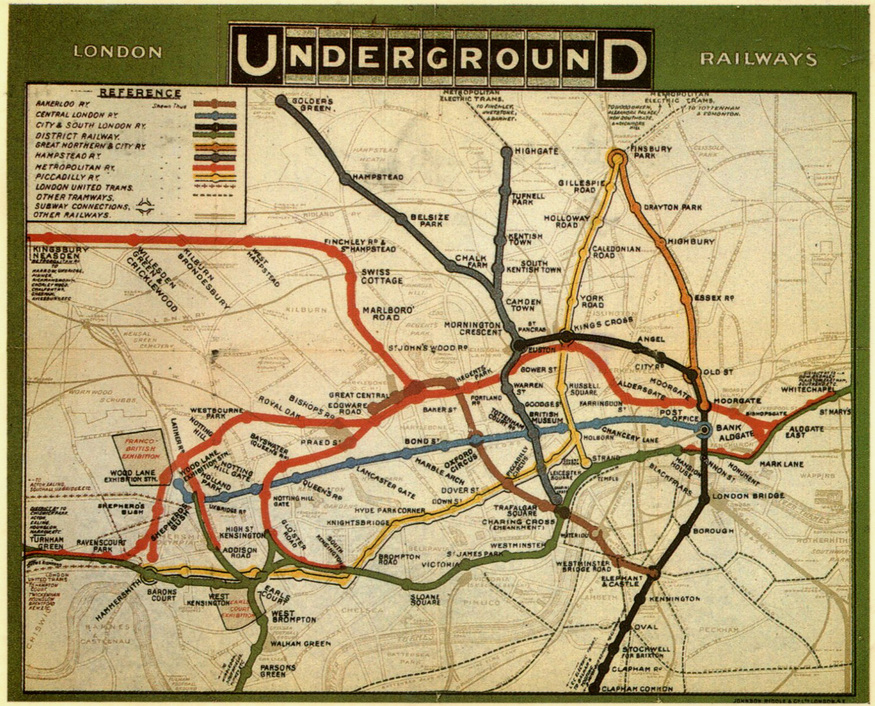
The expansion of the network was stupendously rapid in these early years of the 20th century. To use their modern names, the core of the Central line opened in 1900, followed by those of the Bakerloo and Piccadilly in 1906, and the Charing Cross branch of the Northern line in 1907. Plus lots of extensions all over the place.
What London did without these railways it is difficult to imagine, for they now seem absolutely essential. The companies between them own 864 miles of railroad, and last year carried 312,500,000 passengers, or nearly a million each day. The average length of a journey is about two and a half miles, and as the average speed, including stops, is over seventeen miles an hour, one may reckon that the average Londoner spends nearly a quarter of an hour each day over one underground journey, while a wonderfully elaborate calculation shows me 7000 people travelling down among the foundations of London at any given minute of the day.
What a marvellous compendium of stats. The network has greatly grown since 1911, and today supports around 1.2 billion passenger journeys per year. That’s roughly the entire population of China. To put it another way, Elon Musk could afford to hand out $833 to every person who crosses the ticket line for a whole year. I made about 100 Tube journeys last year, so I figure he owes me $83,300.
The average length of journey today, according to this FOI request, is 9km, which is 5.6 miles — more than double the average of 1911 as reported here. The average speed today (according to another FOI request) varies by line, but hovers around 30 kph, which is 18.6 mph. In other words, it’s very similar to the pace in 1911. How many people are ‘travelling down among the foundations of London at any given time’ today? Well, about 3 million people use the service every day, between the hours of 5am and midnight (ignoring Night Tube). So that’s about 160,000 people per hour. So I’d guess about half that (80,000) are on the network, as an average, at any given moment.
The tubes proper are only large enough to allow a single train to shoot through, the trains always running in the same direction. In these a collision would be impossible, unless indeed one train should overtake another which had broken down, as was pleasantly suggested by a man in our carriage the other day, when something went wrong and for three or four minutes the train was stuck groaning in the dark tube, while the motormen scampered to and fro and shouted at each other, and the experienced passengers looked on undisturbed. As a matter of fact the man was wrong. On these lines they have automatic signals and brakes, and at a danger signal the brake springs up from the live centre rail, holding the rain until the danger is removed. On the old underground lines there are double lines, but on one of them at least the same automatic brake is used, while of course aall the trains are lighted by electricity.
Collisions of any kind between London Underground trains are vanishingly rare. Correct me if I’m wrong, but I think the last collision between passenger trains on the network was in 1986. Most fatalities on the network, through its entire history, have been through passenger incidents or terror attacks. There are exceptions, though, like the Stratford Tube crash of 1953 and, of course, the Moorgate disaster of 1975, as well as various derailments.
The lifts that people complain of so much are in their way as interesting as the tubes, some of them going down to great depths. The one at Holborn goes down to a depth of 130ft, while the Hampstead one, according to a liftman, is about 190ft deep, and the station there is 200ft below the surface of the earth. Even then so high is Hampstead that the train running from the city is on an upgrade all the way. The tubes run far below the sewage system, the run beneath the river, and cross and recross each other while down there in the darkness, they climb up and down little slopes according to the level of the ground above, and they twist their way round many a curve, as one can see when watching the track from the end window of the Hampstead train by the light of the red and green lamps set here and there.
All of this is still true (apart from the red and green lamps). Hampstead’s platforms remain the deepest below street level, though the Jubilee line at Westminster is furthest beneath sea level (or closest to the centre of the Earth).
Everything works so smoothly that one does not realise what an enormous amount of traffic is dealt with each day, but on one line alone, between the Mansion House and South Kensington, a thousand trains are run each day, one every ninety seconds, and the Mansion House Station holds the record when at one period in the day it despatches three trains in each direction in three minutes.
This also remains true today. We might like to moan about the Tube, but the frequency and reliability are enviable when compared to most other rail systems in the UK. When all’s going well, the route between Mansion House and South Kensington today sees five or six trains every 10 minutes in each direction (timetables here), on par with 1911 levels. The other important thing to know about Mansion House station is that it’s the third-closest station to the Mansion House. Also, it’s one of only two station names to contain all the vowels. It’s this kind of trivia that keeps you reading, isn’t it?
There is material for many a detective novel in the possibilities of the tubes, and I have wondered for days over an incident I saw which might well have served for the beginning of a sensational novel. A little old lady, rather peculiarly dressed, came into the carriage at an underground station, and as she passed to her seat she paused to stare with sudden interest at a passenger seated near the door, a quite harmless looking boy. So interested was she that she afterwards changed her seat to have a better view of his face, and gazed at him conspicuously throughout the journey, hurrying out to keep near him when the arrived at the Bank Station, which is the terminus, and watching to see which lift he would enter. He made for the first lift; she followed him, so he turned back to the second, which was just the thing she had always meant to do. Then he thought better of it and came towards the third lift, she following him without a word. I heard the boy complain to the lift-man in an injured tone, and then the door slammed and we shot up, leaving them both behind. I was so curious to see what would happen that I waited near the head of the shaft till the next lift came up, and the old lady appeared alone, hurrying off with a worried look up one of the half-dozen subways. The youth, presumably, had slipped through an archway into a train going in the other direction and once he was off, pursuit was hopeless. But what did it mean? Why should such an elderly lady be so angry with such an innocent-looking lad, and did they ever meet again, and if so, what happened? One would like to know.
I know at least three murder/mystery/detective novelists who read Londonist: Time Machine… so there’s your challenge. It strikes me that a fourth person might have observed Ms Isitt following the strange pair and might, in turn, have wondered why she was so interested in them.
The underground companies advertise enormously, boasting their immunity from fogs and blocks and road upheavals, and the inexpensiveness of their fares. At the door of every station is a poster bearing the words which won a newspaper prize: “Underground to anywhere; quickest way, cheapest fare,” a jingle that is almost as maddeningly reiterative as Mark Twain’s famous “Punch, brothers, punch with care; punch in the presence of the passenger.”
It’s no longer the cheapest fare — buses or cycle hire will beat the price for most journeys. And Mark Twain wrote pithier words than these. Incidentally, trivia fans, Mark Twain was one of the very first people to ride on the Central line.
Quickest way it certainly is, and cheapest fare, but this in the long run makes it very expensive both as regards time and money - so far as the visitor to London is concerned. When one can get to the other end of town in no time at all, why not go, and when it costs only twopence or threepence to go, one forgets it will cost as much to come back, and as in the course of the day the visitor anxious to see the most of London takes the most tremendous journeys, hardly realising as the train rushes through the darkness how very long they are. A journey on a horse ‘bus is a journey without doubt, a journey on a motor ‘bus is an adventure for the passenger or the passer-by, but a journey underground is merely an episode, and it is not till the end of the day that visitor discovers why a London working day contains only six working hours that two others have been dropped somewhere deep beneath the city’s foundations, and then in his reckoning of the day’s expenditure he discovers also the cost of shooting through those labyrinthine passages.
The Tube can still be a spendy business. Happily, today we have the transport cap, which means you can never spaff more than £16.30 on pay-as-you-go Tube journeys, even if you visit all 272 stations in one day, or spend the entire 5am to midnight window riding from Cockfosters to Mudchute in some lewd, avant-garde performance-art project. Which, of course, I’m now going to have to do.
And that concludes Ms Isitt’s account of the Tube, and our time-travelling adventure through the Edwardian network. All change, please. This article terminates here.