This feature first appeared in December 2024 on Londonist: Time Machine, our much-praised history newsletter. To be the first to read new history features like this, sign up for free here.
Note: The following was written entirely on location, in the cafes, pubs and churches of Putney, drawing on whatever historical material I happened to stumble across.
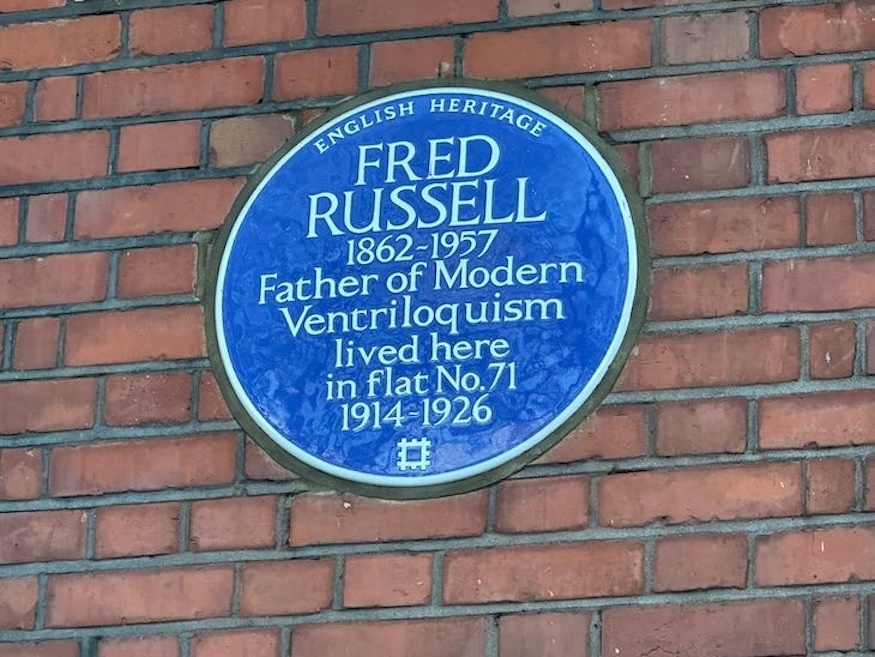
Fred Russell, the “father of modern ventriloquism”, lived in flat No. 71. So claims a Blue Plaque on Kenilworth Court, next to Putney Bridge.
(Can we start a rumour that he really lived in flat No. 72, but convinced everybody he lived next door, by throwing his voice?)
Russell was an interesting character. He was the first to go on stage with a single dummy and do the whole “gottle-of-gear” thing to a live audience. He kept at it, too. Just look at the dates on his plaque; 1862-1957. This man honed his vocal tricks in Victorian London, and was still performing in the age of television, a medium in which he appeared regularly. Russell was known in the business as “the oldest ventriloquist in the world”, and died at the grand old age of 95.
Besides being the ‘father of modern ventriloquism’, Russell was also the actual father of Val Parnell, the theatre impresario who gave a 12-year-old Julie Andrews her first paid gig. (She would go on to do her own puppet act, in the ‘goatherd’ scene of The Sound of Music.) This, as I’ve said many times before, is why I love finding plaques. They are not so much solid discs as rabbit holes, which lead into branching tunnels of curiosity if only we can be bothered to google.
Putney, it turns out, is a hotbed of puppets. Gerry “Thunderbirds” Anderson and Jim “Muppets” Henson both leased the same workshop in Rotherwood Road for a time. Mary Shelley, creator of the twisted, rebellious puppet known as Frankenstein’s monster, twice lived in Putney. Meanwhile, erstwhile Putney resident Nick Clegg is in the news this week [when I wrote this in 2024] for suggesting that Elon Musk is becoming a “political puppet master”.
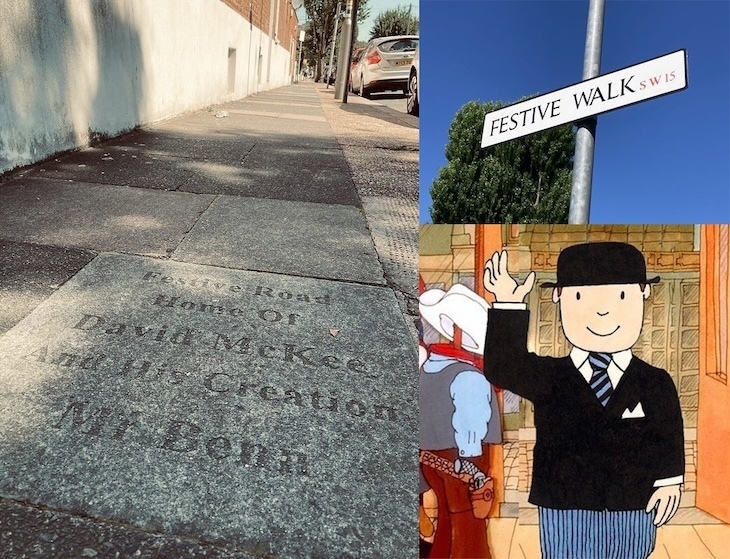
More animated history can be found on Festing Road, to the west of Putney. This road always takes me back to my childhood. Not because I ever strayed over this way — I’d never heard of Putney — but because of the street’s on-screen identity of Festive Road. This was the abode of children’s character Mr Benn, a bowler-hatted gent who, when the fancy took him, wandered into fantasy realms via his local costume shop. The TV show, which ran in the 1970s and 80s, was written by David McKee, perhaps more famous for Elmer the patchwork elephant. McKee lived on Festing/Festive Road, as a subtle pavement plaque attests. A small footpath to the north of the road was recently named Festive Walk in another tribute to the show.
Putney’s history, of course, starts long before the age of famous puppets and cartoon adventurers. The name traces to Anglo-Saxon times, and means Putta’s landing place (on the river). Putta is another of those fellows like Wemba and Billing whose name lives on a thousand years after his death, but about whom we know nothing whatsoever.
One historic Putney resident about whom we do know a lot is Thomas Cromwell. The commoner-turned-Earl was born and raised on the Putney shore in the late 15th century. Almost nothing remains of Cromwell’s Putney — indeed, the whole town is conspicuously lacking in truly old stuff, when compared with, say, Fulham across the water, or Richmond upriver. There is one exception, however…
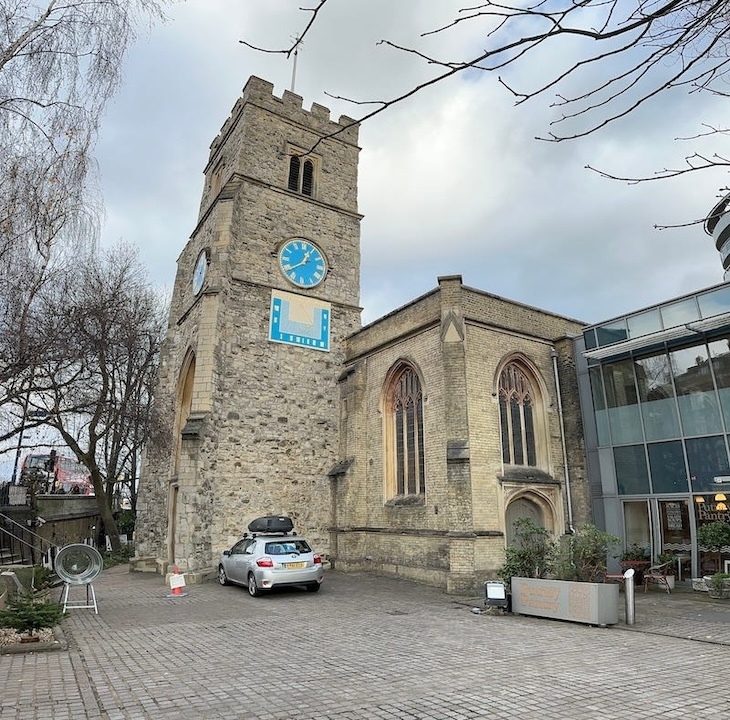
The church of St Mary’s goes back to at least the 13th century. It was old, even when the young Thomas Cromwell cobble-squabbled with his eel boy. What we see today is largely an 1830s reconstruction, heavily patched up again following a fire in the 1970s. However, the tower survives from the 15th century. We’re looking at the very same stones that once deflected photons into the eyes of Thomas Cromwell, 500 years ago. A few arches within the church also date from this time.
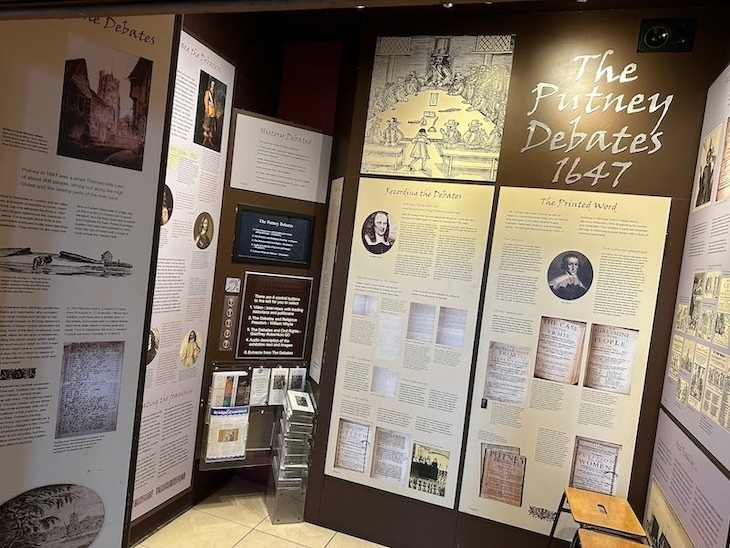
Thomas’s great-great grand-nephew, Oliver Cromwell, also knew this church. St Mary’s was the scene of the ‘Putney Debates’ of 1647. This was a protracted discussion over how the nation should be governed after Cromwell’s forces had claimed victory over Charles I. The Debates are most remembered for raising the possibility of universal male (but not female) suffrage, centuries before that happened. They concluded… well… inconclusively, but would prove influential on later developments. If you visit the church today — and I’m sat inside it right now, typing these words from the excellent cafe — then you’ll find a stone plaque that commemorates the Debates. Not only that, but head into the church proper and they’ve built a small but nourishing display about this landmark of English democracy.
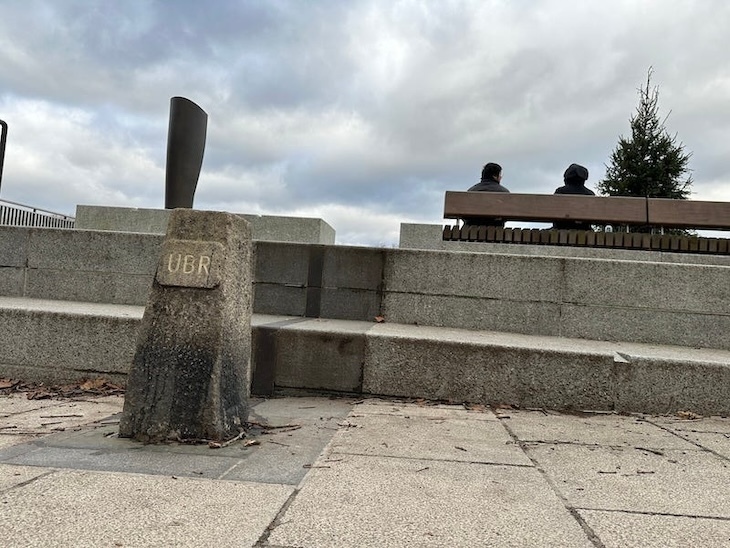
I suppose the other key event popularly associated with Putney is the Boat Races. These take place every year, with crews from Oxford and Cambridge duking it out on the waters between Putney and Mortlake. We’re coming up to the 200th anniversary of the men’s race (2029) and the centenary of the women’s race (2027). The historic granite marker for the start line stands close to Putney Bridge, beside a new piece of embankment built in the 2020s as part of the Super Sewer project.
If you’re ever over this way at low tide, be sure to head down the ramp to the foreshore, where you can gain some unique views of Putney Bridge and St Mary’s. I was able to dip my toes in the Thames, at a place where the young Thomas Cromwell must once have paddled. He wouldn’t have seen a bridge. The first would not be built until a century after his death, and that was a temporary structure resting on boats. A permanent span arrived in 1729.
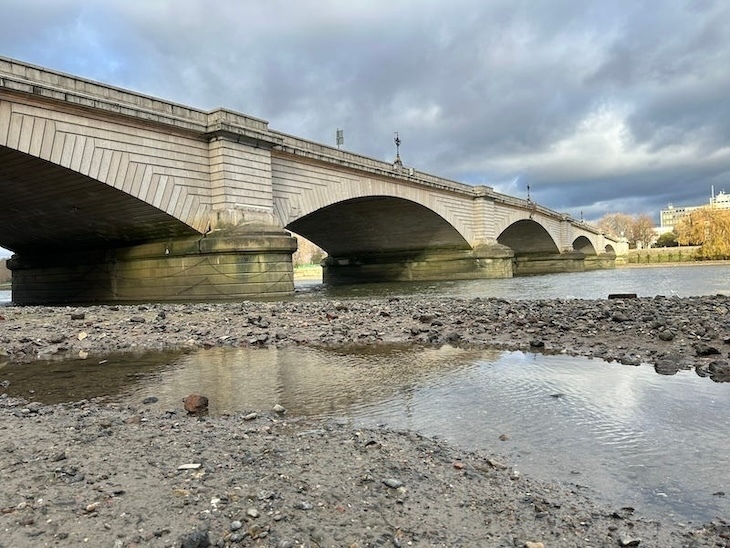
The bridge almost claimed a famous life. Women’s advocate (and mother of Mary Shelley) Mary Wollstonecraft leaped from the deck in 1795 in an attempt to take her own life, but was rescued from the water. The current bridge, opened in 1886, was designed by none-other than Joseph Bazalgette, architect of London’s sewer system.
I finished my morning in Putney by climbing the long high street, which leads up towards Putney Heath and Wimbledon Common. Around the time of the Putney Debates, the wealthier locals were agitating to have their high street paved over. Its pronounced slope would become an impassable quagmire during wet weather. A thousand tons of stone were laid, at a cost, I learn from the small museum in the church, of £360. But when it came time to settle the bill, the ratepayers claimed they’d never wanted it done in the first place. This is just the kind of volte-face my five year old plays, after I’ve spent considerable time sorting out his Lego. The contractor had to go to court to get his dues. I have no place of higher appeal with my offspring.
I encounter no paving issues today, as I make my way up the hill. This is not a pleasant road, mind. It leads directly down to Putney Bridge, and so is a continuous jam of traffic. But I’m soon up by Putney Heath, a place with its own deep history. It was here in October 1684, in the twilight of his reign, that Charles II held a parade of 6,000 soldiers. The location, conspicuously far from royal centres, may have been chosen with an arch side-eye to the Putney Debates, which had presaged the execution of the King’s father, Charles I.
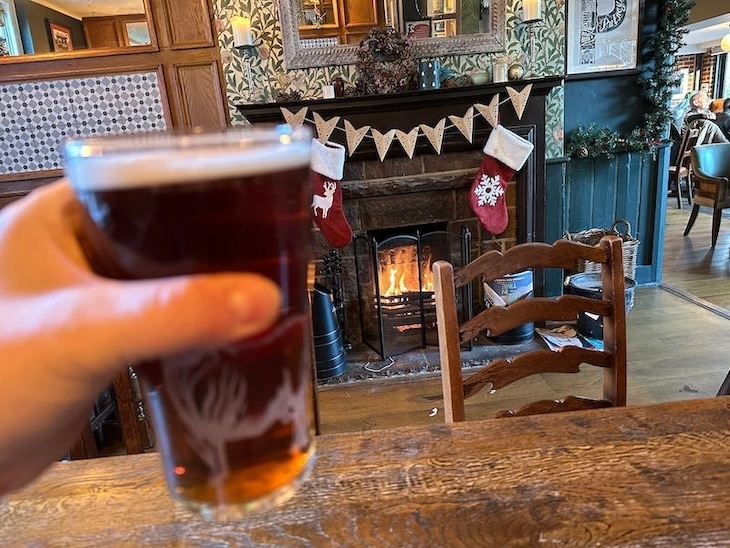
I consider walking on to explore the heath further, but I think that’s best left for the summer months. Instead, I find myself drawn to the Green Man, a 300-year-old pub with a roaring fire and legends of highwaymen. Inside, I learn that the heath was a favoured ground for 18th century duelists. Two Prime Ministers, William Pitt and George Canning, engaged in pistol fights on this high ground. They may well have stopped by the Green Man for some Dutch courage.
I follow their lead and settle beside the fire with a pint of Young’s Best. So here ends my picaresque pootle round Putney.