Lord's Cricket Ground is so historic that it supports at least 50 memorials. A new book reveals their fascinating history.
Lord’s Cricket Ground was established by the Marylebone Cricket Club (MCC) at its current site in 1814, and has since become known as the ‘Home of Cricket’. Within its walls (and without), Lord’s contains many memorials honouring cricket’s history and the MCC members and cricketers associated with this famous old ground.
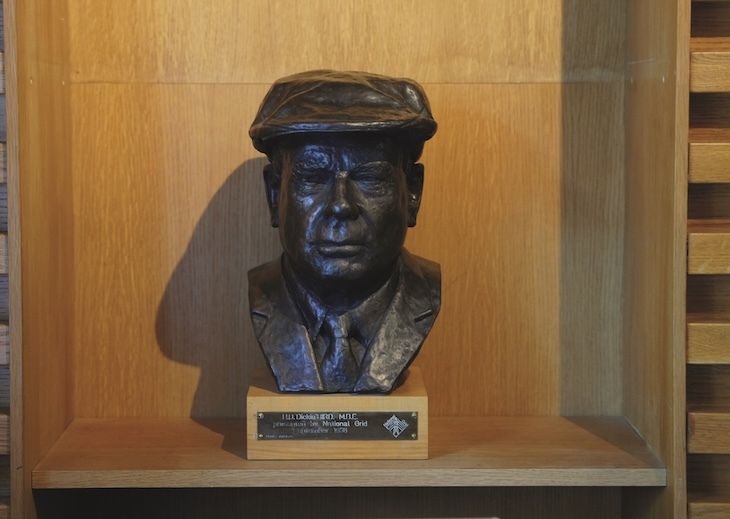
In his new book — Lord's Cricket Ground in 50 Memorials — Lord's tour guide Steven Miell lifts the lid on a half-century of such items, from busts and statues, to commemorative gates, to war memorials and even a Royal Charter.
Below, he has chosen two favourites to bowl you over... 48 more where these came from.
Father Time Weathervane
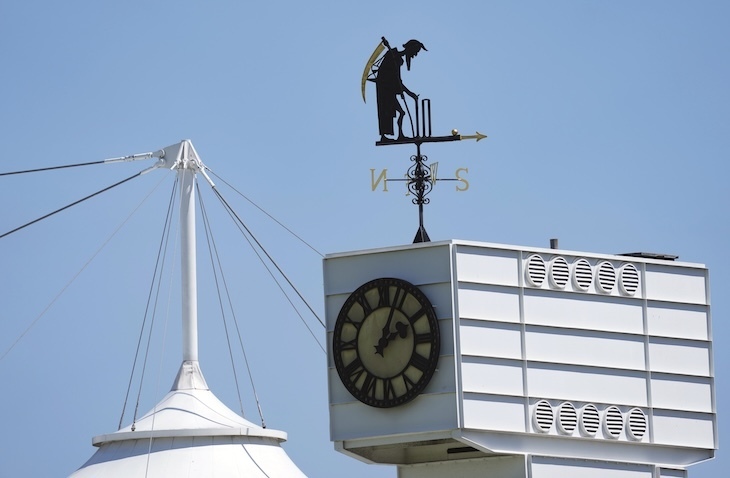
One of the most recognisable symbols of Lord’s Ground is the Father Time Weathervane. The weathervane measures 6 feet 6 inches (1.98 metres), while the figure of Father Time itself stands at 5 feet 4 inches (1.63 metres). Father Time is a human representation of time, and this example depicts him either removing or replacing the bails on top of the stumps. On the opposite side of the stumps from Father Time is a ball, which may indicate that a wicket has just fallen. Additionally, on Father Time’s back are a harvester’s sickle and an hourglass shown as half full. These two symbols remind the onlooker that time moves unstoppably forward but, at the same time, offers renewal.
The weathervane is positioned above the clock tower, which is located between the Mound and Tavern stands and was initially placed on top of the 1926 Grand Stand. While there, it became the only casualty at Lord’s during the Second World War when a steel cable from a barrage balloon became entangled and dragged it to the ground. Father Time spent the rest of the war in the Committee Room. It was eventually repaired and returned to its previous position. The weathervane was relocated to its current spot when Baker’s Grand Stand was demolished in the 1990s.
In 1992, the weathervane was struck by lightning, and the subsequent repairs were featured on the BBC children’s programme Blue Peter. In March 2015, Father Time was damaged once again, this time by high winds, which required extensive repairs by specialists.
Bowler statue
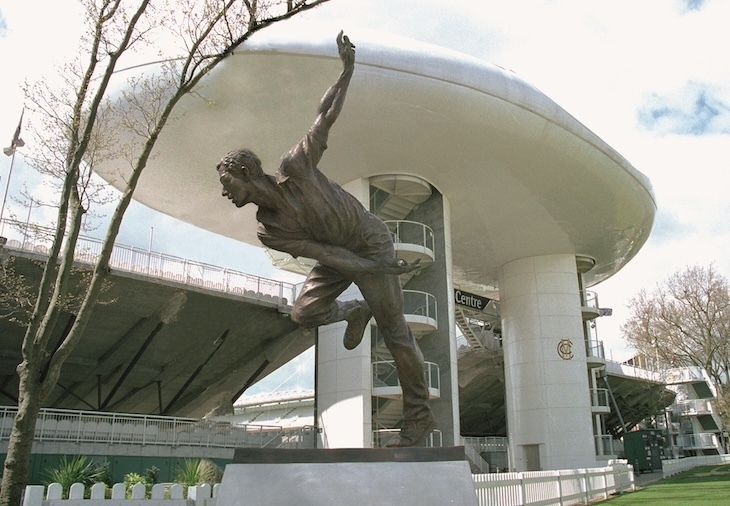
Behind the Media Centre, accompanying a similar ‘Batsman’ figure, is a statue of a bowler. Called simply ‘Bowler’ but also known as ‘Fast Bowler’, it was created by Antony Dufort, a Council Member of the Society of Portrait Sculptors and a member of the Royal British Society of Sculptors.
Antony Dufort kindly shared his experience of delivering the ‘Bowler’ statue to Lord’s. He mentioned that in 2000, MCC’s arts and library committee asked him and Gerald Laing to tender for sculptures of a bowler and a batsman for two corners of the Nursery Ground. Maquettes of the proposed designs were presented to the committee about six months later.
Dufort presented a figure of a fast bowler, substantially the same as the final statue. However, to convey a sense of dynamism and accurately position the muscles, his model – a dancer and keen amateur cricketer – posed wearing only a jockstrap. A discussion ensued about nudity in sculpture. Lord Fellowes, the committee Secretary and also Her Majesty the Queen’s private Secretary, was asked for his opinion. Fellowes replied, ‘If we want to be the laughing stock of the entire cricketing world, then a nude bowler would be a good idea.’
Following the meeting, Gerald Laing was awarded the commission for the batsman, while Antony Dufort received the commission for the bowler. It was hoped that a wicketkeeper and a fielder could be added to the other two corners of the Nursery Ground at a later date.
Antony Dufort admitted to me that he knew little about cricket. As part of his preparation for the model that was later presented, he obtained permission from MCC to film bowlers from a private box during a Test match. He then watched the footage in slow motion to analyse their bowling actions. He also reviewed archival film of famous fast bowlers. Ultimately, the aggressive style of Dennis Lillee served as an inspiration, but with a higher follow-through leg position.
The sculpture stands 9 feet tall from the base to the tip of its raised finger. It took over a year to create and an additional six months to cast. Made of bronze, which is only a quarter of an inch thick, it weighs more than 800 pounds. Inside the sculpture is a bent, solid stainless-steel rod (5 inches in diameter) that extends from above the knee, through the toe, and into the solid stone base.
Antony Dufort’s expertise as a draftsman has significantly contributed to his proficiency in various artistic disciplines, including illustration, film storyboards, portrait painting, and public sculpture. In recent years, Dufort has sculpted the late Queen twice and produced a large sculpture of Margaret Thatcher for the Members’ Lobby of the House of Commons. In case they are ever needed, Dufort has also created maquettes of a fielder and a wicketkeeper. His training as a historian has aided him in conducting the background research necessary to ensure that his subjects are depicted appropriately and realistically.
The former England captain Ted Dexter unveiled the ‘Bowler’ statue on 14 May 2002.
Lord's Cricket Ground in 50 Memorials by Steven Miell is available now from Amberley Publishing. Buy direct from the publisher, or via Bookshop.org, which sources from independent bookshops and gives us a small commission.