Where to see the finest mosaics in London.
The ancient art of the mosaic is alive and well in London. Indeed, it's everywhere once you keep your eyes open. Churches, walls, subways, museums, Tube stations, parks... even car parks; all can be the canvas for a bit of tesserae talent. Here are some of the brightest and best that we've admired on our wanderings:
Tottenham Court Road Tube station mosaics
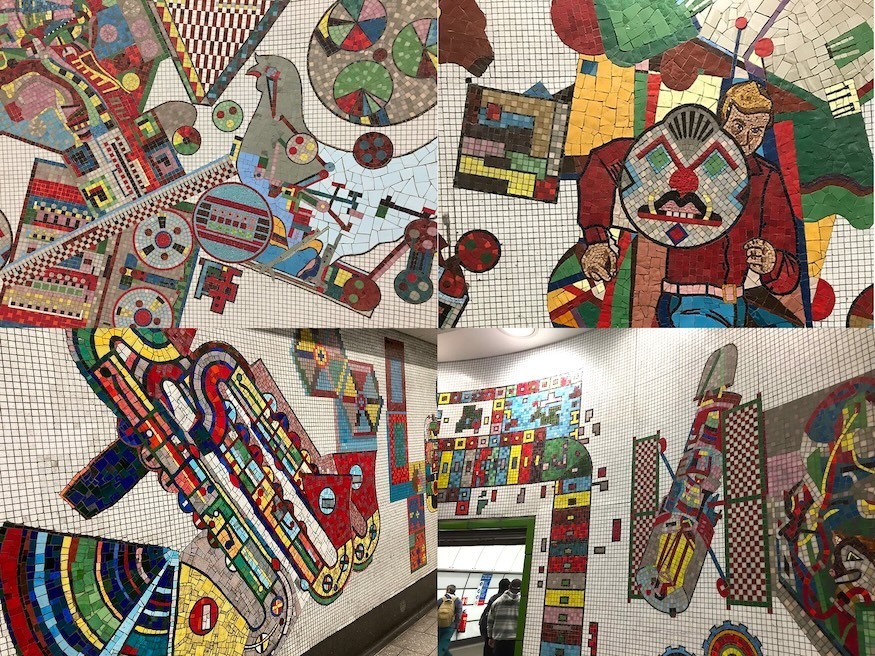
Fun fact: Tottenham Court Road is London's busiest Tube station not serving a rail terminus. Hence, we can confidently declare that the mosaics lining its passageways and platforms are London's most viewed. The semi-abstract imagery was accomplished by Sir Eduardo Paolozzi and team in the 1980s. Such is the variety on offer that it's possible to spot something new on every visit. Our favourite patch is the panel featuring the Hubble Space Telescope, installed here beneath the streets of London several years before it actually launched.
Tube roundel mosaics
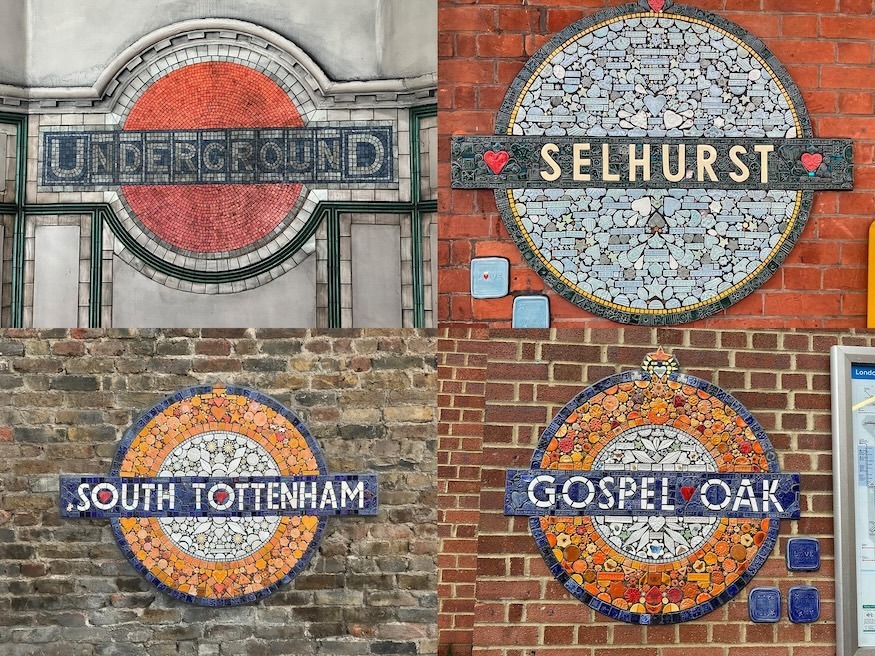
Paolozzi's panels are not the only mosaics on the network. Many stations feature decorative roundels picked out in small tiles. The earliest (top-left) is this original feature of Maida Vale station on the Bakerloo line. More recently, a (welcome) rash of roundels have appeared at London Overground stations, particularly those to the north. The mosaicist behind them is Maud Milton and her team at Artyface, whom we interviewed a few years back. The project has strayed occasionally beyond the northern rails. We clocked this one (top-right) in the Southern station of Selhurst.
Ancient mosaics
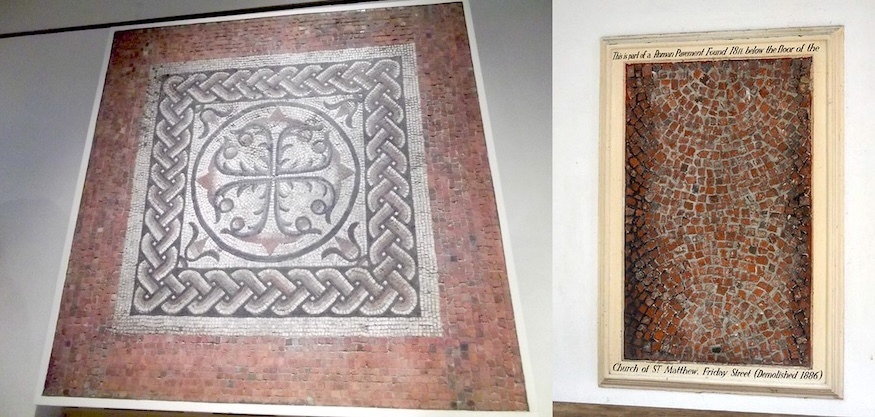
The mosaic art-form, of course, goes back to antiquity. We have original examples right here in London. Three major Roman mosaics, for example, have been uncovered at the Bank of England over the years. A find from the early 19th century is on show at the British Museum (left image), while another is in the Bank's museum, and a third can be viewed at the bottom of a stairwell inside the building's entrance. Roman mosaics can be viewed at various other locations across town. The one shown in the right image now hangs outside St Vedast Alias Foster, but was recovered from beneath the demolished church of St Matthew, Friday Street.
History of London mosaics
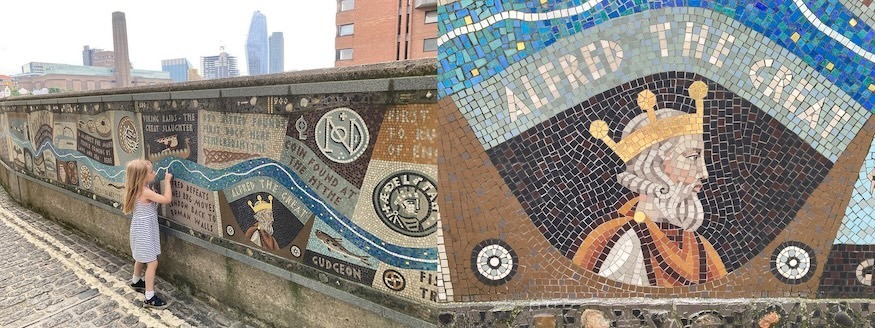
Follow the North Bank round from Millennium Bridge to Southwark Bridge and, along the wall of Queenhithe, you'll be stopped in your tracks by this mosaic. It tells the history of London from prehistoric times to the age of skyscrapers, and it's full of curious detail. We're confident, for example, that this is the only mural in London to feature King Alfred staring at a gudgeon. The masterpiece was put together by the omnipresent South Bank Mosaics, to a design by Tessa Hunkin... who deserves an entry of her own...
Tessa Hunkin's heroic contribution
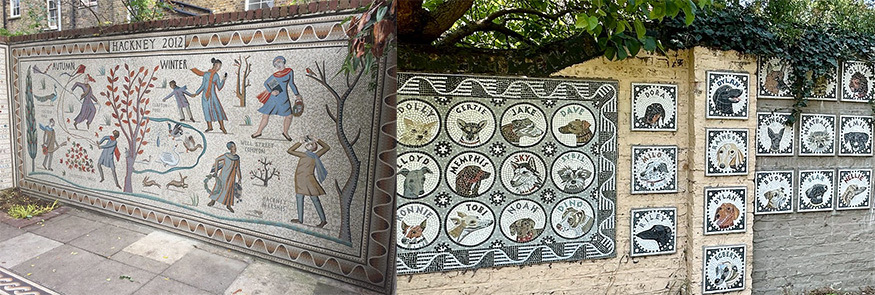
Tessa Hunkin and the Hackney Mosaic Project are responsible for perhaps the greatest collection of modern mosaics in London. As well as the Queenhithe mosaic above, her work beautifies many other locations, including half the walls in Hackney Downs and the hidden outdoor art gallery of Shepherdess Walk (both pictured above).
Such is her contribution that the Gentle Author has now published a book about her work.
(Incidentally, Tessa's brother is Tim Hunkin, the inventor who designed the crackpot amusements on Southwold Pier and Novelty Automation in Holborn. Talented family.)
Boris Anrep's heroic contribution
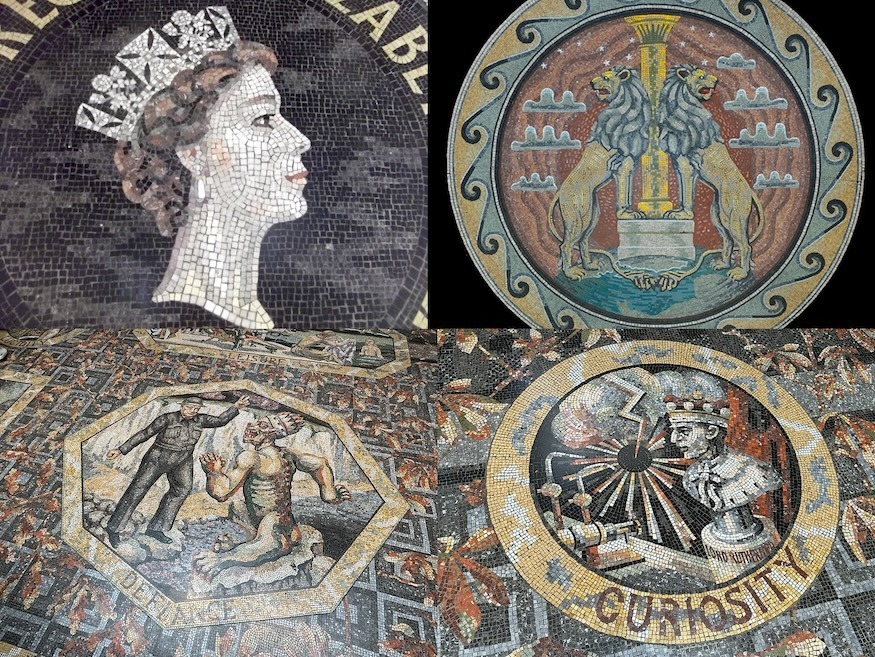
The King of London Murals must be Boris Anrep (1883-1969). Over his long career, Anrep contributed many tennis-courts'-worth of mosaic floors and wall panels to notable London places. The most publicly visible are those that carpet the (former) main entrance to the National Gallery. These cover a seemingly random spread of topics, including football, mining, pubs, compromise and, um, a Christmas pudding. You might also spot Winston Churchill in there, standing in defiance of some peculiar species of demon. Anrep's work can also be found in Tate Britain, Westminster Cathedral, the Bank of England and One New Change, among other places.
Religious mosaics
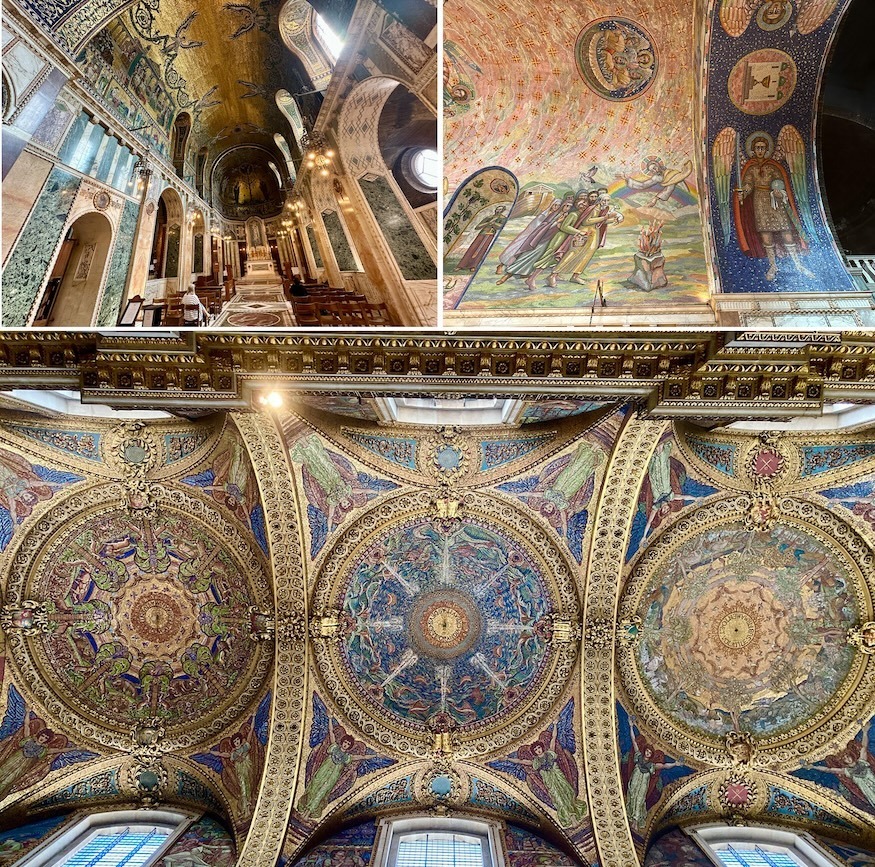
Westminster Cathedral is arguably the greatest site of mosaic work in London. Boris Anrep and Tessa Hunkin have both contributed to its tessellated riches, along with many other mosaicists over the years. The central domes over the nave remain plain and dark, awaiting some future artist to bring them to life. But most of the side chapels and the glorious golden Lady Chapel are resplendent in mosaic, which even non-believers regard with awe.
St Paul's is also richly adorned in mosaic. This was not always the case. The interior was often criticised in the 19th century (including by Victoria herself) for its plain walls. From the late Victorian period onwards, the Wren masterpiece has acquired numerous paintings, adornments and mosaics. Among our favourites is the glorious roof of the Quire, by William Blake Richmond, installed in the 1890s. Meanwhile, down in the crypt, the words "England expects every man to do his duty" are picked out in mosaic tiles around Nelson's tomb.
William Blake mosaics
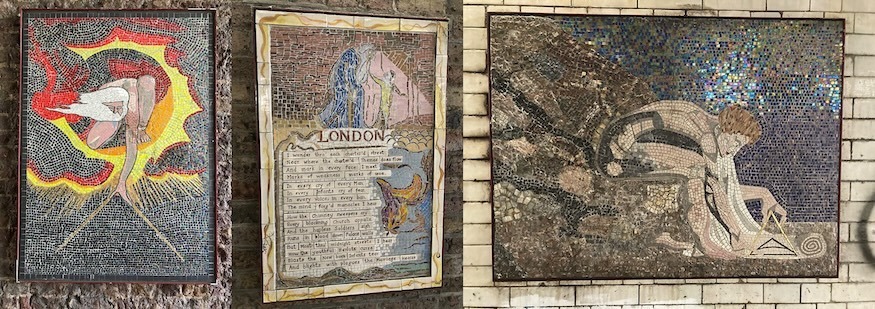
We've subtly been building to William Blake. His work inspired Boris Anrep's mosaics in Tate Britain, while St Paul's mosaicist William Blake Richmond was named after the great mystic-artist-poet. But Blake has a wider collection of mosaical tributes spread throughout Lambeth, where he lived. Walk under the rail bridges round here, and you should encounter recreations of his most famous works. Crepuscular lighting and the growl of trains bring these mystical creations to life. These, too, are the work of South Bank Mosaics.
Invader mosaics
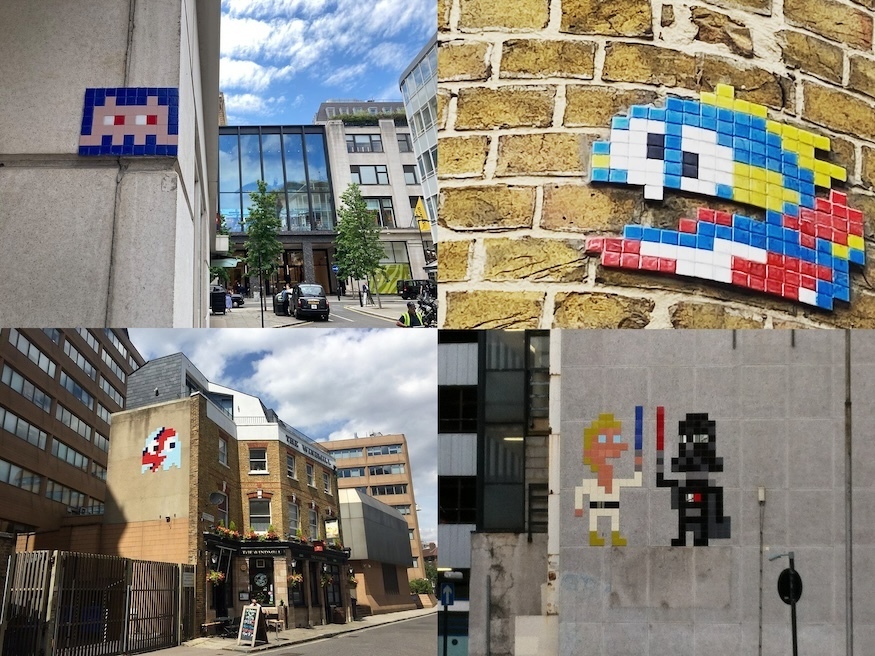
Anyone who's spent time wandering London's streets must have chanced across the work of Invader. The French street artist specialises in low-res mosaics depicting 8-bit video game characters. Dozens have been appended to London's walls over the years (and many other cities), and many are still in place. Sadly, the Star Wars homage (bottom-right) in Shoreditch disappeared a few years ago. The force was not strong in that one.
Alfred Hitchcock mosaics
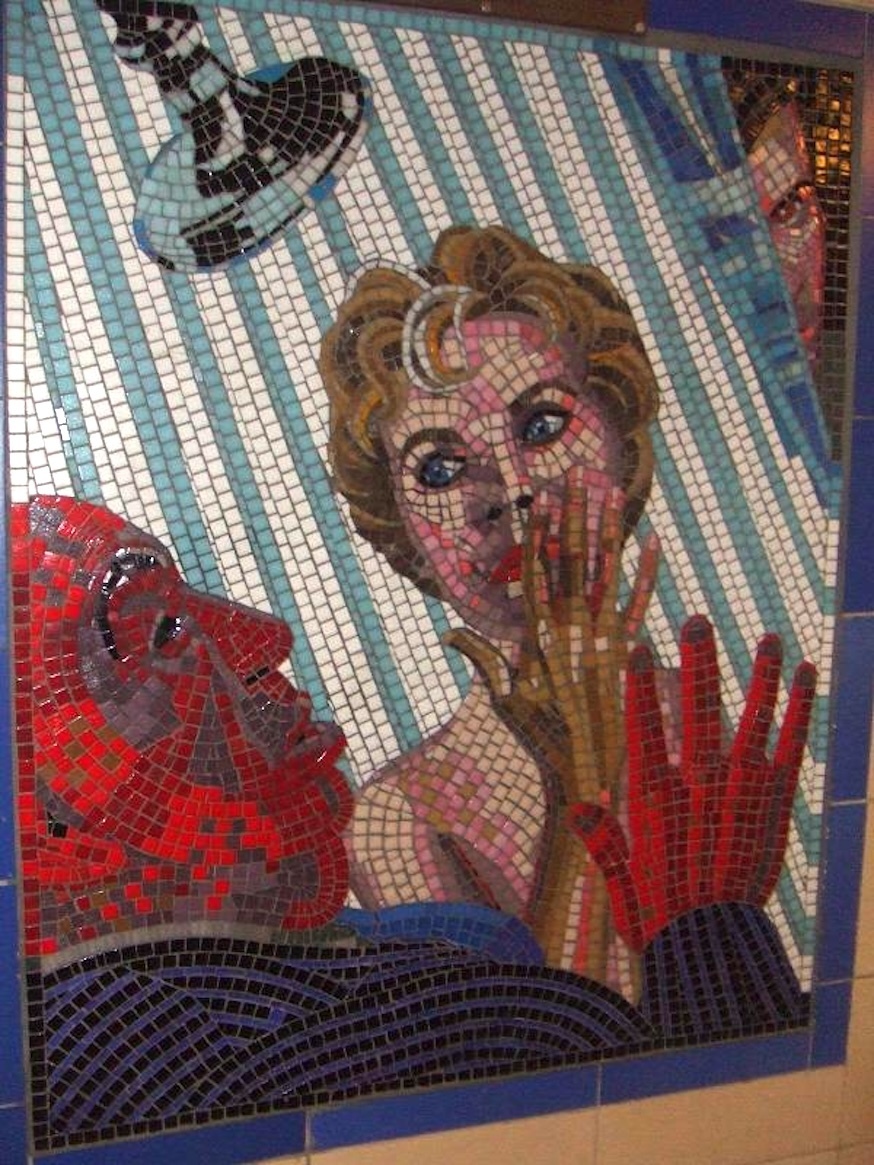
Leytonstone Tube station is famous for its series of mosaics featuring the films of Alfred Hitchcock, created in 2001 by the Greenwich Mural Workshop. The master of the uncanny grew up hereabouts, and various Hitchcocking plaques and sculptures are dotted around the wider area. The mosaics are his greatest memorial (after the films themselves, of course), but can be tricky to admire because of the constant come-and-go of passengers. Hitchcock often made a cameo in his own movies, and he also pops up several times on the mosaics, including in the famous shower scene from Psycho.
The Sutton Heritage Mosaic
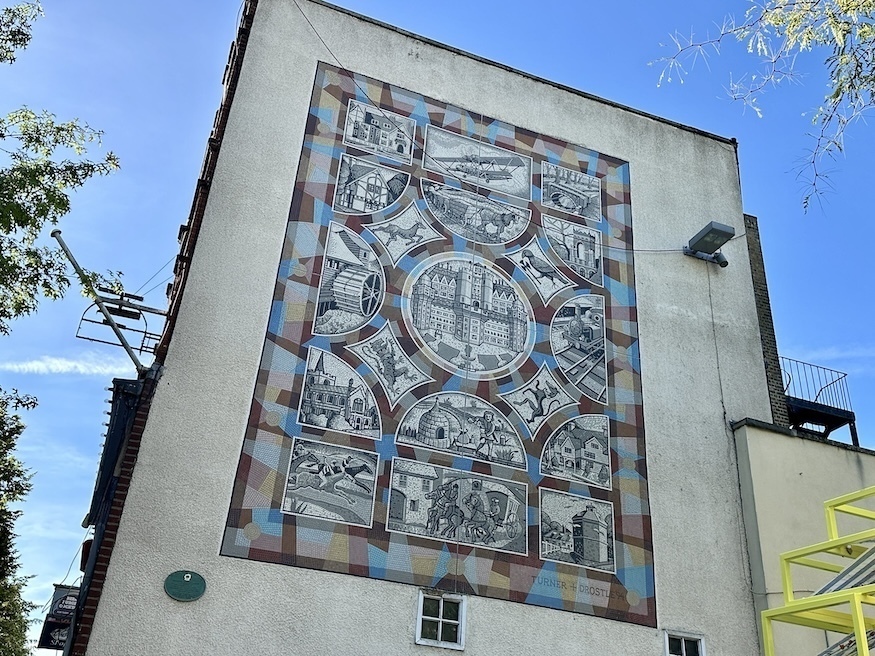
Community mosaics are always wonderful to see, decorating the walls of schools and library entrances. What might just be London's largest, however, can be found on Sutton's high street. The Sutton Mosaic was created by Rob Turner and Gary Drostle in 1994, and it is colossal. The artwork depicts various people and places from the local area, which we've previously explored in detail.
Commercial mosaics
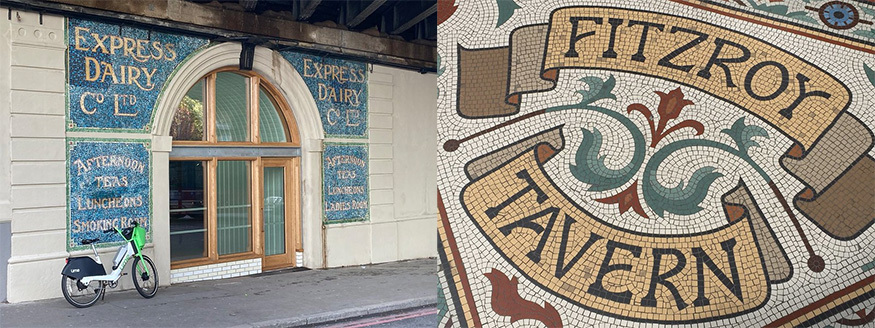
Finally, the unsung commercial mosaics, found all over town. A mosaic entrance is a mark of a business with confidence and pride in its appearance. Many Victorian or Edwardian pubs, like the Fitzroy Tavern here, have joyous mosaics at their entrance. Meanwhile, the blue-and-gold facade of the former Findlaters building at London Bridge could not be more handsome (other than by removing that Lime bike).
London's mosaics are legion, and this list is nowhere near comprehensive. Please do suggest your own favourites in the comments below.