Continuing our series digging into the details of London's finest murals.
A detailed look at one of London's most accomplished local history murals.
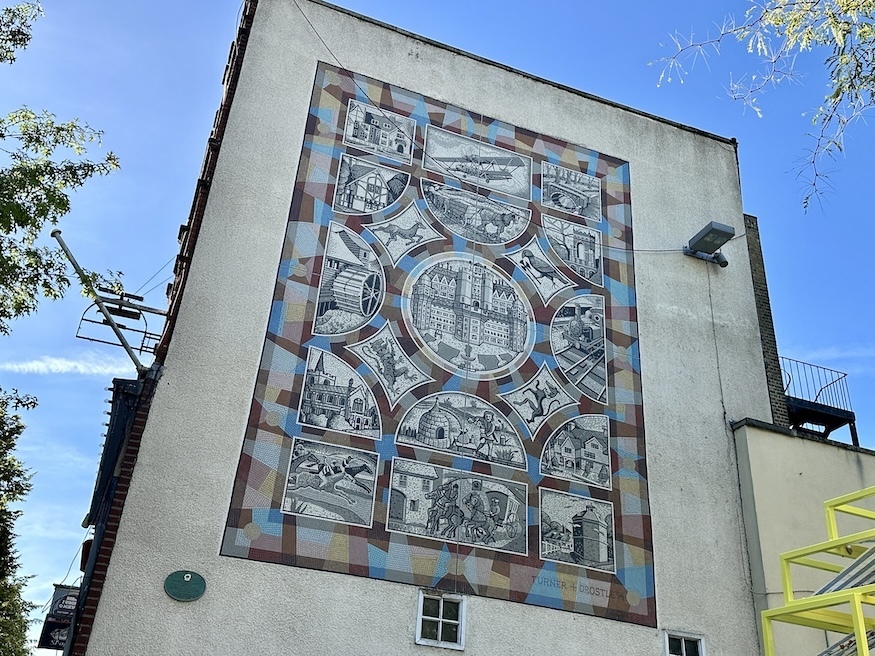
Sutton is often overlooked among the 32 boroughs, but it has a rich history with some of London's oldest buildings. This history is neatly summed up on the Sutton Heritage Mosaic, in pride of place in Trinity Square, just off the High Street.
The mosaic was designed and installed by Rob Turner and Gary Drostle in 1994. At nine metres tall, and using 100,000 tesserae, this must be one of the largest vertical mosaics in London. All the better to fit in 19 nuggets of Sutton history. Let's take a look:
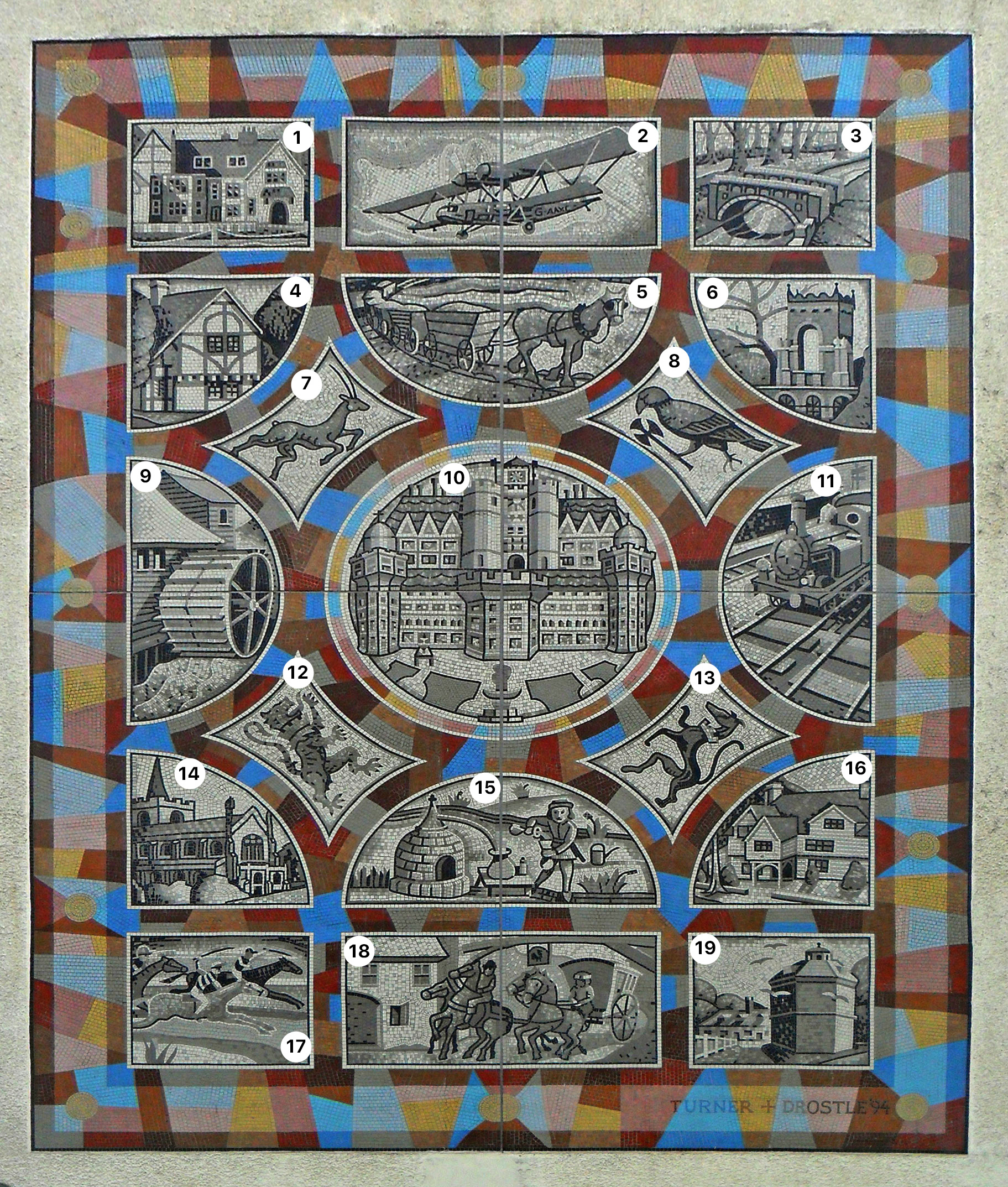
1. Honeywood House. A 17th century house by Carshalton ponds, much added to over the centuries. It serves as an excellent local museum, with a small cafe attached. The mosaic depicts the white chain fence separating the house from the ponds.
2. H.P.42 or H.P.45 Biplane. An early airliner, designed and manufactured by Handley Page. They were commonly flown from Croydon Airport during the 1930s. Despite the name, much of Croydon Airport was located on land that is now part of the Roundshaw Estate in the London Borough of Sutton. The plane in the mosaic appears to carry the registration number G-AAXC, which would mark it as the Heracles. However, online information identifies it as the Hannibal, the prototype H.P.42.
3. Stone Bridge over the River Wandle. As may be seen in Beddington Park.
4. Old Cottage, Cheam. Delightful weather-boarded cottage from the late 15th century. It now stands in a different location to its original setting — timber frames are easily dismantled and re-erected.
5. The Surrey Iron Railway. London's oldest railway line, with carts pulled along tracks by horses. It tracked the River Wandle, and part of it ran through what is now the London Borough of Sutton.
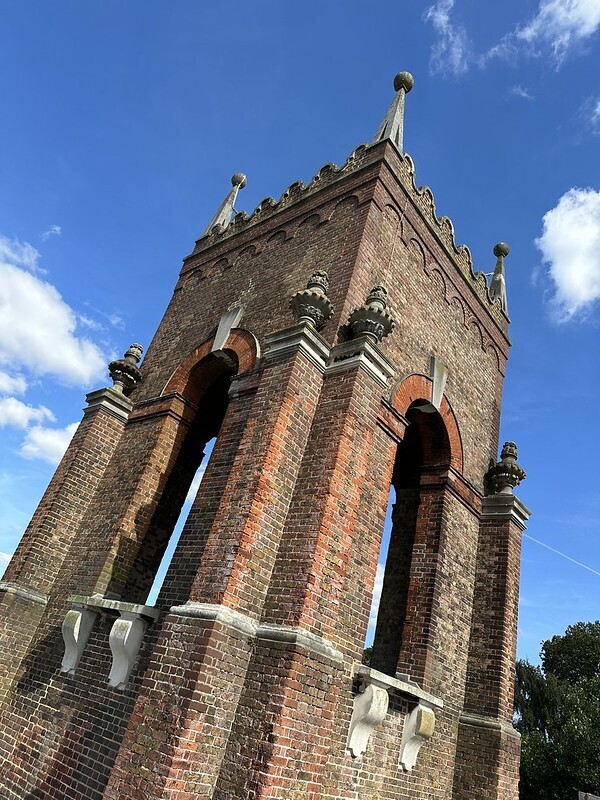
6. Water Tower at Carshalton. An early 18th century brick water tower, which is open for visits every Sunday over the warmer months.
7. Heraldic antelope. Part of the arms of the Carew family, who held land in Beddington.
8. A popinjay. Fancy word for a parrot, and symbol of the Lumley family, who held land in the Cheam area. Gorgeous, colourful examples can be found inside the Lumley Chapel at St Dunstan's, Cheam. The popinjay carries the cross of the See of Canterbury, which held the land from Saxon times up until the Lumleys' tenure in the Tudor period.
9. A water mill on the River Wandle. Once a common sight along the Wandle, examples can still be seen in Merton Abbey Mills and Morden Hall Park (both in the London Borough of Merton). The mills on the upper river were particularly noted for snuff grinding.
10. Nonsuch Palace. A magnificent palace built on the orders of Henry VIII in what is now Nonsuch Park. It lasted little more than 100 years before demolition. Fragments, and an excellent model, can be seen in Whitehall (see 16). Its site is just outside the borough, in Epsom and Ewell.
11. Steam locomotive. Representing the coming of the railways to Sutton, which led to the area's rapid development.
12. Heraldic lion. A symbol of the Burghersh family, which held the Manor of Stone Court in Carshalton in medieval times.
13. Heraldic greyhound. A symbol of the Gaynesford family of Carshalton. The most prominent pub in the village is named The Greyhound. The greyhound, the lion and the popinjay all appear on the coat of arms of the London Borough of Sutton.
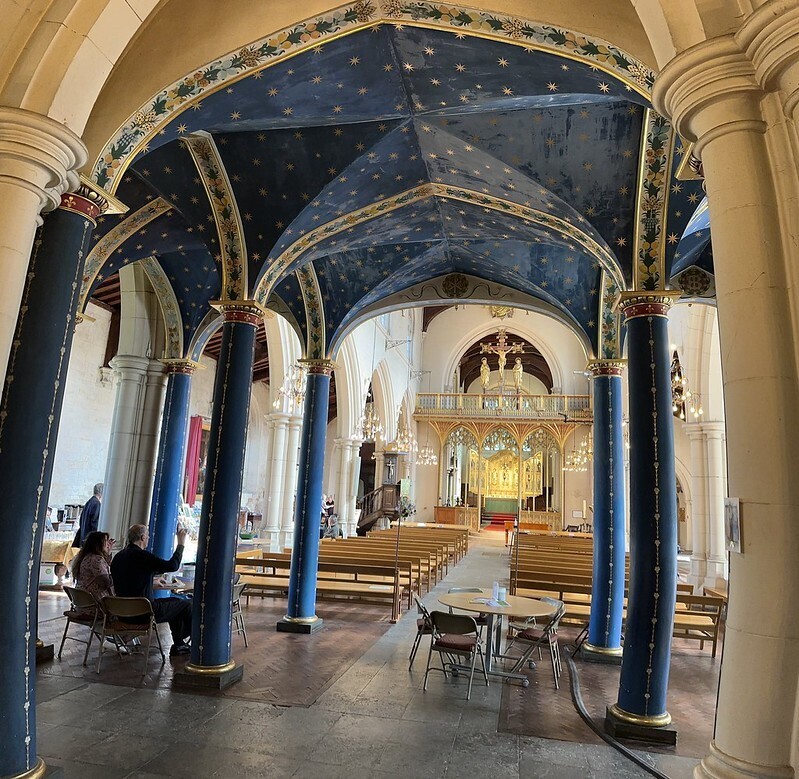
14. All Saints, Carshalton. A sizeable church, much of which dates from the medieval period.
15. Lavender Still. Used to extract lavender oil from the flower. This was a key local industry. Lavender fields can still be found in the wider area.
16. Whitehall. A timber-framed house museum in Cheam, dating to the Tudor period. It once served as a council house, and a home to several locally important figures, and is today a museum of the history of Cheam.
17. The Oaks. Famous horse race now ran at nearby Epsom. It is named after The Oaks in Carshalton, from which the race was originally ran from 1779.
18. The Cock. An old Sutton coaching inn, long vanished. However, its hanging sign is preserved on a post at the high street crossroads.
19. The Carew Manor dovecote. This exceptionally large dovecote was built in the early 18th century and still stands next to Beddington Park.