Alan Alexander Milne, the Londoner best known as AA Milne, is more often associated with Hartfield in East Sussex than the big city. Yet, he and his ursine creation Winnie the Pooh have plenty of links to London — take a wander through them:
AA Milne's birthplace: Kilburn
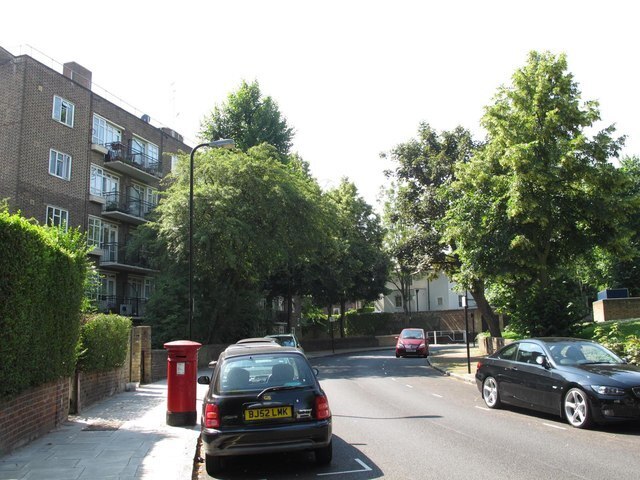
Milne was born in Kilburn in January 1882. His father John Milne ran Henley House School at 6/7 Mortimer Road (now Mortimer Crescent), so Milne was a student there and was briefly taught by HG Wells. He also lived at the school, which was destroyed by a V1 in the war. Remsted House, part of the Mortimer Estate, has now taken its place at the junction of Mortimer Place and Kilburn Priory.
Westminster School and AA Milne
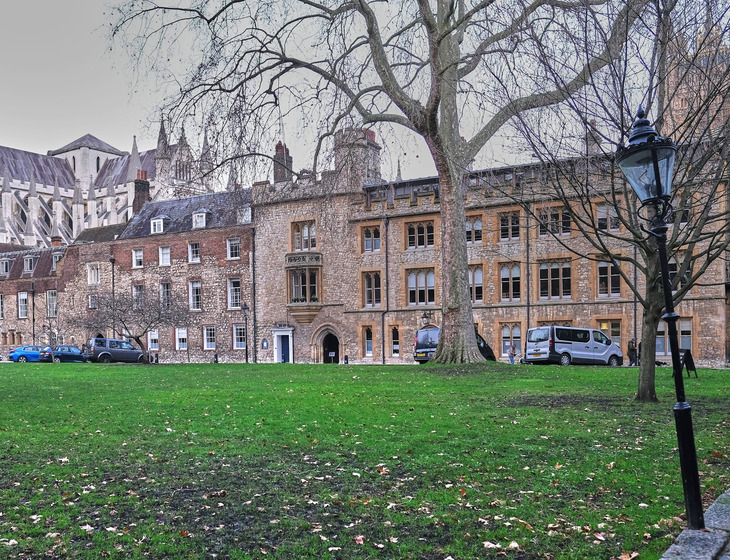
Milne attended Westminster School from 1893 to 1900. After his death, he bequeathed a one quarter share of the copyright of Winnie the Pooh to the school, which remains the largest benefaction given to the school to this day. Today, the school's AA Milne Society oversees all gifts to the school, distributing funds for things such as scholarships, bursaries and building improvement work, and one of the school's houses is named Milne's in his honour.
AA Milne plaque in Mallord Street, Chelsea
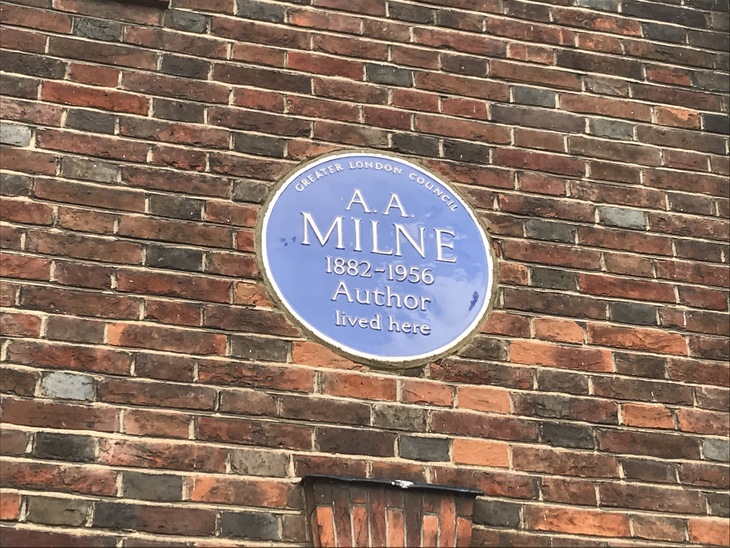
When Milne was discharged from the military in 1919, he moved into a house in 13 Mallord Street in Chelsea, just off King's Road. It now has a blue plaque on it and is Grade II listed. It went up for sale in 2013. When Milne first moved in, he was writing for Punch magazine, but while at the house he wrote poetry for his son Christopher Robin (who was born there) and found that his talents lay elsewhere. Milne owned the house until 1942.
Melina Place, St John's Wood
5 Melina Place, in the shadow of Lord's Cricket Ground in St John's Wood, is where artist EH Shepard lived until he retired to West Sussex in 1955. During his career he illustrated the Winnie The Pooh books. Shepard's Melina Place home was put up for sale in 2012, and appears to have since been subdivided into multiple properties. The house bears no plaque or nod to Shepard's time there.
AA Milne and London Zoo
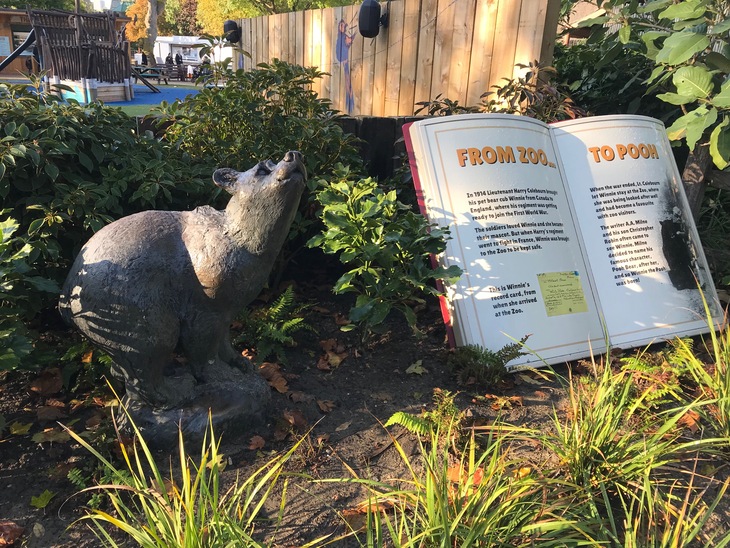
Ever wondered where the inspiration for Winnie the Pooh came from? Winnipeg was a black bear given to London Zoo in 1914 by a Canadian regiment called up to fight at the trenches in France. AA Milne used to take his son Christopher Robin to the zoo, and began telling stories about Winnipeg. The rest, as they say, is history.
Today, there's are two statues within the zoo dedicated to the literary bear — the one pictured above, and another showing Winnipeg hand-in-hand with a soldier. Parts of film Goodbye Christopher Robin were filmed on location at London Zoo in 2017.
More on Winnipeg the bear here and here.
AA Milne in the London Evening News
Pooh's first appearance was in the London Evening News on Christmas Eve 1925, in a story called The Wrong Sort Of Bees. We imagine there was honey (or 'hunny') involved.
AA Milne at the British Film Institute
As well as his children's books and work for Punch magazine, Milne wrote four stories for Minerva Films which were filmed in the 1920s (at least one of them at Bushey Studios in Hertfordshire). Some of these films survive in the BFI archives today, including The Bump and Five Pounds Reward.
Lovers in London by AA Milne
Lovers in London (1905) was Milne's first book, a series of fictional sketches, although he himself wasn't happy with it, and later in his life chose to identify his 1910 book The Day's Play as his first book.
As the title of his debut work suggests, it makes use of several London locations including St James's Park, Battersea, Finsbury Park, Victoria Park, Piccadilly and more.
AA Milne and The Lyric Theatre
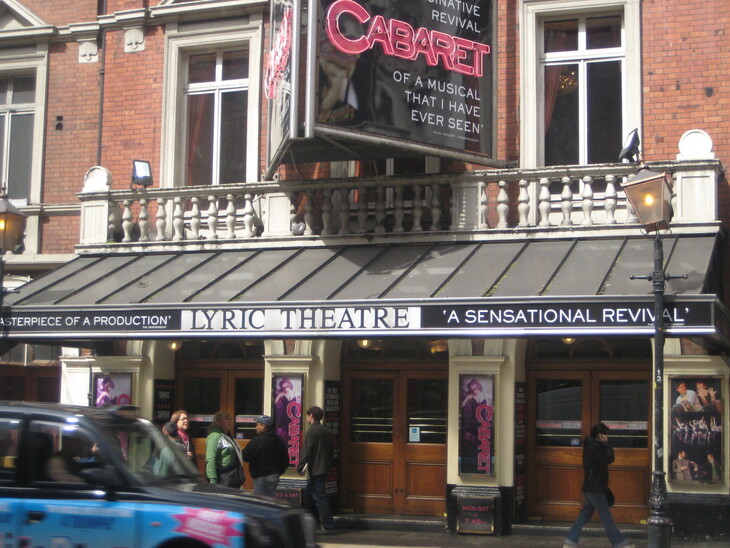
Milne's animal writings weren't limited to anthropomorphised bears and their friends; he adapted Kenneth's Grahame's 1908 novel The Wind In The Willows into Toad Of Toad Hall for the stage. The first performance of this adaptation is reported to have taken place at the Lyric Theatre on 17 December 1929 (other reports claim that the first performance was four days later, in Liverpool, and that the production didn't make its West End debut until December 1930).
AA Milne and the Garrick Club
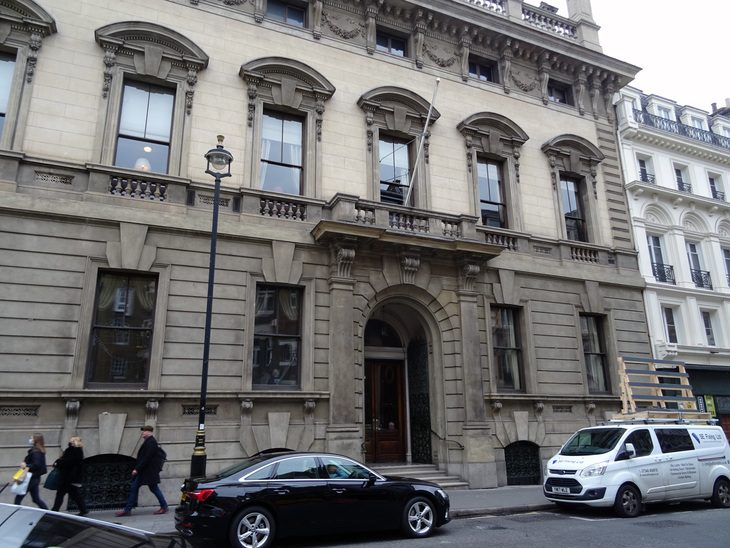
As well as Westminster School, The Garrick Club Charitable Trust was another of the four beneficiaries of AA Milne's literary estate, though in 2001, the Club sold its part of the estate to the Disney Corporation. Milne had been a member of the club and, to this day, a room in the Covent Garden building is named the Milne Room in his honour.
AA Milne and Sotheby's
In 2008, a collection of E H Shepard Winnie The Pooh illustrations sold for more than £1.2m at the London branch of Sotheby's auction house. 10 years later, Shepard's original map of the Hundred Acre Wood — familiar to many from the inside cover of childhood books — sold at Sotheby's for £430,000.
Winnie the Pooh at the V&A
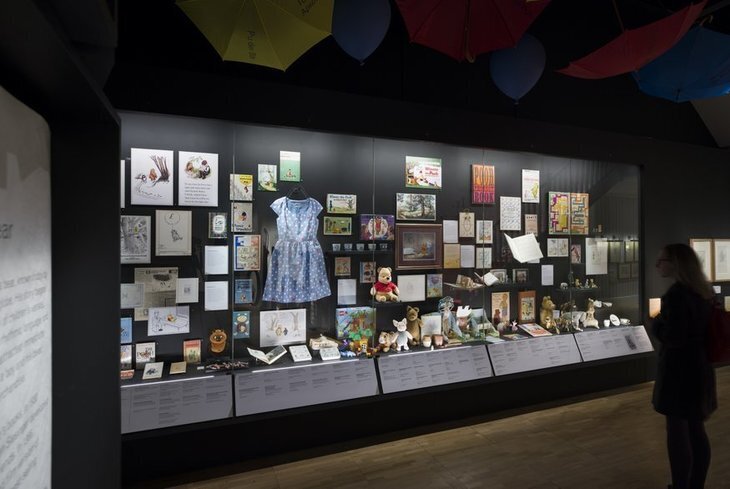
In 2017-18, the V&A in South Kensington hosted Winnie-the-Pooh: Exploring A Classic, an exhibition exploring the partnership between AA Milne and EH Shepard in bringing the books to life. Exhibits included sketches, cartoons, and more recent uses of the characters, including a Winnie the Pooh fashion range launched by Cath Kidston in 2016.
AA Milne and Buckingham Palace
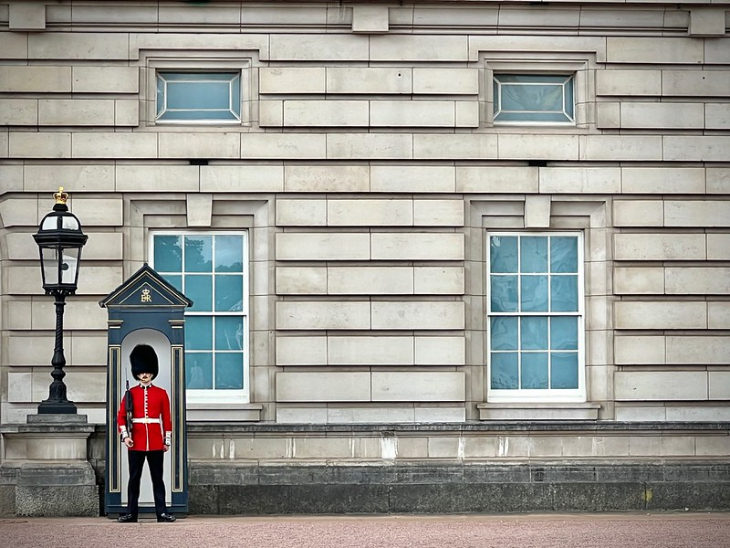
In Milne's book of poems When We Were Young, published in 1924, a work called Buckingham Palace reads:
They're changing guard at Buckingham Palace -
Christopher Robin went down with Alice.
Alice is marrying one of the guard.
"A soldier's life is terrible hard,"says Alice
Christopher Robin of course is Milne's son. Alice refers to Olive Brockwell, the nanny who cared for him as a child. When he went off to boarding school aged nine, she married a man named Alf Brockwell. Christopher Robin Milne dedicated his 1975 memoir, The enchanted places, to "Olive Brockwell. "Alice" to others, but "Nou" to me".
The links between Winnie the Pooh and Buckingham Palace strengthened in 2016, the 90th birthday year of both the bear and the late Queen Elizabeth II. A new book, Winnie-the-Pooh and the Royal Birthday, was released to mark the occasion, though of course original author AA Milne wasn't around to see it.
Winnie the Pooh art in Yonge Park, Finsbury Park
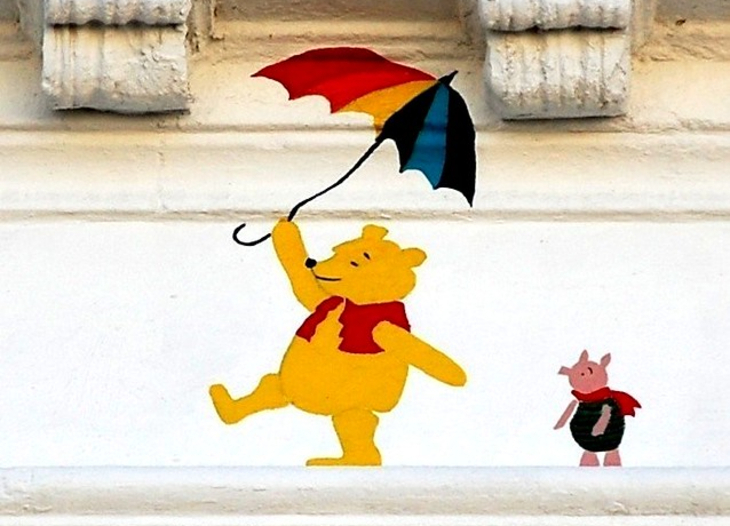
Most people wandering down the residential Yonge Park in Finsbury Park completely miss it. But if you ever find yourself there, cast your eyes to the eastern side of the street and look up. You'll need to look very carefully as it's ever so tiny, but at the top of one of the houses is a charming painting of Winnie the Pooh holding an umbrella, followed by Piglet.
The reason for its existence can presumably be attributed to a whimsical homeowner, as the address bears no known links to AA Milne's world. As of September 2025 it was still in situ, having been there for at least 14 years... and long may it stay.
Mr Sanderz' grotto at Syon Park
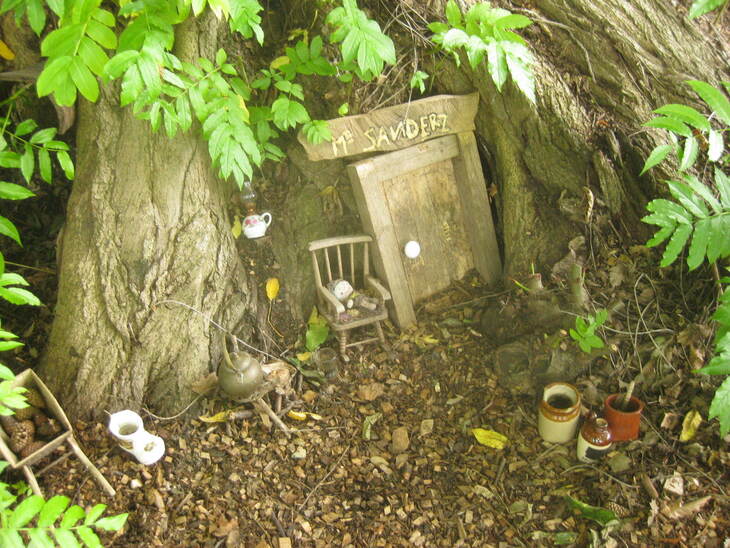
For a few years, west London's Syon Park was home to a replica of Mr Sanderz' house — AKA Winnie the Pooh's own home. Pooh "lived under the name of Sanders" (also variously spelt "Sanderz") in the Hundred Acre Wood, having moved into the tree stump vacated by the previous resident. The name "Mr Sanderz" was carved over his door, an imitation of which was mounted at ground level of Syon's trees, made all the more magical by the inclusion of a tiny chair and other details.
Sadly the door was removed a few years ago, and hasn't been replaced, but a similar replica can be found near Pooh Sticks Bridge in the real Hundred Acre Wood: the Ashdown Forest in East Sussex.
AA Milne's life beyond London
In 1924, AA Milne bought a country home in Hartfield, East Sussex, near to a spot now known as Pooh Corner, and his family moved there from Chelsea. Milne died at that residence, Cotchford Farm, in 1956.
These days, Cotchford Farm is a private residence, though very occasionally the gardens open to the public.
AA Milne and All Hallows-by-the-Tower
After Milne died, he was given a private funeral. But shortly afterwards, a memorial was held at City church, All Hallows-by-the-Tower, alongside the Tower of London, to allow fans to mark his passing.