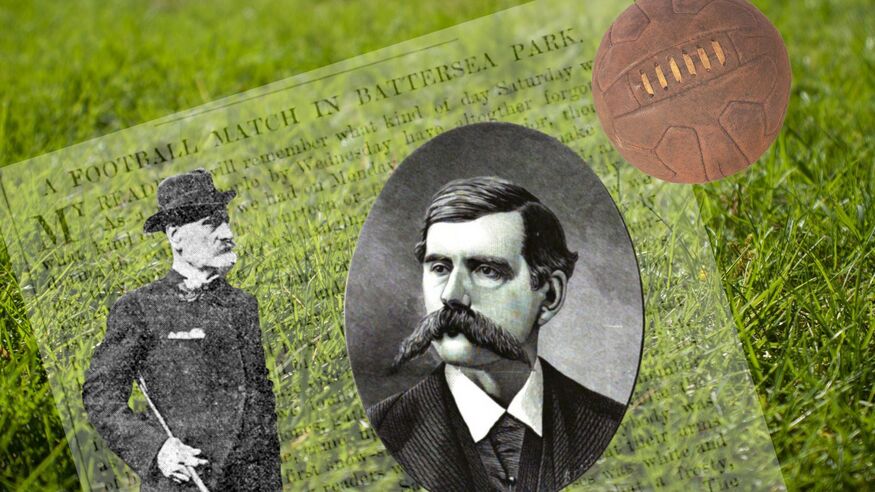
"...when the ball was kicked through the two sticks at the east end how they clapped their hands and cried "Well kicked!"
The game of football — in one form or other — has been passed around London for many centuries. In 1314, the rough-and-tumble of street football — a "great noise... caused by hustling over large balls" — was banned outright by Edward II. This royal edict of 'No Balls Games' couldn't keep London's budding footballers down, however, and the beautiful game continued to roll with the punches, and evolve.
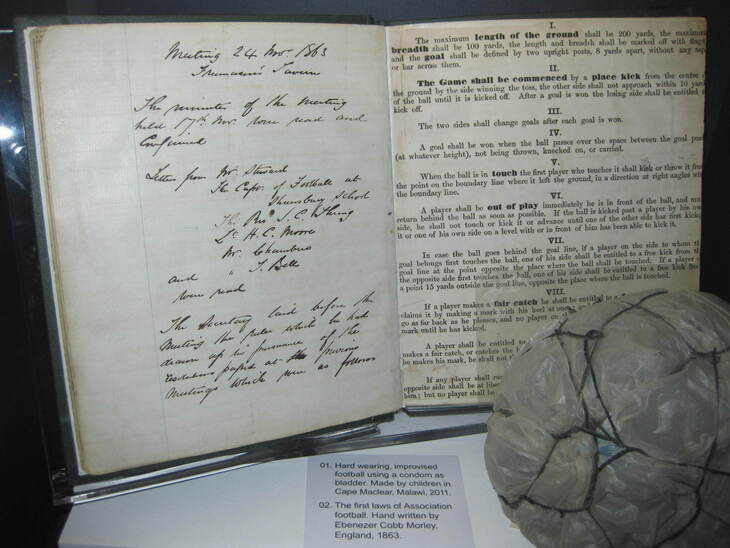
Fast forward some 550 years — to the evening of Monday 26 October 1863 — and the Football Association (FA) was officially formed in the Freemasons' Tavern in Great Queen Street, Holborn. There and then the FA set about establishing a definite code of rules for the regulation of the game, and by 8 December 1863, they had 13 rules* (most still recognisable in today's game) published in a 'neat little book' by John Lillywhite, cost: one shilling and sixpence.
So when was the first game of football played to the FA's shiny new rulebook?
The city's nascent football teams — which included now-unfamiliar names including War Office, Crusaders and Forest, and No Names — were itching to get on the pitch, and an exhibition 15-a-side game was played on 19 December 1863 between Barnes and Richmond, in Mortlake. The publication 'Field' reported that both teams took to the new rules well, but the result was a colourless 0-0 draw: "Although Richmond more frequently had the ball near their goal," reported Field, "we cannot congratulate Barnes on their play. If it had been after Christmas, we might have accounted for their slowness and want of condition."
That match, however, wasn't official; for one thing, Richmond were not FA members.
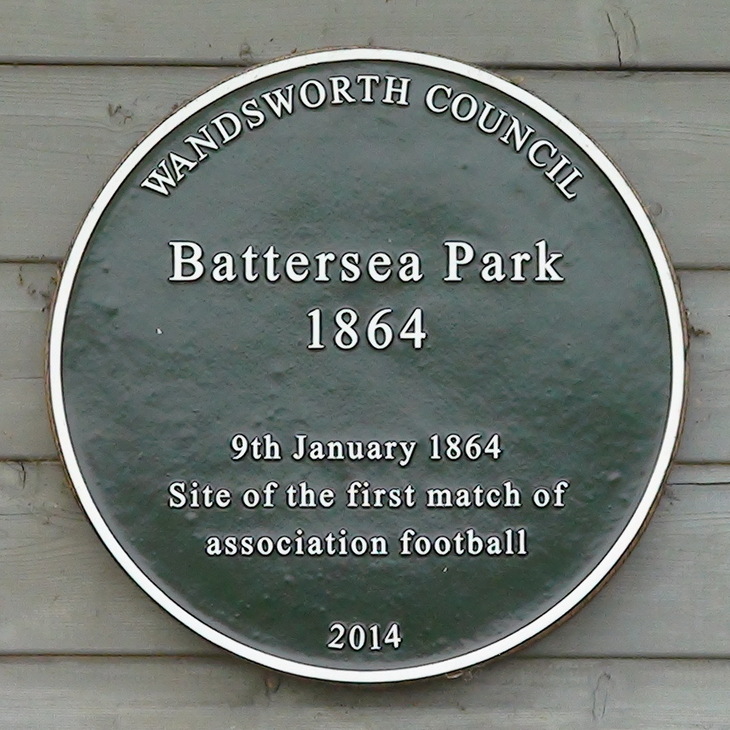
The first official FA rules match that took place in a frigid Battersea Park early the following year, was between two composite teams headed by Ebenezer Morley (of Barnes FC, and the first secretary of the FA) and Arthur Pember (of No Names, and the first president of the Football Association). Yet while the FA has long considered the date of this milestone match to be Saturday 9 January 1864 — there's even a plaque in Battersea Park stating as much — it actually took place a week earlier, on Saturday 2 January 1864.
How do we know this? This Boys' Journal from the era relives a game played on that date — with a diagram of the pitch and everything — stating: "This was the inaugural match, played by the rules of the Association...". When we conferred with the National Football Museum while researching this article, we were pointed in the direction of a post from football expert Andy Mitchell, who suggests the January 2/9 date got mixed up because Bell's Life printed the match report two weeks running.
But we've also found another couple of reports on that 2 January game (both published on 9 January — maybe another reason for the confusion?). And one of them in particular has some marvellous wide-eyed punditry.
The first of the reports, from the 'Field' publication sets the scene as a wintry one:
The thermometer was, in the open air, several degrees below freezing point; there was a cold wind, ice three-quarters of an inch thick, hard ground, and people in the streets were buttoned up to their throats.
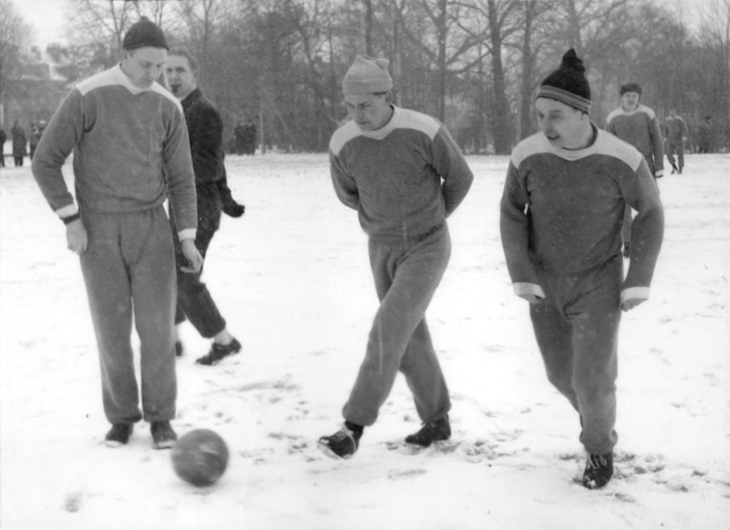
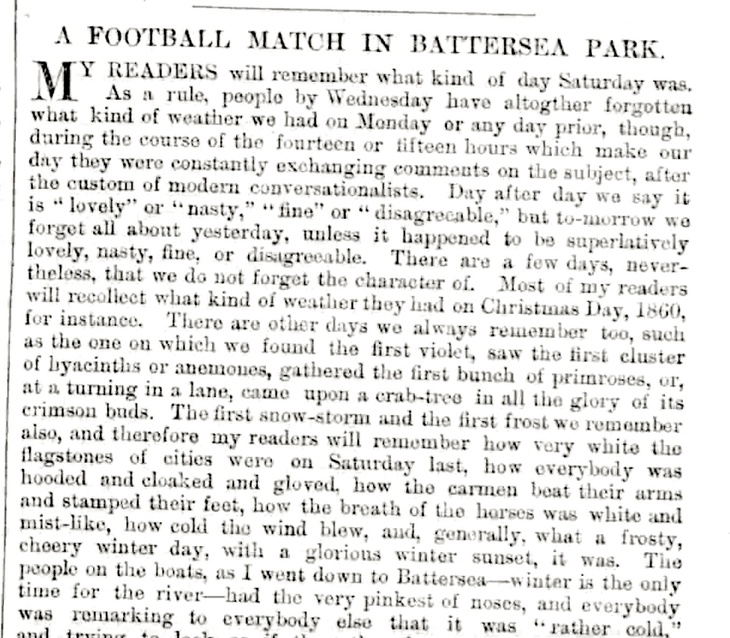
To say that the newly revived game of football received a frosty reception, then, would be meteorologically accurate. Yet, among its first players and spectators, things quickly hotted up. A brilliant account of the match was written up by one John D Cartright in The Queen, entitled: 'A FOOTBALL MATCH IN BATTERSEA PARK'. In it, Cartright tells of serendipitously stumbling upon 28 men in jerseys and knickerbockers, whose appearance today might be considered distinctly hipsterish:
...a great many of them [big] men with broad chests and beards, whiskers and moustaches...
Cartright then give us the kick-off time — half an hour before the three o' clock kick-off that would later become commonplace:
The clock at St. Stephen's had just denoted what a little urchin, who was looking like me very anxiously at this group of gentlemen, described as "arf arter two," when a large round ball of leather, with red seams, was placed on the ground between the two sides.
Cartright then watches on in childlike awe, at the newfangled game plays out, his thoughts apparently with the poor ball being kicked around:
If balls were entitled to bring actions for assault and battery, nothing is more certain than that an action would lie against all those thirty gentlemen. It was no sooner on the ground than one ran at it and gave it a fierce kick. At that moment every one of the statues seemed to come to life and go bounding over the ground, and wherever the ball went, they followed, kicking away at it as hard as they could, one side trying to drive it to the east end, and the other side to the west.
Cartright's match report — extremely detailed, with various bouts of 'bounding', 'bobbing', 'bumping' and a description of the ball making "a booming sound like the discharge of a small piece of artillery" — then witnessed the first goal scored in FA history:
But these gentlemen in the pretty-coloured Jerseys didn't seem to mind a kick or two; and when they came up to the edge of the ground where people with blue cheeks and starved limbs and frozen blood were standing to look at them, it was easy to see the perspiration on their foreheads, and that their faces were all aglow, and it was quite jolly to see the way that they dashed about, and then when the ball was kicked through the two sticks at the east end how they clapped their hands and cried "Well kicked!" "Bravo Green! bravo White! bravo Black!" as the case might be.
It was now 1-0 to the President’s XIV, and before long they'd put away a second:
...the ball was kicked and kicked and kicked, and the west got redder and redder, and the air colder and colder, and the sun sunk lower and lower, and the beads of perspiration got thicker and thicker, and everybody ran fast [sic] and faster, and all the spectators' faces became bluer and bluer, and they looked at their watches and thought they would go, but they didn't, and the ball was caught and caught, and heels were kicked into the ground again and again, and at last the ball was got through the posts at the west end and then everybody clapped their hands again, and went back and became statues once more...
A while after that "an old man who was all blue coat (except a face evidently made to match)" noted they'd been playing for over 90 minutes, and with that the players rushed into a tent, and came out wearing hats and coats "like ordinary English gentlemen."
Fortunately for us, Cartright's curiosity got the better of him, and at full time, he went to chat to one of the players — leading to another confirmation (this one direct from the footballer's mouth), that 2 January was indeed the first FA game:
I just plucked up courage, and went up to a good-tempered looking fellow with blue eyes — I always had a weakness for eyes of that colour — and I asked him what it all meant. "Eh; what?" he said. "Why," I said, "what have you all been doing?" "Doing:" he said, "playing a game, a jolly game at football. We are the Association. This is the inaugural game by our new rules. How hot it is!"
Even more splendidly — and something you can't imagine Erling Haaland doing with the average Man City fan — Cartright was then invited by the player to dinner:
...he said—"We are going to dine at the Grosvenor after six. Will you come?" I went. We had one speech and drank one toast. This was the speech and the toast "FOOTBALL."
As for the Field report, it concluded:
The game of football as we saw it played in Battersea Park, is one in which gentlemen and boys might engage together; at which all classes might play in common... For the future these matches will be played upon the one set of rules, and an increased interest is felt in the game.
Indeed it was. From that moment, association football never looked back. The first FA Cup Final was held at the Oval in front of 2,000 people in 1872, the same year in which the first international match was played, between Scotland and England. The British Ladies' Football Club (BLFC) was formed in London in 1895, with Nettie Honeyball (there is literally no better name) as captain. Battersea Park has all-weather football pitches now; if you're ever passing them on a frosty afternoon early one January, think about that extraordinary match which took place here all those years ago.
There's lots more of the Queen article we've referenced in this article. It can be read in full on the British Newspaper Archive, though it's a paid subscription.
*Incredibly, the modern game of football still only officially has 17 rules.