The old London College of Fashion building is to get a radical overhaul, but what of its heritage?
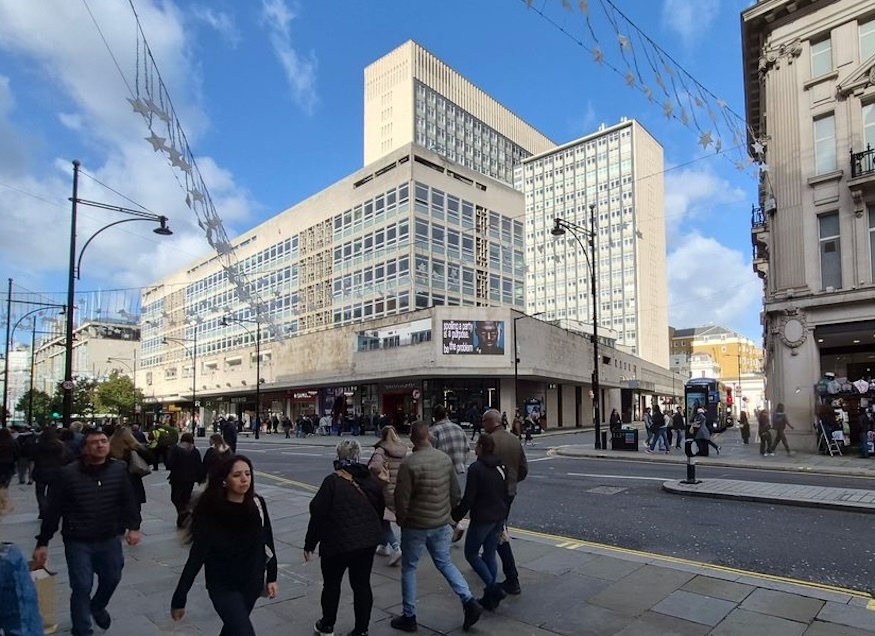
It's been a landmark beside Oxford Circus for over 60 years. But soon, this towering building will undergo a major rebuild. It'll change from this ☝️to this 👇
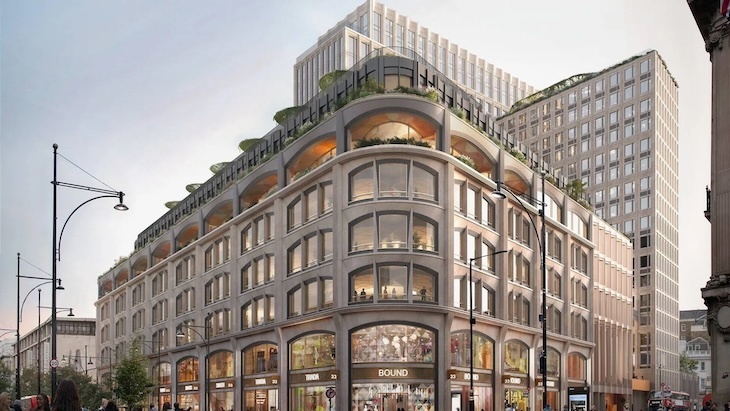
The 33 Cavendish Square development, undertaken by Berkeley Estate Asset Management and architects Kohn Pedersen Fox, will be a mixed-use office, retail and cultural building. It will keep some of the original structure, but with a radical overhaul to the building's appearance, especially on the Oxford Street side.
Granted, 1960s blocks are not everyone's idea of pleasant streetscape, but this building does have its distinctions. For one, we'll be losing sight of this playful facade and mosaic:
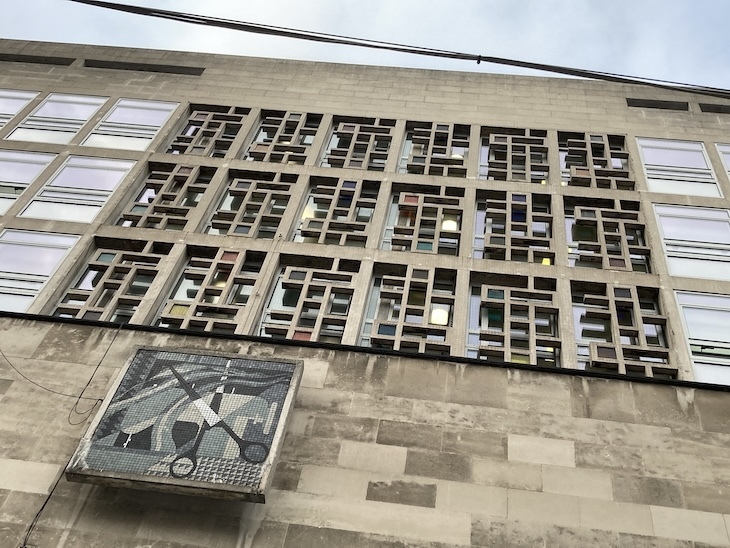
The wider building, designed by TP Bennett in the late 1950s and opened in 1963, has had several tenants over the years, including a branch of BHS. But it is most closely associated with the London College of Fashion, whose name is still emblazoned across the Oxford Street podium.
Now part of UAL, the college recently moved to a new landmark building on the Olympic Park's East Bank. But much affection remains for the old home on the corner of Oxford Street and John Prince's Street.
Now, a group of campaigners, largely drawn from College alumni and fashion professionals, have set up a petition to preserve some of its heritage. Their fear is not only the loss of an interesting building, but the cultural history it represents:
"The building, located just off Oxford Circus, has housed more than sixty years of fashion, design and creative education. Generations of stylists, editors, designers, pattern cutters, photographers and makers were trained within its studios. For many, it served as the unofficial front door to London's fashion industry and one of the last mid-century educational buildings of its kind in the West End."
The group are not asking for the development to be stopped, rather they want the developer to "acknowledge and document the cultural significance of the building and consider whether part of its original architecture can be retained or sensitively integrated".
Architectural designer Fakhry Akkad, who has developed an alternative retention-forward proposal for the site, adds: "We are not opposing regeneration. We are proposing a smarter one. There is cultural and commercial value in preserving part of what made this building significant to so many."
We asked the developer if they had any plans to retain the architectural elements. They could not provide details, but we're assured that "The features on the Oxford Street façade will be retained and incorporated through the proposed scheme.
“Embracing the history of the site is important for us through the proposed retrofit of 33 Cavendish Square, which is why we will be retaining well over half of the existing building through our plans, while enhancing the area’s long-standing reputation for creativity, commerce and culture.”
Although 'over half' of the fabric of the building will be retained, the new 33 Cavendish Square will present a very different 'look' for the area. This, in itself, is not a bad thing. The built environment has to move on, evolving and adapting to new needs, and buildings designed in the 1950s cannot always do this.
The wider redevelopment of the block does, however, continue the trend of deleting significant post-war buildings. One of the first podium-and-tower blocks, Fountain House on Fenchurch Street, is set to go in the near future. So is Bastion House on London Wall. These follow on from many earlier examples, such as the demolition of Bucklersbury House in the City to make way for the Bloomberg building.
Many people would say "good riddance". But we need to be careful here. If the trend continues, we'll soon have very few examples of post-war 50s/60s 'big architecture' left in central London. It's a point made eloquently by Fakhry Akkad:
"London is losing part of its soul because planners often treat these buildings and styles as anomalies, as brief interruptions in the city's architectural narrative. They are dismissed as insignificant, and therefore expendable. Historical styles are fetishised, while modernist buildings — because they dared to be different — are considered fair game."
Westminster Council is due to make a planning decision about the development on 9 December. If you are concerned about the complete overhaul of the building, then you can sign a petition on Change.org.