
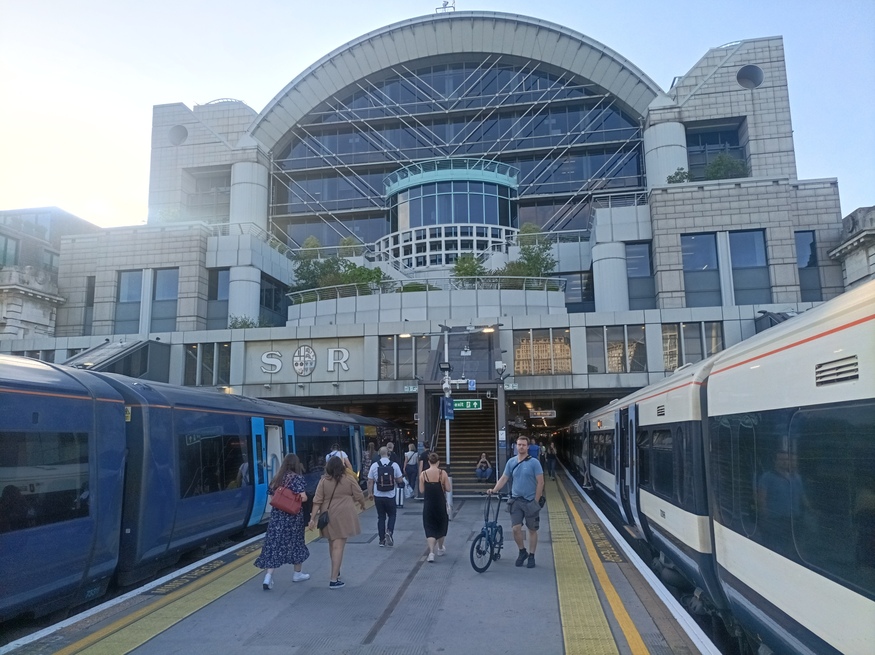
The Twentieth Century Society (C20) has called for the Grade II* listing of Embankment Place — the glassy barrel-roofed office complex hovering about Charing Cross station.
Charing Cross station lost its original barrel-shaped roof in a tragic collapse in 1905, which was then replaced with a less impressive flat one. It wasn't until 1989 that construction began on Terry Farrell's postmodern 'Palace on the River', an 'air rights' building which suspends nine storeys of offices above the station, isolating the space from the thrum of tracks below.
Farrell's design echoed Charing Cross' first roof — not to mention that of the Royal Festival Hall across the water — creating what the developers Greycoat called "a building of exceptional character on a very important site... a building of drama. A proscenium arch."
"A bloated bauble above Charing Cross station"
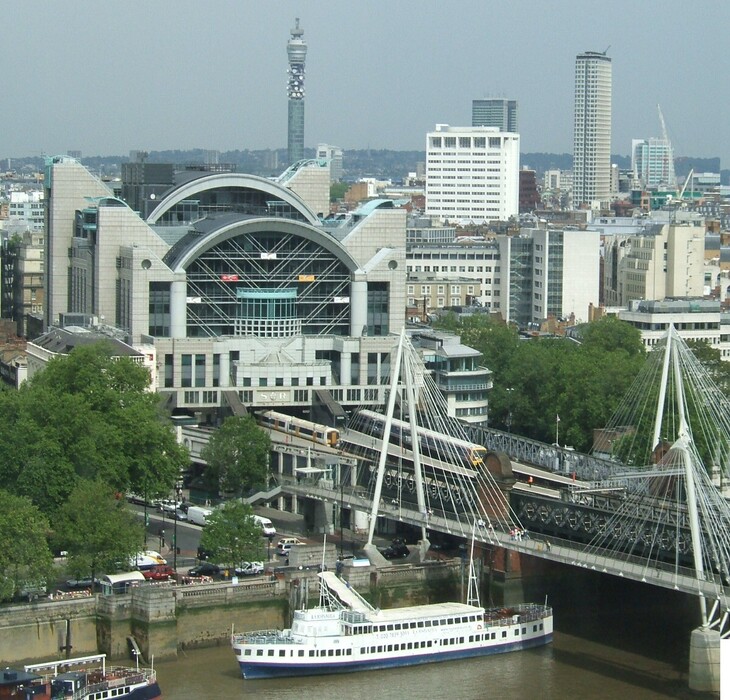
Not everyone saw Farrell's building that way; the Independent lambasted it as a "bloated bauble above Charing Cross station that looks like a giant Art Deco wireless". However, Farrell, who died last year, certainly fulfilled the brief for a structure that would stick in the memory. In a picture quiz, most Londoners would place Embankment Place as 'that building above Charing Cross station' or otherwise perhaps mistake it for the MI6 Building — another of Farrell's cartoonish confections. As is often the way with such audacious architecture, feelings towards the building have softened over the decades.
C20 in particular have a soft spot for Embankment Place. "Of all the commercial 'air-rights' developments above London railway termini," C20's Oli Marshall tells Londonist, "this is undoubtedly the most successful and for a building approaching 40 years old, it has certainly passed the test of time." Calls for its Grade II* listing came after the building's owner applied for a COI (Certificate of Immunity from listing), in line with plans to make substantial alterations, as part of a wider revamp for the surrounding area.
A Grade II* listing would severely limit the changes that could be made to Farrell's building. "Now is the right time for its architectural and historic value to be formally assessed," says Marshall.
The battle for Brutalism is won. The fight for PoMo is on
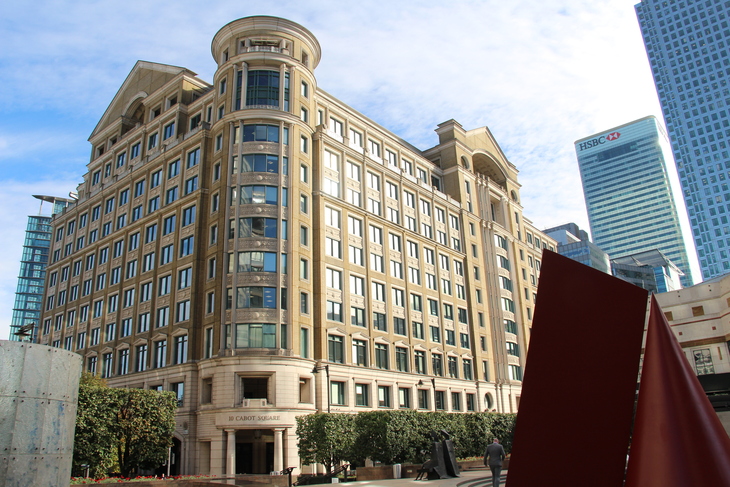
This is a moment of reckoning for London's PoMo architecture. C20 recently called for the listing of 10 Cabot Square in Canary Wharf, currently under threat of being largely demolished, ahead of proposed redevelopment to the blueprints of the Howells architecture firm. C20 says that Skidmore, Owings & Merrill's early 1990s Neoclassical Chicago-style office block "is the finest example of this type of architecture remaining in Canary Wharf." However, there is still much proselytising to be done, to win critics over to the glories of PoMo architecture.
Oli Marshall tells Londonist: "While the recent listing of the Southbank Centre after 40 years of debate shows that the battle for Brutalism has perhaps finally been won, our Postmodern architectural heritage of the 1980s and 90s still remains widely undervalued and under-appreciated."





#/media/File:Charingcross-eye_s.jpg)