
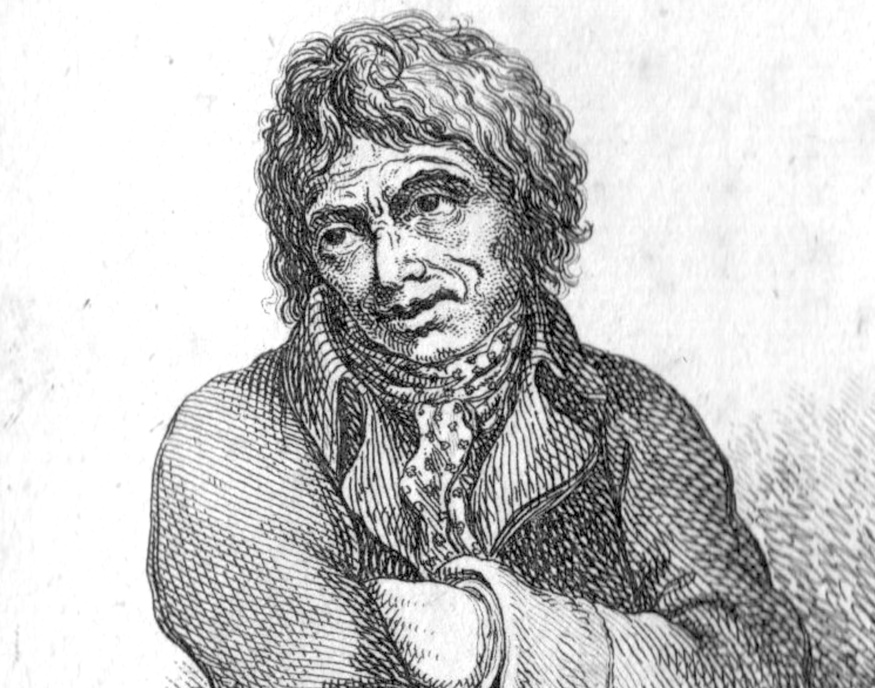
In 1800 — 65 years before the assassination of Abraham Lincoln in a Washington theatre — an attempt was made on the life of King George III at London's Drury Lane Theatre.
Reported Bell's Weekly Messenger:
On 15th May, the prisoner had repaired to Drury Lane Theatre, [and] had there drawn a concealed weapon, and when the opportunity presented itself, had discharged a pistol at the person of his Most Sacred Majesty. The slugs, with which the pistol was loaded, had been found in different places, but all very near the Royal Box.
Said prisoner was James Hadfield, a former solider who had suffered multiple sabre blows to the head during the Battle of Tourcoing in 1794, inflicting serious wounds and brain injury. The King wasn't hit by any of Hadfield's bullets, but after a trial which redefined the definition of 'insanity', the assailant was incarcerated in the 'incurable' ward at Bethlem Hospital in Moorgate, a mental hospital which later relocated to St George's Fields in Southwark, were the Imperial War Museum stands today.
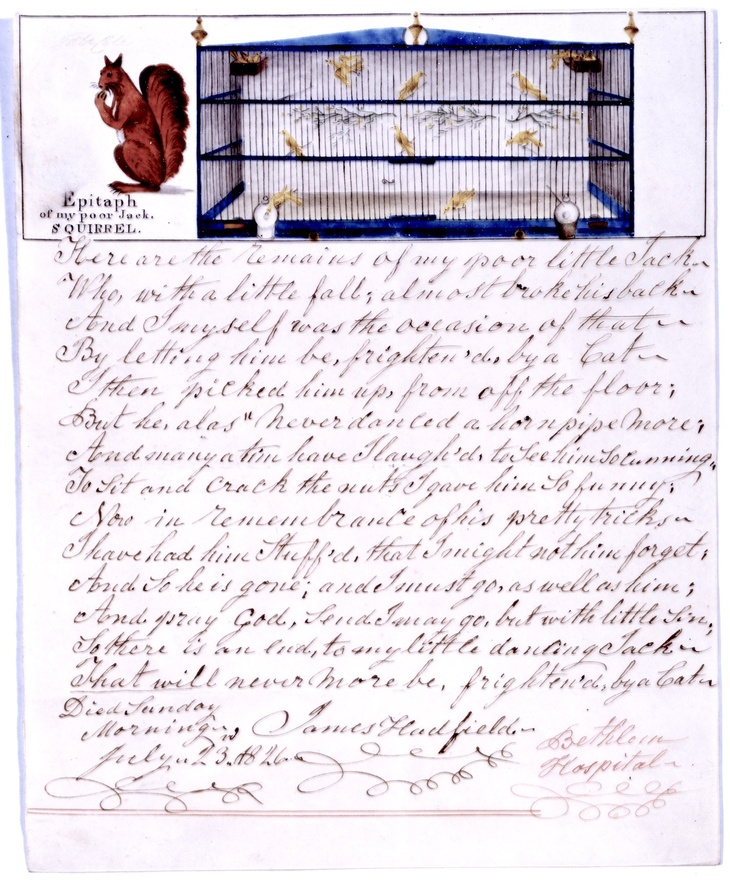
Hadfield was to spend the remaining 41 years of his life as a Bethlem inmate, whiling away his time weaving baskets, and keeping various pets, namely two dogs, three cats, some birds and a squirrel. We know this because at this time, Bethlem also served as a tourist attraction (well documented in Hogarth's disturbing Rake's Progress vignette), and in 1840, the French socialist Flora Tristan visited Hadfield recording: "He lives in a small room and he is not averse to passing the time of day with visitors. We had rather a long visit with him; his conversation and his habits denote a sentimental and loving heart, a pressing need for affection.... He was extremely fond of his animals and was grieved at their deaths; he mounted them himself and keeps them in his room."
Such was Hadfield's sorrow at the untimely death of his pet squirrel, he penned and illustrated a poem: 'Epitaph, of my poor Jack, squirrel':
Here are the remains of my poor little Jack / Who with a little fall, almost broke his back / And I myself was the occasion of that / By letting him be, frighten'd by a cat / I then picked him up, from off the floor / But he, alas, never do need a hornpipe more / And many a time have I laugh'd, to see him so cunning / To sit and crack the nuts I gave him so funny / Now in remembrance of his pretty tricks / I have had him stuff'd that tonight not him forget / And so he is gone; and I must go; as well as him / And pray God, send I may go; but with little sin / So there is an end to my little darling Jack / That will never more be, frighten'd by a cat. — Died Sunday morning, July 23, 1826. James Hadfield, Bethlem Hospital.

In his many years at Bethlem, Hadfield became a minor celebrity, and exchanged copies of his squirrel poem for snuff, up until his death in 1841 — the year after Flora Tristan met him.
Bethlem Hospital moved to Beckenham in 1930, and still exists today as a hospital, alongside a free museum and gallery documenting the evolution of mental health treatment. One of the permanent exhibits here is one of Hadfield's copies of 'Epitaph, of my poor Jack, squirrel' — still causing visitors to emit sympathetic 'awwws' all this time later.
Bethlem Museum of the Mind, Beckenham, open Wednesday-Saturday, free. The latest exhibition, Between Sleeping and Waking, runs from 14 August-8 November 2025, and features another copy of the poem, not usually on display.




.jpg)