This feature first appeared in April 2025 on Londonist: Time Machine, our much-praised history newsletter. To be the first to read new history features like this, sign up for free here.
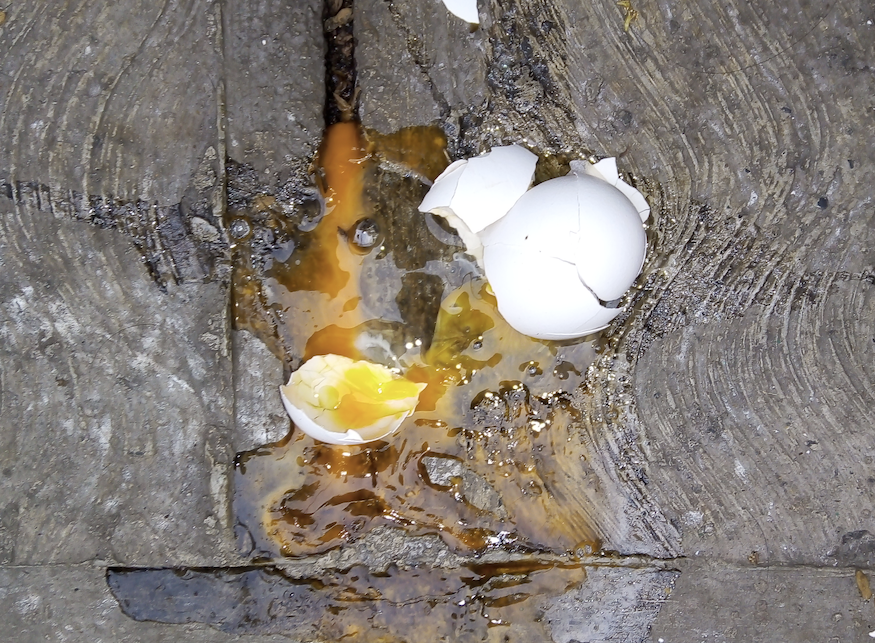
“Bad enough to knock a dog down”. An overpowering stench descended on Bermondsey in the spring of 1915. Residents were forced to keep their windows closed. Visitors stayed away. Businesses failed. The cause was a surfeit of rotten eggs.
Bermondsey — south and south-east of Tower Bridge — had always been a whiffy place. During the 19th century, you could navigate the area by smell alone. The western quarters were home to the tanners, who scraped gore and rotting flesh from skins, then rubbed animal urine and dung into the leather. Nearby, stood the Sarson’s vinegar factory with its own pungent aromas. Move north and you might encounter Jacob’s Island, a squalid slum immortalised in Oliver Twist, whose foetid ditches presented "literally the smell of a graveyard". To the south, more pleasant odours emanated from the Peek Freans factory in ‘Biscuit Town’, alongside a jam factory and a custard factory. Right through the middle of it all ran the sooty waft of steam trains along the magnificent viaduct that still dominates the area.
By 1915, some of the more unpleasant odours had dwindled. But then a new ingredient defreshed the aromatic landscape: eggs; bad ones.
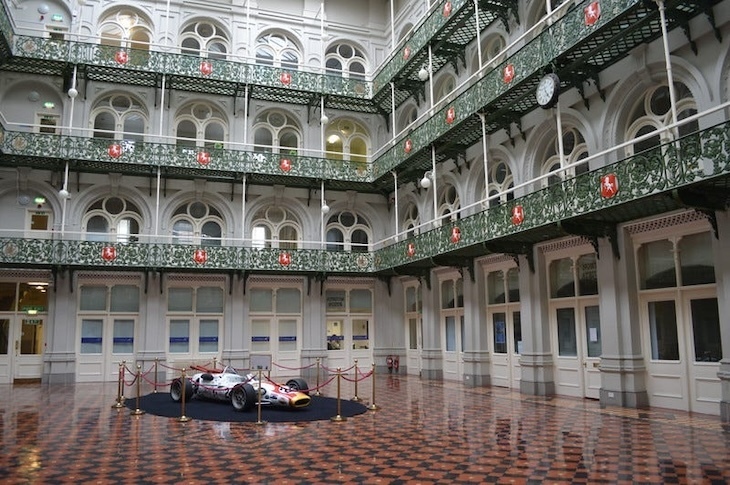
In the early 20th century, Bermondsey had established itself as a hub for imported eggs. A 1921 trade directory lists five egg importers on Tooley Street alone, including, Bloch & Klein, Foucard & Son, and (great name for an indie band, this) Stern Alfred. Their eggs were sourced from numerous countries, including Denmark, Russia and Egypt. Once offloaded in Bermondsey, the eggs would be distributed by wholesalers at nearby Borough Market and from the adjacent Hop Exchange building, which still bedazzles today:
Importing fresh produce is a risky business. Any delay to shipping might spoil the food. Eggs are more robust than some perishables, but even they could spoil when journeying from as far as Egypt. Still, an efficient supply chain had built up and, according to one news report, only half a million rotten eggs were destroyed per year in Bermondsey during the first decade of the 20th century.
Then came war. The European hostilities of 1914 caused unprecedented disruption to shipping. Cargoes were still getting through, but the journey could take much longer. The upshot was food waste on a scale never seen before. In Bermondsey, an estimated 25 million unsaleable eggs were destroyed in the first eight months of war.
Yolk-back Mountain
25 million rotten eggs in eight months is a lot. If we crunch the numbers, that’s 100,000 eggs per day, or 170 eggs every minute (assuming a 10-hour working day, seven days a week). Only the council could muster the resources needed to crack the problem. Indeed, it was their statutory duty. As the local sanitary authority, the council was required by the Public Health Act (1891) to remove and destroy all trade refuse and unsound food. And so an unenviable team of labourers had the task of crushing tens of thousands of stinking eggs daily. It must have been appalling work, though we must remember that shovelling rotten food was still preferable to the most common form of employment in 1915.
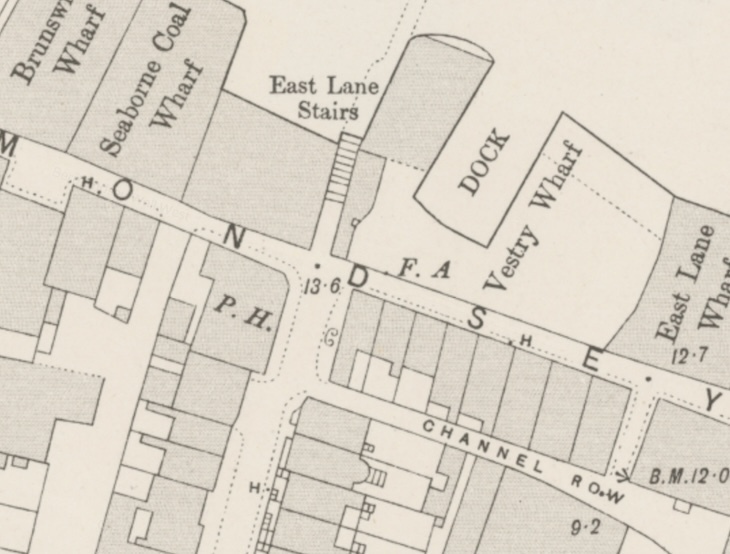
The council’s usual waste destructor could handle neither the quantity nor the muculent quality of the rebuffed oeufs. A new egg-smashing depot was therefore built on a Thames wharf near Chambers Street to chomp through all the waste.
Footnote: Egg-breaking was still a thing to the south of the river into the 1960s. If you’ve never seen it, you must watch The London Nobody Knows, in which James Mason tours some of the more unusual sights of London. These include an egg-breaking factory on Bankside, here played for laughs in one of the most idiosyncratic documentaries you’ll ever watch.
Press reports from the time describe the facility. Every day, a steady stream of rotten eggs would reach the wharf by cart. From here, they were introduced to the council’s dedicated egg-crushing machine, which resembled a giant mangle. Crates of old eggs were loaded into the top, and a man would then turn a handle to crush the produce. Shells were caught in a wire mesh, and the wretched egg-gloop would decant into a gully, and thence the public drains.
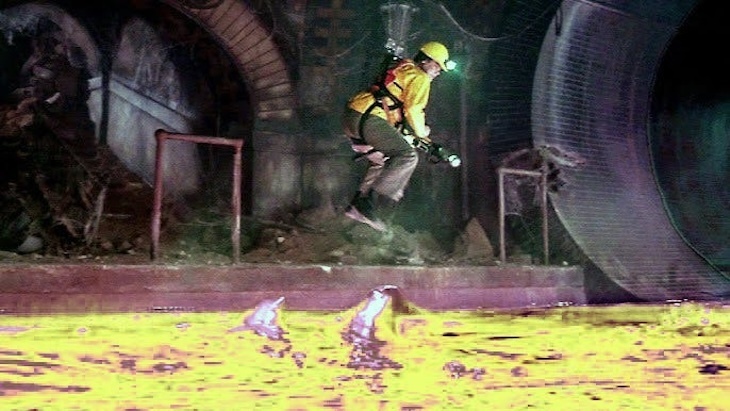
I can find no account of the feculent sewer omelette that must have ensued. And so — professional historian that I am — I’ve recoloured this screenshot from Ghostbusters II to give some approximation:
Bodfield vs Bermondsey Borough Council
Needless to say, the stench of this sulphurous splatmatter did not go down well with the neighbours. One sorry complaint came from John Bodfield, a coffeehouse keeper whose shop at 42 Bermondsey Wall was just 25 metres (80 feet) from the plant. By June of 1915, the stink had so thoroughly deterred his customers that the shop had closed down.
He took the matter to the High Court seeking damages for loss of earnings, and to gain an injunction against further egg smashing in the area. The proceedings were widely reported in the newspapers. The council’s legal representative began by outlining his client’s quandary:
“Either we must destroy the eggs and be sued by Mr. Bodfield and his friends who are also coffee-house keepers in the district (for they say that if he succeeds they will also ask for damages), or we must retain the rotten eggs and be sued by all the people in the district, and we don't know what to do.”
In response, the divertingly named Mr Justice Darling quipped: “I don’t know that the judges of the King’s Bench Division are specially qualified to tell you how to destroy rotten eggs”.
It was then the turn of the people to give evidence. Mr Bodfield outlined how his successful business had quickly dropped away after the egg smashing began. He now had to work as a docker to make ends meet. His children had suffered illness from the fumes. Asked whether he would describe the eggs as rotten, Bodfield replied: “From the appearance and smell, I think they were doubly rotten”.
Bodfield was the most vocal local provoked by croaked yolks, but others spoke out too. Samuel Pearcy, the landlord of the adjacent Bunch of Grapes pub registered his disgruntlement here, and in a separate court action. Meanwhile, Miss Elizabeth Searle, a teacher at the nearby East Lane Girls School, complained of headaches and nausea from the fumes.
Arthur James Devereaux, a seasoned waterman, gave grimly corroborating testimony. He described how he’d sat alongside dead bodies which had been in the water six or seven weeks, and was not affected by them, but the smell at the wharf drove him smartly from the coffee-house.
Since the closure of Bodfield’s coffeeshop, the council had taken measures to counter the noxious egg honk. The court heard how the mangle apparatus had been enclosed, to help contain the smell. Carbolic acid and chloride of lime were now regularly applied to the machine. An electric exhaust fan had also been installed to deflect the odours up through a stink-pipe.
“That will be bad for the Zeppelins,” quipped Mr Justice Darling, who seems to have considered the case to be one running joke.
Another witness, a local river man named Boss, suggested that the council might have shipped the eggs downriver for disposal in a less populated area. “You might have painted the barges like hospital ships,” suggested Justice Darling, “and then they would have been torpedoed”.
(I am not entirely shocked to find that the Oxford Dictionary of National Biography, describes Darling as “known for his erudition and at times inappropriate wit”.)
The council’s actions appear to have been effective. Mr Bodfield himself admitted that the smell had significantly lessened since the measures had been put in place. The judge was satisfied that Bermondsey had done all it could to remedy the situation, and found no cause for an injunction. John Bonfield was eventually awarded £150 damages. Pearcy of the Bunch of Grapes was separately awarded £75.
As the war progressed, London’s egg supply became increasingly domestic and the problem of imported food waste reduced. And so the Bermondsey Bad Egg Boom dissipated as non-mysteriously as it had first appeared. It stands as a small, forgotten chapter in London’s history. But it is also a timely reminder of what can go wrong when supply chains are disrupted by major upheavals in world trade.