This feature first appeared in March 2025 on Londonist: Time Machine, our much-praised history newsletter. To be the first to read new history features like this, sign up for free here.

Did you know that you’re not permitted to climb a tree on Hampstead Heath? Nor may you place a tripod, train a whippet, harry a fish or ride a donkey faster than 12mph. Them’s the byelaws. I love scrutinising byelaws. They often include measures that seem preposterous today, but which were designed to counter a real nuisance in days of yore.
Another place with a long set of Thou Shalt Nots is Covent Garden Market. If someone tells you to meet them at Rules, they’re probably talking about the fancy restaurant on Maiden Lane. But they might just be referring to the lengthy list of prohibitions that decorates a wall within the old market buildings.
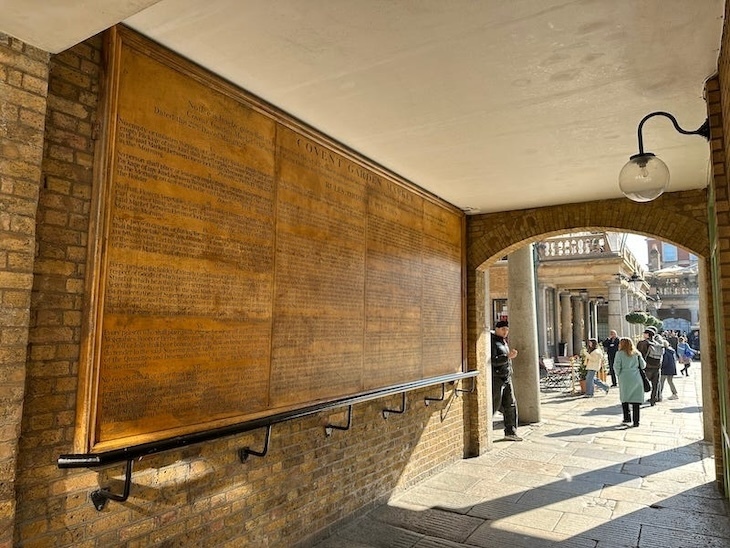
Covent Garden was, of course, a famous fruit, veg and flower market for most of its history. Its streets and alleys were filled with traders, right up until the 1970s when they decamped to Nine Elms. In their place, the old market buildings are now inhabited by delicious cake shops, chocolatiers, superior souvenir shops and purveyors of luxury beauty products. There’s even a Moomin shop. Yet here and there, echoes of the fruit & veg market remain, and nowhere more potently than in the four wooden panels that spell out the bye-laws.
It’s clear from their language that these rules were drawn up some time ago. The preamble pins them to an Act of Parliament in the ninth year of George IV, which would be 1829. The board itself is only half that age, however. It carries a date of 1924.
Most people walk straight past this ancient sign without giving it a second thought. But let’s pay it the attention it deserves. The 25 byelaws it advertises have surely been repealed. Let’s hope so, anyway, otherwise the surrounding businesses will have to pay out many a shilling for transgressions...
Panel 1
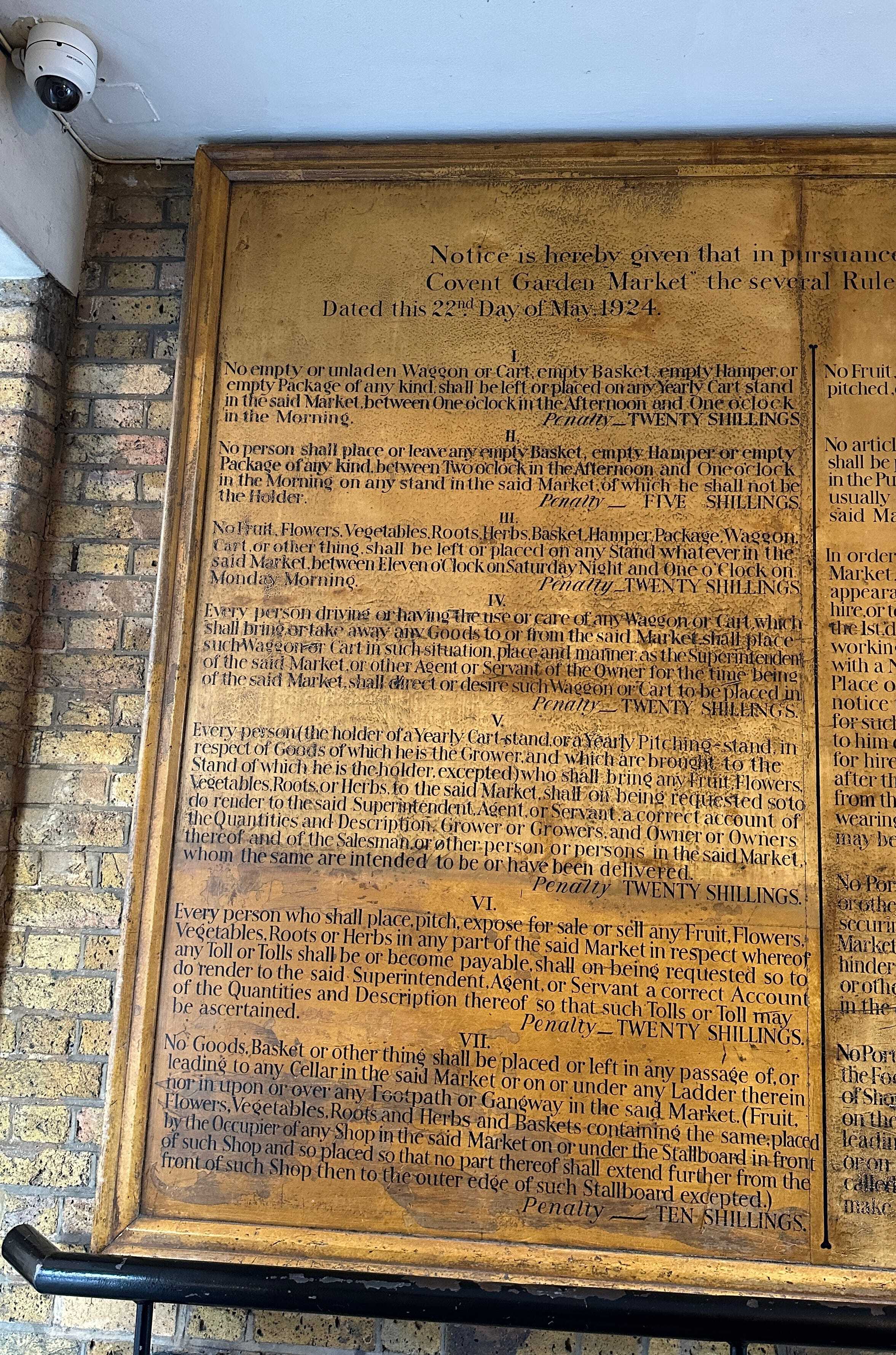
Image: Matt Brown. Click/tap for larger version
Panel 1, it has to be admitted, is a bit of a dull start. Its seven rules are mostly concerned with the coming and going of goods for sale. Basically, you’re not allowed to leave empty hampers or carts lying around, you must pay any demanded tolls on goods, and you must declare, if asked, where your produce has come from. All pretty mundane stuff. Next please.
Panel 2
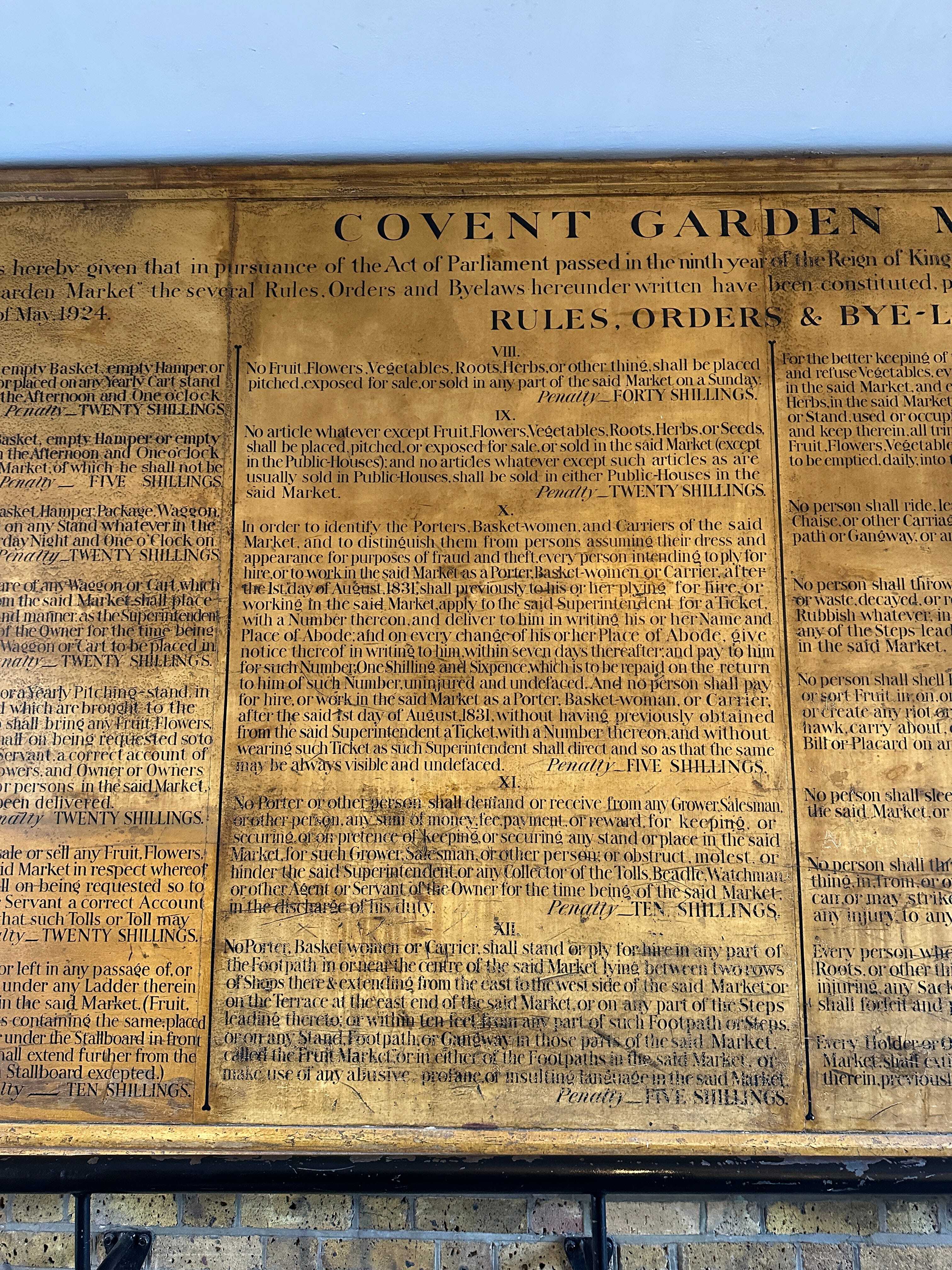
Now we’re getting a bit juicier.
First up, Rule VIII, you can be fined 40 shillings for trading on a Sunday anywhere in the market. For the benefit of overseas readers, the UK still has rules about Sunday trading, with larger stores only permitted to open for six hours. Small shops and stall-based vendors can do as they wish. Modern Covent Garden is all a-bustle on a Sunday, which would have horrified the Victorians.
Rule IX lays out what can be traded from Covent Garden. The list, repeated throughout the rules, is very specific: Fruit, Flowers, Vegetables, Roots, Herbs or Seeds. Sadly for the surrounding businesses of 2025, there is no mention of gelato, iPhones or Moomins among the permitted produce — though perhaps the Apple Store flies under the radar thanks to its fruity name. The one exception to this rule is in Public Houses (pubs), where you can trade “such articles as are usually sold in Public Houses”, which is presumably beer, crisps and nuts.
Rule X is an extraordinarily long-winded way of saying ‘market workers must carry ID’ — here in the form of a numbered ticket that had to be visibly worn. The opening words make it sound like the market suffered from malicious imposters, adopting the dress of porters and ‘basket women’ for purposes of fraud and theft.
Rules XI and XII both concern themselves with respectful behaviour to other market workers and inspectors. Rule XII is a giddying bit of legalese, where the clauses keep coming and coming in such relentless waves that the reader can no longer hold the whole sentence in memory. I think it amounts to ‘no swearing’.
Panel 3
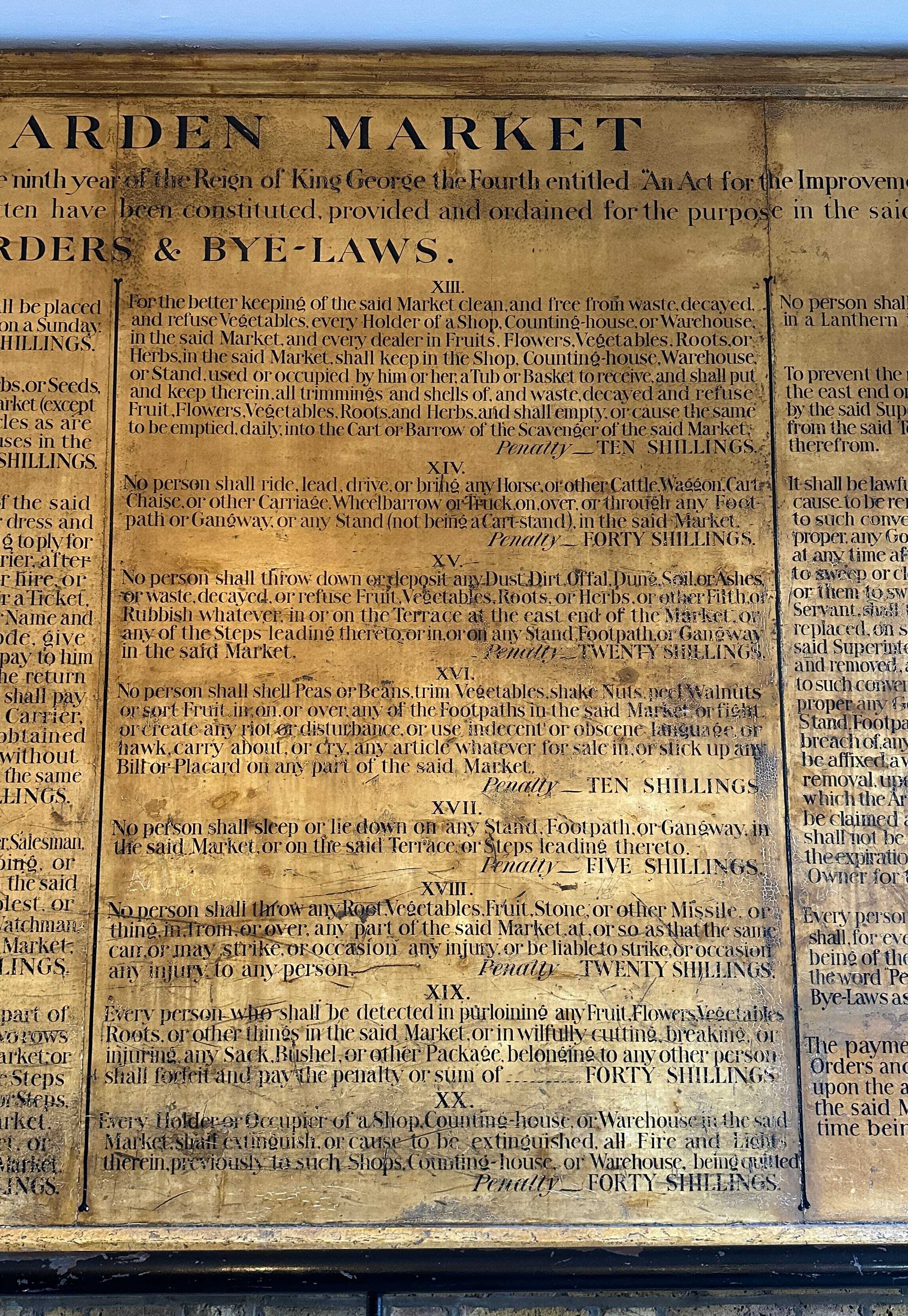
Rule XIII is all about recycling. Every vendor has to have a tub for “trimmings and shells” and other perishable waste, which is collected daily by a “scavenger”, who would then presumably sell it on as animal food.
Rule XV is another warning against dumping waste. The market must be kept clear of “Dust, Dirt, Offal, Dung, Soil, Ashes, or Waste,” which sounds like a particularly grotesque parody of the Seven Dwarfs.
Rule XVI outlaws a multitude of sins, from putting up posters to shelling peas. I shall be especially careful not to “shake nuts” when passing through the market in future.
The other orders on this board warn people against sleeping in the market, stealing from traders, and guarding against fire risk. All fairly obvious. But look at Rule XVIII. It makes an offence of throwing. Among the specific cases, you may not throw a root vegetable over the market. Next time you’re tempted to hurl a turnip, think twice.
Panel 4
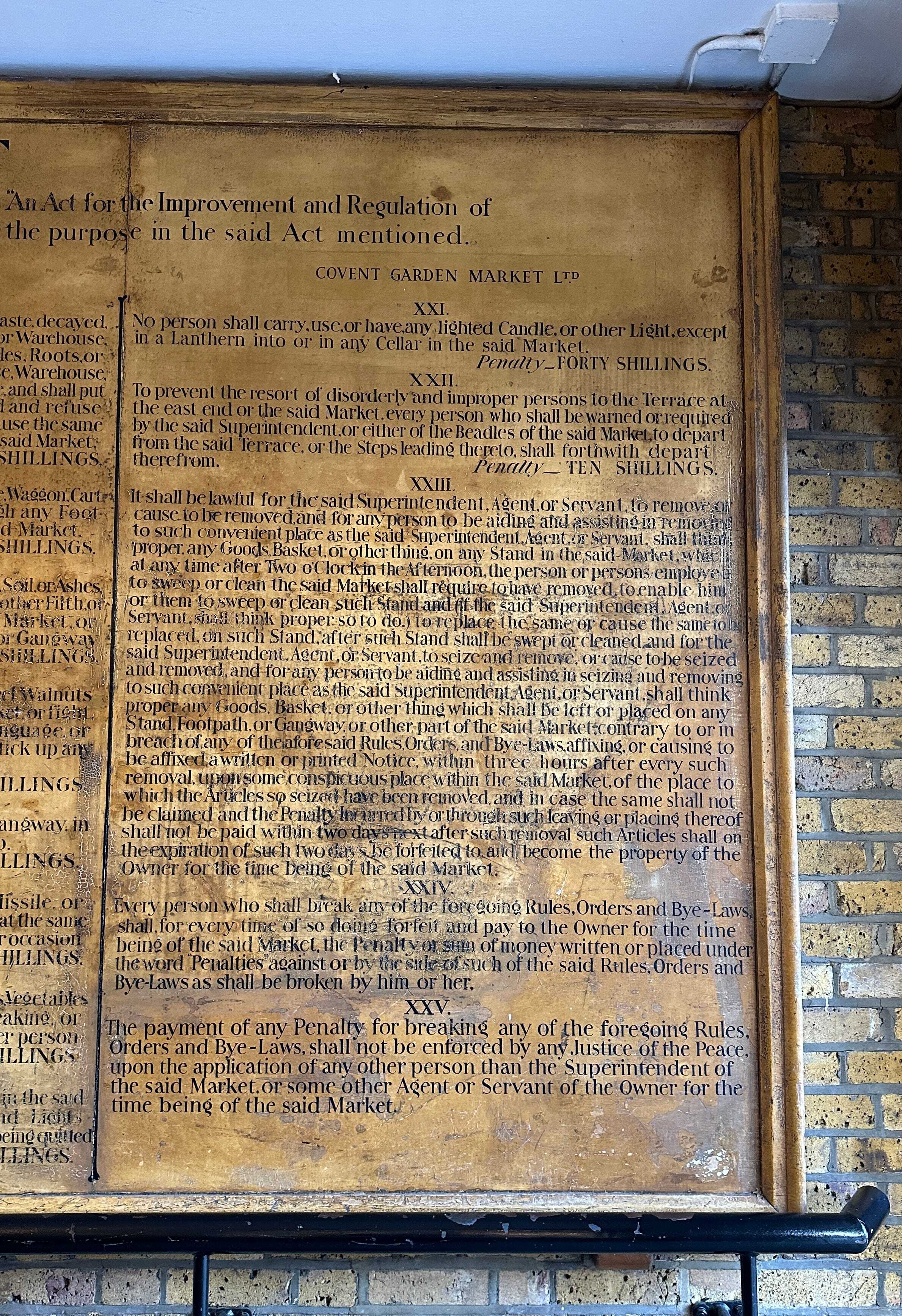
Woe-betide anyone who carries a candle thorough the market. Rule XXI forbids naked flames, restricting illumination to “lanthorns” only.
Rule XXIII is a challenge. Can you read the whole thing out without taking a breath. I cannot. It employs several hundred words to say “Shift your stuff if someone needs to sweep up”.
Rules XXIV and XXV get a bit meta. They reinforce that fines can be levied against anyone breaking the preceding 23 rules, even though this was clear from the fact that most of those rules have fines written next to them. I guess they had to pad things out to get a neatly balanced board.
The market contains a second historic noticeboard in the eastern passage. This one looks very similar, but concerns itself with tolls and fees rather than fines.
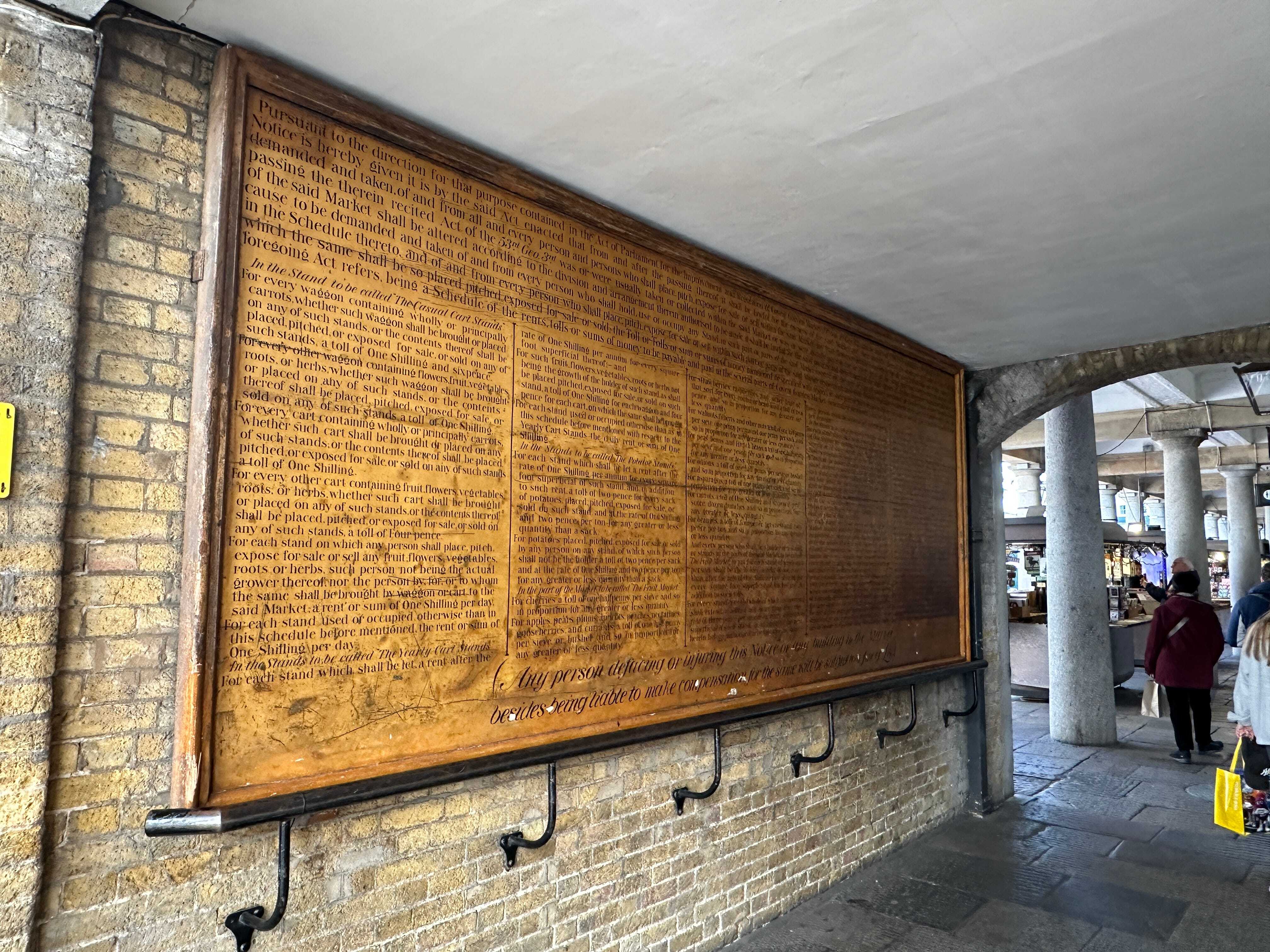
It is, frankly, a dry read, unless you’re researching the intricacies of market practice in the 19th century. We learn, for example, that any cart trading carrots would have to pay a shilling and sixpence in market tolls, whereas a seller of “strawberries, raspberries and other fruit of that sort” can expect to surrender two pence for every round load.
Taken together, the two boards reveal the minutiae of a lost world. They conjure a market not just of “Ripe, strawberries ripe!” barrow sellers, but also of tax collectors, cart manoeuvrings, scavenger men emptying waste buckets, fraudulent porters and surreptitiously hurled parsnips. You won’t find any of that in the Moomin shop.