This feature first appeared in July 2024 on Londonist: Time Machine, our much-praised history newsletter. To be the first to read new history features like this, sign up for free here.
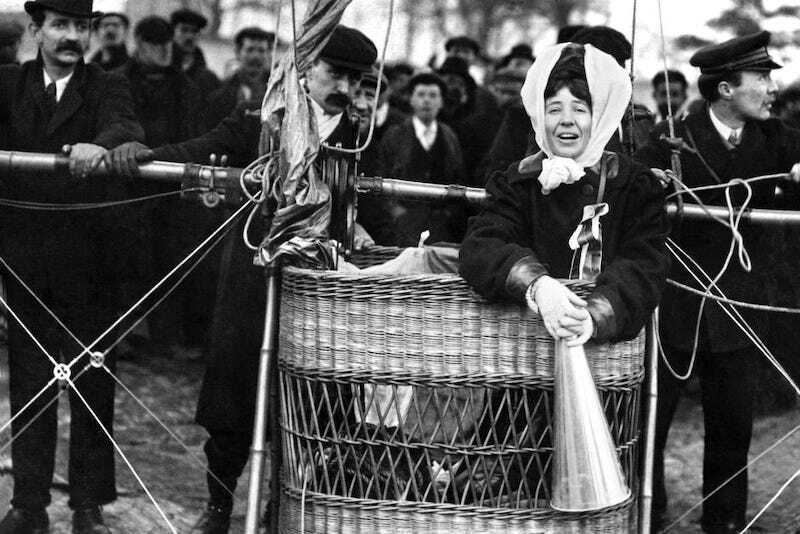
“The most important event in the whole of their propaganda,” said one newspaper. “One of the most enterprising moves for which they have yet been responsible,” said another. In 1909, one London suffragist took to the air in an audacious stunt that deserves to be better known.
I often get asked where I find inspiration for these articles. The best answer is “I just keep my eyes open”. Such was the case with today’s story.
I found myself in Brent Cross West railway station, London’s newest halt. The station opened on the Thameslink line at the end of 2023, to serve the swathe of new housing going up in something they’re calling Brent Cross Town.
Thameslink stations are not known for their attractiveness or cultural worth, but here we find artworks and site-specific baubles at every turn. The contrast is particularly stark if you take a two-station jaunt from the dismal Mill Hill Broadway to the gaudy Brent Cross West. It’s the rail equivalent of Dorothy’s Technicolor entrance to Oz.
And the station has its very own flying heroine, as I discovered from this eye-catching plaque:
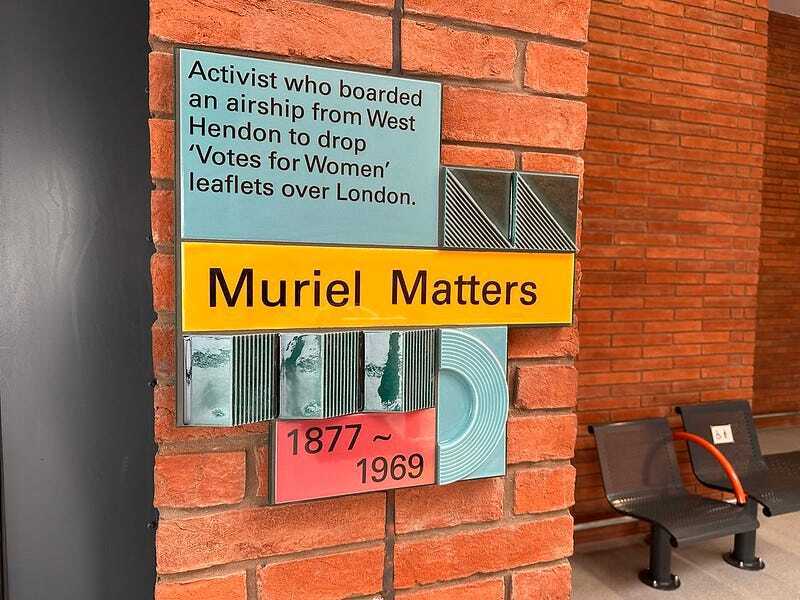
Muriel Matters. It’s one of those names you just have to say out loud. Her one-sentence biography, appended to the station wall, is well-chosen. It lures you in; intrigues; invites you to do a bit of googling. So that’s what I did.
Muriel Matters, I discover, was an Australian-born suffragist, who first came to public attention in 1909 when she chained herself to the grille of the Ladies’ Gallery of the House of Commons. Matters used the opportunity to shout down into the chamber a demand for wider enfranchisement. She may well be the first woman ever to address the House of Commons, albeit from a protester’s perch.
The event was widely reported. It convinced Matters that headline-grabbing stunts were a useful tool in the campaign for women’s voting rights. The following year, she came up with her most audacious plan yet. She would fly over the capital, where no policeman could reach her, and unleash a cloudburst of enfranchisement.
It all hinged around a yellow, rugby-ball-shaped hydrogen balloon, whose sides were emblazoned with the messages “Votes for Women” and “Women’s Freedom League”. Beneath hung a passenger basket on a delicate iron gantry, which held the propellors and rudder. The dirigible, known as “The Idea” was piloted by the seasoned aviator Herbert Spencer. Together, Matters and Spencer would float over London to ensure that the suffragist cause was the talk of the town.
But there was more. Stowed onboard was 25kg (56 pounds) of suffrage pamphlets. Matters intended to scatter them over London while making a speech from a megaphone. Specifically, her target was the procession of King Edward VII who, on 16 February 1909, would be making his way to the Palace of Westminster for the State Opening of Parliament.
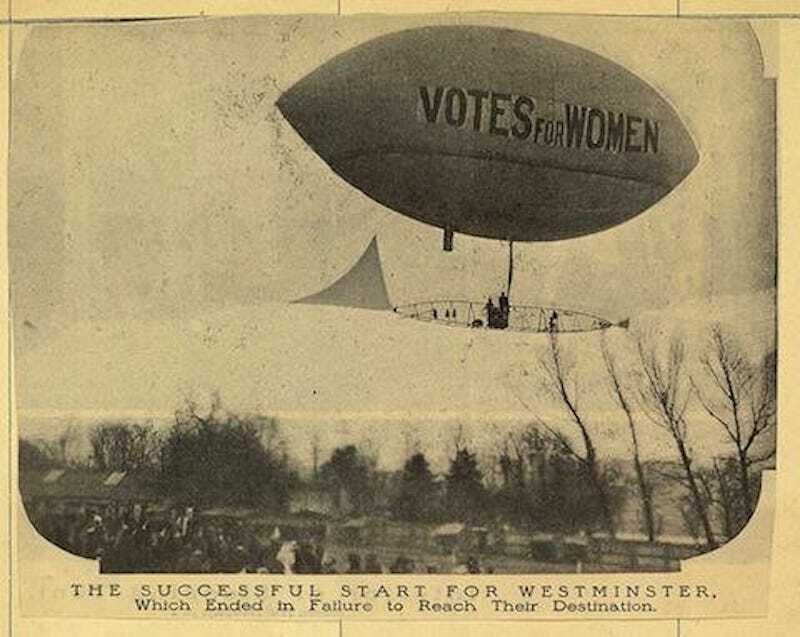
As you’ll intuit from the original caption on that photo, her mission was not entirely successful. The craft lifted off as planned from West Hendon, near the Welsh Harp Reservoir (and the future Brent Cross West station). But the ascent went too well. Matters and Spencer found themselves sailing over Kensington at 3,500 feet — about a kilometre. It was too high, and too far west for the writing on the craft to be seen at Westminster; too distant for her megaphoned cries of enfranchisement to be heard. The King remained blissfully unaware of the protest taking place in His Majesty’s firmament a few miles away.
Still, it wasn’t a wasted effort. The leaflets were dropped over west London “like beautifully coloured birds”, which scattered far and wide. Eventually, the balloon came down in Purley in extreme south London (or Surrey at that date), and landed safely after a close encounter with a hedge.
“I think we can say now we are well up to date,” commented Matters to the press. “If we want to go up in the air, neither the police nor anyone else can keep us down…”
“Think of us landing on the House [of Commons] one of these nights and giving the Members advice through the window by megaphone!,” she told another paper.
An airship over London was still a great novelty in 1909. The aerial protest might not have reached Westminster, but it was still reported widely, bringing publicity to the cause. Not all of the reportage was positive, however. Many of the headlines involved the word “fiasco”. John Bull Magazine was particularly condescending:
“Votes for women will not come a day sooner because you go up in a balloon… Do exercise a little restraint my dear. Why don’t you just get married? I can assure you that marriage is a much more interesting and varied entertainment than you are having now.”
We shouldn’t judge the past by today’s standards but, really, John Bull magazine can just cock off.
As far as I can tell, the suffrage movement never took to the air again, although a tethered, unpiloted balloon was involved in the literal am-bushing of Herbert Asquith a few months later. The Prime Minister was in Embankment Gardens unveiling a statue to Sir Wilfred Lawson, when a group of suffragettes emerged from the bushes to confront him. “Why don’t you do justice to living women rather than dead men?” was the pertinent question. A “monster captive balloon” bearing the Votes for Women message was then raised into the air. The fight continued, but it wasn’t until 1918 that some women would get the vote.
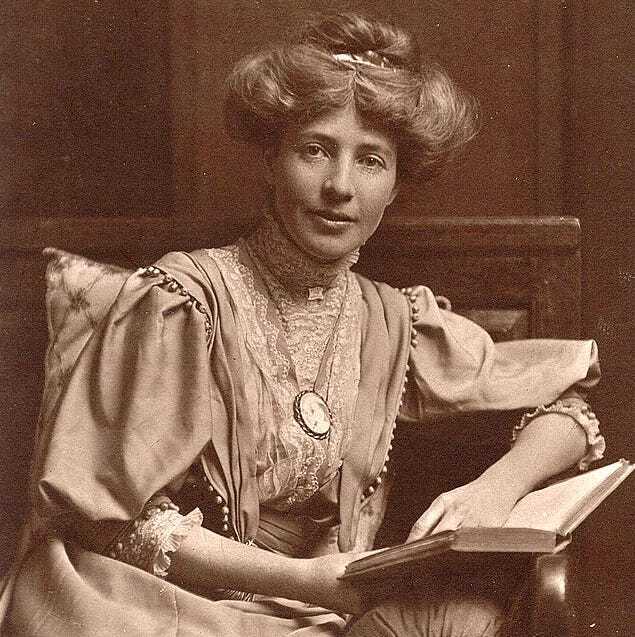
Muriel Matters’s courageous flight over the capital was a one-off, but it does hold a special place in aviation history. This was the first ascent from the Hendon area in a powered craft — albeit powered by the weak engines of a dirigible. The area would soon become known as an important airfield, and later as an RAF base. The RAF Museum now covers part of the site, a little to the north.
It’s fitting, then, than Muriel Matters’s airship adventure should be commemorated in Brent Cross West station, which stands very close to the site of her historic ascent. I salute the person who designed the simple but intriguing memorial. As I always say, pay especial heed to the plaques that make you think “Who?”. They invariably have a story to tell — and Muriel Matters more than most.