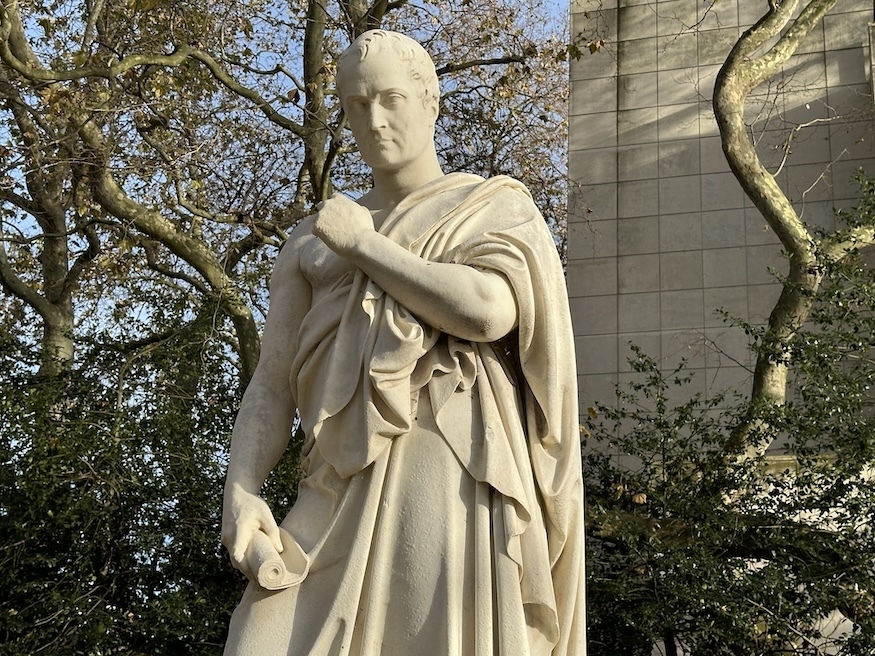
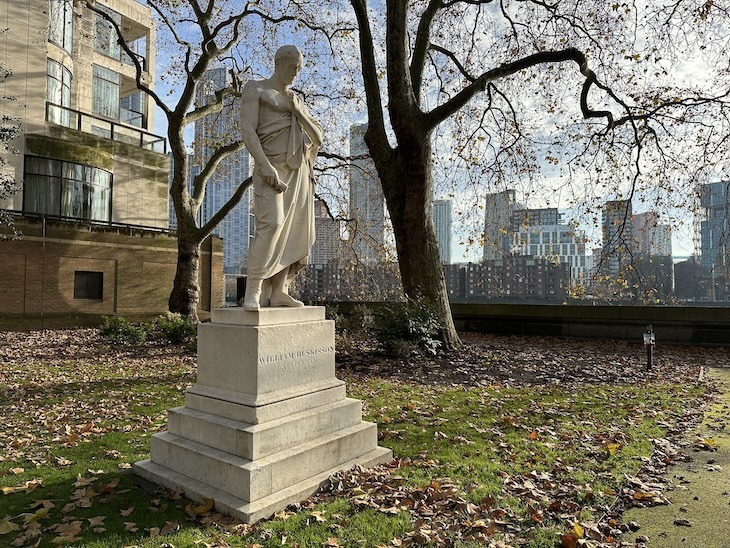
Ignore the toga and toilet roll. This statue in Pimlico Gardens depicts a serious statesman, but one who died under the most unusual circumstances.
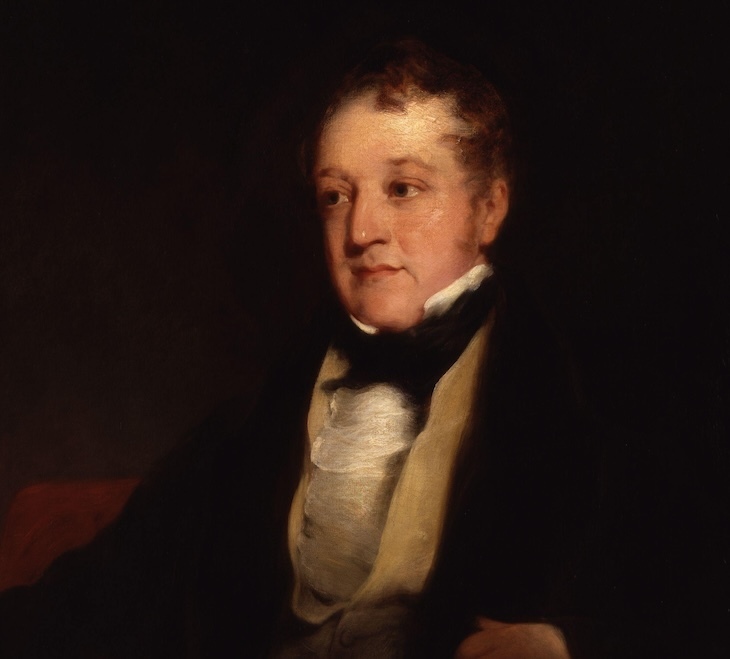
You're looking at the stone likeness of William Huskisson, a resident of St James's, a prominent Member of Parliament and Leader of the House of Commons in the 1820s. The man would be forgotten today — and would lack a statue — were it not for his unusual fate. Huskisson was one of the first people to be killed on the railways... and while surrounded by world-famous figures.
The year was 1830. London was still half a decade from getting its first train service, but a few early lines had opened in northern England. Huskisson had travelled up from London to be among the first passengers on the Liverpool and Manchester Railway. He was, after all, Member of Parliament for Liverpool.
He wasn't the most famous person to board the debut train. Heading the party of around 80 dignitaries was the Prime Minister and war hero, the Duke of Wellington. Also onboard were Home Secretary and future Prime Minister Robert Peel, as well as Lord Salisbury (father of yet another Prime Minister). The ultra-VIP passengers were pulled along by another titan of the age, George "King of the Railways" Stephenson, who drove the locomotive called Northumbrian.
The train left Liverpool and pootled along happily for many miles, a brass band playing loudly from the first carriage. It paused at Parkside station, near Newton-le-Willows to take on water and fuel. Many of the dignitaries used the opportunity to got off and admire the new technology. It was here that Huskisson got into difficulty.
While crossing the tracks to shake hands with the Duke of Wellington, Huskisson was alerted to the approach of a second train on the adjacent line. Had he remained still, then the train would have passed harmlessly by. He seems to have panicked, however. Some accounts say he tumbled in front of the approaching train; others suggest he tried to clamber into the Duke's carriage on the parallel line, but then swung outwards on the door, and into the path of the oncoming train. Either way, his body fell across the tracks, and his right leg was badly mangled by the passing engine.
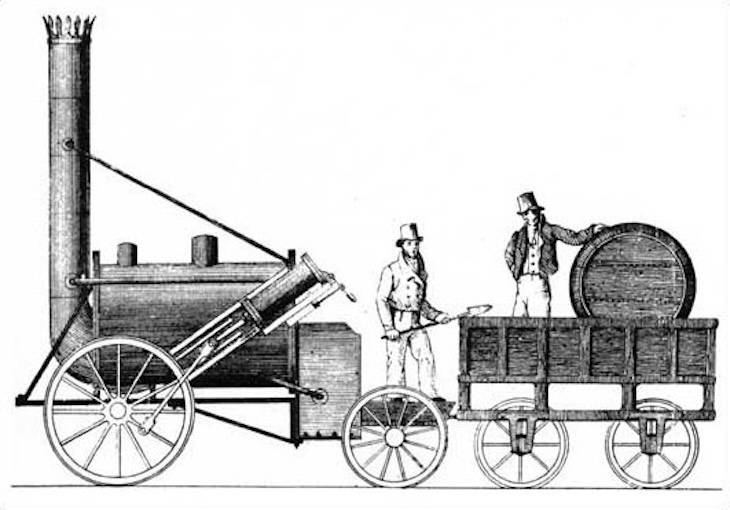
This wasn't any old locomotive, either. It was Rocket, designed by Robert Stephenson with input from his father George, and arguably the most celebrated locomotive ever built. Rocket's driver on the day was another notable individual. Joseph Locke was an assistant to George Stephenson, but would go on to lead many important rail projects. Notably for Londoners, he designed Barnes railway bridge and the viaduct between Waterloo and Vauxhall.
An eyewitness described the horror of the Rocket's strike: '[Huskisson] was caught by it, thrown down & the engine passed over his leg & thigh, crushing it in a most frightful way. It is impossible to give an idea of the scene that followed, of the horror of everyone present or of the piercing shrieks of his unfortunate wife, who was in the car. He said scarcely more than, "It's all over with me. Bring me my wife and let me die"".
A handkerchief was used as a tourniquet on the stricken Huskisson's leg, and he was taken by train to nearby Eccles for surgery (with George Stephenson driving the locomotive ambulance). The train reached 40mph in its haste, thought to have been a world speed record. Huskisson remained conscious as he became the fastest man on Earth, but would die later that evening from his injuries.
It's often claimed, including by History Today, that Huskisson was the world's first railway fatality. This is far from the truth. At least five fatal accidents occurred to passengers or people at trackside in the 1820s (and undoubtedly many men were killed during construction of the early railways). However, this was the first widely reported railway accident, and therefore the best-known.
Indeed, it might be considered one of the most notable rail deaths of all time. A prominent MP was killed at the opening of a new railway, by a cutting-edge locomotive, in the presence of the Duke of Wellington and George Stephenson (both of whom, along with Rocket, have all since appeared on £5 notes, incidentally).
It's hard to think of a modern analogy. Imagine, perhaps, a famous politician being injured by an exploding rocket booster in the presence of Donald Trump, with Elon Musk driving the ambulance to a land-speed record.
Huskisson is remembered by the statue in Pimlico, as well as a memorial at Newton-le-Willows.