
This feature first appeared in November 2024 on Londonist: Time Machine, our much-praised history newsletter. To be the first to read new history features like this, sign up for free here.
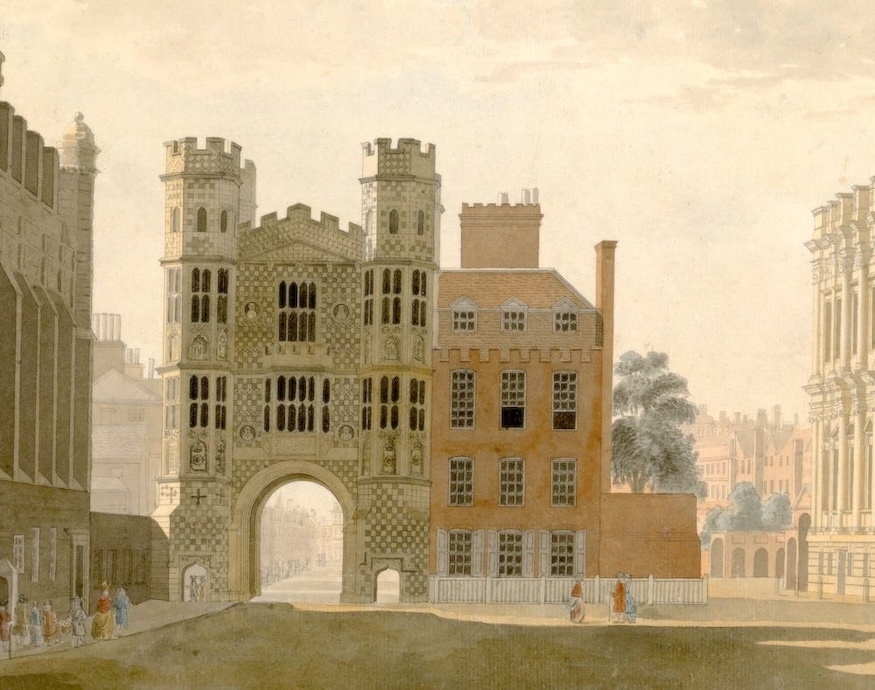
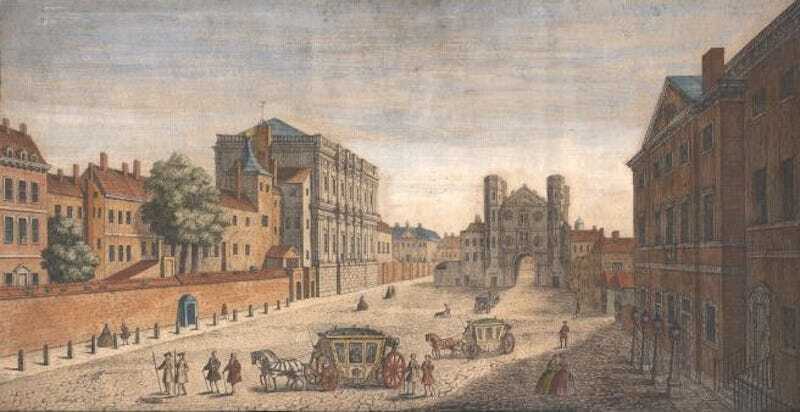
Whitehall, 1759. We’re looking at a handsome Tudor gateway, painted by Thomas Sandby. Long shadows point east. The sun sets in Westminster. It will soon set on the three-decade reign of George II. And this sturdy, crenelated portal has reached its own twilight.
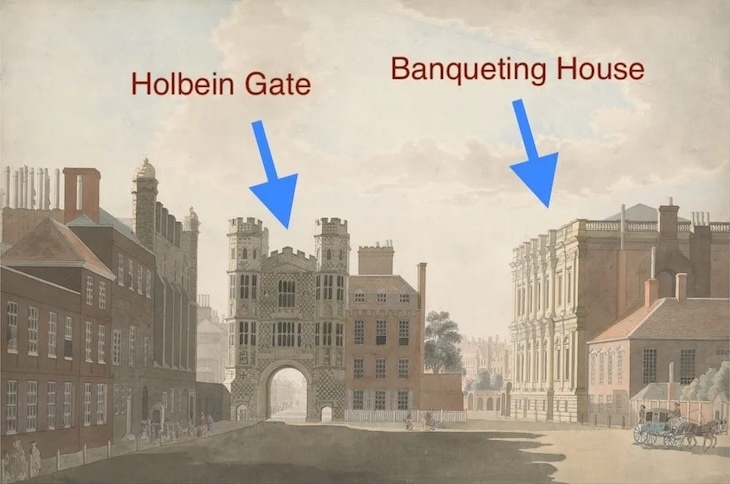
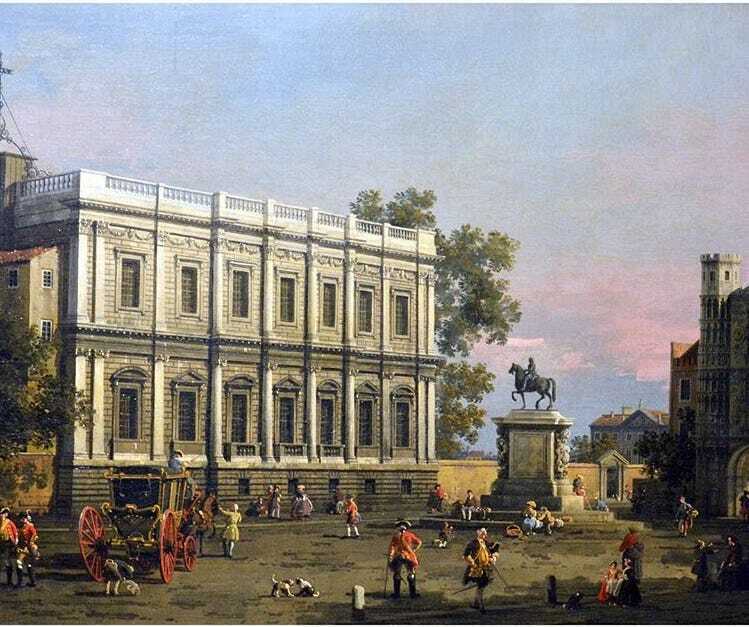
This is the Holbein Gate. It was built in the reign of Henry VIII as a grand, northern entrance for his new Palace of Whitehall. To its right, we can see a corner of Banqueting House, built after Henry’s time, in 1619, by Inigo Jones. Here, Charles I became England’s shortest king, during those tenuous seconds of consciousness thought to occur when a head leaves a body.
The Banqueting House still stands. The Holbein Gate does not. It was demolished in 1759 to help the traffic get through. This was an eminently sensible decision at the time, but a grievous loss to posterity.
Had it stood, the Holbein Gate would today be among the celebrated set-pieces of Westminster. It would feature on a billion Instagram feeds, alongside Big Ben, the Houses of Parliament, Westminster Abbey and the K2 phone box in Parliament Square. It is one of the Great Lost Buildings of London, and a little-remembered one at that.
Wait, Holbein?
If you know anything about Tudor England or art history you will, by now, have asked “is the Holbein Gate named after that Holbein, the one who painted all the kings and queens and nobles and anamorphic skulls?”. The answer is yes. The gateway has long been associated with Hans Holbein the Younger (c.1487-1543), court painter to Henry VIII. It was constructed around 1531 when Holbein already had a worthy reputation from his portraits of Erasmus and Thomas More. By long tradition, Holbein also designed this beauty.
It’s certainly possible. Holbein occasionally dabbled in architectural form and was a well established all-round creative (as we’d now say). But the association with the Whitehall gate lacks any hard evidence. To be honest, it lacks any soft evidence. No written record exists to connect the German-Swiss artist with the building. Indeed, the name Holbein Gate does not seem to have been used until a century or more after Holbein’s death. Earlier sources call it the Whitehall gate, the Cockpit Gate or King’s Gate. The Agas map (1561) labels it as the Court Gate. Only around the time of its demolition do we see references to Herr Holbein.
Besides, Holbein wasn’t even around during its construction. He was overseas between 1528 and 1532, while the gate went up in 1531. It seems unlikely he was involved. Perhaps he simply lodged there at some point, or painted portraits in an upper room. Nobody knows. He certainly would have passed through the gate on many occasions, probably without the slightest inkling that the structure would one day bear his name.
Rare remnant of a lost palace
It’s a double shame that the Georgians knocked the thing down. Not only was the gate a handsome landmark in its own right, but it was also one of the few remaining fragments of Whitehall Palace.
It’s a cliché to describe posh homes as “sprawling” but there is no other word for Whitehall. Behold this plan from 1680.
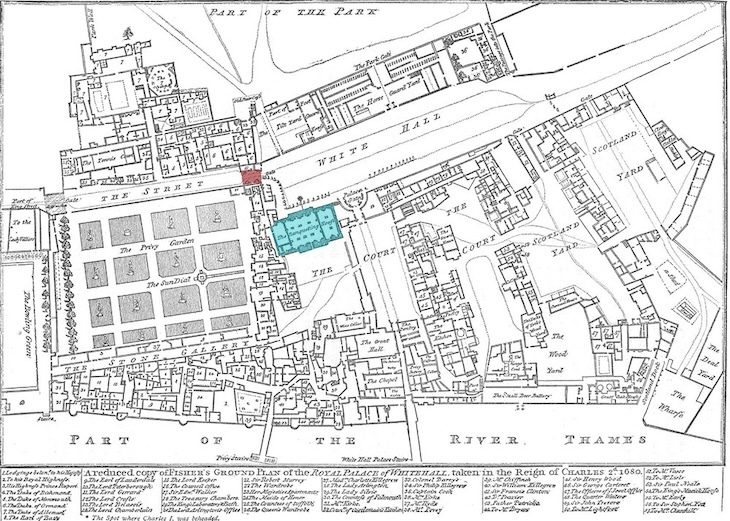
The Whitehall mega-congeries contained over 1,500 rooms. It served as the main residence for Kings and Queens from the 1530s through to 1698. In that year, almost the entire complex burned to the ground. The two most significant survivors were the Banqueting House and the Holbein Gate. Just 60 years later, the gate would also be removed. The Banqueting Hall is now the only one of those 1,500 rooms left standing (with some intriguing caveats, outlined in a postscript below).
What do we know of the Holbein Gate?
The flint-chequered gateway was built alongside much of the palace in the 1530s. Its function was to control traffic on the important road between Westminster and Charing Cross, and thence on to the City. As you can see from the image up top, it was quite the bottleneck, around 3.7 metres (12 feet) wide. You’d struggle to get two carriages or wagons through at the same time. It’s little wonder the Georgians wanted rid of it.
Two floors were built above this pinch-point, along with smaller turret spaces. In later years, the upper floor served as the State Paper Office, the precursor of the Public Record Office, while the lower floor was used for accommodation. You’d think this would be a pretty crummy place to live, what with the clatter and cussing from the roadway below. Yet these rooms saw some noble tenancies, including the Duke of Lennox in 1620 and Lady Castlemaine from 1664.
Castlemaine was, of course, a favoured mistress of Charles II, with whom she had at least five children. The Holbein Gate must have witnessed plenty of Royal rumpy-pumpy during this period. Or perhaps Charles was deterred by the view. Castlemaine’s bedroom would have been just a few metres from the spot where his father was beheaded. Surely a libido killer, even for the Merry Monarch.
Fate of the Gate
We can imagine that the roadway through Whitehall got all the busier after 1698. With the Palace lost to fire, this once royal enclave became a bit more public and permissive. Calls soon came for the gate to be removed. It served little purpose and held up traffic. Even in the 18th century, however, a ‘heritage lobby’ existed. The architect John Vanbrugh led the opposition to its demolition, calling the Holbein Gate “one of the greatest curiositys there is in London.” His intervention brought a stay of execution.
The clock was ticking. 1723 saw the demolition of the other surviving gate, at the Westminster end of the old palace site, and itself quite a looker. Now it was only a matter of time before the Holbein Gate followed suit. In a news article of 1755, we read that:
The Houses at Charing-Cross, from the Corner of Northumberland-House to Whitehall Gate [i.e. the Holbein Gate], have lately been surveyed, in order to procure an Act of Parliament at the next Session for pulling them down, and building a handsome Row a great many yards farther backward; which would be a great Ornament and Advantage to that Part of the Town.
Street widening was the order of the day. Roads all over the city were choked with London’s first great traffic problem, as medieval byways struggled to cope with a growth in Imperial commerce. The gates of the City of London would be torn down in the next decade. But the Holbein Gate met its fate a little earlier. Its noble edifice, which had witnessed regicide, inferno, Old Master painters and slightly macabre assignations, was torn down in August 1759.
Demolition did not necessarily mean destruction, however. Plans were floated to re-erect the stones elsewhere. The Duke of Cumberland, youngest son of George II and victor of Culloden, wanted to rebuild the gate at the end of the Long Walk in Windsor Great Park. Plans were even drawn up to expand the gate, with bonus wings at either end. Sadly, it never happened. The stones apparently made the journey, but were used only to patch up existing buildings.
That’s the accepted story. However, I found one press mention that casts some doubt. A snippet in the Leeds Intelligencer, syndicated to other titles as well, tells us that:
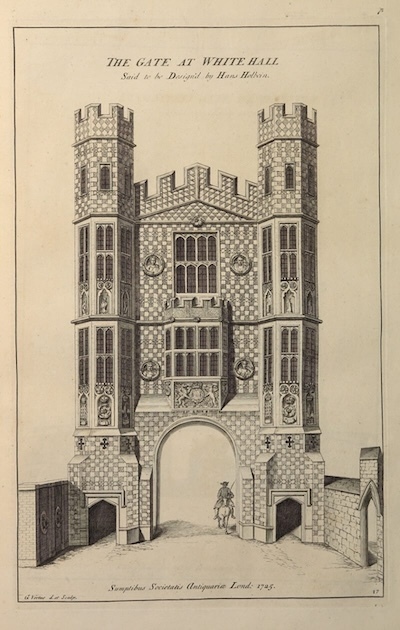
“…the eight enamelled antique heads on the old gate at Whitehall, are to be sent down to Windsor Lodge, for his Royal Highness the Duke.” - 7 August 1759
The heads can clearly be seen on several illustrations of the gate, such as this one.
If the Duke was interested in the whole gateway, why would the news snippet report only the transport of the enamel heads? Who knows. Newspapers of the era can be unreliable. I can find no further record of what became of the stones, or the heads. It’s tempting to believe that the fabric of the Holbein Gate may still exist, smeared out across a number of locations around Windsor. Perhaps the heads, too, decorate anonymous outbuildings somewhere in the Home Counties.
(An unreferenced comment on Wikipedia notes: “Three terracotta busts by Pietro Torrigiano owned by the Wright family in Hatfield Peverel until the 1920s were thought to come from the Gate, but later scholarship doubts any connection.” I’ve since heard that two of the heads are thought to have survived at Hampton Court Palace.)
As I’ve predicted before, our city will celebrate the Great Festival of London in 2051, marking 200 years since the original Great Exhibition but also 2,000 years (near enough) since the Romans founded Londinium. It’s my only ambition in life to be on the organising committee. One of my proposals will be to recreate some of the Lost Buildings of London holographically (or with whatever technology comes along by then). The Holbein Gate will be first on the list. It shall rise again.
Postscript: A few other surviving fragments of Whitehall
As I mentioned above, Banqueting House is the only major survivor from Whitehall Palace. But smaller fragments remain here and there. The largest can be seen in the basement of the Ministry of Defence (well, it can if you happen to know someone with security clearance). Deep below the neoclassical fortress lies “Henry VIII’s wine cellar”, a modestly sized room that was indeed used for wine storage in the Tudor era. Like a bibulous courtier, the room has lurched somewhat from its original position. During the late 1940s, the stone remains were lifted and repositioned a few metres to the side, to make way for the MoD building’s foundations. The room is now used for internal social events. I have been down there, sneaking in with the help of a friend of a friend, but I was asked not to take photographs.
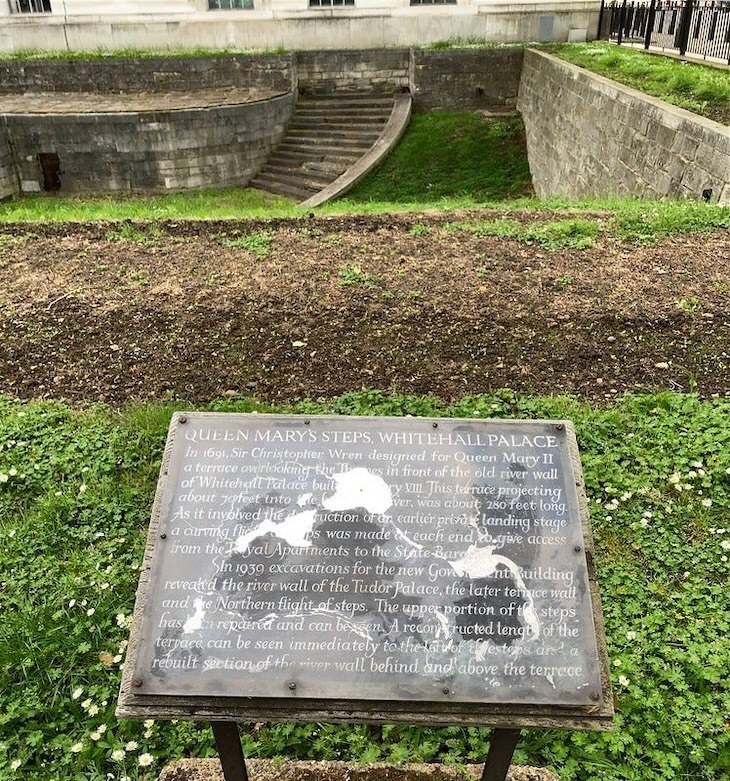
A much more readily viewed fragment can be found on the Embankment side of the MoD. Here we find “Queen Mary’s Steps”, a short flight of stairs and part of an embankment. These were added to the palace in 1691 by Sir Christopher Wren, just seven years before the palace burned down. These too were uncovered during construction of the MoD.
I’m told that further fragments can be seen inside the Cabinet Office and Old Treasury Building. I’ve never seen these personally. If anybody reading this has access, and the ability to invite an inquisitive feature writer in for a look, then I would be delighted to hear from you! ([email protected])



_(14597893099).jpg)