Adapted from a feature that first appeared in September 2025 on Londonist: Time Machine, our much-praised history newsletter. To be the first to read new history features like this, sign up for free here.
London has so many museums that you could easily build a family tree with different clades and genera. One of the shorter branches — or perhaps roots — would be the ‘crypt museums’, historical snapshots built into church undercrofts. We don’t have many crypt museums, actually, but they’re all marvellous, and I bet we have more than Los Angeles, Tokyo or Hull.
Next time you’re in central London, consider popping into these hypogeal treasure houses, most of which are free. The ancient surroundings are often as enchanting as the exhibits.
St Bride's, Fleet Street
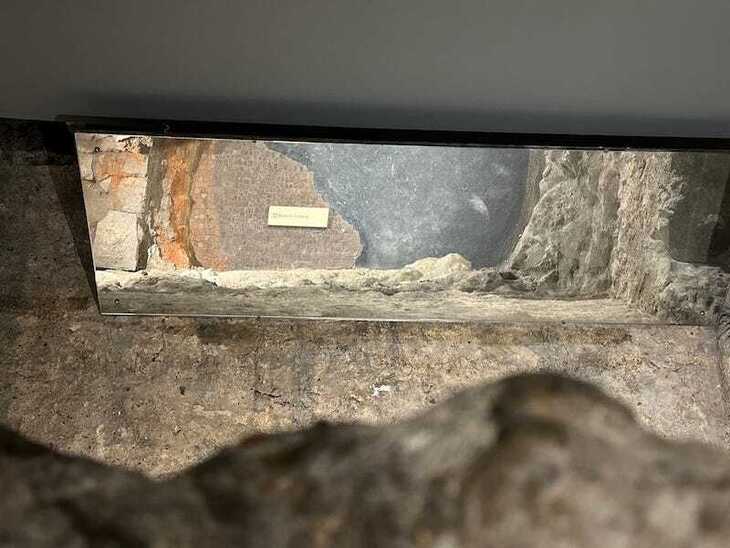
St Bride’s off Fleet Street is one of Christopher Wren’s more famous churches. Its colossal steeple supposedly inspired (pun reluctantly intended) the stepped-shape of wedding cakes. (Nobody has ever found proper evidence of this, but it’s repeated in reputable books and websites, so it must be true.) As well as gazing upward, though, we should also look below, because St Bride’s has one of the best basements in London.
Its extensive crypt serves as a museum to the building’s complicated history. Indeed, it might be regarded as a potted history of the City itself. The eastern end contains part of a Roman pavement, preserved in situ for almost 2,000 years. You’ll also find a section of wall from a Saxon church (very rare in the Square Mile), as well as various medieval replacements.
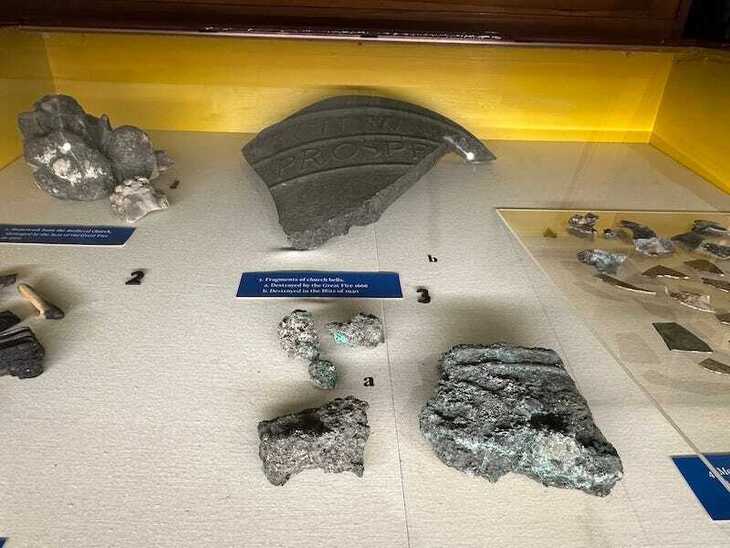
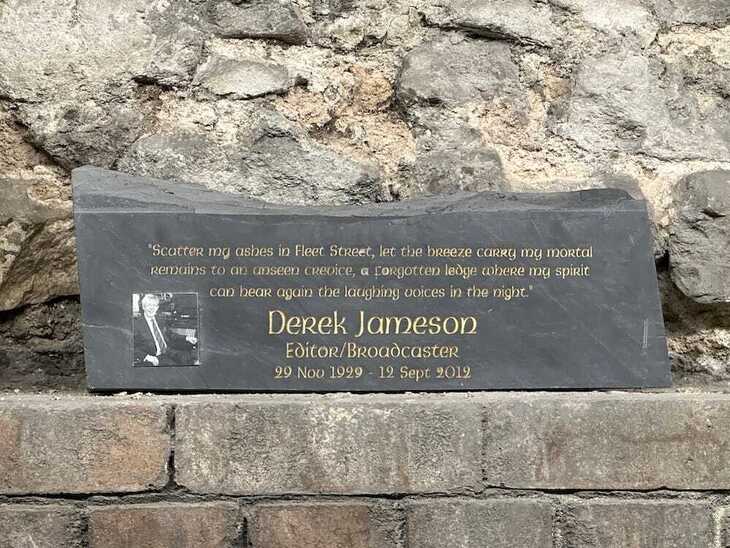
St Bride’s has burned down on at least two occasions. Broken, part-melted bell fragments from the Great Fire of 1666 are placed on display next to similarly stricken metal from the Blitz. The tintinnabular relics are a powerful example of continuity. Nearby, you can examine an original key from Christopher Wren’s era, along with writer Samuel Richardson’s coffin plate, and an iron casket designed to deter grave robbers. Meanwhile, a side corridor displays tombstones of some of the long-term inhabitants. Among them is a memorial to a journalist and broadcaster whom many British readers will remember:
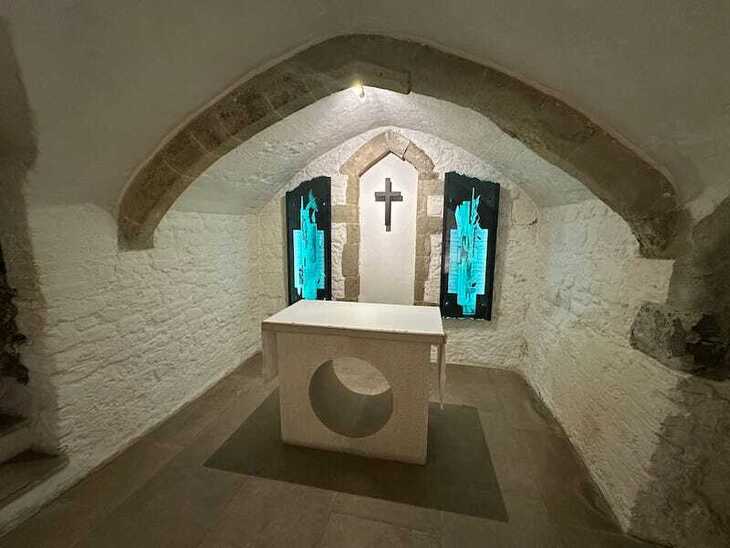
Just beyond, a medieval chapel from the pre-Fire church has been preserved, and is now a memorial to the staff of Associated Newspapers who lost their lives in the world wars.
I distinctly remember seeing a charnel house down here, too. Actually, I even got a photo of it. That area was not open to the public on my most recent visit, however.
St Bride’s Crypt Museum is free to visit, and open seven days a week during church hours.
All Hallows-by-the-Tower
London’s other impressive crypt museum can be found at the opposite end of the City, right next to the Tower of London. All Hallows-by-the-Tower, also known confusingly as All Hallows Barking, is a rarity in that Christopher Wren didn’t touch it. The nave is early medieval and escaped the Great Fire, while the tower was built in 1658 following the destruction of its predecessor in an explosion (a tale for another day). Much of the church is, however, a patch-up after it sustained heavy damage in the Blitz.
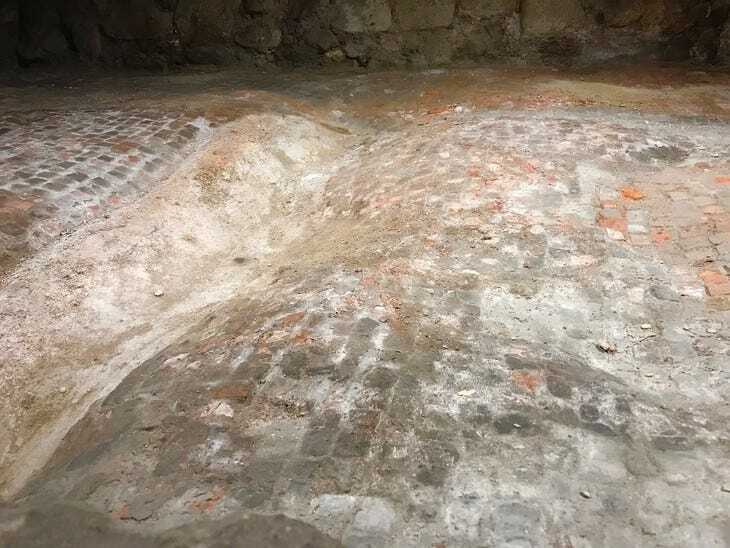
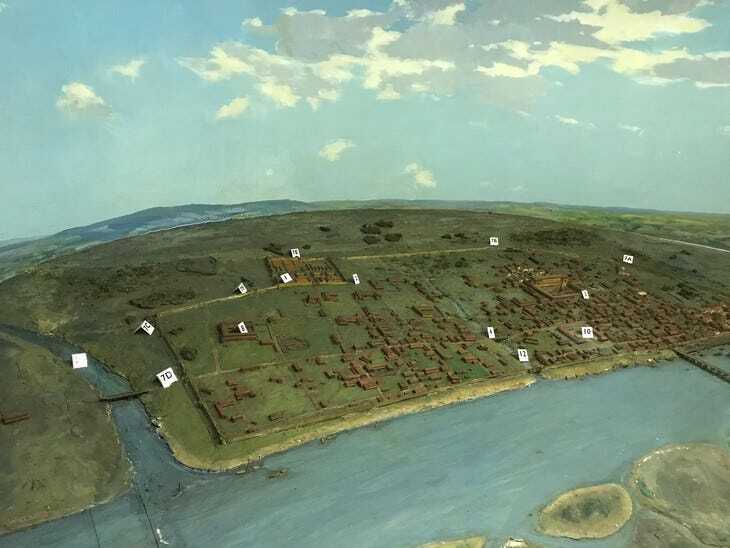
The temporal fusion continues inside, where an Anglo-Saxon arch survives among the later masonry. Down in the crypt — also largely Saxon — we once again push back to the limits of London chronology, thanks to the significant survival of a Roman pavement. This is complemented by a charming model of Londinium. This recreation is a century old, and is itself now an historic artefact. It was created decades before the discovery of the Roman amphitheatre beneath Guildhall, which is therefore absent.
American visitors will applaud the central section of the museum. William Penn and John Quincy Adams were respectively married and baptised in the church, and the parish records from these events are on show. An impressive plaque to Penn, damaged in the Blitz, is also on display.
Other exhibits in the museum include various bits of church plate, more Anglo-Saxon stonework and the crow's nest from Ernest Shackleton's last Antarctic voyage (I don’t recall why). Look out for the twisting stalactite of metal in the side-chapel. This is another relic of the Blitz. Firebombs melted the church’s lead roof, which trickled to the floors below.
All Hallows-by-the-Tower Crypt Museum is free to visit and open seven days a week during church hours.
St Martin-in-the-Fields, Charing Cross
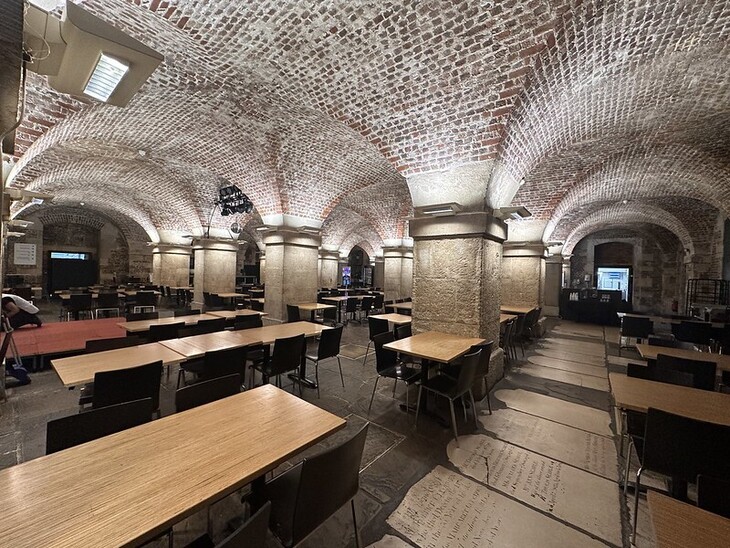
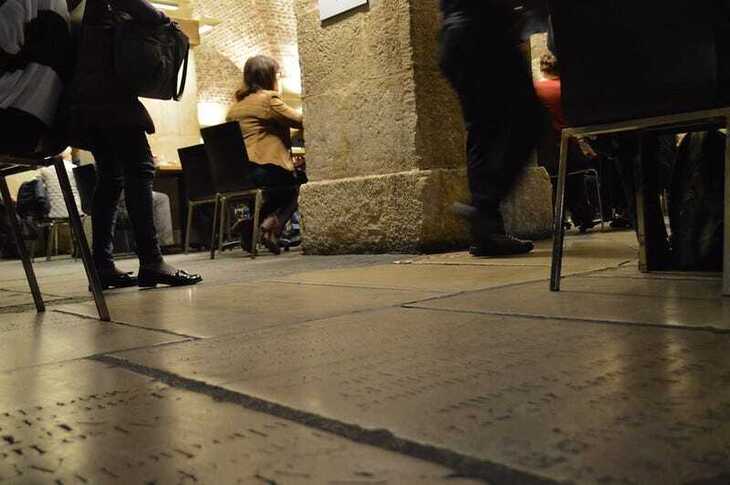
Of all London’s crypts, St Martin’s is easily the most visited. Its spacious refectory-style cafe is always full (the photo above was taken outside opening hours), thanks to the location beside Trafalgar Square and the National Gallery. Very few people, it seems, are bothered about dining on top of gravestones.
The western end of the crypt contains an easily missed series of chambers that serve as a small (and free) museum. Only a handful of items are on display, but they’re all interesting. Where else can you see an 18th century whipping post next to a statue of the first Pearly King?
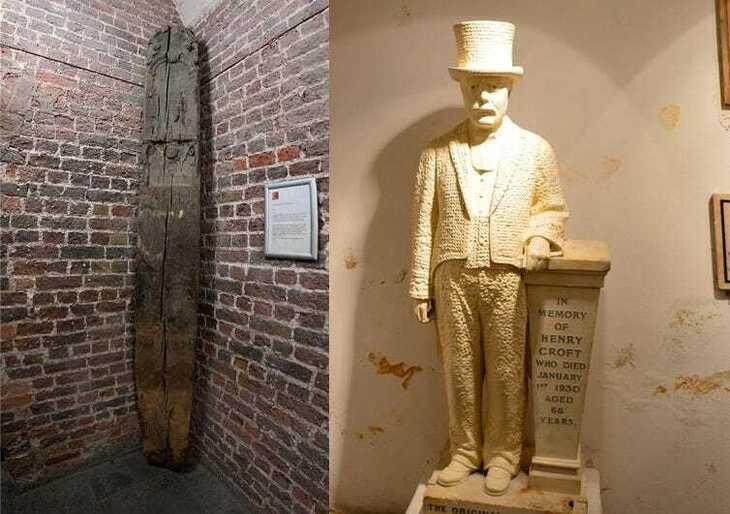
St Martin-in-the-Fields crypt gallery is free to visit and open seven days a week during church hours.
Other equipped crypts
St George’s Bloomsbury: This Nicholas Hawksmoor church houses the Museum of Comedy in its basement. Despite the name, the space is predominantly a stand-up venue, but it does display a handful of exhibits, such as Bill Bailey’s six-neck guitar.
St John’s Smith Square: Known as ‘Queen Anne’s footstool’, because it looks like an overturned stool, this former church in Pimlico is now a concert hall. The crypt is an upmarket cafe known as the Footstool restaurant.
St Mary-le-Bow: The famous Wren church on Cheapside has a notable place in London lore. You can only consider yourself a true Cockney if you were born within the sound of Bow bells (which means no true Cockneys were born in the 40s or 50s thanks to the bells’ destruction in the Blitz). Until recently, the crypt housed a very welcoming cafe, situated among the bow-shaped arches that gave the church its name. Unfortunately, it closed in late 2025, and we can only hope it will reopen again in some form.
St Mary Magdalene, Paddington: An utterly enchanting polychrome crypt, which is occasionally open to public visits.
St Martin Outwich: Merchant Taylors’ Hall on Threadneedle Street is an exceptionally interesting example of a livery hall, which I’d encourage you to visit if you can find a tour. Its basement hides an almost unique survivor — part of the crypt of St Martin Outwich. This medieval church was rebuilt after the Great Fire, but demolished in 1874. The bit inside the livery hall survives from the pre-Fire church and is a little-known wonder of central London.
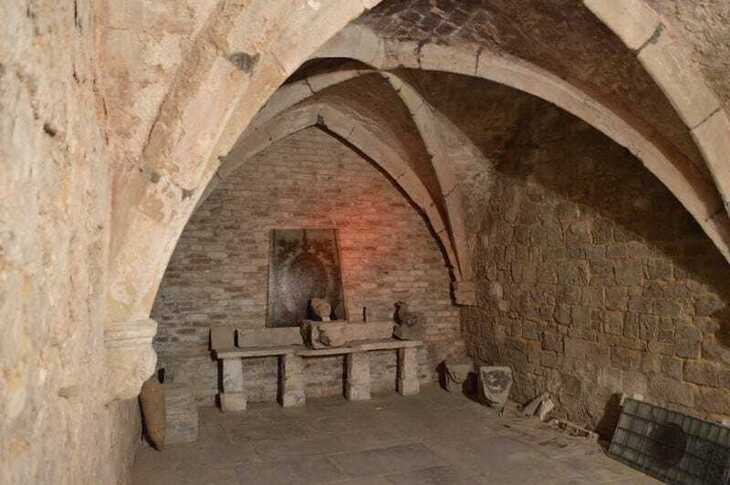
St Pancras New Church: The crypt of this early 19th century church near Euston has long served as a gallery space, with regular changing exhibitions.
St Paul’s Cathedral: One of the ‘must see’ crypts of London, and included in a cathedral entrance ticket. Down here, you’ll see the famous tombs of Nelson and Wellington, as well as memorials to such notables as Lutyens, Florence Nightingale, William Blake, Robert Hooke and, of course, Christopher Wren. They also have a cafe, which can be accessed without entrance fee.
Westminster Cathedral: NOT the Abbey, which doesn’t have a crypt the public can visit, but the Catholic cathedral just down the road. It houses a crypt cafe which, somehow, I’ve never got round to visiting. Maybe I’ll head there now…