This feature first appeared in July 2024 on Londonist: Time Machine, our much-praised history newsletter. To be the first to read new history features like this, sign up for free here.
Everything beneath this brief introduction was written on location; tapped into my phone from Victoria Park.
It’s something I’ve wanted to try for a while. How much history can we absorb simply by observing our surroundings, by reading noticeboards, and by examining the landscape? People use desk research to write about the history of places they have never visited. Can this be flipped? Is it possible to write about the history of a place by visiting, without ever doing the desk research?
I chose Victoria Park in East London for my experiment. It seemed like a good place to start. It’s suitably historic; it’s familiar to many; and it’s a place I feel I don’t know as well as I should. Plenty of scope, then, for historical discovery.
To write this article, I followed three self-imposed rules:
-
Every word must be written inside Victoria Park, and on one visit.
-
No Googling. Only information found within the park, or drawn from my own observations or memory can be used.
-
No editing afterwards, other than the insertion of images, and typo correction.
That’s it. Obviously, this won’t be the most rigorous or reliable history of Victoria Park you’ll ever read, and nor can you expect the most elegant prose. But I hope that writing in situ will offer some kind of winsome, gonzo-historical twist on “place writing”. Follow me…
On-the-Spot History: Victoria Park
Its story begins with a petition. The East End had been agitating for green space for some time. The West End had four royal parks, but there was, as yet, little public recreational space out east. “Why should landscaped gardens be just for the posh and rich?”, was the gist of it. 30,000 people signed a petition, which was presented to Queen Victoria. Personally, I’d have taken it to the local planning department.
It seems to have done the trick because, a few months later, James Pennethorne got the plum job of designing the new park — the largest for miles around. It would eventually open in 1845, just five years after the petition.
It’s a park of two halves. Or, rather, two unequal moieties, because the ‘East Park’ is several times larger than the ‘West Park’. Head west if you want formal gardens, a gourmet cafe, an adventure playground and a Chinese pagoda. Head east if you’re after open fields, summer festivals and, well, more formal gardens, another cafe and another playground. This place is BIG.
It’s a lovely park, too. I seat myself on a lawn and admire the wildlife. A fritillary flits by. A parakeet shrieks. A nosy wood pigeon eyes up my shoes, for some reason. And all in the time it takes to type this short paragraph. Everything is so green. So green in a way that the dusty, sooty terraces of the Victorian East End so decidedly were not. A visit to Victoria Park must have been like stepping into a magic trick.
Nearby, the west lake teems with life. What I choose to believe are adolescent herons sift through the algae for snacks. Coots form a galore — the best collective noun I can come up with, given that Google is forbidden. The black and white birds totally boss the lake, though the ever growing population of Egyptian geese may soon give them a waddle for their money.
Dogs, though, are the dominant species here. I count 17 from my current, slightly over-moistened position. A woman nearby struggles with four muscular mutts, each intent on sniffing a passing terrier’s fundament. A curly haired man with a shaggy black dog bounces from owner to owner, to warn about “Tower Hamlets’s ‘ASBOs for dogs’ plan”. It would, he says, force owners to keep dogs on leads at all times. “You might have seen it on BBC News,” he tells one passer-by.
I don’t know what I can make of these current concerns in a history-focussed newsletter, other than to observe that Victoria Park has a long association with dogs. Two famous hounds guard the park’s Bonner Gate. Here they are:
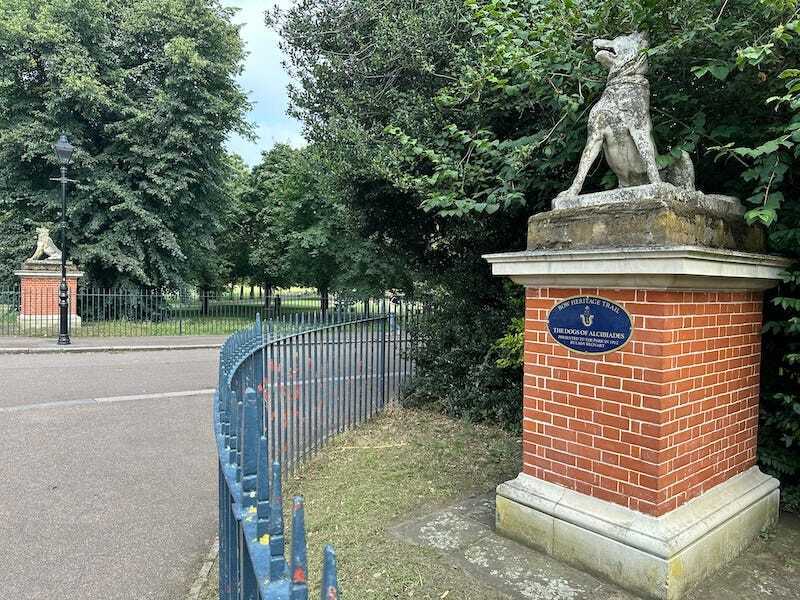
These fearsome guardians are the “Dogs of Alcibiades”, a pair of stone canines based on Roman sculpture. The duo have kept their vigil here since 1912. Those who are well read in London non-fiction may recognise them from the front cover of Iain Sinclair’s Lights Out for the Territory. What we see today are 2010 replicas, installed after the originals became too weathered to mount a credible guard. And they do have a health and safety function. According to legend, the dogs will spring to life to save anybody drowning in the canal. I casually wonder if they’ll be able to perform their heroics if the Mayor’s “ASBOs for Dogs” comes into effect.
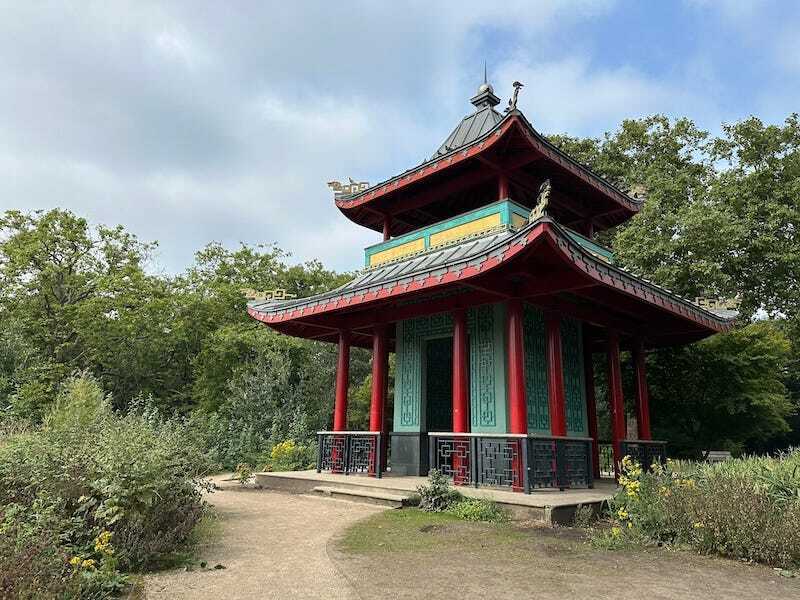
Although Victoria Park opened in 1845, many of its best-loved features were yet to come. In 1847, Pennethorne picked up a second-hand pagoda for £110, late of an exhibition of Chinese curiosities in Hyde Park. He placed it on an island in the middle of the West Lake, where it was greatly admired by the locals, who’d never seen such a thing.
Sadly, the original was damaged in the war and targeted by arsonists in the 1950s. Like the nearby Dogs of Alcibiades, the structure that stands today is a modern replica, erected in 2012 on precisely the same site as its predecessor. You can even walk through the middle. I did not. The dead pigeon with attendant flies, aromatically decomposing within the portal, scared me off.
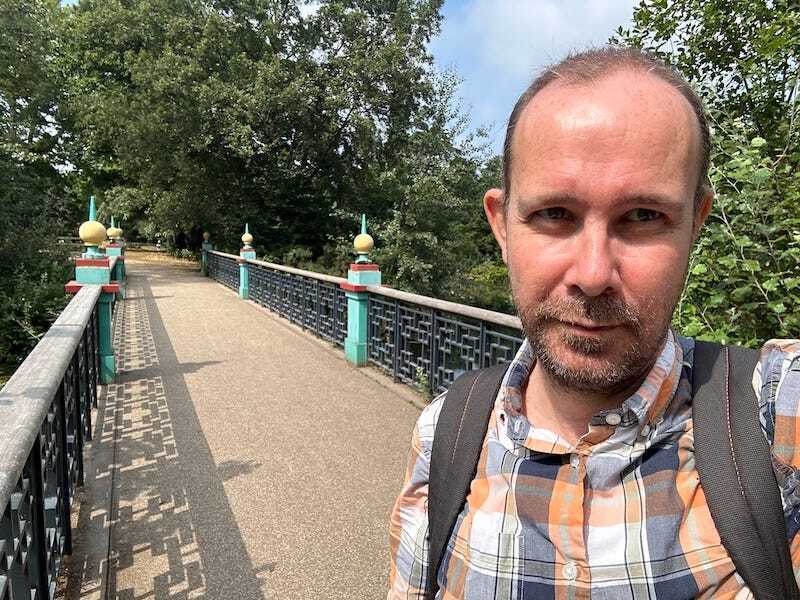
A Chinese-style bridge now connects to the pagoda island. This, too, was Pennethorne’s idea, but he never got the funds. Some 170 years later, this unbuilt structure was finally realised, and I’m typing these words upon its span. Look:
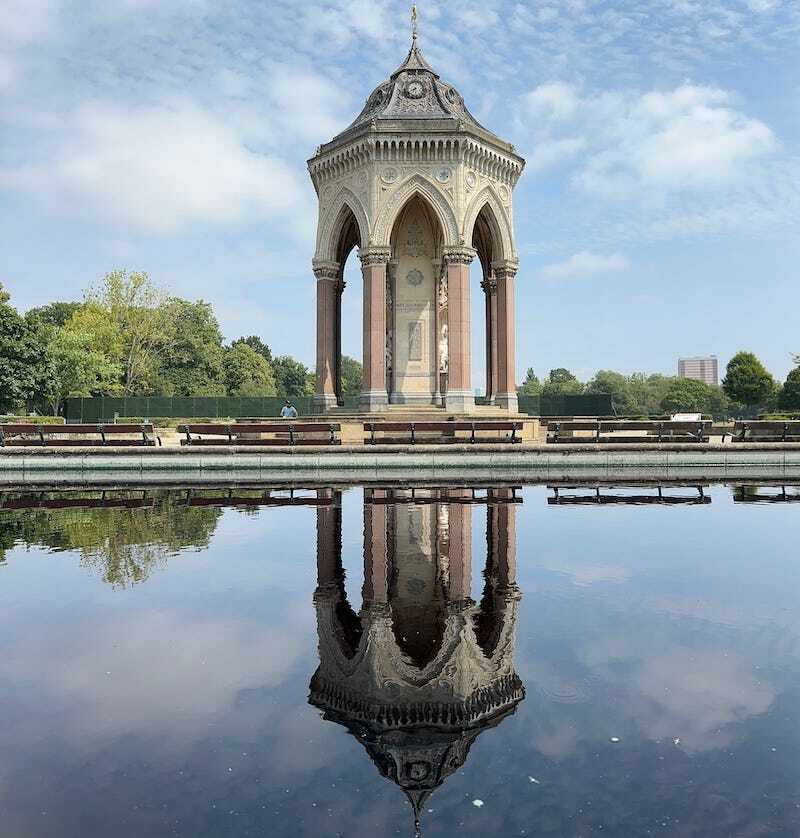
The park’s loftiest structure is the Burdett-Coutts fountain, which rises out of the mid-park like a stockier riff on the Albert Memorial. This must be London’s largest drinking fountain. Angela Burdett-Coutts (ABC to her friends, possibly) had it erected in 1862 as part of her unrivalled sequence of philanthropic additions to London. Its four be-niched cherubs dispensed clean drinking water to the thirsty populace at a time when they would otherwise rely on grim standing water like the park’s lakes. Today, the structure is a flamboyant bauble, but 150 years ago it probably saved the lives of many who might have otherwise succumbed to waterborne disease. That said, the surrounding pools remain popular with the park’s superabundance of dogs

I stop for a brief respite in the magnificent People’s Park Tavern. This sprawling pub is noted for its beer garden, which protrudes heroically into the perimeter of the park. Outside at the Royal Gate I learn that this part of the park was once the East End equivalent of Speakers’ Corner. The spot attracted many famous orators, including George Bernard Shaw and William Morris, to what locals dubbed the “Forum-and-Agin-em” (For them and Against them).
I move on to the northern section, which has fewer monuments and features of interest, and is a lot more ‘fieldy’. This area was traditionally given over to sporting facilities, including tennis courts where Fred Perry trained. A set of cricket nets and bowling greens remain, with modern tennis courts further to the centre.
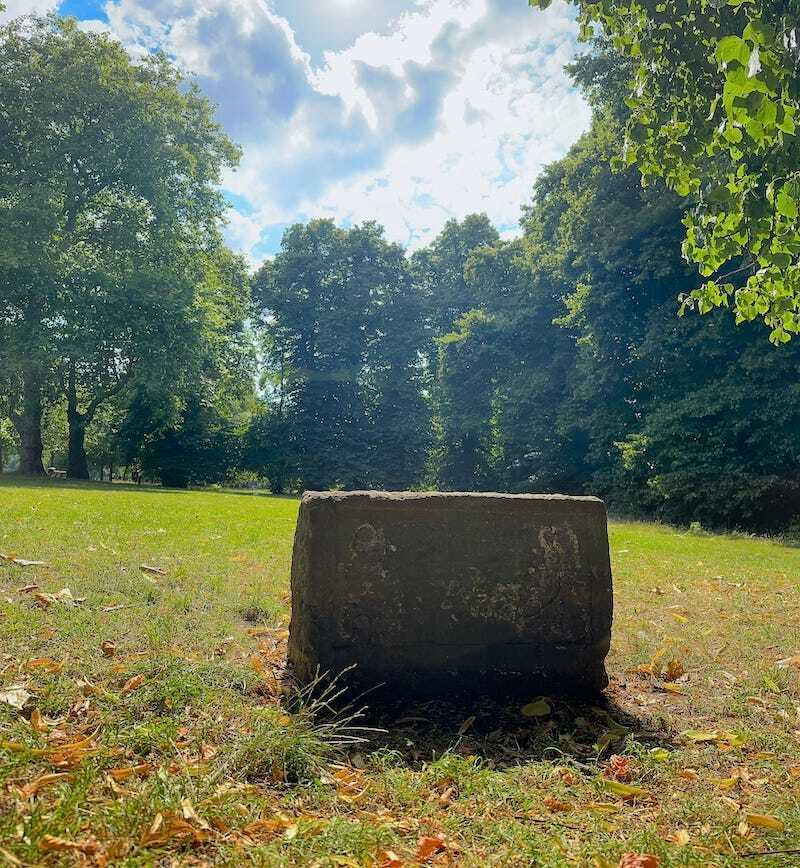
The north-east corner is dominated by an absence. A single stone block marks the place where once stood the alter of St Augustine’s church, built inside the park in 1868. The church was destroyed in the war. Rather wonderfully though, a circuit of mature lime trees marks its erstwhile perimeter. I adore hidden remembrance like this. How many people jog past and never notice? I also wonder if the numerous granite blocks I’ve seen scattered through the northern part of the park are also remnants of the ruin.
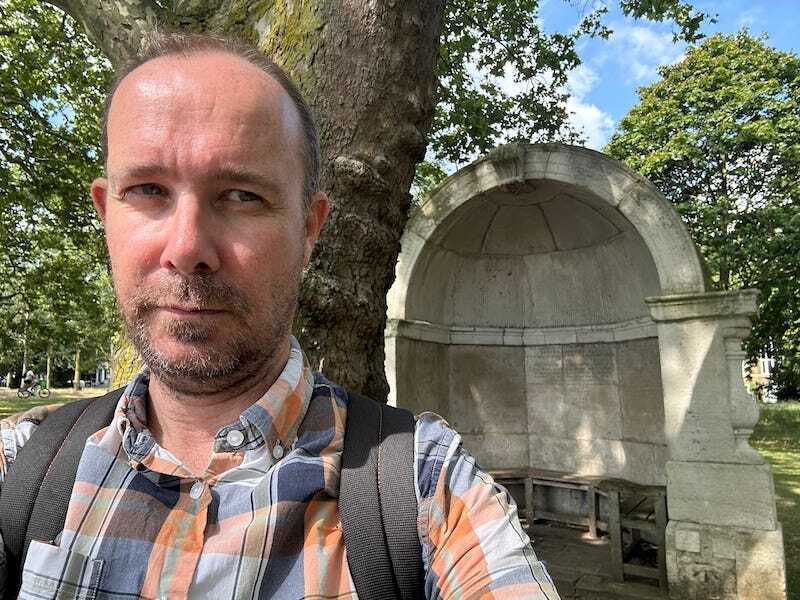
A much better known slice of “hidden history” can be found at the extreme eastern end of the park. Here sit two stone alcoves from Old London Bridge, which was demolished shortly before the creation of Victoria Park. They were placed here in 1860. Two other alcoves survive in London – one in the grounds of Guy’s Hospital and another on an East Sheen housing estate. I’d love to know where the other 10 ended up.
I had intended to complete a full circuit. An amble along the canal towpath to the south would have been nice, and I could have tested the legend of the life-saving stone hounds. Alas, time has defeated me and I must slink off to the train at Hackney Wick. The act of writing in place, of conferring with the turf and the plaques and the ornamental fountains, of sitting and looking and overhearing, has given me a new appreciation for this grand old park. Now approaching its third century, it remains one of our city’s greatest, greenest treasures, for humans and dogs.
Enjoyed this? Sign-up to Londonist: Time Machine for free weekly newsletters about London history.