This feature first appeared in May 2025 on Londonist: Time Machine, our much-praised history newsletter. To be the first to read new history features like this, sign up for free here.
What’s the last thing you expect to happen to you at church?
“Mr. Goodson, a master-taylor in Craven-buildings [Drury Lane], being at the late Mr. Whitefield's chapel in Tottenham-court road, was struck dead by a flash of lightening; the studs in his sleeves were melted, his shirt was burnt, and the hair on one side of his head.” - Caledonian Mercury (syndicated), 30 March 1772
Bartholomew Goodson was struck by lightning, during divine service. Not only that, but his fate seems oddly specific — a master tailor getting fried until his buttons melted. Not only that, but one of the world’s leading authorities on atmospheric electricity died that very same day (22 March 1772), a couple of miles away in Spitalfields. God moves in mysterious ways.
The lightning strike was no idle hearsay. Three gentlemen of the Royal Society were in attendance and even got a scientific paper out of it, complete with diagram. They found that the lightning bolt had been attracted to a pineapple-shaped finial on the roof, which was “shivered into very small fragments.” The electricity then conducted down through the building into the unfortunate tailor’s head. He left behind “a wife and two children in distressed circumstances, who were entirely dependent on his labour”. Goodson was buried in the churchyard just metres from the scene of his electrocution. He might lie there still.
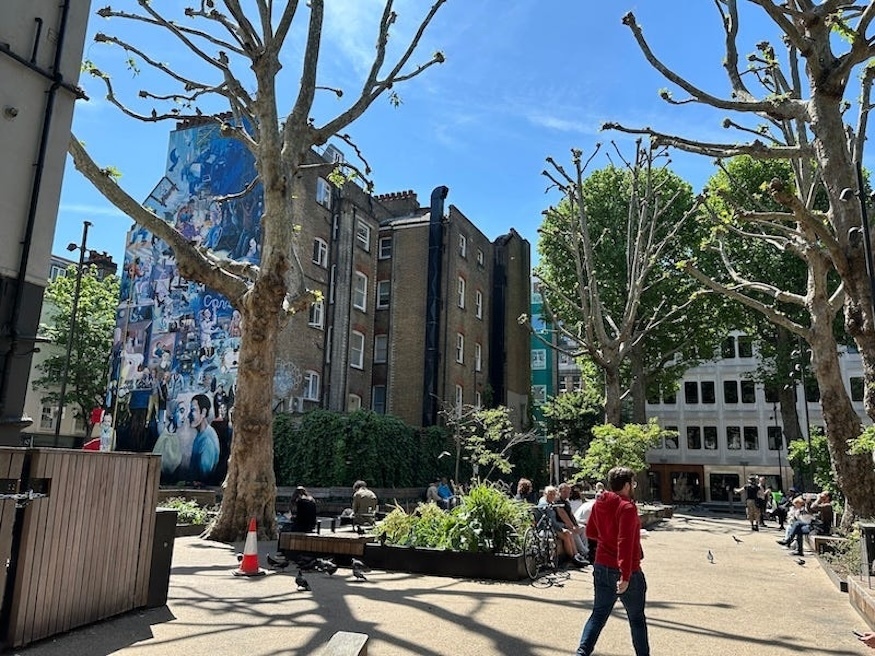
Then again, probably not. The one acre of land where Whitfield’s (sometimes Whitefield’s) Chapel once stood is among the most turbulent sites in London. You probably know it. It’s that peculiar open space mid-way along Tottenham Court Road, just north of Goodge Street station:
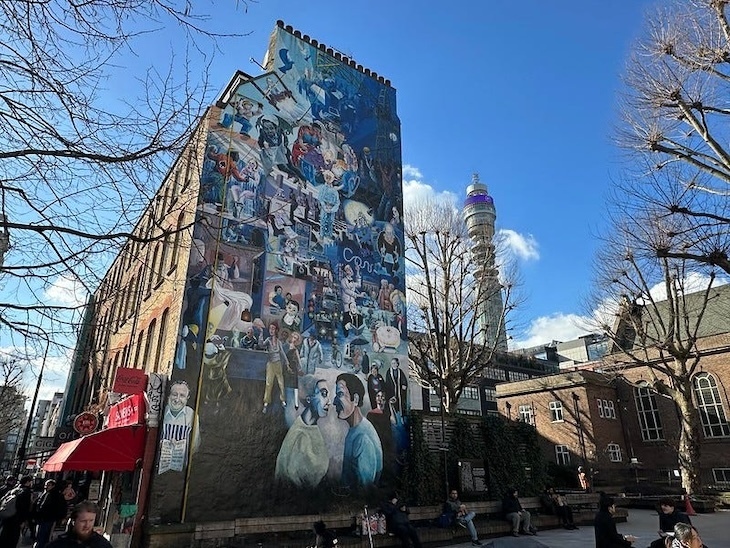
Today, it’s called Whitfield Gardens, though it lacks any turf. (As does Fitzrovia in general; nearby Crabtree Fields is the only bit of publicly accessible grass.) This former graveyard is now paved over with flagstones. 250 years ago, however, these were the verdant limits of London. It was here, in 1756, that the celebrated evangelist George Whitfield chose to build his third tabernacle. As a non-conformist, Whitfield was often at loggerheads with the Anglican church. Hence, he’d been looking for somewhere well away from the central parishes to establish his ministry. This was his plot of choice:
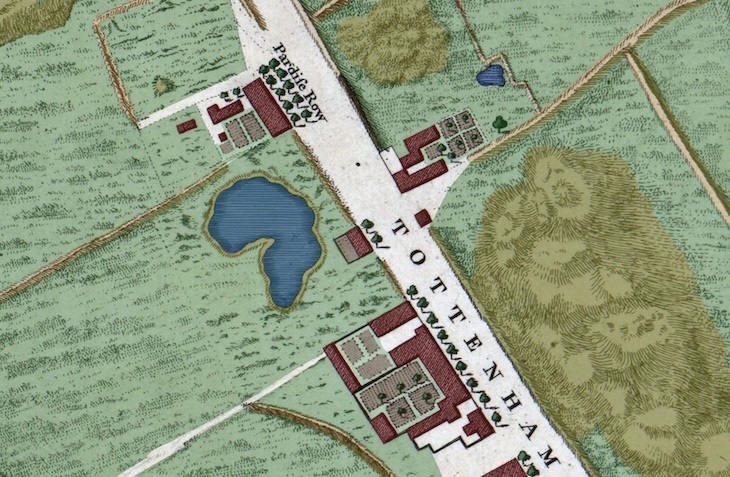
Now, if you were presented with the map above in Sim City or some other town-planning computer game, where would you place your new church? Whitfield opted for the least auspicious spot. He took out a lease on the field containing that Africa-shaped pond. The pool was known as the ‘little sea’ or ‘little deep’ at the time, and it came with a woeful reputation. In 1735, a young apprentice was fished out of the pond, quite dead. Heavy stones were found in his pockets. In 1755, just months before Whitfield gained the lease, another young man was found drowned in the pool, “the Misfortune was occasioned by a Matter of Love”. This was not prime real estate.
Whitfield drained his plot and began to construct his tabernacle. As a dissenting preacher, he was unable to get the ground consecrated through the Anglican church. According to legend, he had a cart-load of blessed soil brought over from one of the City of London churches, which he then covertly sprinkled around the grounds. Consecration by stealth. In the gardens, which would become the churchyard, he erected an epitaph: “Stop giddy World, and consider this Place”.
270 years later, here we are taking up that invitation.
Whitfield had a curious career. He’d been one of the key players in John Wesley’s Methodist movement, though he’d since parted ways and was preaching his own flavour of evangelical non-conformism. He was a celebrated orator, attracting crowds that could sometimes reach the tens of thousands, including such luminaries as Horace Walpole and David Garrick. But he also had a dark side. Whitfield made several voyages to America, where he acquired a plantation and became a slaveholder. He would often preach to enslaved groups, and spoke frequently against their mistreatment. Yet he never decried the slave trade itself, and benefited from forced labour.
His London orations were wildly popular, and could often get rowdy. In 1766, two men “very genteelly dressed” were locked up after “breeding a riot” in the church. Accounts of pickpocketing among the congregation were common.
Whitfield died in 1770, but his church continued. We get a good glimpse of the chapel in the 1799 Horwood plan of London. Here we see the original square tabernacle, with its octagonal extension built just a few years later. Open land to the north and south served as twin burial grounds for Whitfield’s flock (as well as his wife Elizabeth, who died in 1768).
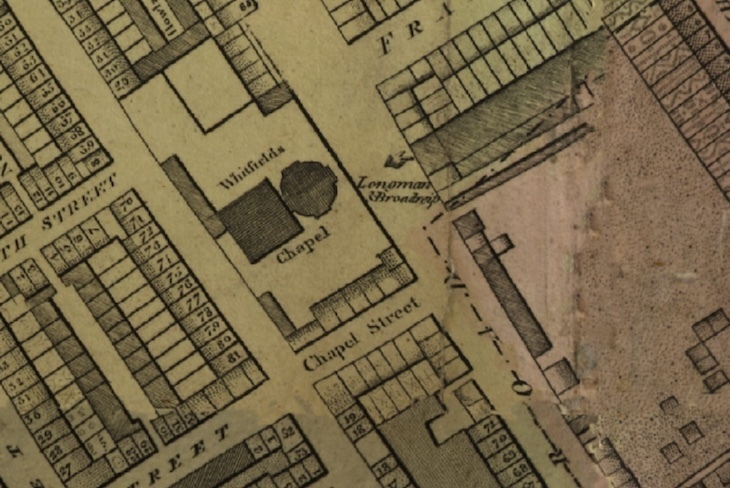
Despite Whitfield’s zealous, uplifting energies, the plot of land would not shake off its tragic associations. Traces of the old pond still remained around the building, prompting an ongoing battle with subsidence. In 1768, an old man was fished from a vestige of the pond, repeating the fate of the two drowned apprentices. In 1785, a man called John Fray caught pickpocket Thomas Waking practicing his light-fingered arts on Tottenham Court Road. He proceeded to throw the thief into the Whitfield pond, where the lad got into difficulty and drowned. Fray was later convicted of manslaughter.
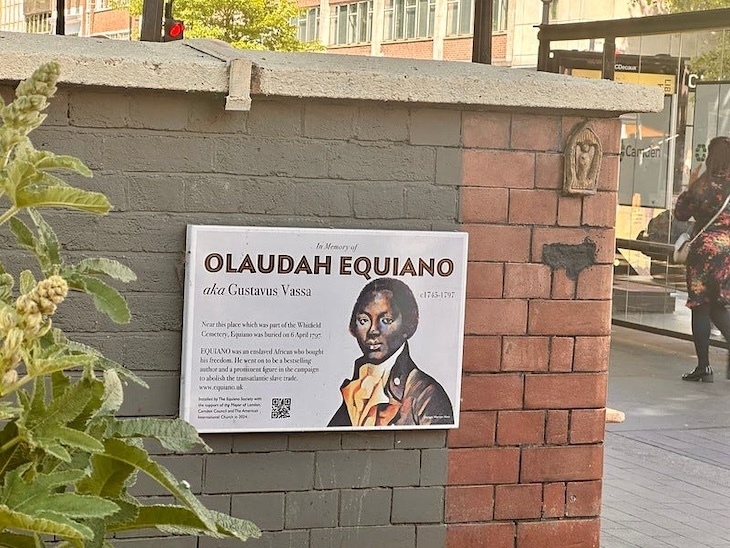
All this time, the adjacent church yards were filling up with bodies. These included the noted abolitionist Olaudah Equiano (1745-1797). Himself a Black former slave, Equiano lived locally and had dabbled in Methodism and Evangelism. He probably worshiped at the tabernacle, and it was the natural burial place when he died in 1797.
Equiano might not have remained underground for long. The churchyard was a notorious spot for grave robbers, seeking recently deceased bodies to sell to surgeons. The year after Equiano’s burial, the Kentish Gazette describes a scene that would make the swimming pool in Poltergeist look like a wildflower meadow:
“It is a most afflicting scene to witness the concourse of people who daily flock about the burial ground in Tottenham court-road, to discover whether the remains of their relatives are still left interred in their graves. Numbers of coffins have been opened for this purpose; and on Tuesday no fewer than twenty-nine coffins were broken up in the church-yard for fire-wood, the bodies having been stolen. There was quite a scuffle for the wood.”
Most of the purloined cadavers were reportedly children, which is… well, I don’t want to think about it. The Kentish Gazette concluded with the kind of insinuation that would have libel lawyers drooling today: “The Sexton supported his family very genteelly, and, exclusive of of his house in town, had a place in the country, without any known means, except the emoluments of his situation.” In other words, he was (allegedly) taking back-handers to allow the grave robbers free reign.
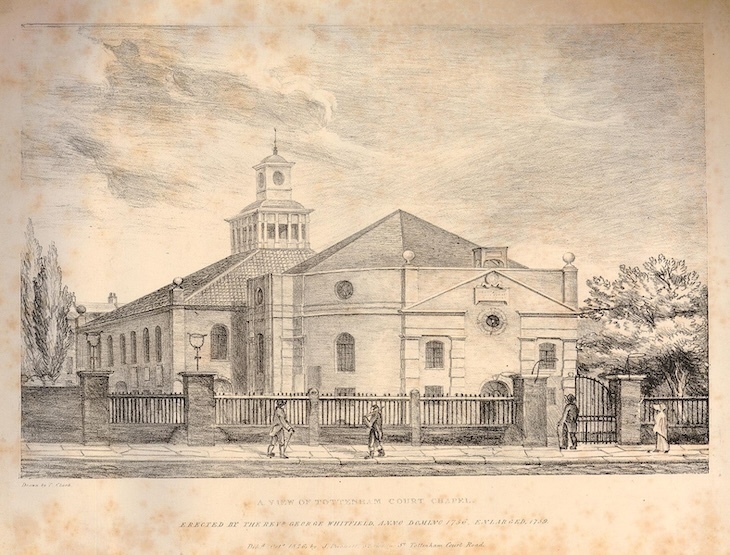
So things continued for many decades. The Tabernacle remained a popular place of worship, but its grounds were an allotment of corpses. New interments only added to the problem. By one estimate, some 30,000 souls were buried in this awful acre; no one can say how many remained there.
The churchyard was finally closed down by the General Health Board in 1849. Even so, a cloud would remain over this spot for many years. A serious fire almost destroyed the tabernacle in 1857. The roof was consumed, and serious damage was done to the interior. It was quickly patched up and continued as a place of worship.
The closure of the graveyard, meanwhile, did nothing to improve its reputation. After a protracted series of ownership disputes (expertly essayed by Paul Slade), the land became neglected, to put it mildly. A press account from 1886 paints a grim picture:
This burial place is now a "no man's land," a hideous eyesore visible to every passer by, in one of London's main arteries. It has become a receptacle for rubbish of all kinds; old shoes, broken bottles, scrap iron, dead cats, and other abominations lie scattered over its surface, with here and there a fragment of human bone. The two of three tombstones which remain are fenced in by a hoarding covered with gaudy advertisements... All the rest have disappeared, carried away in fragments by the urchins who, before the present board fencing was put up, used to play football with the skulls which they scooped up from the reeking mould with their sacrilegious hands… it is a disgrace to this mighty city that, in one of its most frequented thoroughfares, there should be seen a sight so exquisitely painful and shocking to a sense of decency as this neglected Golgotha. -Pall Mall Gazette, 9 Jul 1886
This and other reports prompted St Pancras Vestry (the equivalent of a local council) to acquire the land and turn it into a public park. This did not go well. Within months, the space had been occupied by a tawdry funfair, with a “steam hurdy-gurdy attached to a merry-go-round" along with attendant fortune tellers, coconut shies, a rifle range and freak shows. The hurdy-gurdy and rifle range were so loud that services in the tabernacle became impossible. The church would not last much longer, in any case. In 1889 it was found to be dangerously unstable, “shored up like a cripple on crutches”. The structure was demolished and rebuilt to a new design.
To recap, this sorry corner of London had seen a fatal lightning strike, covert consecration, a drowning or three, the worst excesses of body-snatching, a maddening carnival, fire and ruinous subsidence.
The worst was yet to come.
On 25 March 1945, Whitfield’s Tabernacle received another bolt from the blue. This time, however, the agent was man-made rather than natural. A V2 rocket shot up from the Nazi-occupied Netherlands, crossed the threshold of space, and then arced down towards Tottenham Court Road. It struck just south of the tabernacle. 11 people were killed and many more injured. The surrounding area was devastated. Only one building survived intact, and it still stands today in isolation:
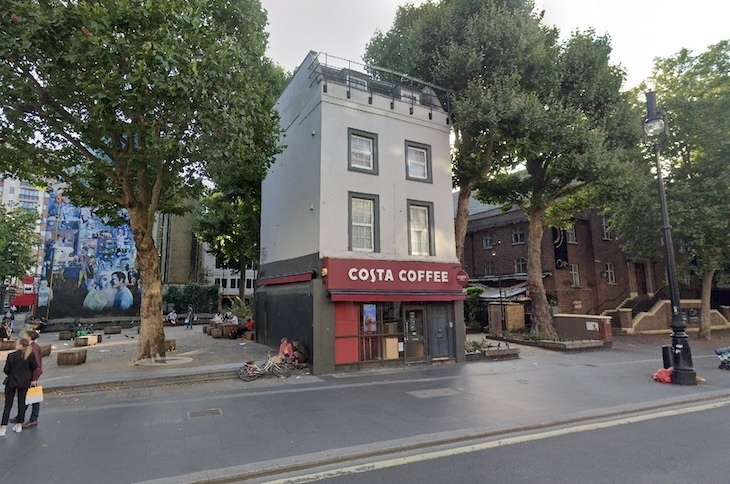
Following the war, the land became a kind of ‘meanwhile’ space, with a sunken sports pitch and a small playground. (This had to be removed in 1953, after repeated vandalism.) In 1957, the tabernacle was rebuilt as the Whitefield Memorial Church. It remains in religious use today as the American International Church.
The link to America is strong here. Whitfield, as we’ve seen, travelled to the colonies several time to preach. Then, during the Second World War, General Eisenhower maintained a secure bunker adjacent to the church, in one of those deep-level shelters whose entrances can still be found along the Northern line.
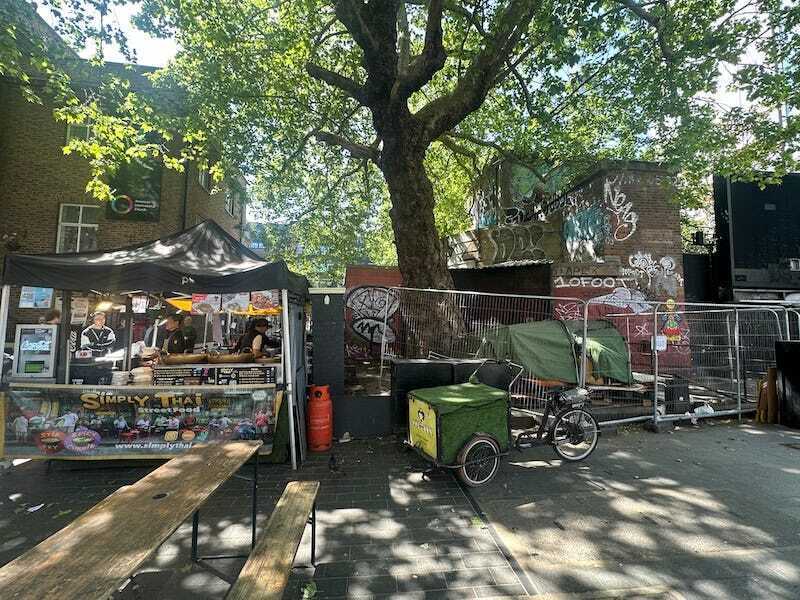
And what of the churchyard today? Camden Council gave it a big overhaul a few years back, adding in new benches and plantings. Even so, there remains an air of disquiet about the place. I popped into the gardens last week, only to be shouted at by a drunk within seconds of arriving. I’ve twice seen mice scrabbling in the borders, presumably attracted by the street-food market that operates to the north of the church. Pigeons are everywhere; same reason.
Yet for all this, Whitfield Gardens is perhaps more welcoming than it’s ever been. The Fitzrovia mural is a much-loved local landmark; the seating provides a rare (for Fitzrovia) space to relax outdoors; the church does good work for the community, including a daily soup kitchen. There’s much to commend the place.
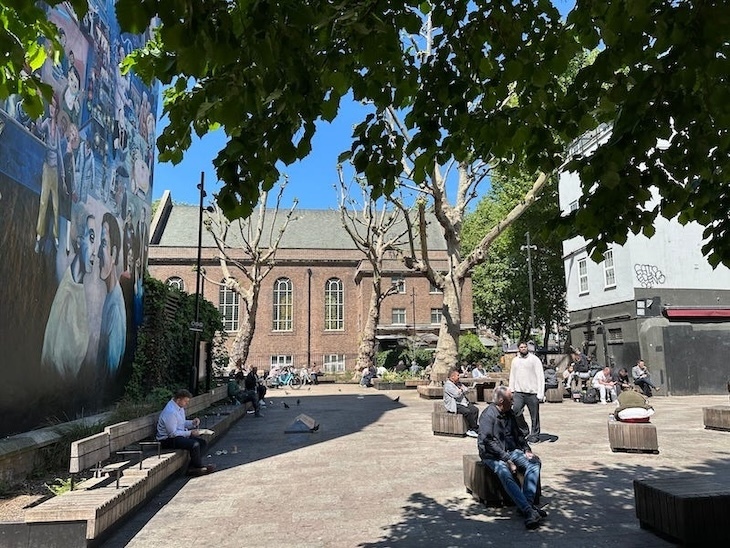
After a lightning bolt, drownings, scuffles, fire, mass exhumations, collapse and a rocket attack, perhaps this turbulent site is finally able to rest in peace.