This feature first appeared in October 2024 on Londonist: Time Machine, our much-praised history newsletter. To be the first to read new history features like this, sign up for free here.
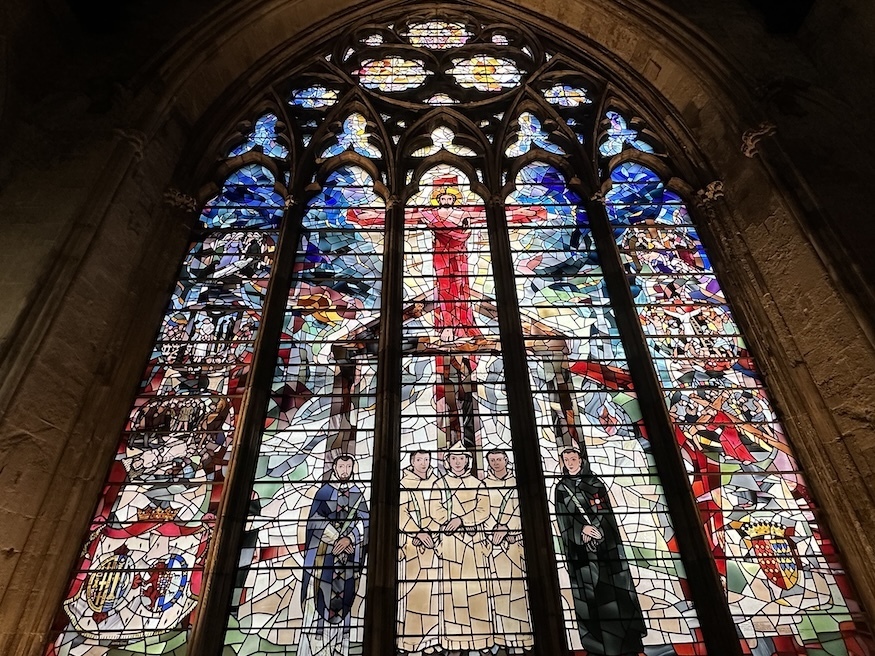
Libraries, archives and internet resources can all offer a window into the past. But sometimes an actual window is all that we need.
St Dunstan’s in Stepney is arguably London’s third most-famous church dedicated to that saint. Everyone knows the “secret” St Dunstan-in-the-East for its bombed out nave that’s now a peace garden and TikTok magnet. St Dunstan-in-the-West is celebrated thanks to its prime position on Fleet Street.
But St Dunstan’s in Stepney is a bit far out of centre to attract much non-local attention. This is a shame because:
(a) It was built by the saint himself (Dunstan was Bishop of London in the 10th century). You can’t say that about many London churches.
(b) For centuries, this was the only church covering the land east of the City. It’s known as the Mother Church of the East End.
(c) It has a magnificent and unique stained glass window:
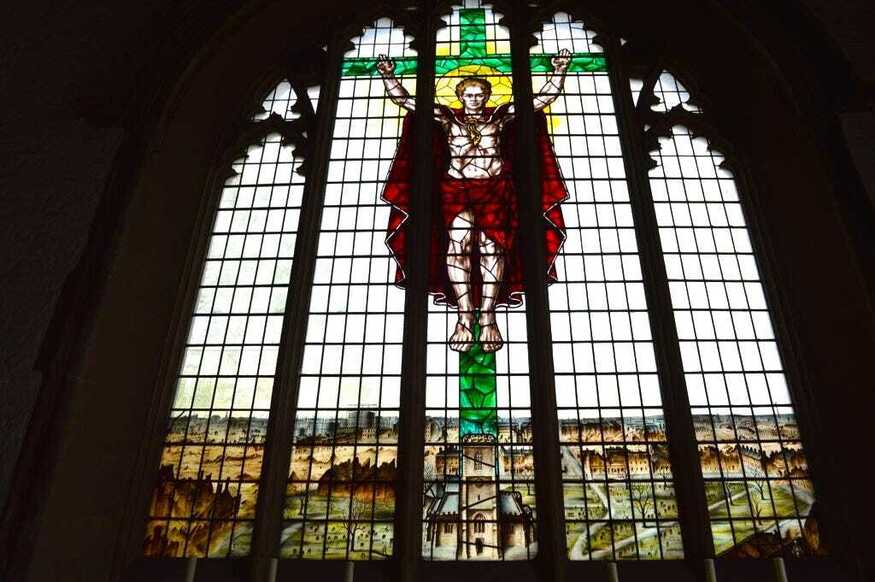
Yes, that really is the crucified Christ patrolling the East End skies. He’s the centrepiece of the Blitz Memorial Window, which was crafted in the 1950s to replace glass damaged during the war.
Beneath the crucifixion, we see St Dunstan’s church standing proud among the ruins of the East End. Houses lay in shambles or deleted. Tracts of open space, cleared by the Luftwaffe, are an atavistic throwback to medieval Stepney. But there, in the distance, we can just make out an old gasholder, thought to be the now-demolished structure that once stood on Ben Jonson Road, north-east of the church. I’m going to stick my neck out and say that this is London’s only depiction of Victorian gas infrastructure on a stained glass window. But I’d love to be proved wrong.
Stained glass in usually associated with saints and sermons, a visual, multicolour reminder of scripture, from an age when few people could read it for themselves. But the medium has been put to much more versatile use. In this photo-led feature, I’d like to share a few examples I’ve spotted around town that offer insights into London’s history. Prepare to be gently dazzled…
The Pedlar of Lambeth
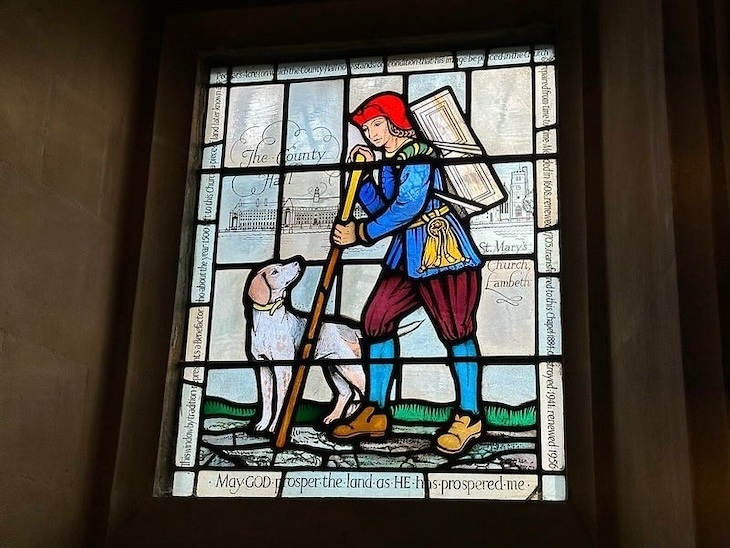
The pedlar of Lambeth is shown with his trusty companion, a dog who is clearly wondering why master is carrying round a corner-unit from a fitted kitchen. This beautifully proportioned window can be found in the Garden Museum, inside the former church of St Mary. It relates the legend of a poor pedlar whose dog uncovered a treasure hoard close to that church. The pedlar used his serendipitous bounty to help the local poor.
The tale is an old one, and has been celebrated here in stained glass for centuries. The current window is from 1956. You can tell it’s 20th century because there, in the background, is County Hall, built from 1911 to house the London County Council. Today, it is home to the Shrek Experience (which, incidentally, has a stained-glass window, of no historical worth). County Hall was built on land once known as Pedlar’s Acre, hence the building’s inclusion on the window. More on the pedlar here.
Stained glass skyscrapers
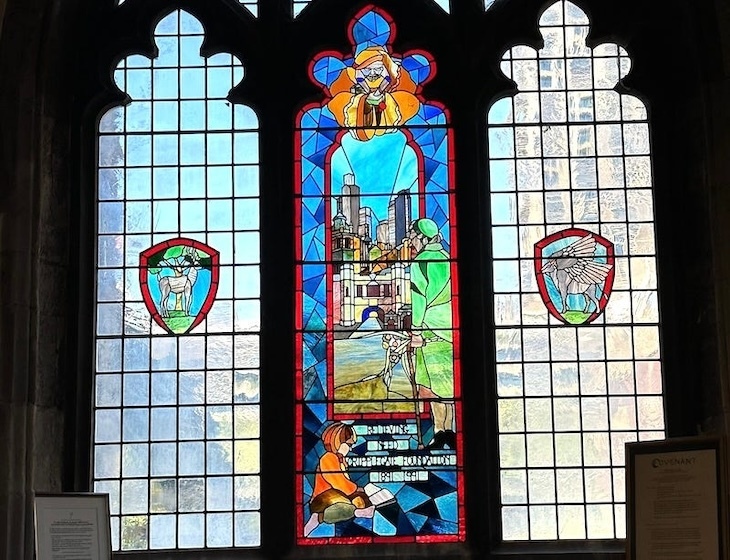
St Giles Cripplegate is one of very few buildings in the Barbican area to have survived the Blitz (though only just; it is much rebuilt). One of its western windows celebrates the 1991 centenary of the Cripplegate Foundation, a local charity still going strong. I find this window fascinating because the main image combines elements of the local area’s past and present. The skyscrapers of the City, including an identifiable NatWest Tower, rise above the Cripplegate — a long-demolished gateway into the city. The two animals either side, incidentally are a deer (symbol of St Giles) and a winged ox (symbol of St Luke, who is the patron of the neighbouring parish).
The printed word
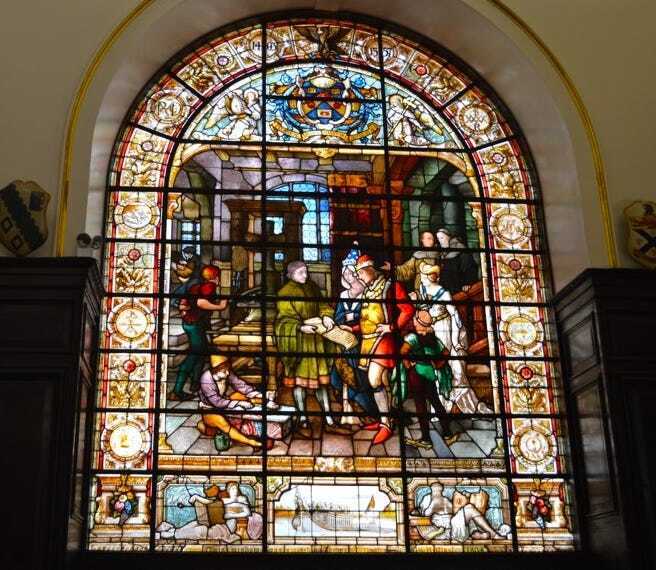
Mass publishing in England began with William Caxton, who introduced the first printing press in 1476. This intricate window in Stationers’ Hall shows Caxton commending his handiwork to Edward IV and Queen Elizabeth Woodville — a royal showoff for which there is no evidence. The background depicts Caxton’s Westminster workshop, with a young apprentice sat (in royal presence!) to the bottom-left. This is Wynkyn de Worde, Caxton’s remarkably named successor, who moved the press to Fleet Street. The area’s long association with printing and newspapers arguably began with him. The border is filled with the arms of various notable members of the Stationers’ Company, whose roll-call has included John Jacob Astor, William Hague and Rupert Murdoch.
Pepys through the window
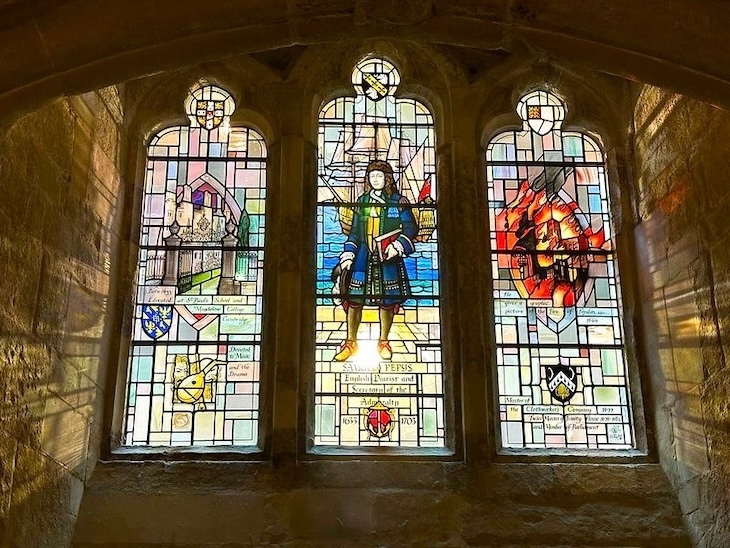
How do you want to be commemorated 300 years after your death? How about a stained-glass biographical triptych inside the Guildhall? That’s how diarist Samuel Pepys is remembered. The three panels show Pepys’s alma mater at Cambridge, his fondness for music, his stewardship of the Admiralty, his chronicling of the Great Fire, and other line items from an impressive CV. It’s one of many exceptional windows in the Guildhall complex — we featured an adjacent window in the recent article about Gog and Magog.
Gresham grasshoppers
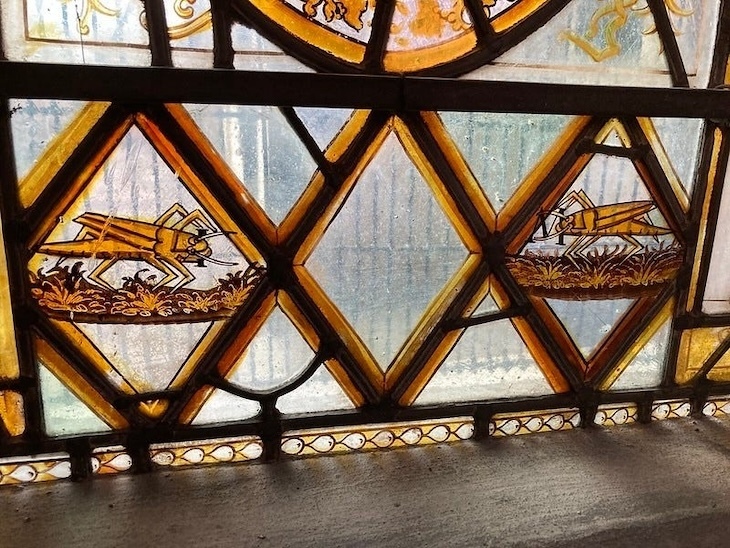
As one of the City’s grandest of grandees, the Tudor banker Thomas Gresham is remembered in more than one window. The most unexpected, however, is out in Ilford. Here, the ancient Hospital Chapel (worth a visit if you get the chance) harbours a “Gresham Window” complete with painted grasshoppers (so, technically, this is not a stained glass window).
Grasshoppers were the personal symbol of Gresham, probably adopted because his name sounded a bit like ‘grass’ in a 16th century tongue. You’ll find grasshoppers all over the City, particularly around the area of the Royal Exchange, an institution he founded.
Gresham and his family have no known connection to Ilford or the chapel, and it’s a bit of a mystery why this window was moved here from Surrey in 1751. British visitors to the chapel might also by mystified by the appearance of the name Bamber Gascoigne on certain memorials. The Gascoigne family were local bigwigs in the 18th century, and “Bamber” was one of their favourite names. It has been bestowed on multiple generations of sons, right up to the erstwhile host of University Challenge.
Bentley Priory
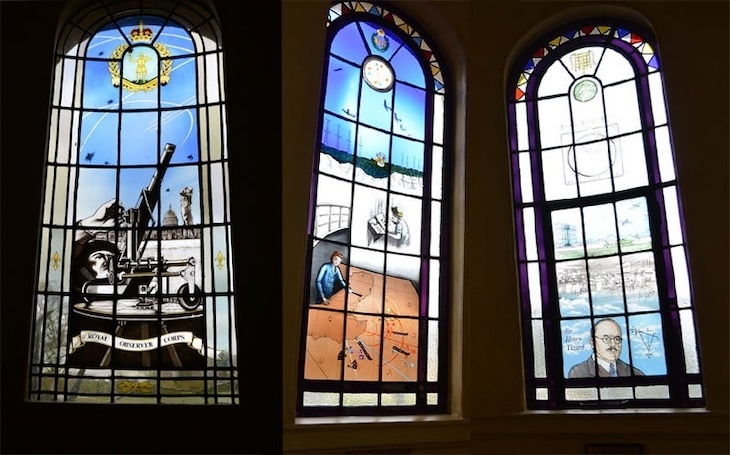
Bentley Priory, on the northern edge of London, is a large stately home that became the headquarters of Fighter Command in the Second World War. The Battle of Britain, our “finest hour”, was masterminded from within its walls.
Today, Bentley Priory is a museum, rather oddly located in the middle of a posh housing estate, with checkpoints on the gate. It’s worth making the effort, though, because this place is full of eccentricities, right down to the Spitfire-themed toilet flush.
You’ll also find these peculiar painted windows (among others, not shown). They depict the Royal Observer Corps (left), who watched the skies around London for enemy planes. The WAAF (centre), was a female auxiliary of the RAF whose recruits worked at radar stations, intercepted coded messages and plotted enemy movements at Bentley Priory and elsewhere. The third window celebrates the work of Sir Henry Tizard, one of the key figures in the development of radar.
A double-decker in stained glass
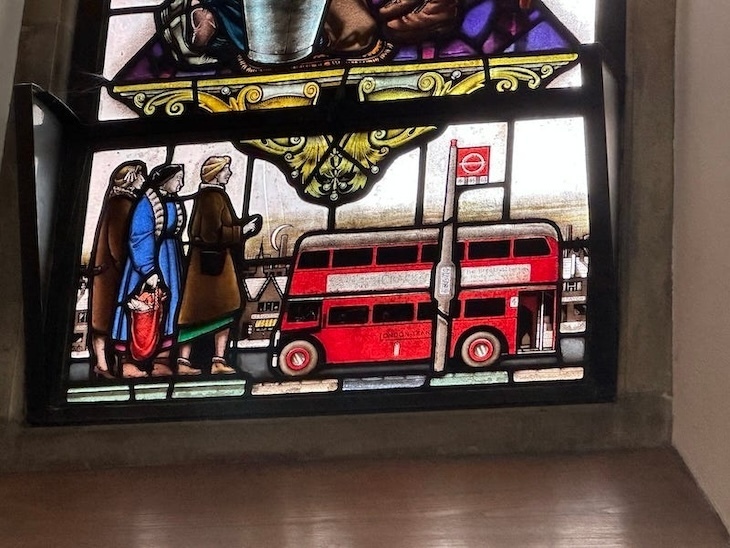
Christ Church on Blackfriars Road contains a whole series of historical windows, depicting life in the local area during the mid-20th century. The artworks include this unique depiction of a Routemaster serving a bus stop outside the church. The waiting passengers appear to include Ena Sharples, a once-famous character from Coronation Street. For more on this and other windows in the church, see our previous article.