This feature first appeared in July 2024 on Londonist: Time Machine, our much-praised history newsletter. To be the first to read new history features like this, sign up for free here.
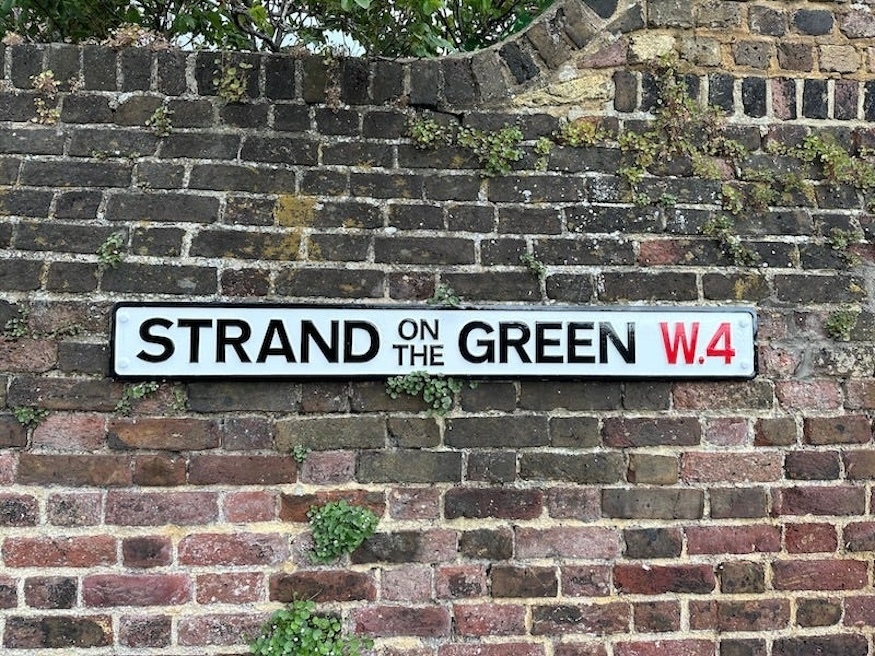
Come take a stroll along one of London’s most charming riverside paths. Strand-on-the-Green, opposite Kew, is ridiculously picturesque, drenched in history and, which is more, boasts four lovely pubs within its half mile. Let’s all go down (the other) Strand…
Strand. It’s an Old English word for the shore, still occasionally used in some parts of the country. London’s Strand is an ancient route that followed the Thames, connecting the City of London to the Royal palaces and church at Westminster. Today, you can see the river from only a couple of places where sloping side streets offer an uninterrupted view. Back in medieval times, the water would have lapped much closer. The Strand would have ran like a seaside promenade, following the raised ground above the high-water line. It would have been a literal, and indeed littoral, strand.
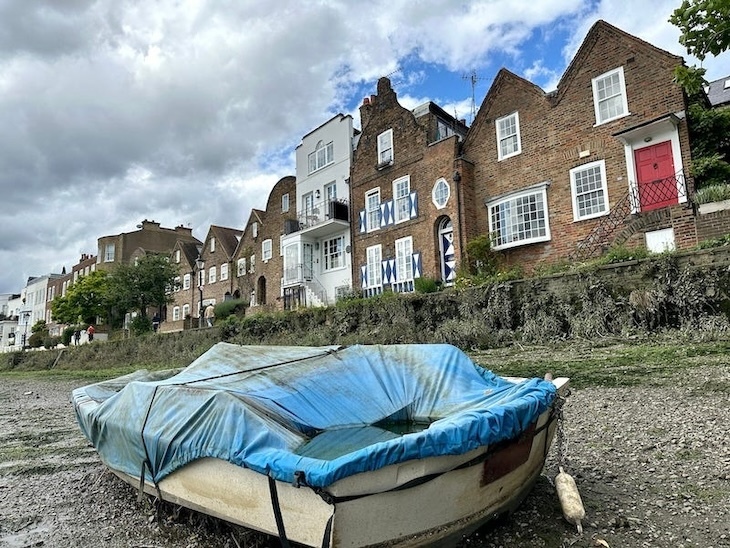
But, like a DNA helix, London is double-Stranded. There is another road of that name far upriver, and much quieter than its central namesake. This is Strand on the Green, a half-mile of tranquility where Chiswick finally runs itself out into the Thames. Quiet it may be, but it does not lack in history.
Between the bridges
Where exactly is Strand on the Green? I’m glad you asked, because it gives me the chance to knock together this map:
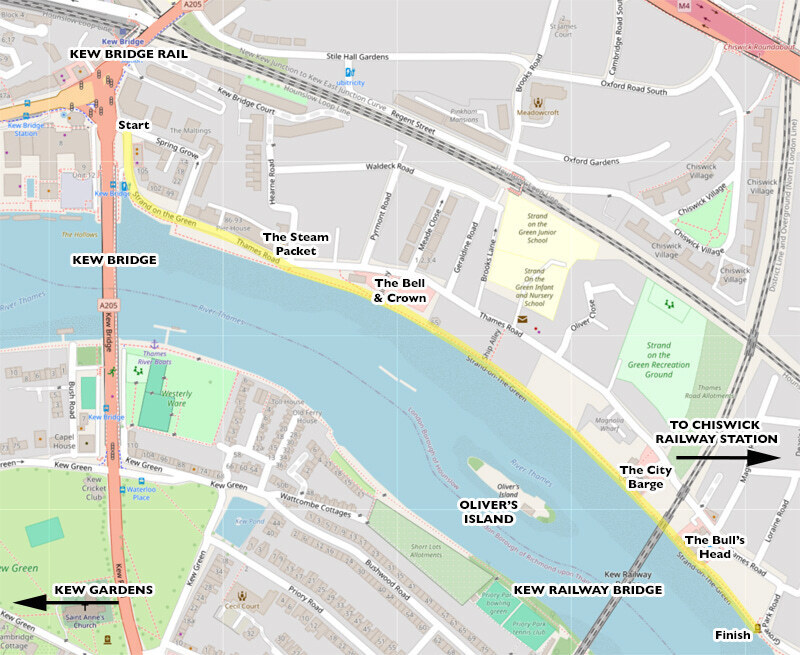
In the map, Strand on the Green is the sandy yellow line running from Kew Bridge to Kew Railway Bridge, and then a little beyond. If you’re thinking of walking the route (and I commend it to you with all my lung capacity), then I’d suggest starting at Kew Bridge station, walking along the river, and then returning to central London via Chiswick station (just off the map to the right). Both stations are on the national rail service into Waterloo.
Kew Bridge, where the walk begins, is one of my favourite London spans. I mean, just look at the decorative voussoirs on that:
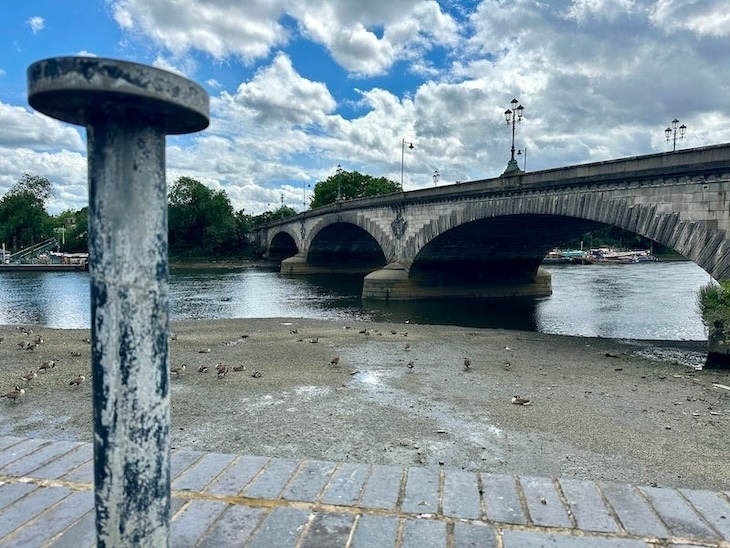
This is the third Kew Bridge. It was opened by Edward VII in 1903. For his troubles, the King was given a commemorative chair made from the wood of the first Kew Bridge. It’s a remarkable bit of furniture (you can see a copy at Richmond Museum), with the profiles of all three bridges built into its back.
The Kew Bridge we see today was engineered by John Wolfe Barry, who had form when it came to conquering the Thames. This is the man who’d already helped design Cannon Street Railway Bridge, Blackfriars Railway Bridge and, that ultimate London icon, Tower Bridge. His dad Charles Barry was the mastermind behind the Houses of Parliament. Quite incredible to consider that the two most-photographed buildings in London were the work of father and son.
Kew Bridge does not attract nearly so much attention, which is a pity because its a deliciously handsome structure.
Walking on along Strand on the Green, and the view ahead is dominated by the more utilitarian Kew Railway Bridge.
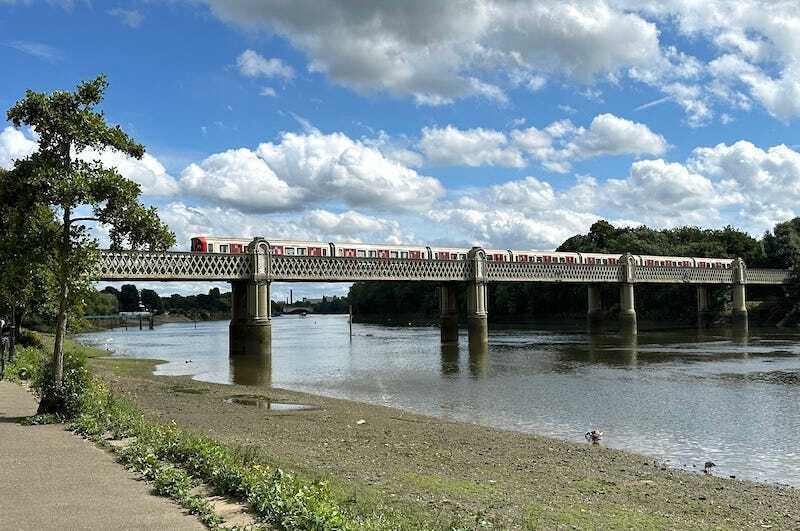
As you can see, this flat, girder bridge carries the District line (and Overground trains) above the Thames from Gunnersbury, to reach Kew Gardens and Richmond. This bridge is a generation older than its neighbour. It was built in 1869 by WR Galbraith, who would go on to oversee the engineering of the Waterloo & City line and Bakerloo line. That’s not a bad CV either.
Along the Strand
People have been admiring this curve in the Thames for thousands of years. To go with his fancy chair, Edward VII was also presented with a neolithic flint axe, which had been discovered on the foreshore during construction of Kew Bridge. According to various web sources (and Peter Ackroyd), a cache of 100 ancient skulls was discovered in the river here in the 1920s. They seem to have gone missing before anyone could pin down their age or origin, and I cannot find a primary source. It’s not the last legend we’ll encounter on our wander.
The area first enters recorded history in 1353, when it is noted as a fishing village called Stronde. It remained a place of riverine trade for many centuries, with landing jetties for bricks and coal and grains and other materials.
Yet the place was too lovely to leave to merchants and boat builders. The strip gentrified in the Georgian era, especially after the first Kew Bridge opened in 1759. Many of the towering riverside houses that characterise today’s Strand on the Green were built at this time. You had to be rich to live here. Today, you have to be very rich. Three-bedroom houses are valued north of £1.5 million.
Before reaching the posh houses, we first encounter this intriguing long-and-low creation.
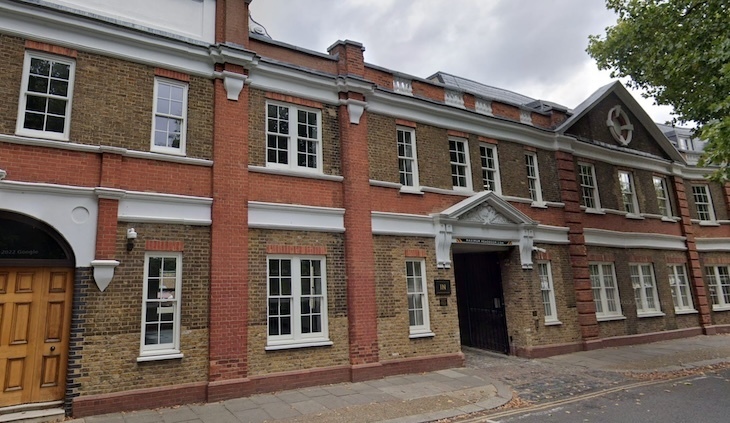
This was the Pier Head Laundry, one of the largest laundries in London. A date on the roofline suggests it was opened in 1905, shortly after the revamped Kew Bridge increased accessibility to the area — though the business was much older. After a recent conversion, it is today office space, including a headquarters for Fuller’s, whom we shall encounter again.
The rest of the route is lined with grand houses. These are a rum riot of sizes and architectural styles, yet they somehow form a coherent, eye-pleasing cluster when seen from afar. Twenty-five of them have listed status. This includes number 65, the former home of Johann Zoffany the 18th century portraitist, which carries an ivy-obscured blue plaque. This pocket-mansion was later occupied and restored by Philip Hepworth, architect of Walthamstow’s remarkable town hall. Meanwhile, the musician Midge Ure lived in nearby Zachary House which, as one commenter points out, makes this a very unusual street for possessing two houses beginning with a Z.
According to the Strand on the Green Association, “There are quite a few reasonably famous people who currently live at Strand on the Green - but for now, we will spare their blushes.”
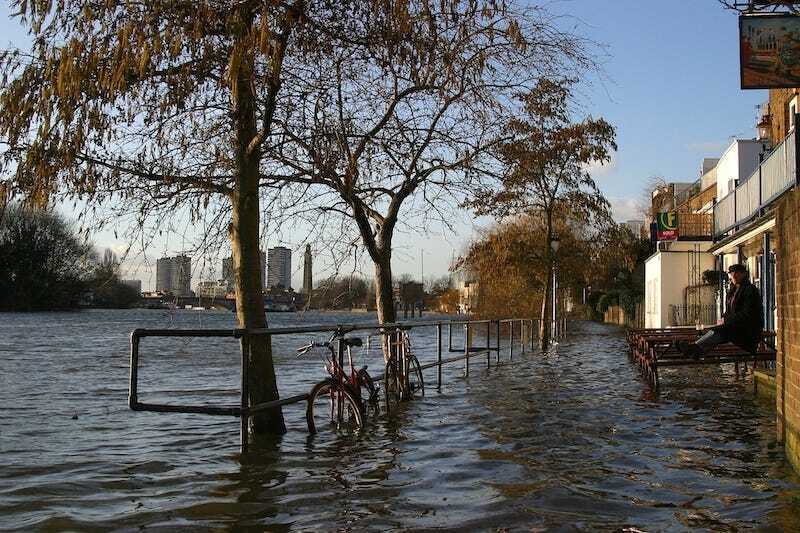
I’d recommend timing your visit to coincide with low tide. The foreshore is easily reached by several sets of steps, and here you’ll get a better view of the terrace. I would not recommend visiting during Spring high tide, or this might happen:
The Cromwell connection
The River Thames contains dozens of small islands, often called aits, ayts or eyots. Can you name any? If the question were asked on a gameshow, the top answer would surely be Eel Pie Island, the Twickenham speck famous for its rock-and-roll history. In second place, I suspect, would be Oliver’s Island, which lurks off Strand on the Green like an attentive puppy.
The island’s semi-fame rests on two claims. First and oar-most comes the beer. You’ll find Oliver’s Island golden ale on sale behind most bars in these parts. It’s brewed at the Fuller’s Griffin Brewery, just around the river bend. But the island was well known long before its namesake beer. According to legend, Oliver Cromwell took refuge here during the English Civil War, to escape the the Cavaliers. It’s a claim without a pebble of evidence, or logic. I mean, why would he? Can’t Cavaliers cross a few feet of water, or something?
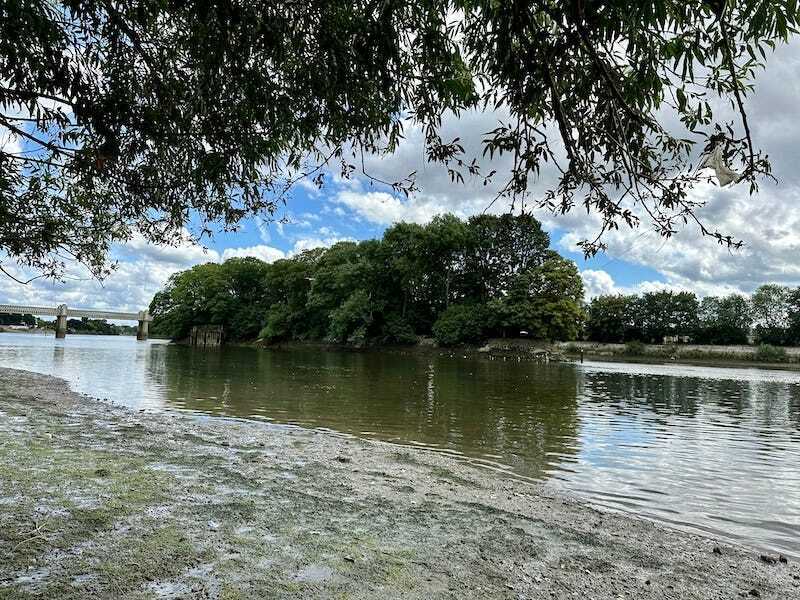
The island was historically known as Strand Ayt long after Cromwell’s time, and the earliest mention of “Oliver’s Island” I can find is from 1818. So it’s all a rotten canister of piffle. Probably.
What we can say about Oliver’s Island is that it’s a microhaven for wildlife. The tiny eyot is dense with mature trees, and is rarely disturbed by human intrusion. Herons and cormorants top the pecking order, but it’s also home to bats, rare molluscs and other animals.
An Historic Pub Crawl
Few parts of London can rival Strand on the Green should you want to hold a pub crawl. The short stretch contains four old pubs, every one of them a treasure.
Walking west to east, we first encounter The Steam Packet, a modern refit of a Victorian pub, noted for its first floor balcony with views over the Thames. Next comes the Bell and Crown, a stylish Fuller’s pub that dates back to at least the 18th century. This also sports a dining terrace with much-sought views.
Kew Railway Bridge is sandwiched between two further historic pubs. The City Barge reckons to date back to the 15th century, under various guises. Unfortunately, it was badly damaged in the Second World War, and only the bar area is of any vintage. News reports from the 1970s suggest a “secret tunnel” was discovered here a few decades earlier, though I’ve not been able to substantiate that. The pub is also famous among Beatles fans as one of the locations in the movie Help! This is the place where Ringo orders "Two lagers and lime and two lagers and lime”.
Finally, the Bull’s Head with its low-timbered ceiling has the most “ye olde” feel to it. This place dates from the 18th century, though it may be on the site on an even older pub. Oliver Cromwell supposedly used it for military councils, and the Bull’s Head is also said to have a secret passage to his eponymous island. Either way, it’s a load of old Bull.
One legend who definitely did inhabit this stretch is Donald Pleasence. The much-loved actor owned the cottage adjoining the pub, which strikes me as one of the most idyllic spots in London, befitting of his surname. I wonder if the Blofeld actor had his own secret passage leading to an underground lair.
Strand on the Green peters out just beyond the pub buildings. Its termination is marked by a red granite drinking fountain.
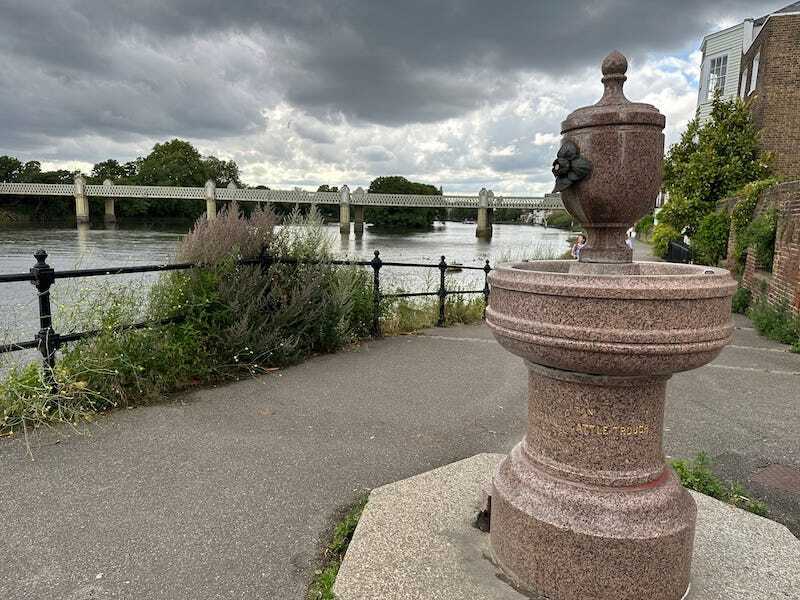
I’m not aware of any legends about a hidden tunnel here, but that base does look mighty suspicious, wouldn’t you say?