In Victorian London, you could walk down a Japanese street of bamboo shops and dwellings fitted with thatched roofs and oiled paper windows, call in at a Buddhist temple then retire to a teahouse to sip a steaming cup of sencha.
Japan sits high in the conscience of modern day London, everywhere from Kensington's Japan House, to the mountains of katsu curry and takoyaki inhaled with gusto in London's glut of Japanese restaurants. Late Victorian Londoners harboured a similar fascination. With trade and diplomatic relations between Britain and Japan galvanised in the mid-19th century, the drawing rooms of middle class Londoners began to clutter up with "paintings, pottery, china, kimonos, fans, screens, silks, and swords". The 1862 International Exhibition in South Kensington even housed a Japanese Court. But 1885 was the year Japanomania really made its mark on the British capital.
Real shops, temples and teahouses
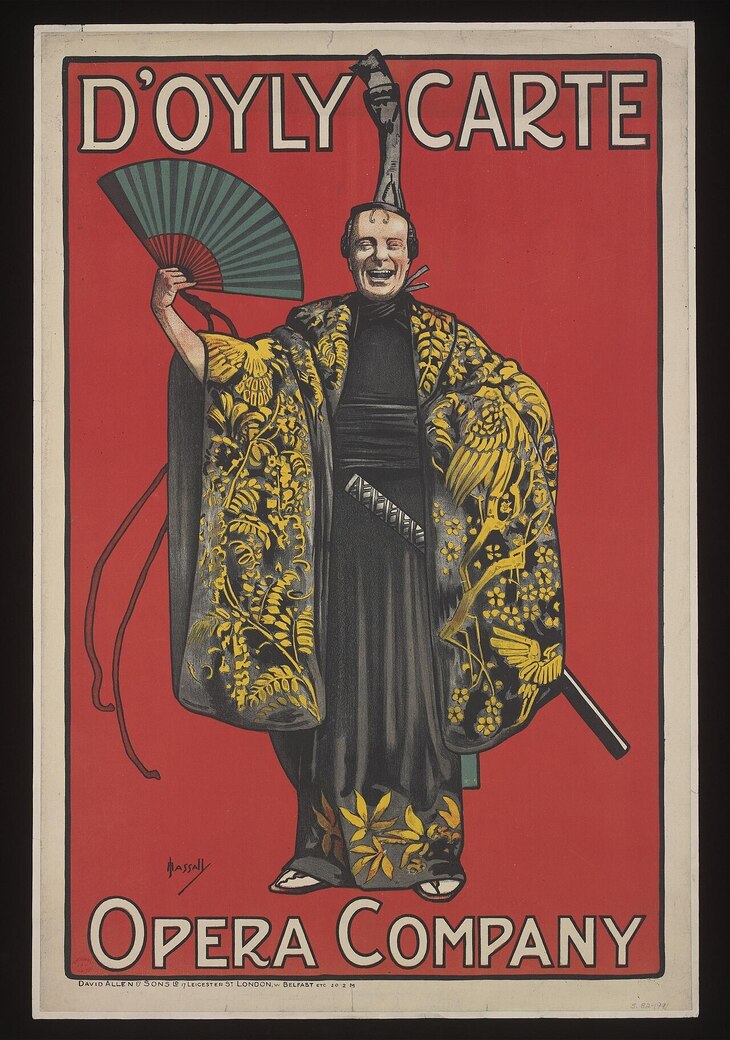
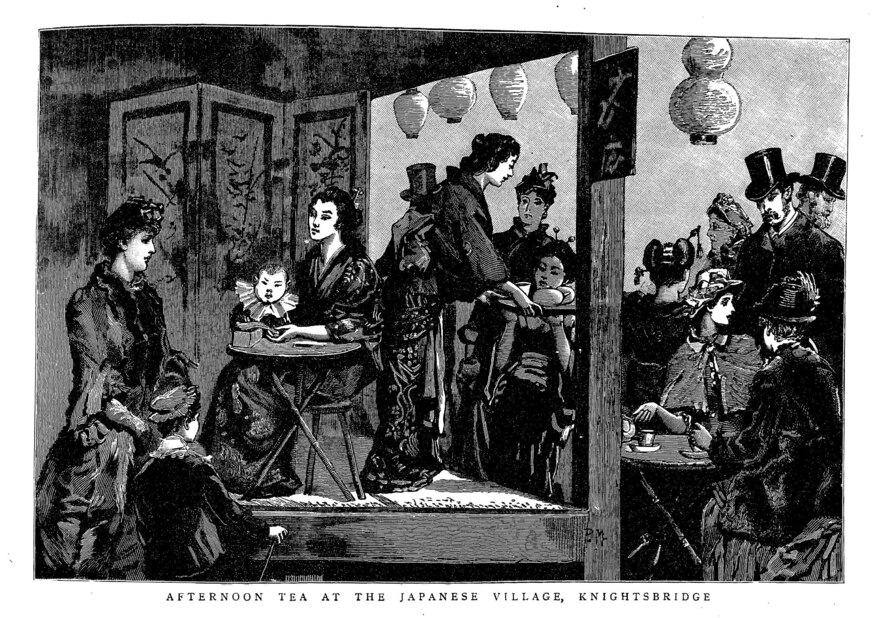
While writing duo Gilbert and Sullivan put the finishing touches to their Japan-set comic opera The Mikado, over in Humphrey's Hall, Knightsbridge, a full 'Japanese Native Village' opened. The concept of impresario Tannaker Buchirosan, a man who'd already hosted Japanese events around Britain, the unprecedented village layout prided itself on on its 'authenticity', an advert declaring it to be:
...erected and peopled exclusively by natives of Japan (males and females). Amongst whom are skilled artificers and workers who will illustrate the manners, customs, and art industries of their country, clad in their national and picturesque costumes.
For the price of a shilling, curious Londoners could step into a distant land; wander around Japanese gardens; watch marital arts demos; visit temples officiated by real priests; peruse shops and buy fans, toys and musical instruments; then retreat to the teahouse, to be served cups off lacquer trays by kimono-wearing attendants.
Importantly, Londoners could rub shoulders with real Japanese people. It was the closest most would ever get to exploring Tokyo or Kyoto, and the Japanese Village was wildly popular, clocking in quarter of a million people in its first five months. W. S. Gilbert popped his head in for some inspiration, while provincial towns up and down the country hastily constructed "many wretched imitations", as Buchirosan would call them.
A true picture of Japan?
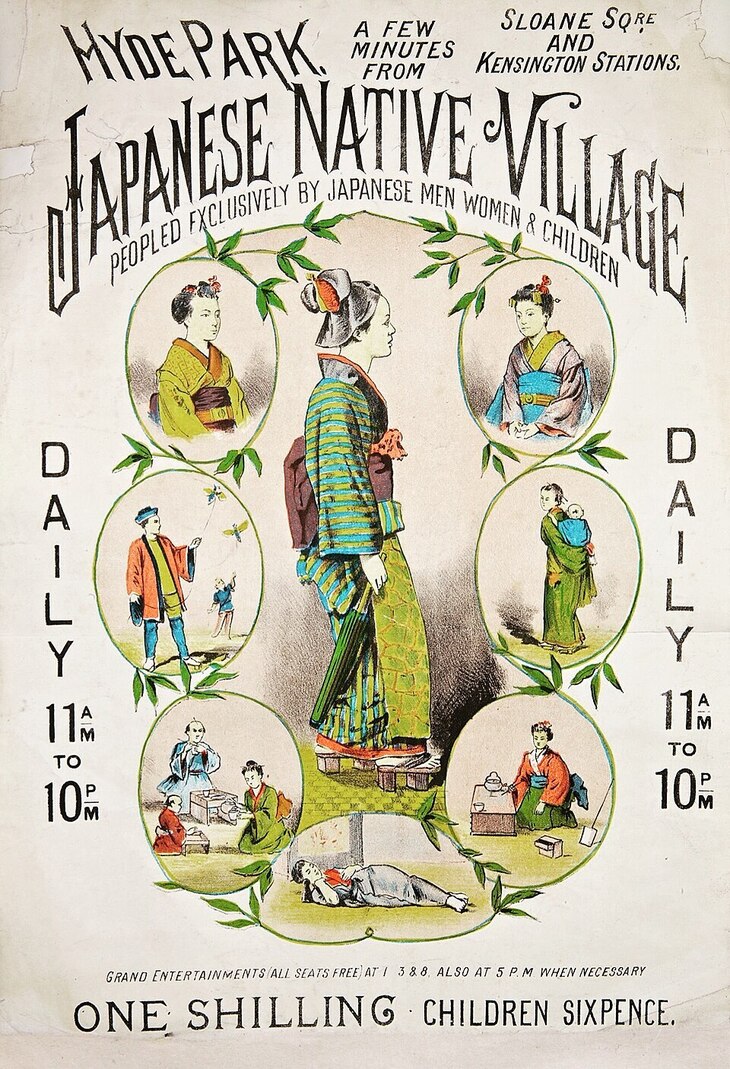
On the one hand, this really was an authentic experience. Not only did some 100 Japanese craftspeople and performers populate the village, some had spent months building it, and most even slept here at night.
But the Japanese Village had an agenda. Here was a picture of a 'quaint' and 'simple' Japan; one which glossed over the country's rapid modernisation and industrialisation during the Meiji era — not to mention that in the real Japan, folk were increasingly wearing Western attire. As Anna Jackson, Keeper of the Asia Department at V&A, says: "The lives of these supposedly simple, innocent, primitive Japanese people could be viewed with escapist longing by those coming to terms with the complexities of life in the industrialised West.
"This admiration for the simplicity and purity of Japanese life was, however, entirely dependent on the unshakeable belief in the ultimate superiority of Western civilisation."
To put it another way, if this had been a British Village in Tokyo, everyone would've been whirling around a maypole while singing Scarborough Fair, glugging flagons of mead and rolling cheese wheels all over the place. All very pleasant, but all rather disingenuous.
"One of the prettiest sights in London"
On 2 May 1885, disaster struck, when a fire — probably caused by the gas lamps that lit the place at night — burned the entire village down, killing a Japanese wood carver. The West London Standard blithely suggested (using a slur we won't replicate here): "While the carts of the contractors are at work, it might have been well had carte blanche been given to Carte of the Savoy, to add to the realism of the 'Mikado,' by introducing the unemployed [Japanese people] in some of his scenes."
London's Japanese Village was reconstructed before the end of the year, and even expanded with "various free-standing idols, and a pool spanned by a rustic bridge" — running until June 1887. The Graphic declared it "one of the prettiest sights in London".
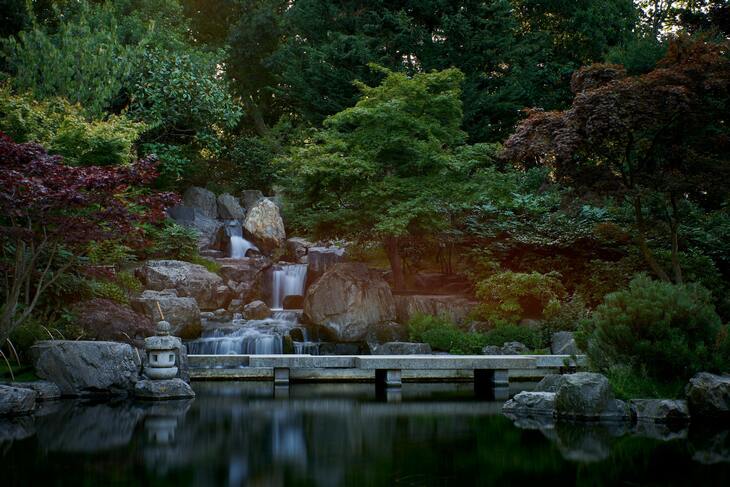
Though such a setup would be deemed stereotypical now, the Japanese Village was an influential moment — a precursor to the sights, sounds and tastes of Japan we enjoy in London today — from Kyoto Garden in Holland Park, to the Royal Albert Hall 's recent sell-out Grand Sumo Tournament, to the Hyper Japan festival, now so popular it visits London twice a year. What might baffle anyone who visited that whimsical Japanese Village 140 years ago, is how so many of the cutting edge gadgets used by Londoners in 2026 were made in Japan, not here.