This feature first appeared in June 2024 on Londonist: Time Machine, our much-praised history newsletter. To be the first to read new history features like this, sign up for free here.
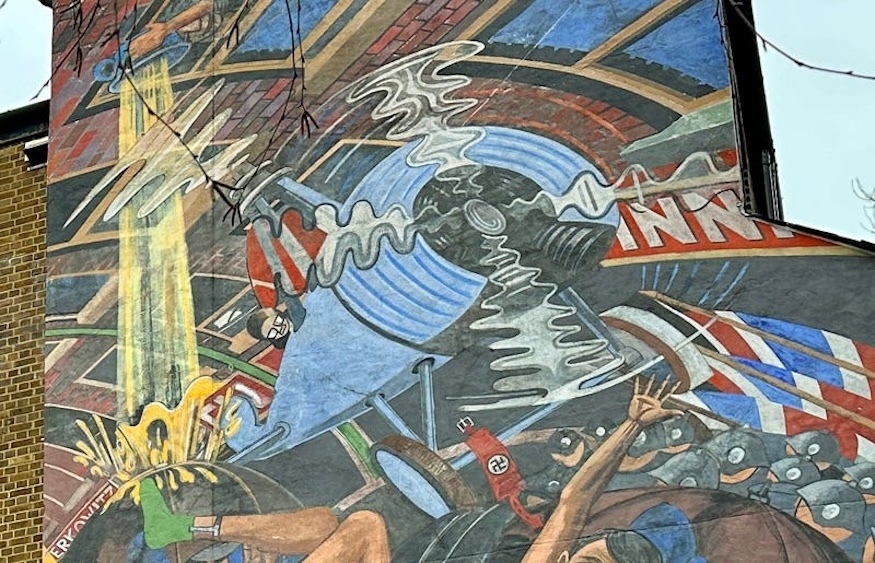
Have you ever visited the Battle of Cable Street mural in Shadwell? This exceptional landmark records many eyewitness details from the events of 1936, which saw fascist ‘Blackshirts’ march on the East End. One facet in particular catches my eye. To the top-right, a blue aircraft flies along the street, buzzing a troupe of Nazi sympathisers below.
A conventional aeroplane? No. Look at that blur above the pilot’s head — the one that intrudes over the vertical stream of urine. It’s like a second propellor. In fact, it’s a rotor. The craft depicted in the mural is a police autogyro. Strange though it may seem, the authorities were using a predecessor of the helicopter as early as the 1930s. But let’s just glide back still further, to look at the origins of police flight.
A flying visit
It curled through a clear blue sky, humming like a mechanical bee. No fixed wing or silken balloon held the craft aloft. The curious vehicle flew just 800ft from the ground, lower than the present-day Shard. It must have been quite a sight.
The date was 15 August 1934. Thousands of Londoners witnessed this first central London flight of an autogyro. It took off from Hanworth Aerodrome in what is now west London, flew down through Hounslow and Kew, on to Barnes and Olympia, before touring the central area.
The autogyro’s two memorably named occupants were RAF pilot Reggie Brie and Assistant Commissioner Alker Tripp, a senior police officer with an interest in town planning and traffic management.
Brie was, in some ways, a curious choice of pilot. Only a year before, he’d been fined £5 for flying another autogyro low over the Kingston bypass. “Motorists stopped suddenly because they thought the auto-gyro was coming down,” reported the Daily Herald, “Cattle in a field rushed about in a terrified state, and a cow ran into a haystack.”
A few months on from his trouble with the law, and the bovine-bothering pilot found himself sharing a cockpit with one of the most senior officers in the force. Assistant Commissioner Tripp was keen to assess the autogyro’s potential for spotting jams and coordinating traffic officers on the ground. He had special permission from the Air Ministry to take the aircraft wherever he chose. Rather than disturb the livestock of Kingston, Tripp instructed Brie to head into the centre. A journalist in a chase plane describes the route:
“Then we flew along the Kensington High Street, the Assistant Commissioner’s ‘plane [sic] looking unusually low as it passed over the traffic, to Knightsbridge, Bayswater, Hyde Park Corner, and Buckingham Palace. Oxford Street with its continuous stream of traffic seemed especially to interest the Assistant Commissioner, for his machine turned and flew for a second time over the entire length of the street.”
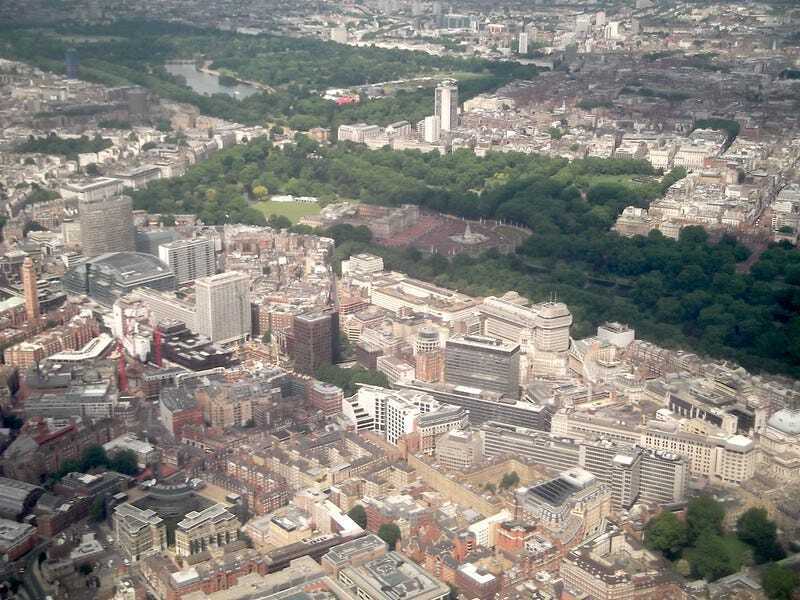
Other points of interest included Trafalgar Square, Bloomsbury and Regent’s Park, with some attention given to Tripp’s base of Scotland Yard. The small aircraft remained aloft for about an hour and a half as Tripp took notes.
“Those who saw the autogyro manoeuvring,” commented the Western Mail, “found it easy to anticipate the use of such a machine in catching criminals.” That, however, was outside the present scope. These early test runs were strictly considering traffic management.
The press, as is their wont, had a field day with the puns, dubbing the aerial constabulary the new “flying squad”. Others took the groan level still further:

Joking aside, the mission was deemed a success. Tripp told the press he looked forward to the “tremendous possibilities” for aerial policing. Further test flights took place over the coming days, including a journey from Hendon to Wimbledon and back. The age of the ‘eye in the sky’ had begun, but the vehicles would soon be put to sterner test than spotting gridlock.
Hang on. Back up. What exactly is an autogyro anyway?
Tripp and Brie’s 1934 flight took place in a C30 Cierva autogyro, a bit like this:
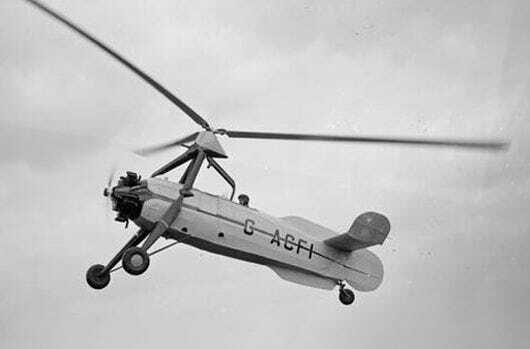
Autogyros look superficially like the now-more-familiar helicopters. The key difference is in the rotor blades. Helicopters use an engine to rotate their blades; autogyros, as the name suggests, do not. In early models, the blades would begin to spin when the aircraft moved forward under the power of a front-mounted propellor. This created sufficient lift for the vehicle to get airborne. Once aloft, they could reach speeds of up to 160mph but, crucially, they could also putter along at under 30mph, giving them advantages over a fixed-wing craft for aerial surveillance.
The autogyro had been invented by Juan de la Cierva in 1923. His early trials at Hanworth were initially mocked. “He caused laughter every time he landed,” said one reporter, “so unexpected were the antics of this queer-looking machine.” But there was no denying its utility and cost-effectiveness.
Cierva rapidly developed the autogyro into a safe and reliable vehicle unlike anything else at the time. (Powered-rotor helicopters were in their infancy at this stage, and much more unreliable than Cierva’s autogyro. That technology would progress through the Second World War, but would only reach maturity from the 1950s.)
Early police trials
His Majesty’s Constabulary had long held an interest in aerial policing. An airship, the R33, had been fielded for traffic control at the 1921 Epsom Derby, and again at Ascot but this proved unreliable and was not taken forward. A decade on, and the autogyro seemed more promising. It was first used at the 1932 Epsom Derby to keep an eye on traffic buildup on approaches to the racetrack. Preparations for the flight from Croydon Airport were captured by Pathé.
Pilot REH Allen was at the controls. He manoeuvred the vehicle around the area at a height of 2,000 feet. Epsom was notorious for its traffic jams, and Allen was able to spot them before earth-bound police units. Information was radioed down to a ground station, which would then relay the message to patrol vehicles. This was probably the first use of a rotary wing vehicle for police operations anywhere in the world. The two-way radio made it work. The technology had only recently got to the point where a small unit could be carried aloft on something as small as an autogyro, allowing real-time communication with the ground.
As it happened, the autogyro went beyond traffic control that day. After the race, the pilot spotted a fight between rival gangs at a distant end of the racecourse. He radioed it in, and the police rushed over to arrest the combatants.
The autogyro was proving its worth, but not without incident. A test flight in North Yorkshire almost ended in tragedy in 1931, when a sudden gust of wind overturned an autogyro during landing. Its pilot sustained serious injuries but survived. The first fatal crash occurred in January 1935, when an RAF pilot crashed into the northern slopes of Old Sarum near Salisbury.
Cierva would himself be killed in an air crash in 1936 — not in one of his autogyros but a conventional aircraft. He was a passenger on a KLM flight out of Croydon Airport, which struck a house and came down near Purley. It was the worst plane crash in the UK at that point, with 15 fatalities. Conspiracy theorists might be interested to learn that REH Allen, the pilot of the first police autogyro over Epsom, was killed in 1934, when he was mown down by a motor car on Whitehall.
Despite its failures, the autogyro’s potential guaranteed it further work. The derby flight was swiftly followed by another run over an RAF Pageant at Hendon airfield in north London. The autogyro was back at Epsom the following year. After a handful of central London flights, the Metropolitan Police had enough confidence in the vehicle to put it into routine service.
Watching the Blackshirts
The newly commissioned autogyro, based at Hendon, was initially set to traffic duties, but it quickly found other roles. On 9 September 1934 some 5,000 of Oswald Mosley’s fascist ‘Blackshirts’ gathered in Hyde Park for a rally. A similarly sized group of communists and other anti-fascists showed up in opposition. Outnumbering either faction was the police. They quickly set up cordons to keep the rivals apart. Overseeing it all, literally, was the police autogyro, in constant radio contact with ground units. This was the Met’s first ‘real world’ test of their machine, and one that went beyond its anticipated traffic duties. In the event, only minor skirmishes occurred, but it was a taste of things to come.
Two years later, the Blackshirts marched on the East End, an area strongly associated with the Jewish community. This time the clashes were more fierce. Several locations saw violence, but it was in Cable Street that the most celebrated battle took place. Locals and anti-fascists erected barriers here to block the march. But the real clash came with the police, who set about demolishing the barricades. As shown in the Cable Street mural, the constabulary were pelted with bricks, tools and buckets of human waste. These and other actions deterred Mosley’s men from progressing through the East End. “They shall not pass,” screamed the defenders, and they did not. It became a symbolic moment in the struggle against fascism. And it was all surveyed, from above, by the police’s roving eye in the sky.
The autogyro continued its service up to the Second World War. Just before the Cable Street incident, it had kept watch over a fire in a quilt warehouse in Great Sutton Street, Clerkenwell. Also that year, the pilots of two low-flying aircraft were prosecuted for trailing adverts over the Epsom Derby — a police autogyro pilot gave evidence about their altitude. Its other duties were legion. The aircraft was put to use reconnoitring the King’s procession route, snapping photographs of London from the air, assisting in searches for missing people, and monitoring crowds around football matches.
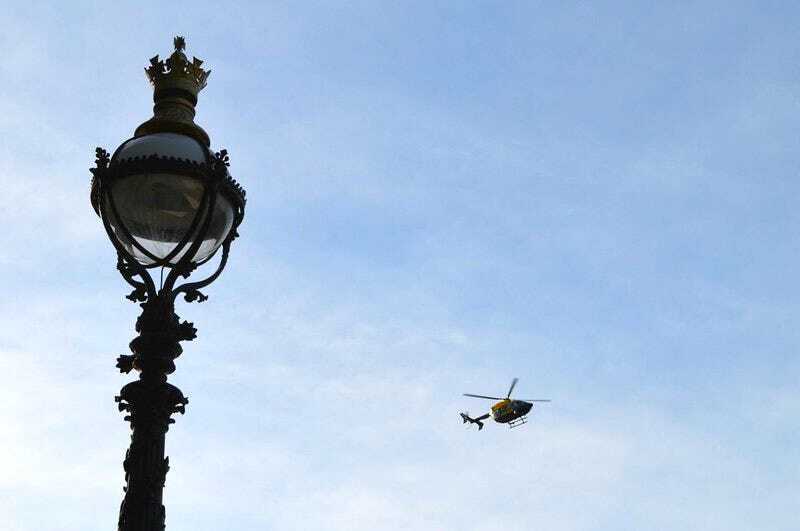
The advent of the second world war put an end to the Metropolitan Police’s autogyro adventures. Anyone with flying experience now had more pressing places to be. Even after the war, it would be several decades before the police would routinely take to the skies once more, this time in more powerful helicopters.
Autogyros never really went away, though. They briefly entered popular cognisance for a second time, appropriately enough, in You Only Live Twice. The 1967 James Bond film saw the autogyro ‘Little Nellie’ apparently piloted by Sean Connery. Such aircraft continue in mostly recreational use worldwide, with a particular strong community here in the UK.
I’m sure it won’t be much consolation next time the police helicopter hovers noisily above your bedroom, but it’s remarkable to consider that it’s following in the slipstream of a 90-year-old tradition.