This feature first appeared in March 2024 on Londonist: Time Machine, our much-praised history newsletter. To be the first to read new history features like this, sign up for free here.
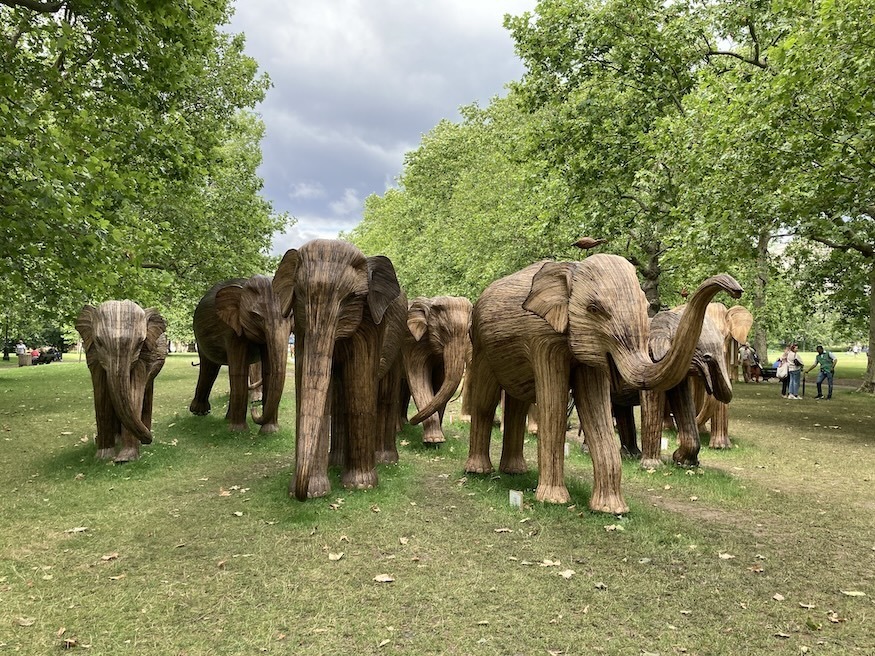
Elephants were once indigenous to London. Well… to the area that would become London. Their prehensile noses were snuffling through the foliage long before the first human settlement.
Ice sheets eventually drove them away but, in more recent centuries, they’ve returned in droves as part of circuses, novelty acts, zoos and menageries, and even as royal gifts. They can’t help but make a big impression.
As I browsed through the archives, I found tales of drunken elephants, rampaging elephants, plummeting elephants, influential elephants and even a tasty elephant. I can’t list them all (that would be a mammoth task) but below are what I reckon are the most interesting elephants in London’s history.
But first… prehistory
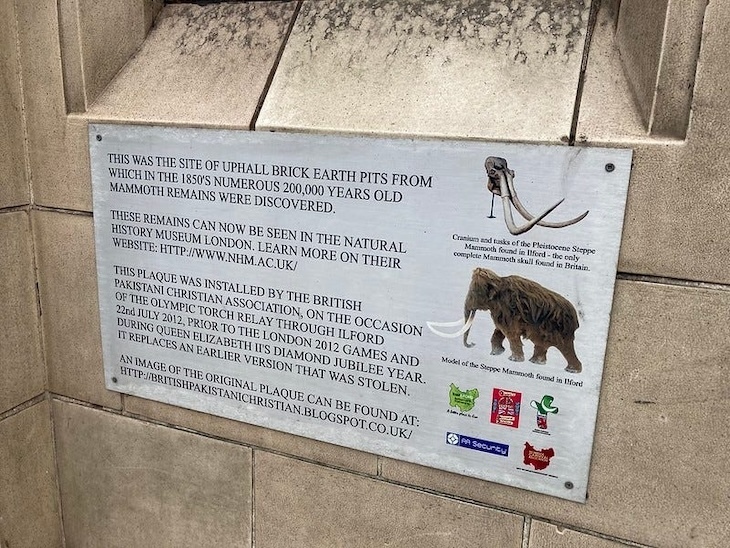
Were you to take your time machine and wander along the River Roding in Ilford 200,000 years ago, you might stumble across a dying mammoth. Remains of the creature, including the only complete mammoth skull found in Britain, were discovered here in Victorian times. Elephant and mammoth fossils have also been found beneath Trafalgar Square and Regent Street, while the Museum of London holds an elephant’s foot, unearthed in Rainham.
AD 43: Roman invasion?
London’s indigenous elephants died out tens of thousands of years ago. We’d see no further trunksters until the dawn of the Roman period in AD 43. According to common account, Emperor Claudius made use of war elephants during his invasion of Britain that year. Or did he? The claim rests upon the history of Cassio Dio who was writing over 150 years after the event. No other strong evidence exists for pachydermic intrusion in the first century. Even if the elephants did come, there’s no reason to assume they ventured to the future site of London, which was just one of many small staging posts at the time.
1255: Drunken gift elephant
1809-1826: Chunee and Co
The absurdly powerful East India Company brought a trio of Indian elephants to London between 1809 and 1811. All three were used/abused for public spectacle. Chunee, the most celebrated, was initially put to work on the Covent Garden stage, performing alongside such notables as Edmund Kean. The animal was then moved to Exeter Exchange, a hideously cramped menagerie on Strand. He was trapped here for over a decade, getting increasingly irascible. Things came to a nasty head in 1826 when Chunee fatally turned on one of his keepers. A few days later, soldiers were brought in to shoot the unfortunate animal. 152 musket balls later, and the elephant still stood. He was eventually finished off with a hand weapon.
1827: A therapeutic elephant in Chiswick
A year after Chunee’s brutal death, a much tenderer elephant story was unfolding in west London. The Duke of Devonshire had acquired an Indian elephant called Sadi for his palatial Chiswick House. The elephant would roam the gardens, entertaining guests with her ability to uncork bottles and turn door handles. She had many celebrity admirers. These included Prime Minister George Canning who spent a chunk of his final months attempting to recuperate at Chiswick House, where he was ‘much amused’ by the beast. The trunk couldn’t stop the truncation of his tenure. Canning died soon after, having served just 119 days as PM (the shortest stint ever, until Liz Truss knocked that one out of the park).
1831: First elephant at London Zoo
The very first elephant to arrive at London Zoo walked there from the East India Docks in May 1831. The poor animal had been penned up on a ship for nine months during a journey from Madras to London that somehow also took in China. Named ‘Jack’, he was a popular attraction at the zoo, except among bonneted ladies who were relieved of their headgear by a curious trunk on more than one occasion.
1865: The original Jumbo
London Zoo’s first African elephant was arguably the most culturally important elephant who ever lived. Dubbed Jumbo by his keepers (apparently the Swahili word for ‘chief’), the animal lived at the zoo with a female elephant called Alice, until he was bought by Barnum’s circus in 1882. It was at the North American circus that he found widespread fame. The elephant was so impressive that the word ‘jumbo’ became adjectival for any large object. Modern jumbo jets owe their epithet to this individual and, of course, the Disney film Dumbo is a cruel play on the name. Sadly, Jumbo would die in 1885 after being hit by a freight train.
1876: The Prince’s elephants
Jumbo and Alice received some new playmates this year, when Nepalese elephants Jung Persha and Salar Kulley arrived at the Zoo. The pair had been gifted to the Prince of Wales, later Edward VII, and remained his possessions. Jung Persha would emerge from Jumbo’s shadow as a zoo favourite, and gave rides to thousands of young visitors to the zoo up until his sudden death in 1896.
1884: Elephants rampage through Tufnell Park
Yes, Tufnell Park. Two elephants called Ida and Palm managed to escape from a travelling circus that had set up camp in the area. They travelled some distance through the neighbourhood, breaking two bystander’s collar bones along the way. The tusked fugitives were finally contained on Pemberton Terrace after falling into a basement. Fellow circus elephants Jim and Rose were drafted in to help haul out the troublesome duo. The wonderful Kenitshtowner website has the full details.
1905: Jumbo Jr visits the Cheshire Cheese
London’s smallest elephant, ironically named Jumbo Jr, arrived from Ceylon in 1903. He was quite the celebrity. The pint-sized pachyderm was invited to Buckingham Palace (twice), a Covent Garden ball, the Stock Exchange, the Guildhall and, perhaps more appropriately, something called the Eccentric Club. He would often travel in a horse-drawn cab.
On 3 August 1905, he was brought to Ye Olde Cheshire Cheese on Fleet Street at the invitation of some admiring American ladies. After squeezing in through the ancient doors, Jumbo was led to Samuel Johnson's Corner. Here, the elephant attempted to squat in the great lexicographer's favourite chair, and was treated to the pub's famous pudding and some bananas. He was also introduced to the pub’s own celebrity animal, Polly the Parrot (whose stuffed remains can still be seen behind the front bar). Jumbo’s gad-about-town lifestyle didn’t last long. He was soon packed off on a touring circus, his eventual fate unknown.
1904: The Hippodrome Elephants
What’s the largest herd of elephants ever assembled in London? Quite possibly the eight performing proboscideans who were squeezed into the West End’s Hippodrome in the early years of the 20th century. The octet performed on a reinforced stage, sliding down a 45 degree chute into a water tank in a frenetic recreation of an elephant hunt. Any sensitive Edwardians who feared for the creatures’ wellbeing could be reassured by the Hippodrome’s pledge “not to use a whip in public view”. So that’s OK, then. Such spectacles seem appalling to us now, but it was tame by the Hippodrome’s standards. A few years later, they staged a Christmas show featuring 70 polar bears.
1930: Elephant stampede!
Elephants and lions have never been on the best of terms. But an encounter between the ancient foes almost killed several Londoners in what would have been the capital’s most unlikely disaster.
It happened at the Lord Mayor’s Show of 1930. Four elephants had been acquired to make the annual procession even more impressive than usual. The beasts were making their way along the Embankment, when they were suddenly spooked by the appearance of a lion, albeit a red-painted sculptural lion.
All four elephants trumpeted loudly at the sight of the mock predator. According to a press report, “The foremost elephant suddenly turned to its left, and with trunk and tail erect, rushed screaming at the wooden lion. It seized the ‘lion’ and trampled on it”. 30 people were injured in the kerfuffle.
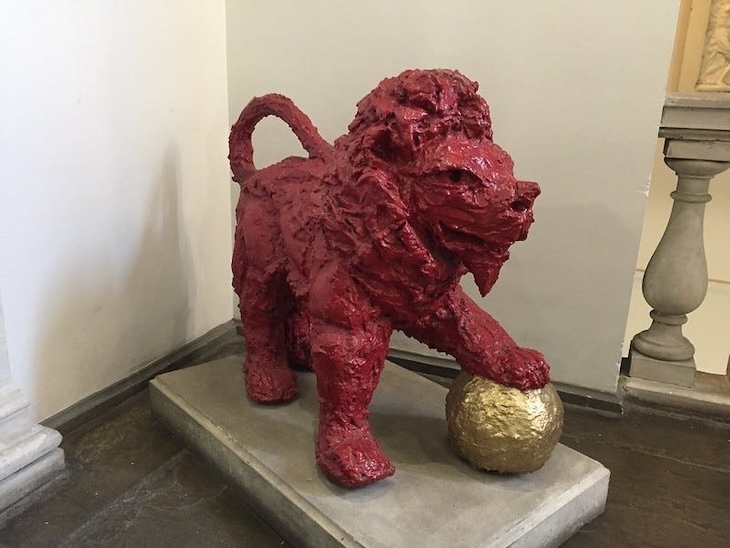
The red lion in question survives to this day. It was Reggie (above), mascot of King’s College, who was out for a ‘stroll’ with some trouble-making students. You can read the full story here.
1949: Dumbo flies in
London Zoo took receipt of a new female Indian elephant this year. The orphaned newborn was the first elephant ever to fly into the country (by plane, not supersized ear-flaps), and so was inevitably named Dumbo after the 1941 film character. She remained in London until her transfer to Moscow Zoo in 1958. Her fellow elephants at London Zoo included Rusty and Rajah.
1951: An elephant eaten
The aforementioned Rajah went stir crazy in 1951, seriously injuring two keepers. The animal, deemed too unruly to keep, was consequently killed. Press reports say that the copious flesh from the elephant would be fed to carnivores. But it seems that the meat found its way into human stomachs too. The press association’s food correspondent deemed the meat ‘a little tough’, but of ‘excellent flavour’ after slow simmering.
1967: Diksie falls to her death

Alas, elephants can’t really fly. In this year, London Zoo lost one of its African elephants, when 27-year old Diksie plummeted into the dry trench surrounding the enclosure. Because of its bulk, a short fall can be fatal to an elephant, and Diksie died a few hours after her two-metre plunge.
2006: The Sultan’s Elephant
The Sultan's Elephant was a multi-storey robotic elephant that roamed around the West End, spraying water from its trunk and leaving dropped jaws all around. This was such a staggering event; those who witnessed it look back and wonder if it actually happened at all. It seems so unlikely now. Perhaps the greatest art event ever staged in London, and it was all about an elephant.
2012: The final elephants leave London Zoo
The Olympic year was a big one for London Zoo. After 170 years as a home to elephants (with a short break during the Second World War), the final trio packed their trunks for the much more spacious fields of Whipsnade Zoo. Their names: Dilberta, Lyang-Lyang and Mya (the first two had been resident since the mid-80s).
London has been entirely elephant-free ever since which, given all that the poor animals have been through in the capital, is surely a good thing.