This feature first appeared in February 2025 on Londonist: Time Machine, our much-praised history newsletter. To be the first to read new history features like this, sign up for free here.
Bollards, coal and tax. Not words to get many hearts racing. But this unpromising material leads into a fascinating London story.
If you’ve ever wandered through the outer reaches of Greater London, then chances are you’ll have stumbled across one of these sturdy fellows.
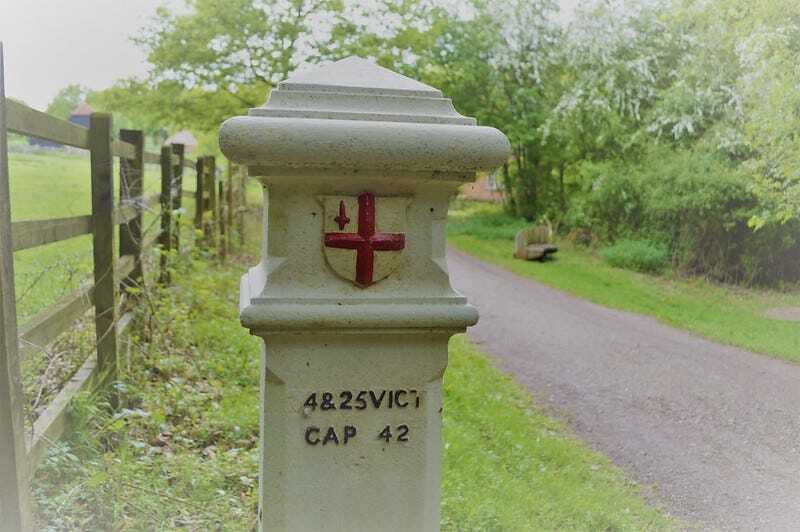
More than 200 of these cast-iron sentinels form a ring around the capital. Each is about 1.2 metres high, painted white and emblazoned with the shield of the City of London. Not one of them is in the City of London, however.
Rather, the bollards engirdle the capital 20 miles out from the centre. You’ll find them at Uxbridge, Potters Bar, Dagenham, Caterham, and many places in-between.
If you hadn’t already guessed from the title, these are coal tax posts. They mark the frontier beyond which inbound coal merchants would have to pay tax to the City of London Corporation.
The system was scrapped over a century ago, but it does have parallels with the modern Ultra-Low Emission Zone (ULEZ). Here was a duty on a heavily polluting fuel, levied on anybody entering a clearly defined boundary far outside central London. Where it differed (apart from the lack of number-plate recognition technology) was that coal tax had no environmental purpose. It was simply to raise money for improvement works in the City of London.
“We built this city on rocks of coal…”
Today, so little coal is used domestically that Londoners scarcely think about the black stuff. Yet for hundreds of years this was the principal fuel for both heating and mechanical work (e.g. steam engines). Huge quantities were shipped to London annually, even before the Industrial Revolution. The city became known as the Big Smoke, thanks to all the coal it burned. All of it was taxed.
This wasn’t just a money grab. Coal tax played a crucial role in shaping London. After the Great Fire of 1666, St Paul’s Cathedral and many of the Wren churches were rebuilt largely with money from coal duties — the ultimate expression of fighting fire with fire. In a later age, the Victoria Embankment and wider sewer system were made possible by coal tax. The choky fuel thereby helped to end the Great Stink. This most hard-working of taxes also supported the building of Holborn Viaduct, New Oxford Street, and numerous other road improvements. London would look utterly different were it not for the tax on coal.
Until the Industrial Revolution, the carboniferous cargo was brought in to the Port of London exclusively by barge. Taxation was easy. Johnny Q. Collier could only tie up and offload his barge at a handful of dedicated quays. Tax inspectors would collect their dues and deposit them straight into the coffers of the City of London Corporation (or, in times of emergency, the national exchequer).
Then the canals came along, swiftly followed by the railways, and a more reliable road network. Suddenly, coal could make its sooty way into London via hundreds of different routes. Great for the coal supply, but a challenge for the customs men.
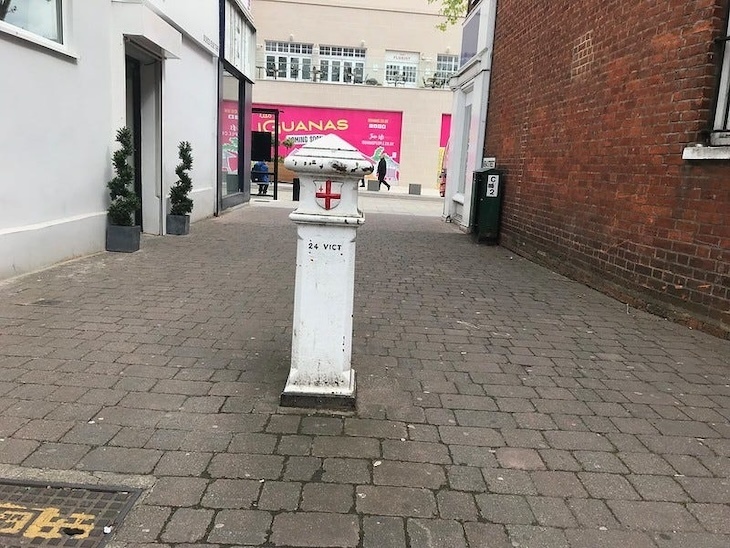
How to account for a commodity that could reach the region unseen by the inspectors? A load of old bollards. That’s how.
280 of the distinctive coal tax posts were erected in the wake of the London Coal and Wine Duties Continuance Act 1861. This defined the 20 mile boundary in near harmony with that of the Metropolitan Police District, as it was in the mid-19th century. The posts sat on prominent roads, as well as beside canals and rail links. These were not the first such markers. Others survived and were, indeed, reused from earlier schemes. But it is the 1861 white posts that remain most prominent today.
How did they work? No tax was paid at the bollard itself (with a tiny number of exceptions). Rather, the post stood as a reminder to the coal-importer: “Beyond this point, you are liable to pay tax, or face a serious fine”. It’s much like certain toll roads today — or the ULEZ charge for that matter — where you don’t pay during the journey, but once you reach your destination (via the internet).
As it happened, most coal continued to come in by river and, later, the railway, so the markers didn’t play a huge part in the grand scheme of things. Still, every little helps.

Despite all the good works that coal tax was channeled into, it was always unpopular. It’s a tax. They are never popular. But this one seemed a trifle unfair. Most taxes were applied across the whole of the country, but this oddity only troubled London. Meanwhile, those living outside the centre complained that they saw little benefit from the tax, which nevertheless put up the price they paid for coal.
This latter issue was acknowledged in the 1870s, when some of the duties were spent on removing bridge tolls further out of town. The spans at Kew, Kingston, Hampton Court, Walton upon Thames and Staines all became free to cross thanks to coal money. Two bridges of the Lea, near Chingford and Tottenham, also threw off their shackles.
It wasn’t enough. Agitation to remove the tax continued to grow. The levy was finally nixed in 1889, when the deeply unpopular Metropolitan Board of Works (who had some oversight of the scheme) was replaced by the London County Council.
The system of white posts had been in situ for less than 30 years. It’s remarkable, then, that around three-quarters of them remain in place today.
Moving the coalposts
You will — being the inquisitive individual that you are — now wish to track down some of these curious relics for yourself.
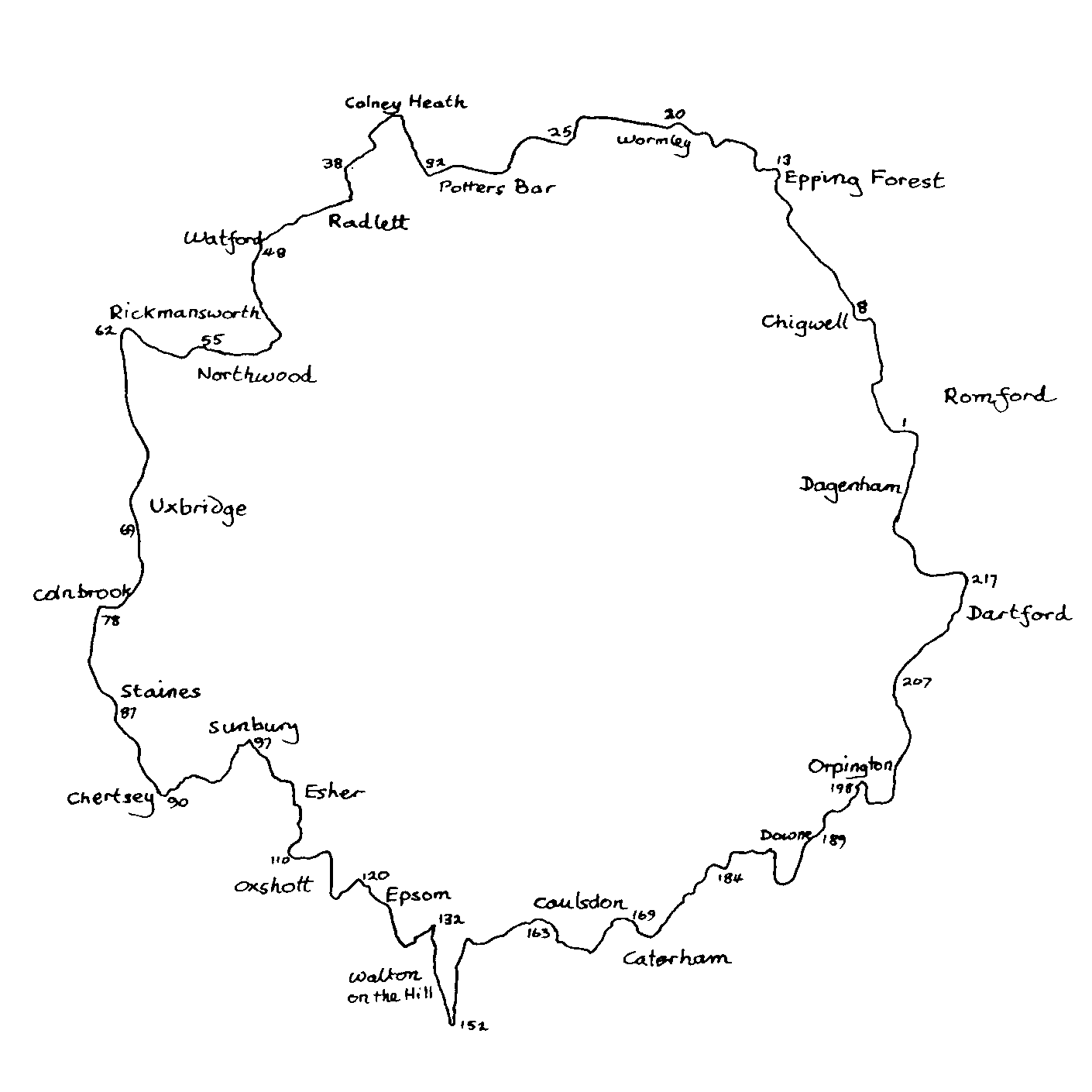
I had intended to map the full set, but this was proving too time consuming. Instead, this indicative map shows the shape of the boundary, with a few key locations marked. Meanwhile, Martin Nail has compiled an exceptionally detailed list of every extant post (he counts 218), including coordinates. If you’re anywhere near the Greater London boundary, then a coal tax post is likely to be within easy reach.
As Martin also points out, the white posts we’ve lingered on here were not the only flavour of coal tax post. A few plainer markers survive from earlier schemes, as well as variations on the standard white pillar. There’s a whole tax-onomy out there.
Not all the surviving posts are by the roadside. The one included at the top of this article, for example, sits within the superb Chiltern Open Air Museum, which is home to dozens of salvaged buildings (and bollards) from around that area. Another can be found at the Valence House Museum in Dagenham. We mention this fact mostly so we can get a “moving the coalposts” pun into the heading.
Finally, we should clear up one issue, to put geekier readers at their ease. Earlier on, we mentioned that the posts were set about 20 miles from the “centre of London”. But where exactly is the centre of London? By consensus, the modern centre is considered to be Charing Cross, at least for the purposes of mileage measurement. Other standards were used in the past. For coal-tax posts, the General Post Office near St Paul’s was chosen. This prominent building was often selected to define catchments, and its location in the City of London put it in better accordance with the Corporation (who collected the taxes) than would Charing Cross (in Westminster).
So there we have it. Coal, tax and bollards can be interesting, wouldn’t you agree? Next week: The history and provision of Sluice Valve markers in suburban settings. (Possibly not.)
Special thanks to Will Gray, who sent in one of the photos above and pointed out the ULEZ analogy.