Dr Mary L. Shannon, a Senior Lecturer in Literature at the University of Roehampton — and author of Billy Waters Is Dancing — gives us a brief history of the Black busker Billy Waters, a man who turned a bad accident into a starry career.
How do you tell the story of undocumented Black lives in Regency London?
This was the problem confronting me when I was writing the biography of William 'Billy' Waters, once a famous Black busker in Regency London, now largely forgotten. "Every child in London knew him", said one contemporary commentator. "Whoever danced as he danced? Waters was a genius!" said another. However, his memory survives only in images and tiny archival traces. Sailor, immigrant, father, lover and extraordinary talent, Billy Waters' life lets us celebrate his creativity and understand a diverse transatlantic Regency world.
Waters had a hit song (Polly Will You Marry Me?), a famous street performance, a well-known costume — and was depicted in a musical that toured Britain and America. He was also a Black, disabled, poor man in an era when to be any of those things was at best challenging, and usually downright dangerous. Yet Waters shaped his life on his own terms as much as he could: he joined the British Navy, turned the accident that disabled him into the start of a new career as a performer, and fought hard to defend his family and livelihood. Waters was a versatile and skilful man.
From sailor to street performer
Where did he learn these skills and this resilience? British naval records tell me he was born in New York sometime around the American Revolution. In his mid-thirties, just before the war of 1812 between Britain and America, he was pressed (or possibly volunteered) into the British Navy. His skills were recognised, and he was swiftly promoted to a Petty Officer. Just six months later, on 3 March 1812, he fell from the main yard of HMS Ganymede, breaking both legs and suffering other severe injuries.
Waters survived but lost a limb and a career. He received a pension of £20 a year for life, but he would need about twice that income to support a family. So he reinvented himself once again: this time as a famous street performer.
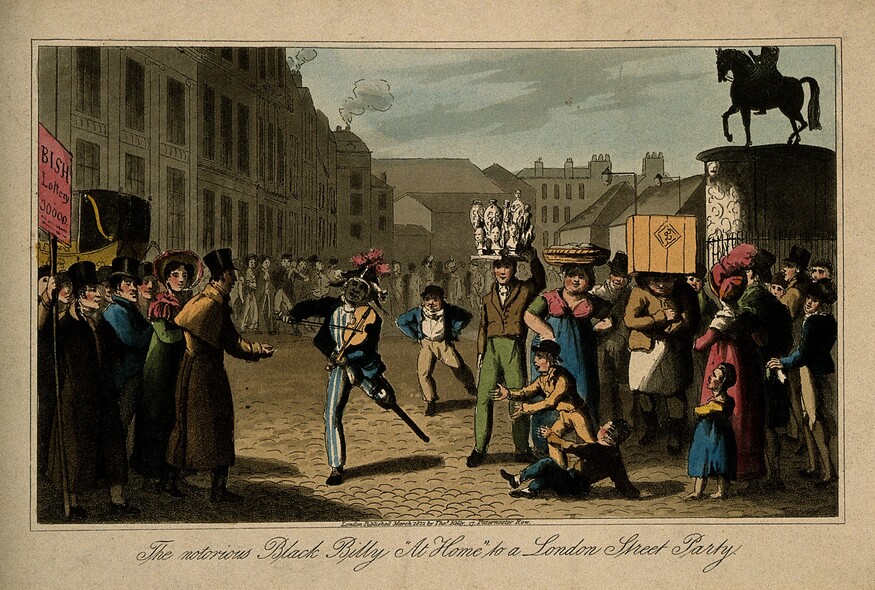
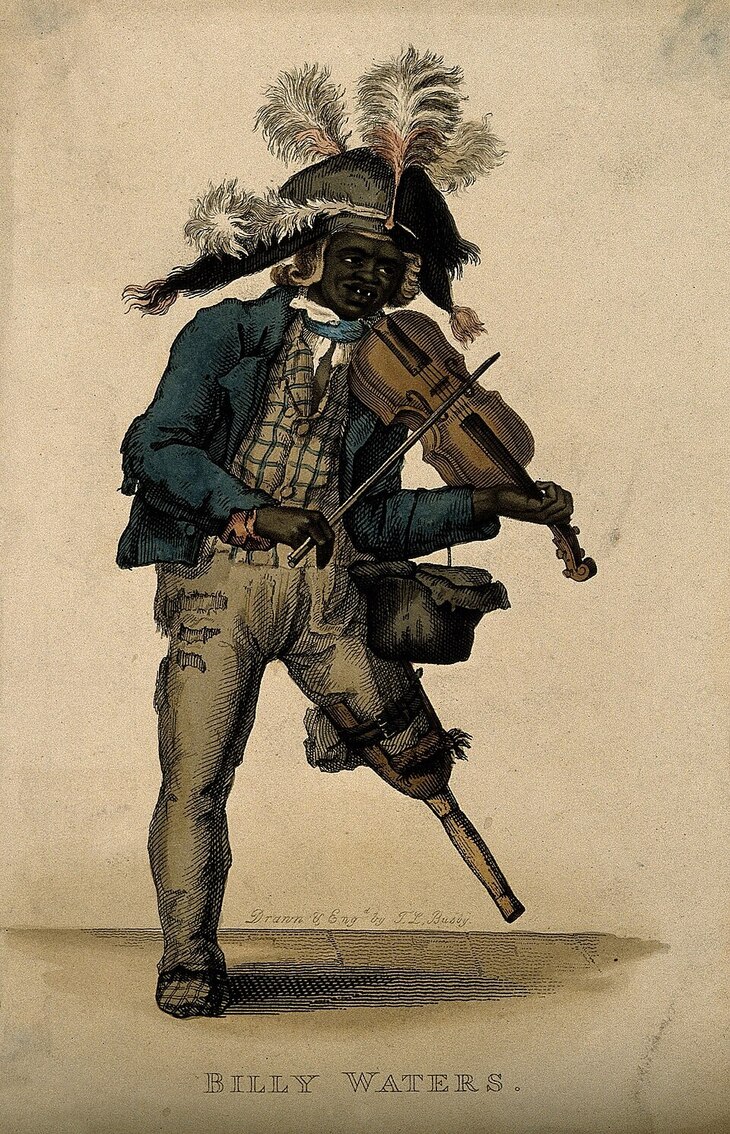
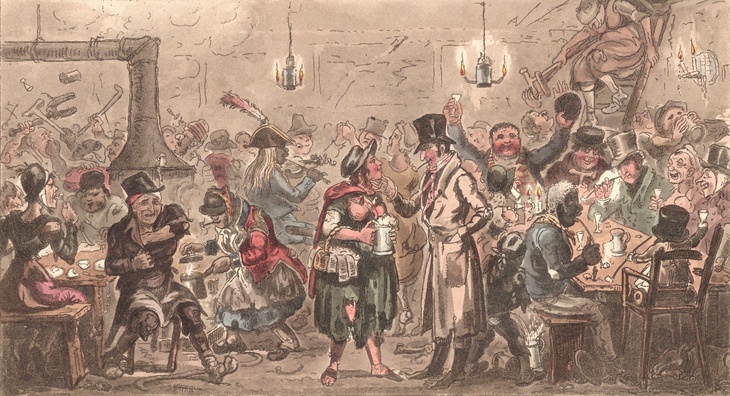
By 1819, singing and dancing around the West End, he earned enough to support a wife and children. His talents drew the attention of writers and artists. His fame grew. A picture survives of him performing in Charing Cross. Another eye-catching picture, done around 1820 by George and Robert Cruikshank (George later illustrated Charles Dickens’s Oliver Twist), survives. The picture shows Waters in the middle of a crowded London pub, playing music as drinking, fighting, and flirting unfold around him. We see his caricatured features and costume: a feathered military hat, sailor jacket, white wig, and the shaft of his wooden leg. But none of these representations were by Waters himself. They all look at him through 19th century eyes.
The cost of fame
When Waters was turned into a character in a hit musical called Tom and Jerry; Or, Life in London (1821), it wasn’t the real Billy Waters who performed on-stage. Instead, a white able-bodied actor played him in blackface. Billy Waters' real history and experiences were lost. His money dried up as people believed the bullying and aggressive 'Waters' portrayed on stage. His last recorded home was a notorious London slum. Meanwhile, the caricatured, racialised version of him travelled across Britain and America as the musical's popularity spread.
However, when Billy Waters died in a London workhouse in 1823 — impoverished and broken by the musical which stole his identity — at least 20 British newspapers carried his obituary. He appeared in books, ceramics and newspapers for decades after his death. Today, a BBC R3 documentaryand a set of free resources for schools reinsert his name into British history.
In November, a permanent installation at the London Museum will open featuring Waters. At long last, Billy Waters is dancing again.
The clues Billy left behind
Waters left no papers, diary, or letters. But those caricatured, racialised Regency images of Waters — by depicting his chosen costume in great detail — provide a window into Waters' creative influences and experiences. They are all we have of autobiography. In his feathered hat, we see an echo of the festivals and costumes of early New York's song and dance culture, and of Black New Yorkers fighting with everything they had to preserve, develop and transmit their ancestors' rhythms. In his sailor jacket, we see his proud assertion of his Navy service for Britain and his implicit declaration that Black men could be war heroes, too. In his fiddle, we see the part he played in the story of English folk music.
Perhaps, without knowing it, these Regency artists depicted Waters' response to the history and heritage of forced migrations he lived through and with. I realised that I didn’t need to develop a creative way to overcome the gaps and silences in the archive. Billy Waters had already managed that long ago.
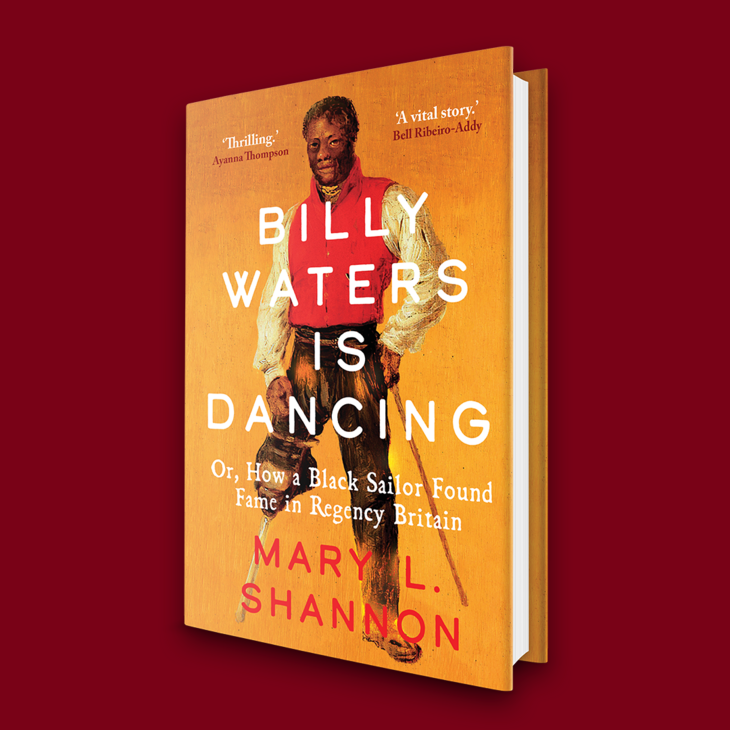
Billy Waters is Dancing Or, How a Black Sailor Found Fame in Regency Britain, by Dr Mary L. Shannon, published by Yale University Press London.
You can also download the free graphic novel, Billy Waters: Songs from the Shadows.