Keep up to date with festive happenings in the capital on our Christmas 2026 in London page.

"Trafalgar Square is changed as never before. A 48-ft Christmas tree has sprung up on the west side of Nelson's Column."
So began a newspaper article on 22 December 1947, as a new and endearing Christmas tradition lit up in London.
The grandaddy of all London's Christmas trees takes pride of place in Trafalgar Square, but what's the story behind it? When and how does it arrive here? And why are Londoners so bloody ungrateful about the whole business? It's time to spruce up on your arboreal knowhow...

What exactly is the Trafalgar Square Christmas tree?
Arguably the most famous Christmas present in London, the Trafalgar Square Christmas tree is a roughly-20-metre-tall Norwegian spruce (Picea abies if you're being all Latin about it) gifted from Oslo to London each year. This has been the case since 1947, when Oslo sent London a tree to reward its/Britain's efforts during the Second World war. Said efforts included providing a safe haven for the King of Norway, Haakon VII, in London, and allowing the Norwegian government-in-exile to govern from here. Bonus fact: there's a good story along these lines about Claridge's and the Yugoslavian Crown Prince too.
Judging by the photos of the Trafalgar Square Christmas tree being felled last week in Norway and arriving today, it’s been transported as hand luggage on Ryanair… (Photos @UKinNorway and @danbarker) pic.twitter.com/iEwKkqPuAd
— Larry the Cat (@Number10cat) November 28, 2022
But why a tree, and not, say a nice Scandinavian jumper or something?
The tradition of cutting down a tree and putting it up in Oslo's Universitetsplassen is a long-held tradition. So sacred is it, in fact, that even when Norway was occupied by the Nazis during the Second World War, members of the Royal Norwegian Navy snuck back into their own country to cut down a tree each year, bringing it back to London for King Haakon to enjoy (now THAT is a Christmas film waiting to be made). Today, the tree symbolises not just what Britain did in the war, but also a respect for democracy, human rights, peace — and solidarity between the two countries/cities.
Where does the tree actually come from?
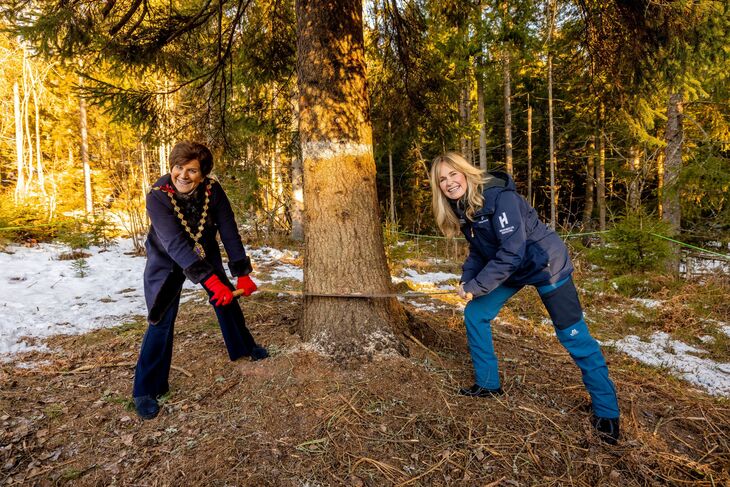
A fresh (and by fresh, we mean decades old) tree is felled in the Nordmarka Forest, to the south-west of Oslo every year, in mid to late November. It's nicknamed the 'Queen of the Forest'. The Mayor of Oslo takes one end of the saw, and the Lord Mayor of Westminster takes the other. Cutting it down looks like hard work.
2026's tree — felled by Lord Mayor of Westminster, Cllr Karen Scarborough, and the Mayor of Oslo, Anne Lindboe — is known as "Jolly Cheery", is 75-years-old and stands at 21 metres tall.
When does the tree arrive in Trafalgar Square?
It's got quite a journey; travelling by road to Brevik, then across the North Sea to Immingham, then by road again to London. (These days, this is done with electric and biodiesel vehicles.)
The tree usually arrives in Trafalgar Square a few days before the switch on, giving time for it to be lifted into an upright position, and its branches to settle before being adorned with 500-odd vertical fairy lights.

When is the tree lighting ceremony?
A special lighting ceremony, involving carol singing and poetry readings, traditionally takes place on the first Thursday of December. In 2026 that's 3 December, 6pm-6.30pm.
The Lord Mayor of Westminster and the Mayor of Oslo will switch on the lights. The Choir of St-Martin-in-the-Fields will sing Christmas carols led by the Regent Hall Band of the Salvation Army. A poem to the tree will be read out by children from Westminster. And there'll be a display by the London Scottish Pipes and Drums and a performance by Sølvguttene "The Silver Boys".
Anyone can attend the ceremony, which is free. More details here.
And every year, Londoners express their heartfelt gratitude to Norway for the thoughtful present... right?
Well mainly, yes! With its traditional Norwegian festoon lighting, the tree brings joy to millions of Londoners and visitors each yuletide. But as of recent years, the tree has come in for some, er, needling, with critics complaining it's 'underwhelming', 'wonky', and 'looks like a cucumber'. Some Norwegians naturally took offence, one saying: "Try getting a Christmas tree from the French to see how nice that is."
Londonist was compelled to investigate in 2018, when we very scientifically asked a handful people what they thought of the tree, before holding a cucumber up in front of it.
Our official line here at Londonist is that we love your tree Norway, and please don't stop this lovely Christmas tradition — Takk skal du ha!

But Londoners reacted appropriately when the first tree arrived in 1947, yes?
Oh, they liked it alright, but maybe a bit too much. Wrote the Yorkshire Evening Post: "Within a few minutes some of the crowd had begun to pull of pieces of the tree decorations as souvenirs." Sigh.
What happens to the tree once Christmas is over?
If you're worried that cutting down a majestic spruce is wasteful, know that, after Twelfth Night, the tree is turned into mulch, which is then used on gardens around London.