Adapted from a feature that first appeared in November 2025 on Londonist: Time Machine, our much-praised history newsletter. To be the first to read new history features like this, sign up for free here.
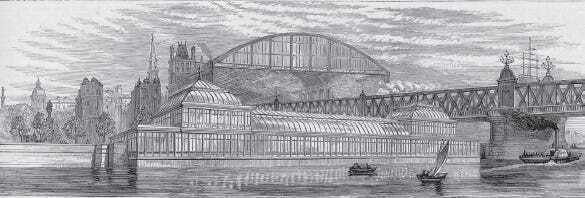
Fancy a dip in the Thames? The Victorians did. For a brief period in the 1870s, our fearless forebears could lark about in the waters off Charing Cross, safe from any passing vessel, and supposedly shielded from the river’s grim contents. This is the story of the ‘floating baths’, which bobbed on the Thames beside Hungerford Bridge between 1875 and 1885:
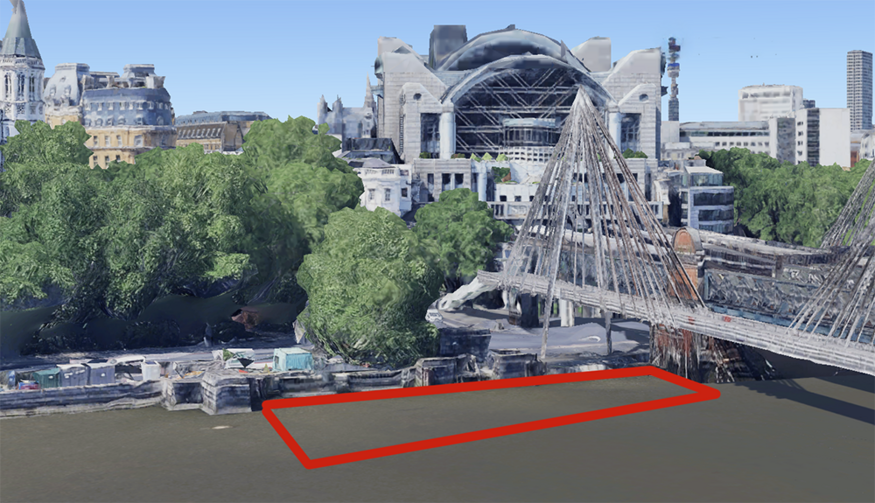
For those who don’t know the area well, here’s the same view today via a slightly crunchy render in Google Earth.
Nobody went directly into the Thames. Bathers instead climbed into a massive tank of river water, held within a barge. This was not so much wild swimming as tamed swimming.
The plan first bobbed above the surface in 1873, when the Floating Swimming Baths Company put out a call for shareholders in the national press. Their proposed pool would meet a desperate need. Few people at the time could swim, and hundreds of lives were needlessly lost each year from drowning. The point would be grotesquely underscored a half-decade later. The sinking of the Princess Alice near Beckton in 1878 claimed well over 600 lives, most of whom drowned (in sewage).
The adverts promised that “Experienced professors of swimming will be engaged; and it is intended to institute periodical swimming matches, with prizes, in order to encourage the practice of swimming as a national accomplishment.”
All very good for public health and safety. But the Floating Swimming Baths Company had a second motive: money. Their appeal for shareholders noted a problem with existing swimming pools. Many turned a profit, but with considerable overheads from the water rates. The floating pool would eliminate that cost by using river water.
It was a virtuous circle. More people might learn to swim, thereby saving lives. Meanwhile, shareholders would reap the benefits, especially if the concept could be rolled out to further Thames-side locations and other rivers. For a time, the mood was buoyant.
The Thames eyesore?
Before we go for a dip, let’s take a closer look at the floating building. The baths were designed by a Captain Julius Roberts with engineering by a Mr Edward Perrett, and were based on similar floating baths in Paris’s River Seine. Its pool was protected from the elements with a glass frame reminiscent of a mini-Crystal Palace. This was built from wood, zinc and iron, and decorated in blue and white paint.
Much of this assembly took place well downriver in Canning Town, courtesy of the Thames Ironworks and Shipbuilding Company. If the name is familiar, it is they who constructed the world’s first all-iron warship, HMS Warrior. They would also go on to form West Ham United Football Club. Some of the club’s first players may have worked on the floating swimming pool. This is NOT why the Hammers’ fans traditionally sing “I’m Forever Blowing Bubbles”, but it would make for a good origin story.
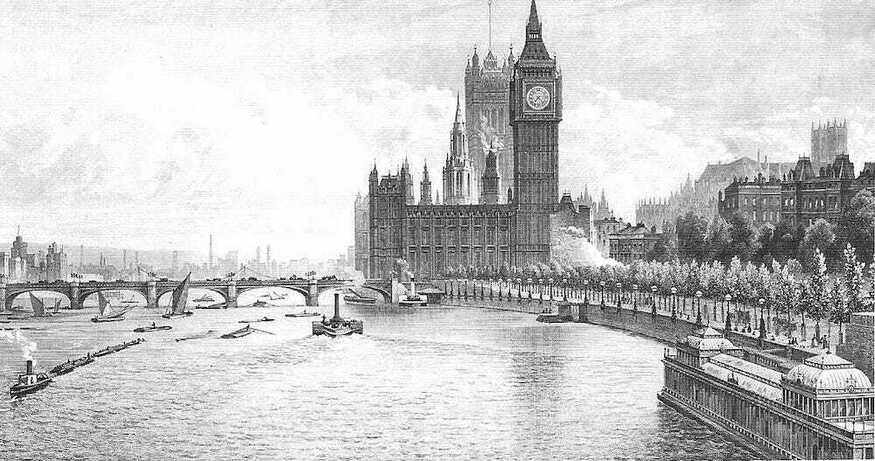
The floating pool was finally completed in mid-1875. Let’s have another look at it.
To my eyes, it’s a dainty confection, which could only beautify the Embankment. It wasn’t universally viewed that way at the time. One concern, reported in The Daily Telegraph of 8 July 1875, was that it would “utterly ruin the prospect” from Northumberland Avenue, then under construction just to the left of the image above.
New buildings will, of course, always find their critics. But, uncharacteristically, the Telegraph was not among them. It reassured its readers that the baths were “by no means so unseemly as we have been invited to believe”. Indeed, the glass-topped barge was a positive beauty compared to its neighbours:
“… it certainly contrasts very favourably with Charing-cross Railway Station itself, and can hardly be said to spoil a spot already disfigured beyond all possible endurance by the hideous squat pile of white brick erected by the Metropolitan District Railway, and the still more hideous iron bridge across which the trains make their way in and out of Charing-cross.”
The baths would finally open in July 1875. In the first 66 days, reported the company, some 27,637 people paid for a swim. That’s about 300 people per day, if we consider that the pool was only open on week days. The following summer, some 41,000 people took the plunge over a similar period. Let’s join them…
Join me for a dip
We approach the baths along one of those gangways that fall and rise with the tides. A uniformed commissioner greets us. He wants a shilling per swim, but wonders: do we suppose we might be back again over the summer? For regulars, he can offer a season pass of 25 tickets for a pound. We politely decline, and venture inside on our single tickets. This is what we behold:
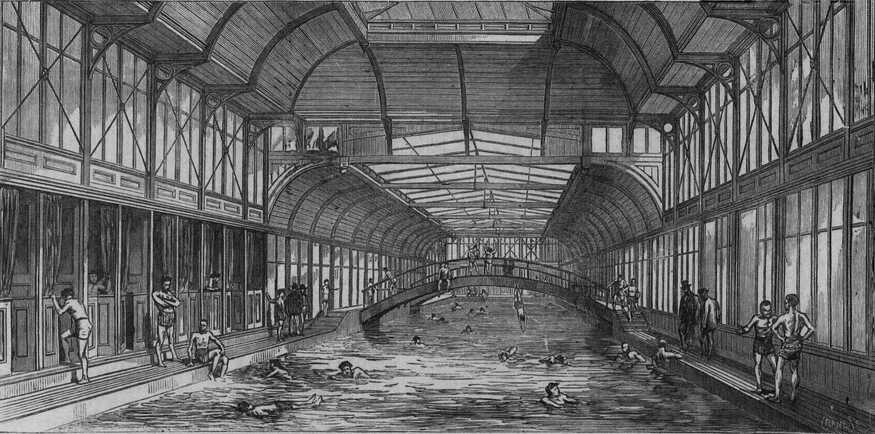
It’s an impressive space, no question. We might easily forget that we’re on a barge in central London, were it not for the funnels and masts of other boats that glide past the windows. Our pool is not rocked by their wake; the internal water is the dampest of dampeners, and prevents any lateral motion.
Nor does the room smell of chlorine. Why would you even think that? Nobody will chlorinate water for another two decades. This is good ol’ Thames water, reassuringly grey and wholesome, and not especially unpleasant on the nose.
We contemplate the pool. It is long and thin, extending some 135 feet (or 41 metres, as the French would have it). That’s almost as long as an Olympic-sized pool… not that the Olympics have been reinvented yet. Two bridges arch over its midriff. They provide a perch for anyone wishing to dive in.
We walk over to the curtained cubicles on the left. 40 are provided, and we have no problem finding vacant boxes in which to change. An extra, larger space is reserved for school parties. Ahead of us, at the western end of the pool, is a viewing lounge for those who prefer to watch.
We jump in. The water is cool and refreshing, and also a little choppy. It is constantly replaced with ‘fresh’ Thames water, pumped in through a fountain at one end, and decanted off at the other. The result is a gentle current, against which it is profitable to swim. Beneath our feet, the floor slopes steeply away. The shallow end barely reaches the hips, whereas the far end might conceal a man of more than six feet.
We spend about half an hour engaged in the natatory arts before retrieving our belongings, dressing and departing. “Come back again,” cries the commissioner. “We’ve got night-swimming by gas light in the autumn!”
But…? But…?
By now, you will have at least two questions.
1. Was it men only?
Yes, it seems so. Swimming was a largely male pursuit in Victorian times. Women could swim at some pools, but only if segregated from men. The early scoping document for the floating baths suggests “if desirable, separate bathing accommodation for ladies will be provided, with every convenience and privacy”. As far as I can judge, this was never done, and no women-only sessions were advertised. Sorry ladies… that sparkling Thames water is for the menfolk only.
2. Just how gruesome was that sparkling Thames water?
Not as bad as you might think, actually. In the first instance, the recent construction of Sir Joseph Bazalgette’s mighty sewers had radically cleaned up the river. Now, hardly any human waste entered the central Thames. The river was much cleaner than it had been a generation before.
That said, London was a heavily industrialised city, and many of its riverside factories still dumped waste water into the Thames. Meanwhile, the flotsam, jetsam and turdsam of a thousand river vessels added to the iffy admixture. You wouldn’t want to drink this stuff.
Few people would voluntarily immerse themselves in this swill. The baths’ proprietors knew this, and built in counter-measures. Before entering the pool, the Thames water was passed through a series of sand and gravel filters, which went a long way towards removing impurities. From here, it was pumped into the public pool at a rate of 500 gallons per minute. The supply was constantly refreshed. As many publications remarked, the floating mere wasn’t quite up to Windermere standards, but it was good enough to attract the crowds.
Some reports would have you believe in miracles, though. “As bright, as fresh, and as wholesome as ever swimmer need wish,” declared one account. Another boasted that the water “sparkles and glitters as if freshly drawn from a deep Artesian well”. (Breaking off to make lunch, I wonder if this is the same optimistic copywriter who bestowed the word ‘spreadable’ on my Marks & Spencer’s ‘softer’ butter.)
The pool evolves
Now, do you remember our friendly, upselling commissioner who promised us gas-lit swims? It actually happened, along with other measures to attract customers outside the summer months.
From October, the water in the pool was warmed by a furnace to 80°F (about 27°C), which is similar to a modern indoor pool. Under its gas lamps, the venue was able to stay open until 9pm, even at darker times of year. Yes, the water quality might still be questionable, but how many of us would turn down the chance to swim in such an elegant building, in heated water, by gaslight? I’d certainly be there.
In the bleak midwinter, the pool became too expensive to run. It closed completely between November and May of the 1876. The following winter, however, saw something remarkable. The pool was turned into a Thames ice rink, dubbed the ‘Floating Glaciarium’.
The pioneering rink, which employed over a mile of refrigeration tubing, accommodated a “considerable number” of skaters on its opening day, each handing over two shillings. The Glaciarium reportedly gave skaters “as fine a surface of ice as they could well wish for”, and recalled the Frost Fairs of old, when the entire Thames would freeze over. However, the cooling apparatus was not as efficient as we’re used to today. The rink could only open for short bursts before the ice was churned up and required a refreeze. It proved uneconomical and the venture only operated for this one season. January 1877, then, was perhaps the last time anyone ice skated over the Thames in central London.
As a side-note, I see that the rink was engineered by a Mr John Gamgee. According to Wikipedia, this gentleman would later adapt his refrigeration technology to build a ‘perpetual motion machine’ — one so ingenious that it hoodwinked President James Garfield. Gamgee got the idea while freezing the inclined swimming pool…
…you could say it was a slippery slope.
Sink or swim
The floating baths were intended to be the first of several on the Thames. A second site off Pimlico Gardens was secured early on. This would have been a whopper, perhaps 260 feet (79 metres) long. Such a pool would have ranked second only to Tooting Bec Lido. Were the first baths to turn a profit, then others might follow on the Mersey, the Clyde and the Tyne.
They never came to pass (though Liverpool had history here). The pool was popular, but not quite popular enough to stir a profit. The shilling entrance fee effectively barred the working classes, instead attracting wealthy loungers and the more adventurous species of barrister from the nearby Temple.
One important exception was the school outing. From day one, the baths catered for schoolboys of every stripe. In 1880, for example, 30 poor lads from the Orphan Working School on Haverstock Hill (north of Camden Town) completed a course here, cheered on by Matthew Webb, the first person to swim across the English Channel.
It was not enough to sustain the baths. As the novelty wore off, attendance dropped and a decision was made to wind up the company. Its final season came in 1884.
The elegant structure was then put up for auction, but failed to make its guide price. For a time, there was talk of the baths moving to Chelsea, or to the riverside City of London School near St Paul’s. Eventually, though, it was snapped up by the South Eastern Railway Company, presumably as a cheap source of metal.
That should have been the end of the story, but it seems the floating baths were not quite ready to sink into history. The glorified barge languished in the Surrey Commercial Docks in Rotherhithe for half a decade. Then, in 1891, it was purchased by a syndicate who restored it to full use.
The born-again bagnio was this time moored beside Cleopatra’s Needle, not far from its original site. It traded as ‘The Cleopatra’, but was sadly not filled with donkey milk, as its namesake might have expected. Nor, curiously, did it contain Thames water. The Cleo switched to mains water to guarantee its purity. It retained its heating system, but would now be illuminated by electricity rather than gas.
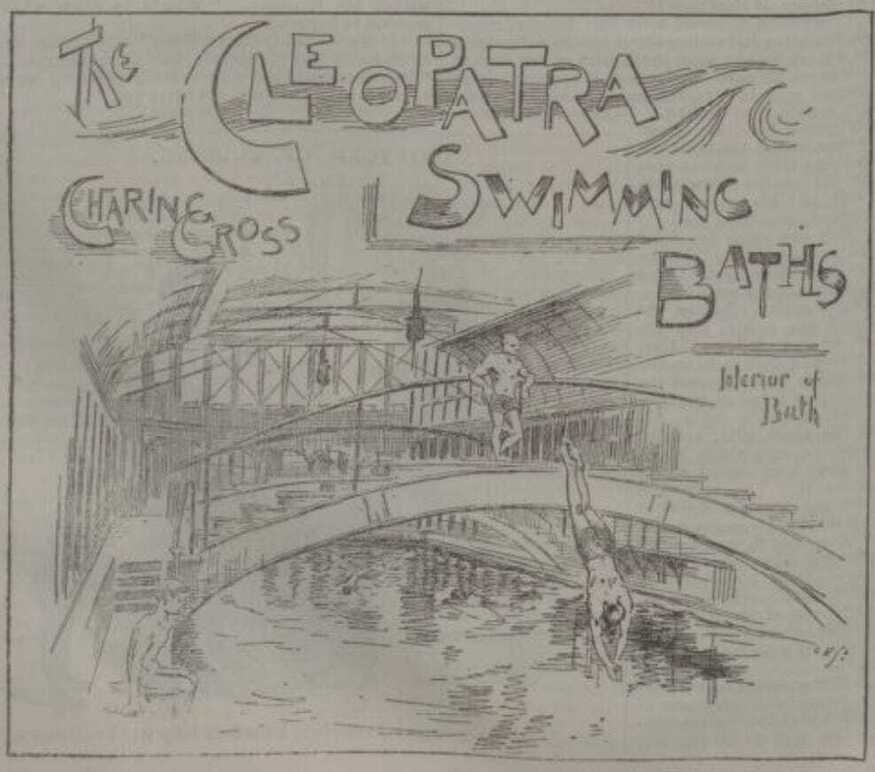
The pool opened in September 1891, with “the gaiety of Margate, intensified and magnified a hundredfold”. By now, though, it had missed the summer peak. The Cleo never made enough money to be viable, and it failed to reopen the following year. The moribund pool languished on the Embankment for a few more years, seemingly without future.
Yet again, a reprieve came. In 1895, the pool-barge was towed down down to Southend sea front, where it opened as a summer pool off the Esplanade. But the Essex shore proved an even more luckless mooring. A news item from October reveals that the bats were “extensively damaged” in a storm.
I’ve not been able to trace what happened to the baths after this. We might presume that the smashed structure was scrapped. However, a hopeful note in one newspaper suggests that the damage was “covered by insurance”. Was the claim ever made? Had the unprofitable baths perhaps been smashed up deliberately, under cover of the storm, as an ‘insurance job’? Or were they patched up to float another day? I’ll leave that one to any local historians who might be able to help.
The idea of a floating pool on the Thames has reappeared numerous times over the ensuing decades. Most recently, design firm Studio Octopi proposed a more naturalistic floating lido for the Embankment. Nothing has yet come of it.
Perhaps one day. With the completion of the Tideway supersewer, our river is now less polluted than at any point since before the Industrial Revolution. Time to refloat the old idea?