This feature first appeared in June 2025 on Londonist: Time Machine, our much-praised history newsletter. To be the first to read new history features like this, sign up for free here.
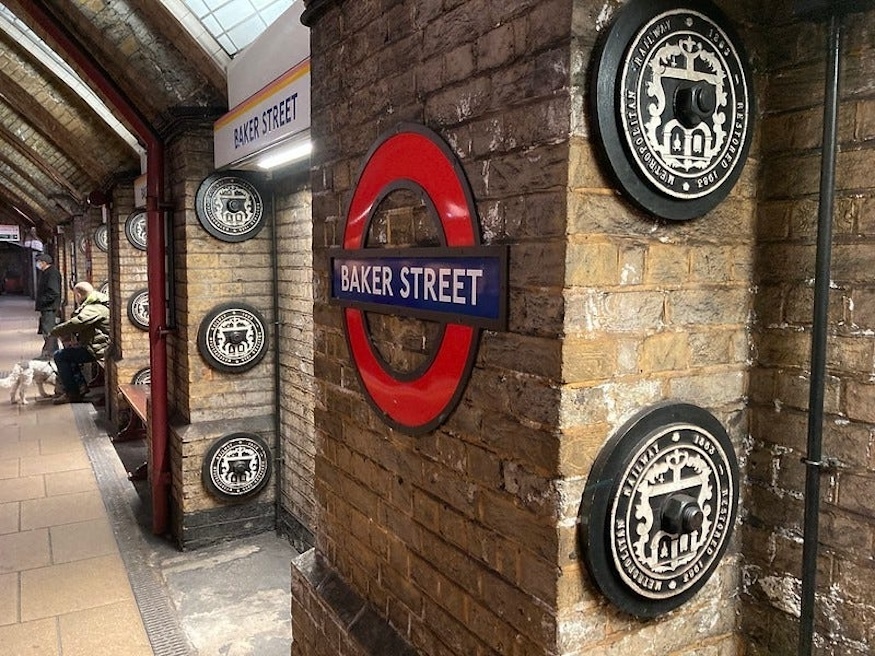
It all began on 10 January 1863. The world’s first underground passenger railway opened to the public. The origins of the Metropolitan Railway, from Paddington to Farringdon, are well documented. So instead of rehashing that, we’d instead like to dig into some notable and unusual ‘firsts’ on the railway. We’ll start with the more serious stuff, then get gradually more lighthearted.
The first accident on the underground railway
Farringdon station was the scene of the very first crash on the running railway. The collision happened on Friday 27 February 1863, just seven weeks after the line opened. A departing train struck another coming in from Paddington, after an error by a pointsman had sent it down the wrong track. We learn from news reports that around 25 people were injured, often with cuts to the head and face. Mr James Best and Mrs Charlotte Shortland received the most serious injuries, and we may consider them to be the first passengers to be harmed while riding the London Underground.
The line was cleared and reopened within half an hour. Today, it would (rightly) have been declared a major incident with serious ramifications, but the Victorians just got on with things.
First fatal accident on the railway
It would be almost four years before the first fatal accident on the Metropolitan Railway. The location was again just outside Farringdon, but this time in the opposite direction at Barbican station, then called Aldersgate Street.
The tragedy occurred on 19 December 1866. The fatal blow came from above rather than from another train. A four-ton girder fell from the construction site of Smithfield Market, just over the tracks. It smashed through the roof of a second-class carriage with devastating results. One lady, 68-year-old Sarah Johnson, was killed immediately, "her skull having been frightfully fractured and her neck broken". Two other passengers in the car (Henry Lukey and Charles Passmore) and the guardsman (Charles Dant) were thrown onto the tracks. They were found still alive beneath the girder, but "crushed by its superincumbent weight... fearfully mutilated". St Bartholomew's Hospital was mercifully close to the site but the three could not be saved.
Once again, the line was up and running within half an hour.
The first subterranean pickpocket
Crowds of people huddled together on dimly lit platforms made for a pickpocket’s paradise. Petty theft was rife. As far as we can tell, the earliest trial for pickpocketing occurred on 28 January, just 18 days after the line opened. The alleged malefactor was John Rice, a “stylishly dressed” 17-year-old. He was accused of lifting a purse from a Mrs Clementson, who was awaiting a train at Gower Street (now Euston Square) station. He seems to have been acquitted, for he appeared again in court later that year on similar charges (which he again overcame).
The first fatal umbrella attack
Gower Street was also the scene of the network’s first known death by umbrella. While riding the Metropolitan Railway, Mr Frederick Klein got into a heated argument with James Vaughan, who had squeezed into the already overcrowded carriage. “I’m a first-class passenger,” claimed Vaughan, as if that should merit him a place. “If you are, then you have not a first-class tongue,” countered Klein.
After much exchange of insults, Klein alighted at Gower Street. He was followed onto the platform by Vaughan who proceeded to ram the point of his umbrella into his opponent’s eye. The injury proved fatal, but only after a few days of agony. The delay meant that Vaughan could only be charged with manslaughter rather than murder. Bizarrely, he received only a 12-month sentence for the appalling attack.
The first person to ride on the London Underground
Now this would be quite a claim to fame, wouldn’t it? Sadly, the names of the first passengers are lost to history (or hidden in an archive somewhere). We do know, however, that the first trial with passengers who weren’t railway men occurred on 28 November 1861, more than a year before the line opened to the public.
A group of journalists boarded a train at Great Western (Paddington) and took a short run to Chapel Street (Edgware Road). They then strolled through the tunnels to Euston Square, where another train took them to King's Cross. Said one adjective-spewing reporter: "The tunnels, instead of being close, dark, damp, and ill-smelling passages, are wide, spacious, clean, and excellently well lit, resembling more a well-kept street by night than a subterranean passage through the very heart of the metropolis".
The names of the journalists are not recorded, but we do know that the journey included railway bigwigs John Fowler (chief engineer) and WH Wilkinson (Chair), and a secretary by the curious name of Mr Henchman. These, then, are the first named individuals ever to ride on London Underground. We’ve told the story in more depth in a previous article.
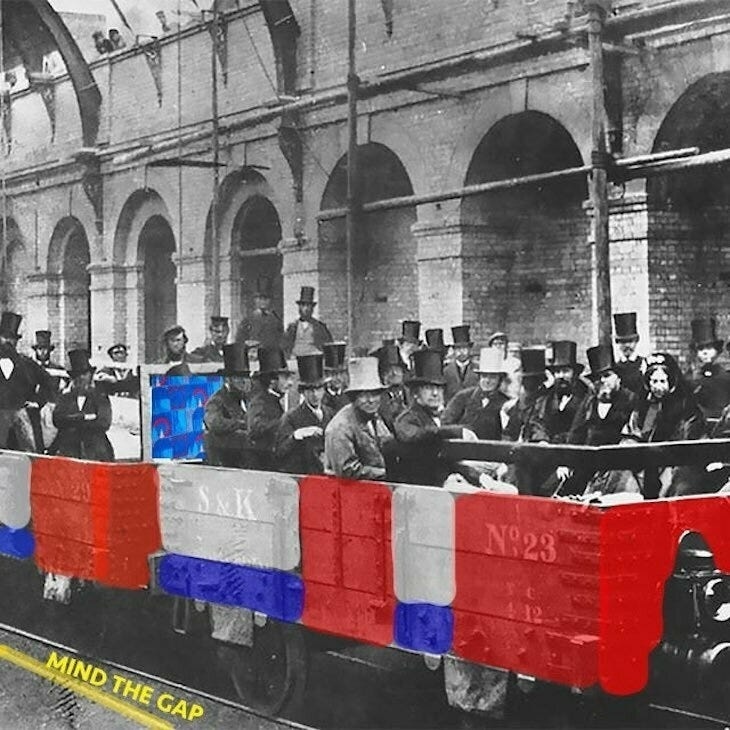
In case you’re wondering, the famous image of William Gladstone riding in an open-topped wagon (see below) occurred almost half a year later. This was the first train to run the full length of the line with passengers:
First poetry on the Underground
According to a contemporary Punch magazine, this clunky stanza was pinned to the insides of carriages in January 1864.
PASSENGERS ARE EARNESTLY REQUESTED
NOT TO OPEN THE CARRIAGE DOORS
UNTIL THE TRAIN STOPS AT THE PLATFORM;
OR THEY'LL COME CROPPERS ON THE FLOORS.
Of course, this might just be an invented merriment from the satirical magazine, but I think it’s genuine because the newspaper then go on to critique its clumsy style and verbiage. “The ‘Carriage doors’? Why carriage? What other doors are there to open?”
Punch then goes on to suggest its own, more succinct, messaging:
“DON’T TOUCH THE DOOR TILL THE TRAIN STOPS, YOU ASS.”
First Underground jokes
Punch is also the source for the first witticisms (‘joke’ would be pushing it) that we can find about the Underground. The following appeared in July 1862, about half a year before the line opened:
The sideswipe relates to a series of incidents that saw sewer water pour onto the tracks. The most serious occurred in June 1862, when the Fleet Sewer burst out of its culvert after heavy rain. The damage to the under-construction railway was severe and took two months to make good, delaying the opening.
It’s not that hard to find other ‘jokes’ about the new railway. It is hard to find good jokes about the new railway.

(From Punch, Feb 1863).
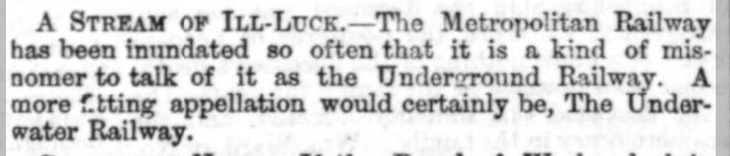
And finally, here’s yet another we chanced across from the Western Morning News, 7 February 1867:

Even in the 1860s, that would have raised more groans than guffaws.
The first graffiti on the Underground
In 1864, just 14 months after the opening of the Metropolitan Railway, Mr Aquila John Williams was up before the magistrate accused of writing "obscene words... calculated to pollute the minds of the passengers on that railway" [Cork Examiner, 10 March 1864]. History does not record his selection of phrase. For the sake of argument, let’s assume it was some lewd wordplay involving Lord Palmerston.
He pleaded guilty and was ordered to pay 40 shillings plus costs. In summing up, the judge said he was confident that the case's publicity "would be effectual in preventing such conduct in future." And no one ever wrote a naughty word on the tube ever again.