This feature first appeared in March 2025 on Londonist: Time Machine, our much-praised history newsletter. To be the first to read new history features like this, sign up for free here.
A trio of figures catch the eye in a stained-glass window. They could be the Three Magi pointing to the crescent moon. But look again. Those are not turbans, but ladies’ hats. And in place of gold, frankincense and myrrh, one of the women carries a tote of fish.
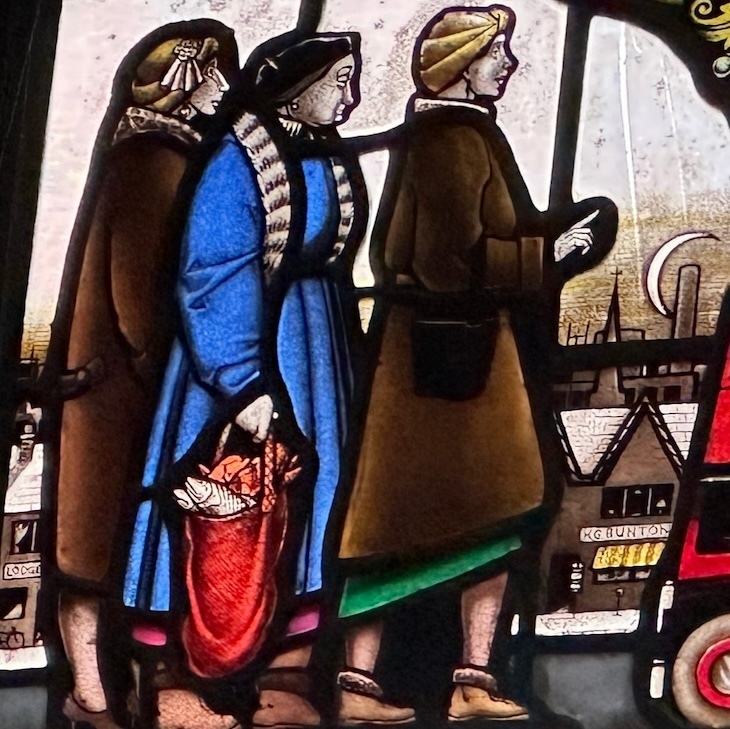
The three ladies — one of whom is clearly based on Ena Sharples from Coronation Street — are not on their way to adore the Holy Child. Their thoughts are more with the omnibus than the omnipotent…
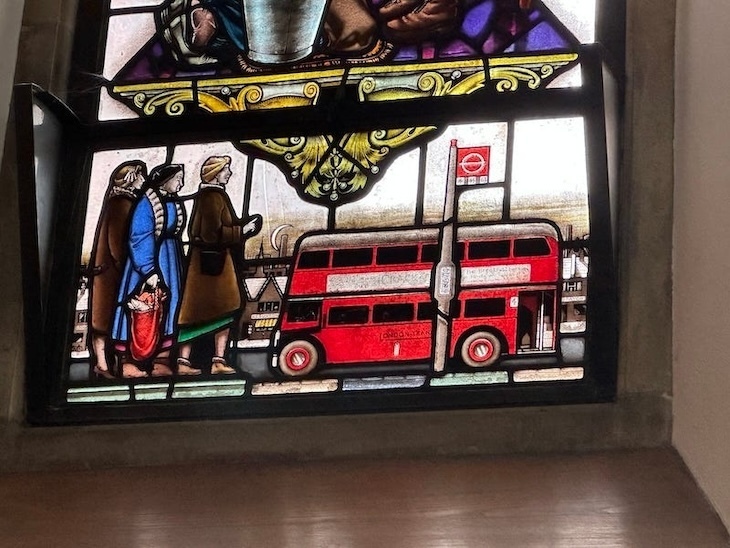
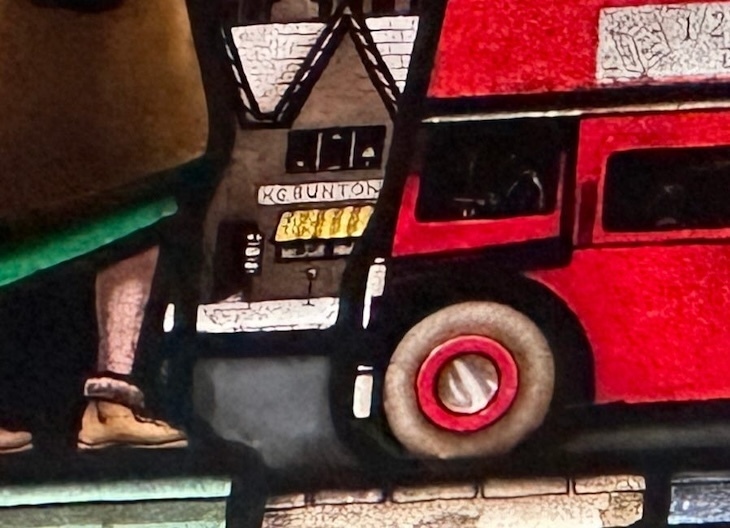
This remarkable stained glass window can be found inside Christ Church Southwark, a 1950s rebuild just off Blackfriars Road. Its details are delicious. The bus is clearly a classic Routemaster, a beloved design that can still be spotted on the roads of London today (albeit not in regular service). Its roof is painted white to reflect sunlight and reduce heat. The bus stop carries three route numbers, 4, 45 and 63. During the 1950s, all three routes would have stopped outside the church (the 63 still does).
This is just one of 10 distinctive windows in the nave of Christ Church, designed in the late 1950s by Frederick Cole and Kenneth Bunton, working for Wippell and Co. If you look carefully, you can see Bunton’s name immortalised on one of the shop fascias.
The remaining windows show various scenes from Southwark life, past and present (i.e. as was, in 1959-60). They include familiar buildings. The window shown below, for example, features a depiction of Bankside Power Station, now Tate Modern:
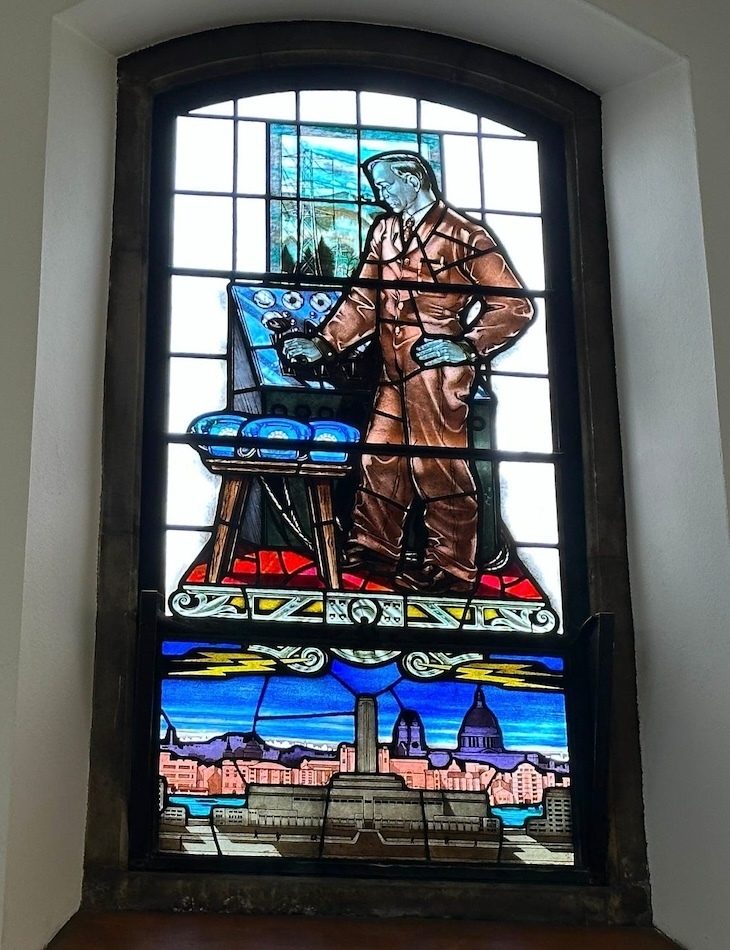
Behind the power station we can, of course, see the dome of St Paul’s. But look behind the chimney. The tallest of the salmon-coloured structures is, I think, the Faraday Building, constructed in the 1930s as a telephone exchange. Power and communications are also referenced in the larger section of the window, which shows an engineer monitoring a bank of dials, with three telephones in the foreground and electricity pylons out of the window.
Here’s another one for you:
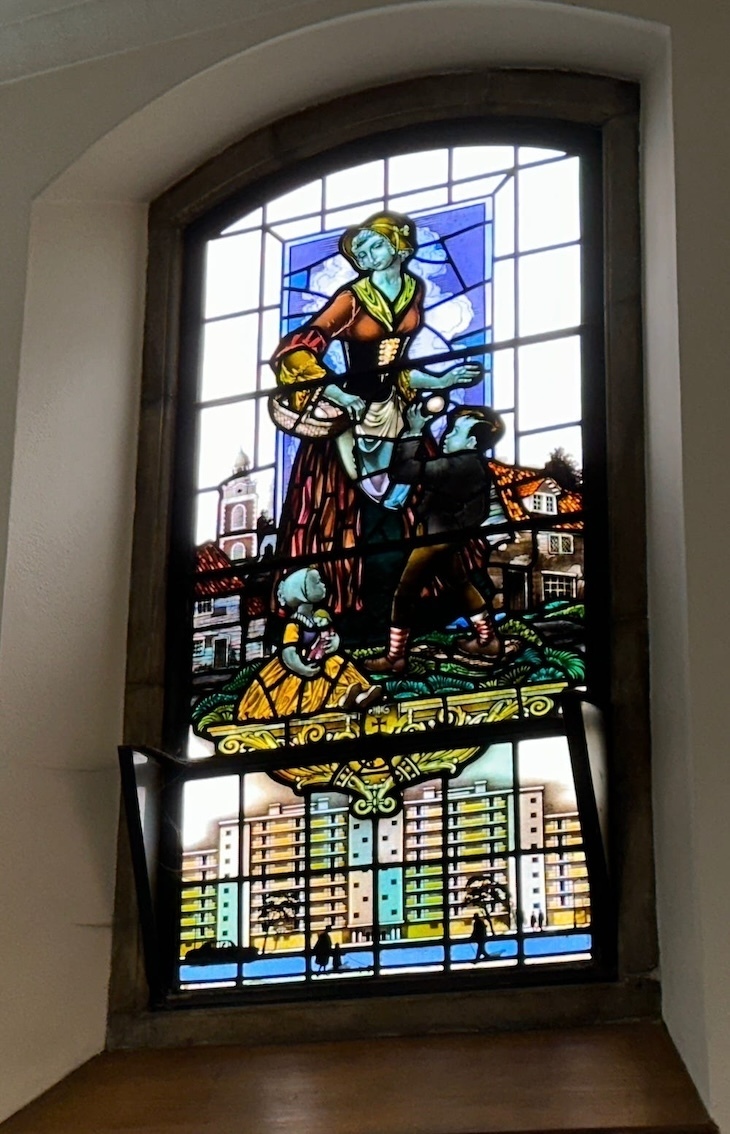
The main image shows a lady and two children in 18th century garb. Behind her, we can see typical housing of the period, along with the previous tower of Christ Church (destroyed in the Second World War). The lower panel, meanwhile, depicts the housing estate of Nelson Square, a little south of the church. This was completed in 1958, just before the windows were installed. The housing estate remains today. The boy and girl featured in the upper panel would be as delighted as my daughter if they could see the playground hidden away inside the square — worth a diversion if you’re on Bankside with children.
Not all the windows have aged so well…
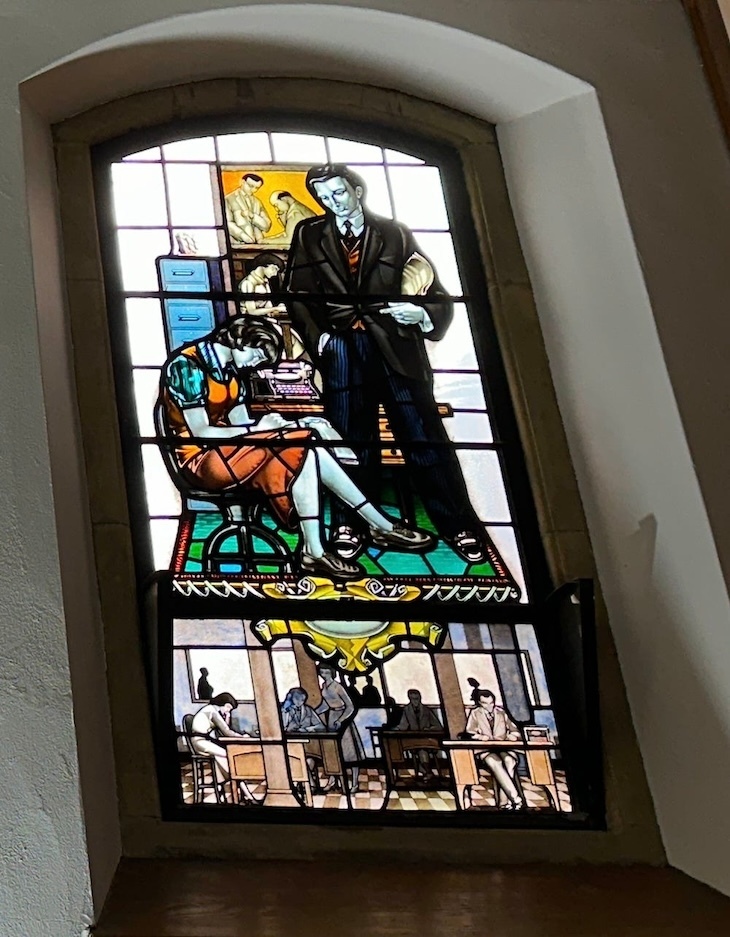
Here we see what must be London’s only stained glass window to depict a filing cabinet. The more central feature, though, is the secretary taking dictation from her boss. The body language here shouts volumes. The lady slumps; the man stands confident and pointing. It is an image of subservience. Further clerical work can be seen below. The desks look empty to modern eyes; where are the computers?
I’ve shown just a third of the main windows above. The rest are also of interest, and feature numerous local trades including bakers, printers, watermen and brewers. Do go have a look for yourself!
The church includes a second set of smaller stained-glass windows in the northern aisle, installed by John Lawson in 1984 to mark the rebuilt church’s 25th anniversary. These, too, have a local flavour. This one’s my favourite:
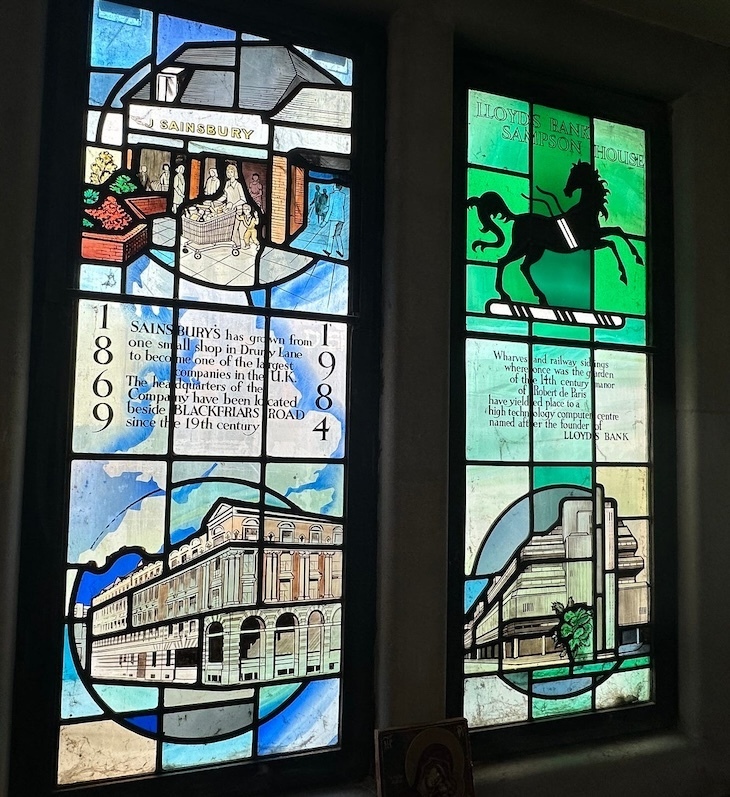
How many stained glass windows feature shopping trollies? This one, as the text suggests, highlights the supermarket Sainsbury’s, whose headquarters were on the corner of Blackfriars Road and Stamford Street until a move to Holborn in 2001. The building shown to the bottom-left has since been demolished. The same fate has now befallen Sampson House (bottom-right). This brutalist office block beside Blackfriars Bridge was home to a Lloyds Bank processing centre for many years. It’s now a big hole in the ground, awaiting redevelopment as part of the Bankside Yards project.
One final example depicts two Southwark buildings that do still stand:
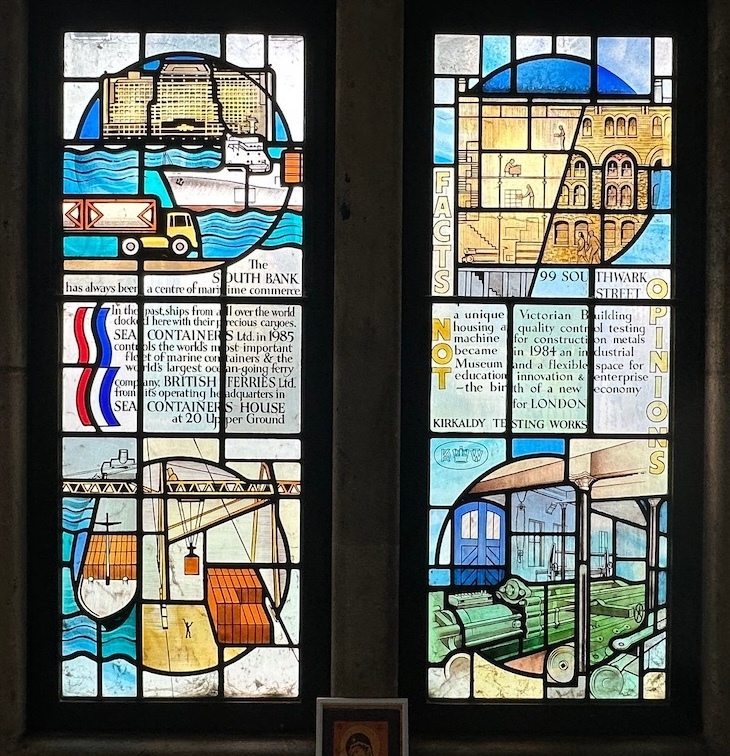
On the left is Sea Containers House. This bulky building is today a hotel and restaurant complex, but was previously a nexus of container shipping operations. The right panel shows the Kirkaldy Testing Works on Southwark Street. This was a place where construction materials, such as steel bars, were tested for their strength. It operates today as the Kirkaldy Testing Museum. Its most famous feature, suggested on the window, is its pediment, which reads FACTS NOT OPINIONS.
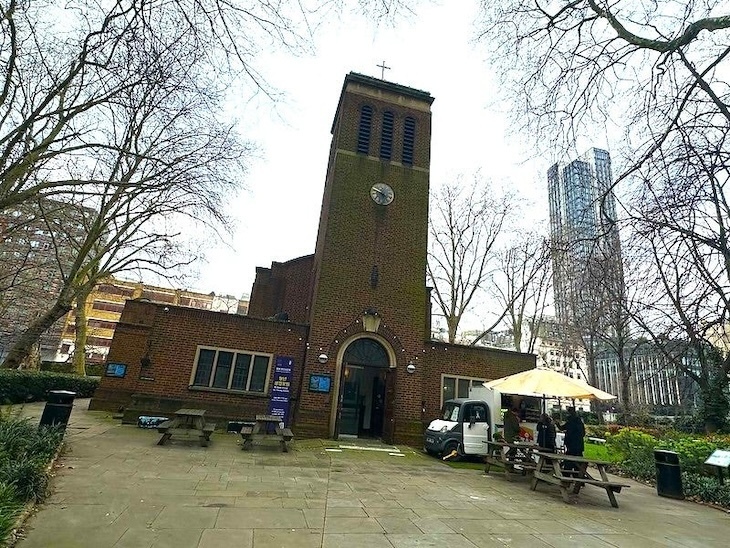
The grounds of Christ Church Southwark are also worth attention. Round the back, we find a curious memory of things past. In 1941, the previous church was reduced to rubble by enemy action. During the conflagration, a wooden cross fell from the church steeple, scorching its own impression onto the grass below. The seared turf was covered over with stone, leaving a poignant reminder of the destruction of war.
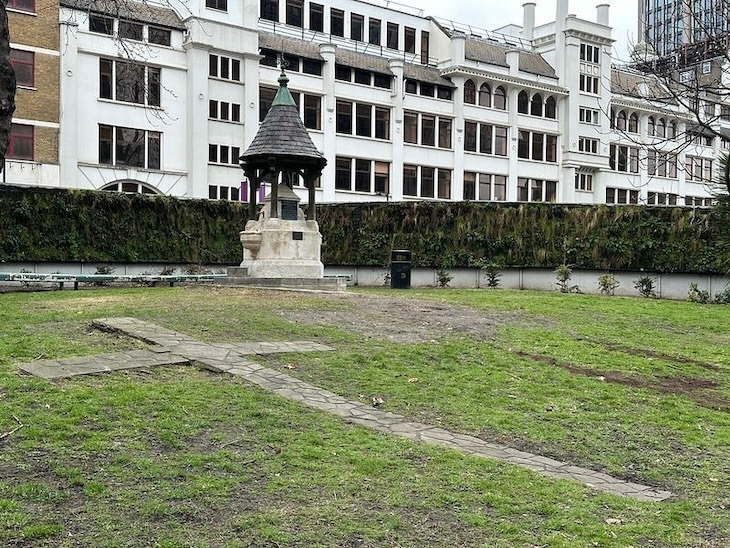
In the background, we can see a pointy-roofed drinking fountain. This was donated by the philanthropist John Passmore Edwards in 1900. It was recently restored and brought back to water by the Heritage of London Trust, who kindly invited me along to the ribbon cutting. It was during this visit that I was able to view the stained glass within the church, and thereby write this article. So we began with a double-decker, and we end with a double thank-you!
If you enjoyed this feature, you might also like my previous article on other unusual stained glass around London.