This feature first appeared in May 2025 on Londonist: Time Machine, our much-praised history newsletter. To be the first to read new history features like this, sign up for free here.
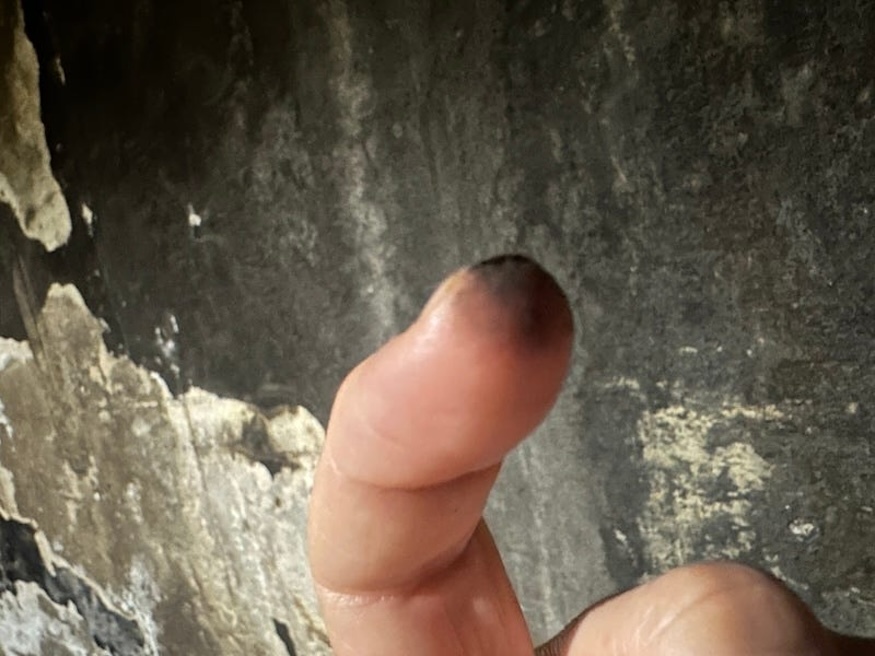
I have a sooty finger. This historic grime issued from a steam engine several lifetimes ago. After clinging to the wall for the entire 20th century, and beyond, the erstwhile coal-motes have now hitched a ride on my digit. Their fate is to be washed down the sink of the Mayflower pub an hour later.
That was a bit naughty of me. The black stuff came from the Thames Tunnel or, more specifically, the immense southern shaft that once led down to this cross-river burrow. It is a Grade II*-listed structure of international significance, and I just removed a microgram of its inky patina. My apologies.
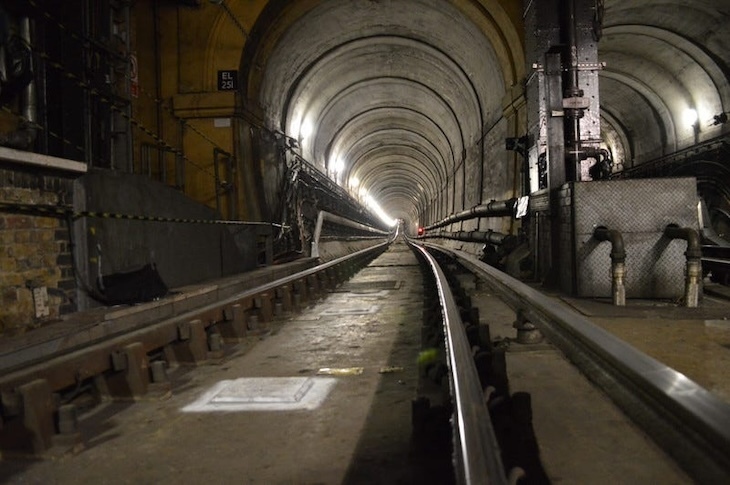
The Thames Tunnel is a curious beast. At 366 metres, it must be among the longest London structures to feature in Historic England’s database. With 16 trains per hour passing through the tunnel on the Windrush line, it’s also one of the most-visited. And yet very few people ever see it. Not properly. We can gain only saccadic snatches of brickwork through the train windows, or get the merest teaser from the platforms at either end.
This is a shame. The Thames Tunnel was the first tunnel under a navigable river anywhere in the world when it opened in 1843. We’re all familiar with the clichéd phrase ‘marvel of Victorian engineering’, but the design and early construction predate that reign. Work began in 1825 — exactly 200 years ago at the time of writing — making it a marvel of Georgian engineering. Behold:
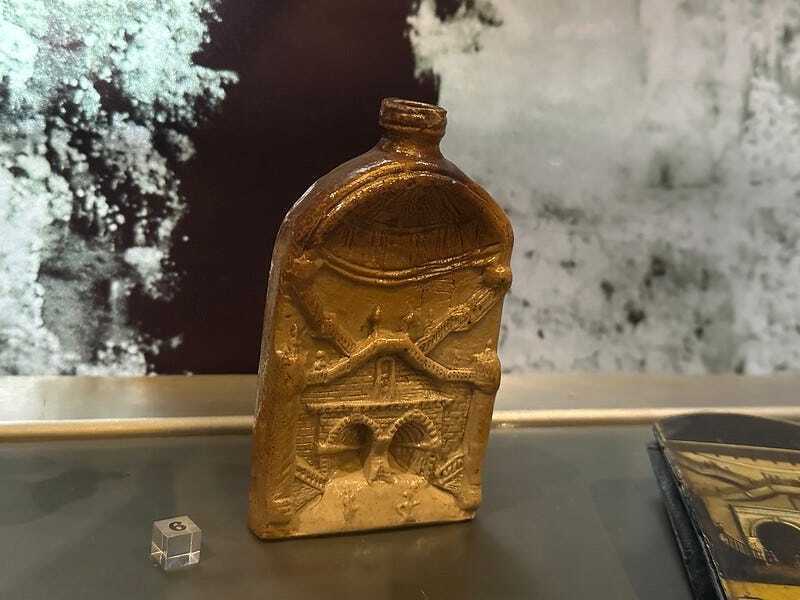
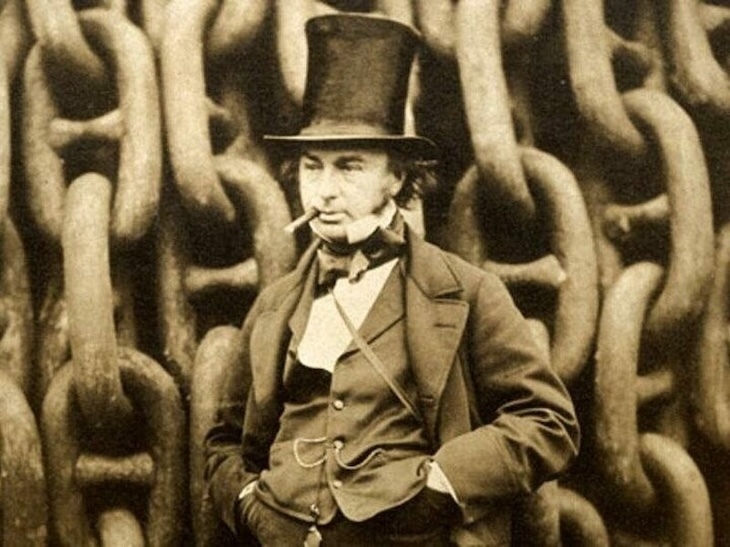
The one place where you can get a just notion of this exceptional structure is the Brunel Museum in Rotherhithe. This small museum is named after Marc and Isambard Kingdom Brunel — father and son — whose 18-year struggle to get the tunnel built is worthy of a whole book, never-mind a short feature. The museum holds many treasures connected to the tunnel, including commemorative objects from the time of its opening. You can spend a very pleasant hour in here, reading up on the history.
The museum’s biggest treasure, however, is the tunnel shaft. This enormous void was hewn from the London clay two centuries ago as a starting point for the tunnel. Entrance to the museum gets you access to the shaft. If I were to compile a book called 100 Incredible London Spaces That Everyone Should Experience, then this room would be one of the first to go into my research spreadsheet.
The museum was recently kind enough to offer a tour of the shaft to Londonist: Time Machine subscribers. They even let us take drinks down into that tamed abyss.
The first revelation was the temperature. (Not the drinks; the shaft.) It’s cold. Our visit came on one of the hottest days of the year, but this Stygian realm is permanently cool. A modern staircase winds gently down to the floor of the shaft. Access is much improved from my first visit, a decade or more ago, when visitors had to stoop through a hatch onto ad hoc scaffolding to reach basecamp.
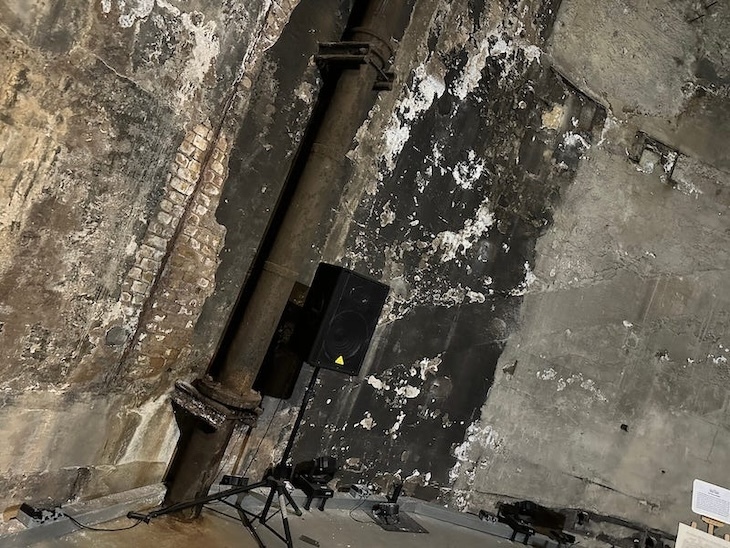
The room has a subtle damp-dusty smell, though it is not as noticeable as you might expect from such a space. Soot coats the walls. The railway line was electrified as early as 1913, meaning much of this grime was deposited before living memory. Diagonal bands also climb the walls, the ghosts of Victorian staircases, long since removed.
Other senses are stirred in this place. Every few minutes, a deep rumble comes from below. We stand immediately above the Windrush line. The concrete floor was only installed around 2010, during works to reinforce the tunnel for the launch of the ‘Overground’ network. Without these works, the shaft would still be off-limits.
As part of our special Londonist: Time Machine tour, museum volunteer Andrea Vasel gave a sparkling talk about the tunnel’s history. There was much to impart…
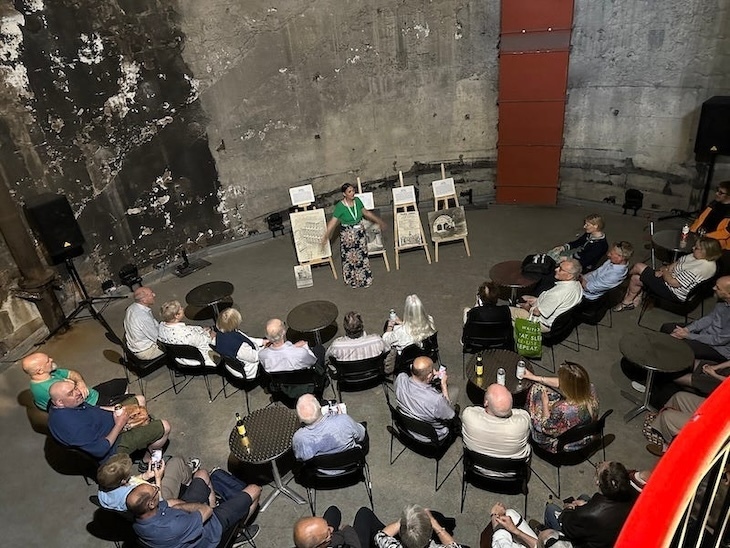
The Brunels (mostly Marc) took 18 years to build the tunnel. It was a fiendishly difficult task. Nobody had ever undertaken such a project before. No blueprint or best practice existed. Every step was an experiment. Marc Brunel, as chief engineer, sold the project on his moveable tunnelling shield. This circular structure, placed at the tunnel head, would protect the diggers from collapse. In theory.
Before any sideways shovelling could happen, though, Brunel had first to dig the shaft. This was also accomplished through a novel technique. Brunel built an iron ring 15 metres in diameter. He then loaded it with weights to the tune of 1,000 tonnes. The whole structure gradually sank into the soft clay like a giant’s pastry cutter. The result is sometimes celebrated as ‘the world’s first caisson’.
Once the shaft innards had been excavated, work began on the tunnel proper.
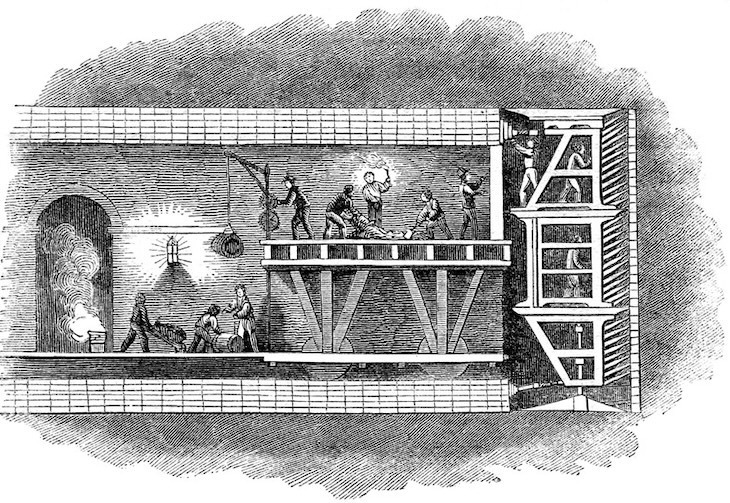
This was the tricky bit. The challenges were enormous. The tunnel was only an errant spade’s thrust beneath the riverbed, and water intrusion was a constant menace. This was a time when sewage and industrial byproducts were dumped routinely and comprehensively into the Thames. The filthy water gave off choking, potentially explosive fumes, and many men suffered from its effects.
The constant dribbles and drips were an irritant, but rapid inundation was the real fear. In May 1827, part of the roof caved in at the tunnel head — by this point about half way across the river. The excavation was entirely flooded within 12 minutes. Fortunately, all workers were able to escape without loss of life. The tunnel was patched up by diving bell, pumped clear of water, and work soon resumed.
January 1828 brought a graver incident. This time, water gushed in at such a rate that the gas lamps were extinguished and all workers were swept along in the dark towards the tunnel shaft. Six men lost their lives, and the 22-year-old Isambard K. Brunel was lucky to not be among them.
Despite these perils, the tunnel became a visitor attraction even during its construction. 600-800 people per day ventured down into the construction site, each paying a shilling. Among them was Dom Miguel, heir to the throne of Portugal. His Royal Highness inspected the works just days before the fatal tunnel collapse of 1828.
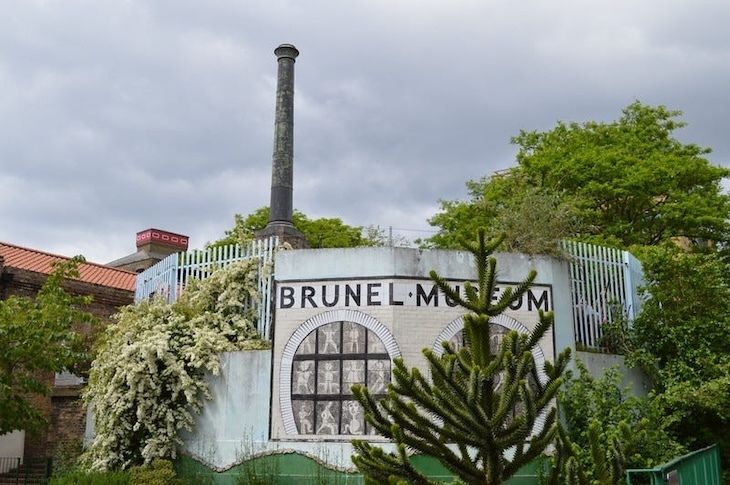
The Thames Tunnel was finally complete in 1841, after further floods, fires and financial woes. It was a testament not only to 19th century engineering, but also the grit and determination of Marc Brunel and his team. It would take a further two years to fit out the tunnel for public use. These latter works included construction of a pump house at the southern end, to deal with the constant water intrusion. Its chimney remains a landmark in Rotherhithe today, and that building is now the Brunel Museum.
The tunnel opened with great ceremony on 25 March 1843. Among the dignitaries were many household names, some of whom we still recognise today. Michael Faraday was there, as was computer pioneer Charles Babbage. John Rennie the Younger, too. 20 years earlier, Rennie had built the adjacent river crossing of London Bridge following the plans of his late father — another familial team to span the Thames. Ahead of all of them in the procession was the recently knighted Sir Marc Isambard Brunel, the man whose vision and tenacity had seen the project through. He would later be eclipsed in fame by his son Isambard Kingdom Brunel, but this day belonged to Marc. “The ladies flocked round all sides to do honour to him,” reported the Morning Post.
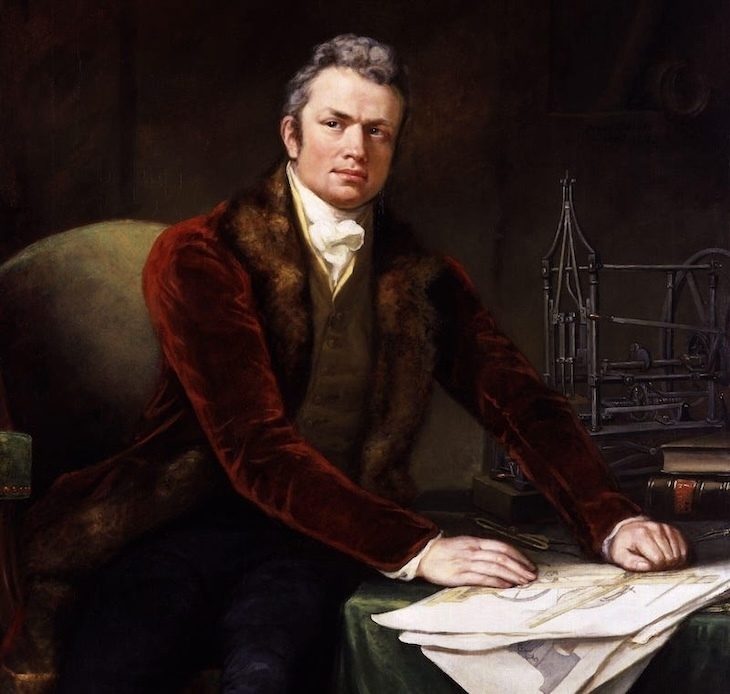
The structure was dubbed the ‘eighth wonder of the world’, because newspapers had lazy journalists even back then. It proved enormously popular in its early years, attracting millions of penny-paying visitors. The Brunels had intended it to be a road tunnel for horse-drawn traffic. Hence, it had been constructed as two separate tunnels to allow vehicles to move in opposite flows. The costs of building suitable ramps proved prohibitive, however, and the tunnel was used only by pedestrians, who would descend and ascend in the Rotherhithe shaft, and its near-twin on the north bank.
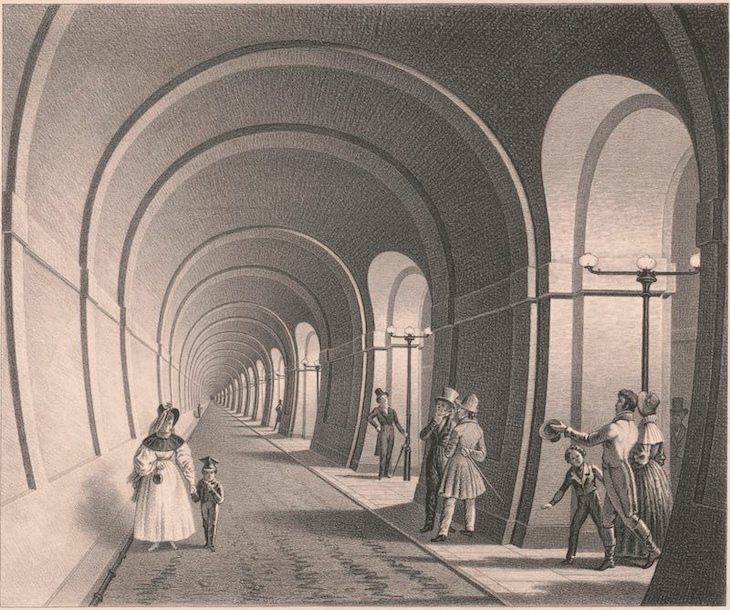
The twin tunnels were interconnected by arches in many places, seen in the image above. These were soon occupied by stalls and booths in the manner of a marketplace. The experience was widely advertised as “The fair at Thames Tunnel,” and it seems to have been quite a draw. An item in the syndicated press of 1844 neatly sets the scene, and also introduces me to the excellent word ‘bijouterie’:
“The various archways, or recesses, of which there are upwards of sixty, were occupied by a number of elegant little stalls for the sale of articles of bijouterie, confectionary, &c. Not the least curious amongst these subaqueous establishments was one professing to be a newspaper office, in which a number of men were striking off impressions of “The Royal Thames Tunnel Paper, printed 78 ft. below high water mark".
The tunnel also featured various grottos, amusement stalls and live performances, including a “thirty inch dwarf” menaced by two boa constrictors. “The dwarf appearing to rely for safety upon his being too insignificant to attract the animals' notice,” reassured the Lloyd’s Weekly Newspaper.
American writer William Allen Drew, who visited a few years later, reported: “…all sorts of contrivances to get your money, from Egyptian necromancers and fortune-tellers to dancing monkeys.” Rampant commercialisation of public spaces is nothing new, though nowadays we eschew the snakes and simian sambas.
The tunnel’s reputation as the ‘eighth wonder of the world’ gradually diminished, as surely as Brunel’s giant cookie-cutter had once sank into the Thames-side clay. The tunnel became known for prostitution, and muggings were reported.
From 1865, the route was converted to rail use by Sir John Hawkshaw. (An oft-overlooked engineer, who worked on many important rail projects and is commemorated in the best way possible… a namesake pub within Cannon Street Station.)
The northern shaft became the entrance to Wapping station, and you can still walk down its staircase today. The southern shaft was used only for steam venting, with Rotherhithe station built a little to the south. It’s had some major work done to it since, including the 2010 installation of the concrete raft. But the structure, in appearance, would still be recognisable to the men who built it.
During their 18-year slog to complete the Thames Tunnel, the Brunels could scarcely have imagined that their perilous burrowing would find its greatest application 200 years in the future. The Thames Tunnel is today used by more people than at any point in the past two centuries. An estimated 60,000 people pass through this space every single day on Windrush line trains. It carries the equivalent of the entire 1825 population of London every four weeks. That’s the nature of major engineering projects. They often pay their greatest dividends years, decades or even centuries after their early problems have been forgotten (cough, HS2, cough).
So Happy 200th sort-of-birthday to the Thames Tunnel, and well done to Marc and Isambard Brunel. I take my hat off to you.
Visit the Brunel Museum to see many wonders connected to the tunnel, and to visit the southern shaft.