The St James's Park pelicans are feathered celebrities, their history here stretching back a few centuries. Here's the skinny on this squadron of extraordinary birds.
How long have there been pelicans in St James's Park for?
This swathe of central London was a swampy chase until King James I had it overhauled into a garden at the beginning of the 17th century, which included adding a menagerie of various exotic birds, not to mention camels, crocodiles and an elephant.
Great White Pelicans enter the story in 1664 when the Russian Ambassador gifted a pair to Charles II, who expanded on James' work, by landscaping the area into formal gardens, under the guidance of Andre Mollet. The pelicans lived in an aviary on what's now Birdcage Walk.
Since then, pelicans have often lived in the park in varying numbers (there have been over 40 overall) — and they've always been well looked after too, originally by the Keeper of the King's Birds, and later, the Ornithological Society of London. Today, Royal Parks care for them.
Not all the pelicans have been of the Great White variety. In 1951, the Daily Express kicked up a stink when the park accepted a pair of American brown pelicans: "Next thing we'll be having G.I.s on guard at Buckingham Palace."
How many pelicans are there today?
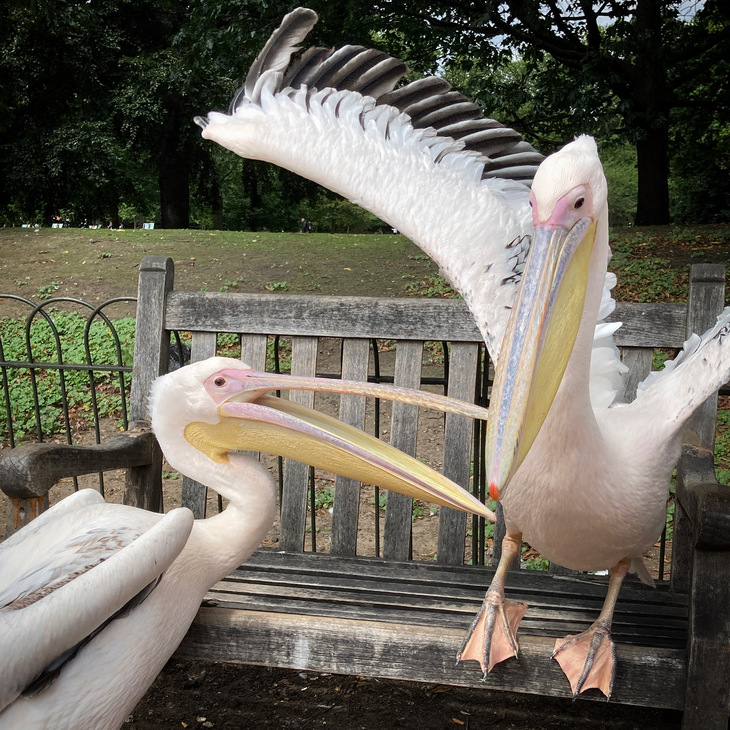
There are six in all. Gargi was donated to the park in 1996, after he was found by a member of the public in a garden in Southend. Tiffany and Isla arrived as a gift from Prague in 2013; part of the funding for the pair came from the Tiffany and Co Foundation in New York, hence one of their names. Isla was named by public vote. In 2019, three more pelicans — Sun, Moon and Star — were introduced to the squadron; also a gift from Prague Zoo. The current number of pelicans flies in the face of advice given by Lord Inglewood in the House of Lords in 1995: "...if more than four pelicans are in St. James's Park they have a tendency to behave very badly towards the other water fowl on the lake; in particular, they eat up the young ones."
Any other good names?
In the 1970s there was just one lone pelican, nicknamed 'the Lady of the Lake' (actual name: Daphne). Two more from Astrakhan in Russia were called Astra and Khan (makes sense); a pelican called Louis came all the way from Louisiana in 1982; Vaclav was a gift from Prague Zoo in 1995 — his name a nod to the last president of Czechoslovakia/first president of the Czech Republic, Václav Havel.
Do the pelicans breed?
Nope. In over 350 years of pelicans at St James's Park, none have had babies. As our friend Lord Inglewood continued in 1995: "My Lords, an egg was laid by the pelicans in St. James's Park but it was infertile. I am advised by ornithological experts that the reality is that pelicans tend not to produce fertile eggs unless they are part of a larger flock of a minimum of about 10 birds... As for the nature of the community in which pelicans live, it is similar to that experienced in monasteries and nunneries."
In 1969, the park's bird-keeper Arthur May built a nest himself, to encourage the pelicans to mate, but to no avail. These birds make pandas seem positively horny.
And are the pelicans captive?
They are indeed (and with the exception of Gargi, are clipped too), though they do have the freedom to roam the park. Being pelicans, they tend to stay around the lake, where they can preen and catch fish — plus they know that they'll get fed on its eastern side. The pelicans have not always been clipped. In 1929, two flew away, one later being spotted in a tree in Chelmsford. Farmers were warned not to shoot the birds.
When is pelican feeding time in St James's Park?
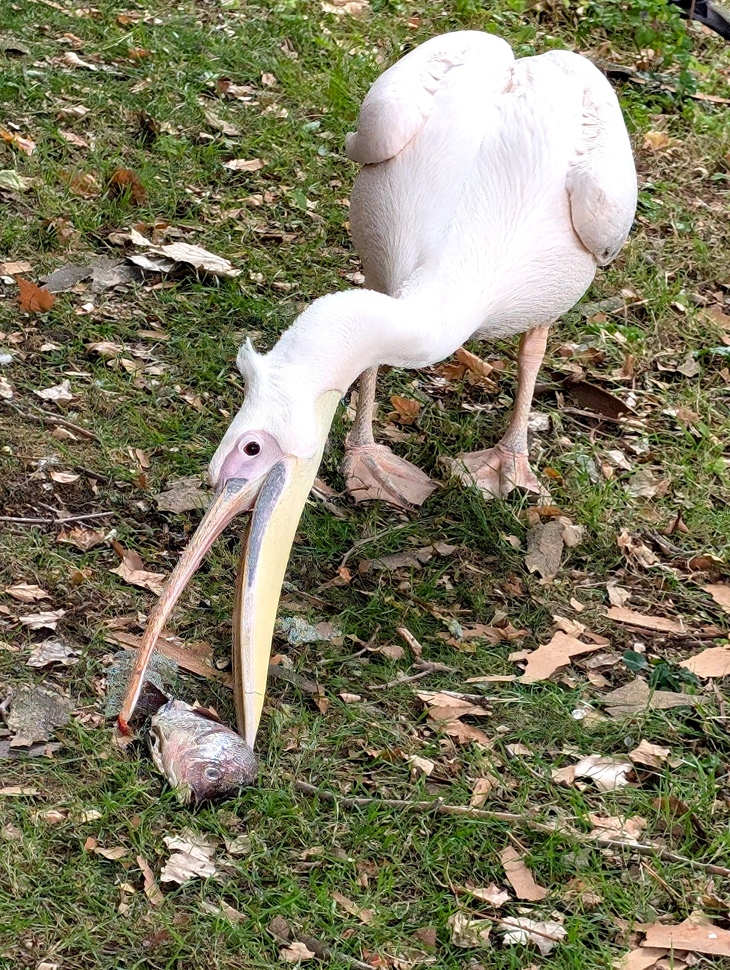
The pelicans' favourite food included mackerel, herring and whiting (of which they guzzle up to 2kg each per day). Feeding time is quite the attraction, with tourists and parkgoers crowding outside Duck Island Cottage daily to watch the spectacle.
It officially takes place between 2.30pm and 3pm each day, although in our experience, they can start/finish a little early, so get there ahead of time.
Do the pelicans just eat fish... or do they eat pigeons too?
Much of the time they're contented with the fresh fish they're given. Although in October 2006, there was an infamous incident in which one of the pelicans decided to shake up the daily menu by swallowing a whole, live pigeon. A spokeswoman for the Royal Parks, Louise Wood, admitted the birds did sometimes stray from their more natural menu choices of fish. "Nature is cruel. These birds will naturally devour other items that appear food-like to them — in this case, a pigeon."
Make sure you've eaten before watching this video:
What other kind of mischief have the pelicans got up to?
Gargi (the unclipped pelican of the current squadron) has been known to fly over London Zoo and pinch the fish from various animals at their feeding time.
There was also an incident in the 1950s or 60s, when one pelican got caught up in a side draught and was blown over Horse Guards Parade and across Whitehall, crashing through a set of large windows in what was then the War Office building, and rudely interrupting a meeting of the foreign Chiefs of Staff.

What goes on in Duck Island Cottage itself?
Glad you asked that — we've been inside to speak to the people who work there, doing wonderful things for London's parks and green spaces.
The original article was written by Zoe Craig.