This feature first appeared in December 2024 on Londonist: Time Machine, our much-praised history newsletter. To be the first to read new history features like this, sign up for free here.
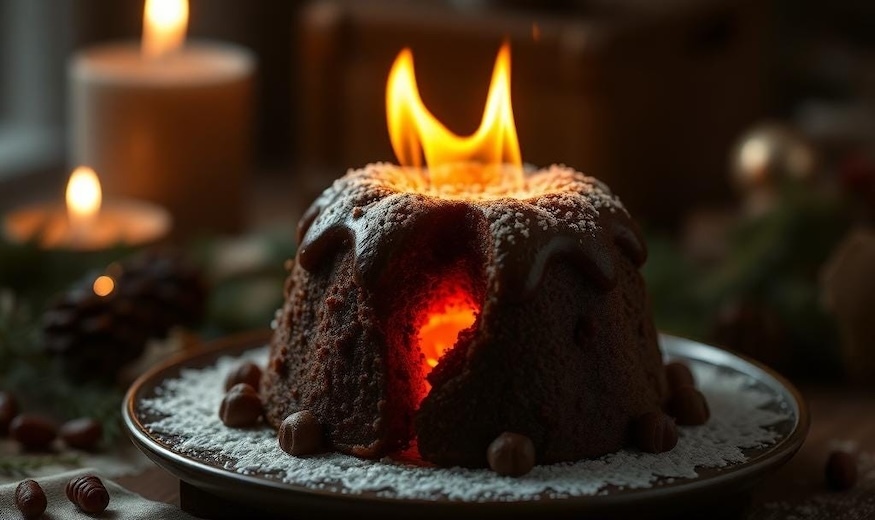
Join us, if you will, in savouring a handful of moments from London’s brandy-rich, spice-laced Christmas pudding history — from the centuries of evolution that have seen the medieval plum broth coalesce into a stiffer, stodgier frumenty… and eventually clump together in the more solid, spheroidal form that Dickens captured as the pride of the Cratchit family’s Christmas dinner:
"…In half a minute Mrs. Cratchit entered: flushed, but smiling proudly: with the pudding, like a speckled cannon-ball, so hard and firm, blazing in half of half-a-quartern of ignited brandy, and bedight with Christmas holly stuck into the top. Oh, a wonderful pudding! Bob Cratchit said, and calmly too, that he regarded it as the greatest success achieved by Mrs. Cratchit since their marriage…"
— from A Christmas Carol by Charles Dickens, from 1843
Despite being, personally, a Christmas pudding refusenik, reading up on the history of it made me feel quite affectionate towards the stodgy, plump little echo of times past. Curled up in the recipe and traditions of every plum pudding eaten today are still the remnants of its wilder forefathers, of pagan sausages set aflame for midwinter and rich, meaty broths being served by the cauldron-full in medieval halls.
It’s been a journey
The Christmas pudding hasn’t mutated much since the Victorians embraced it, and the version the Cratchits sit down to in A Christmas Carol is recognisable to us today: studded with dried fruits, given richness with suet, made flammable with brandy, spiced with the spoils of empire. But the traditional plum pudding had been through an evolution before it reached the Victorians, with an arc that included broths, porridge, and something more sausage-esque, stuffed into animal intestines or stomachs.
The pudding we know today began life as a pottage. This was a kind of broth, including raisins and other dried fruit, spices and wine. It was thickened with breadcrumbs or ground almonds. Not dissimilar to the mince pies of yesteryear, it often included meat or at least meat stock.
The original ‘figgy pudding’ was almost unrecognisable from modern Christmas pudding. For example, this medieval recipe was published in Fygey from the Form of Cury from 1392 period:
"Take almaundes blanched, grynde hem and draw hem up with water and wyne: quarter fygur, hole raisouns. cast perto powdour gyngur and hony clarified, seeth it well & salt it, and serue forth." - Fygey from the Form of Cury (1392)
— by Sam Bilton from History of the Christmas Pudding
There are a number of great articles out there from food historians tracing the progression of the plum pudding through the ages — including the one above by Sam Bilton from English Heritage, which picks up with its 14th century version and charts it through to the present day, taking in a recipe from Queen Victoria’s chef en route.
Christmas pudding was banned in the 1600s
"In 1645 Parliament introduced a new 'Directory of Public Worship', designed as a replacement for the Book of Common Prayer, setting out a new form of worship for the Anglican church. It said that Christmas, Easter and other such festivals were no longer to be observed with special services or celebrations…
…By 1652 Parliament had passed laws reinforcing the Christmas ban - with fines for staging or attending Christmas services, and shops ordered to remain open on Christmas day."
— from Did Oliver Cromwell Ban Christmas? by The Cromwell Museum
The story generally goes that Oliver Cromwell banned Christmas — and anything associated with its celebration, including Christmas pudding — in Puritan horror at its licentiousness. In reality, Cromwell didn’t have much involvement with the ban (and the initial legislation which developed into the ban was signed off by King Charles I), but still: from 1644 to 1660, celebrating Christmas was technically illegal in England, and records show soldiers in the City of London tasked with patrolling the streets on Christmas Day and seizing food that might be intended for feasting.
The past is a foreign country. They do things meatily there
"Now, all those with their fine talk of the glories of Old English fare, have they ever actually made Christmas pudding, in large quantities, by old English methods? Have they, for instance, ever tried cleaning and skinning, flouring, shredding, chopping beef kidney suet straight off the hoof?"
— from Spices, Salt and Aromatics in the English Kitchen by Elizabeth David, from 1970 — via the University of Leeds Library’s Christmas Pudding special collection
It’s a fair point from David, who’s referencing a recipe from Mrs Beeton. The traditional 19th century pudding — as per the recipe from London food writer Hannah Glasse in her 1802 book The Art of Cookery Made Plain and Easy — called for almost as much beef suet, by weight, as it did for either dried fruit or flour.
To get a pound of suet, the hard fat from around the kidneys of a cow, you’re looking at hours of work and a lot of offal and connective tissue to be picked through: an entire cow only yields, according to my now very grisly google history, around 10-15 pounds.
London was shipping Christmas puddings to the front line of the First World War
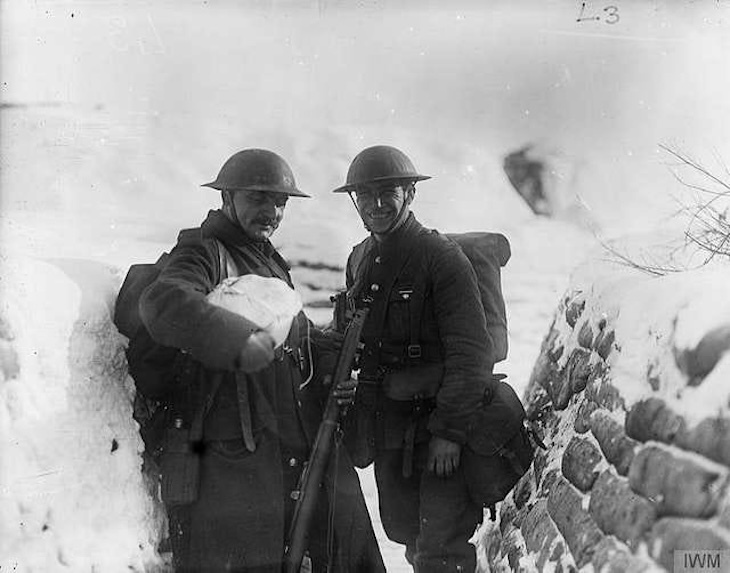
In the Imperial War Museum’s collection there’s a dented, battered circular tin, with a worn label across the top. ‘Hearty Christmas Greetings’, it reads, ‘from the City of London.’ The tin’s from 1914, one of many sent to soldiers in active service, holding a Christmas pudding — precooked so they could be eaten hot or cold, in trench conditions.
The feeding of the 22,500
"…Reports from the time paint a lively scene. The crowds arrived at 1.30pm. Thousands of souls poured into Ham Yard from Windmill Street. They were welcomed by a marquee of "colossal dimensions", decorated with Christmas illuminations, banners and flags “of all nations”. To step inside the marquee was to enter a winter wonderland. Holly, ivy, mistletoe and flowers hung all around, with fresh oranges providing colour and aroma. It was a scene unlike any the impoverished visitors had witnessed before…"
— by Matt Brown, from Soho 1851: The Greatest Christmas Meal Ever Cooked
Long-time readers might remember Matt’s article from this time last year — an in-great-detail account of the Victorian meal where a celebrity chef created a huge feast for those in need. The lunch fed, it’s estimated, around 22,500 people that day — around 1% of London’s population — with a suitably huge inventory list measuring meat by the tonne, nuts by the bushel, pints of porter in their thousands, and 5,000 pounds of plum pudding: nearly 2300 kg.