Adapted from a feature that first appeared in July 2025 on Londonist: Time Machine, our much-praised history newsletter. To be the first to read new history features like this, sign up for free here.
Lyme Regis is the place for fossils. Visit the Dorset town at low tide and I guarantee you’ll find something, even if you couldn’t spot a goose in a bath tub. The ammonite fossil shells are unmissable. I had my first prehistoric encounter within seconds of gaining the beach ⬇️:
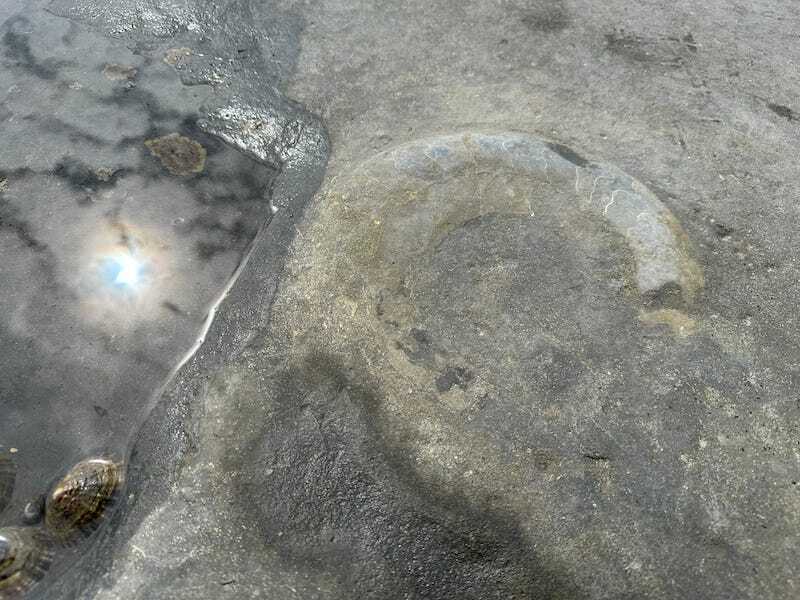
Lyme Regis is justly famous for its fossils, and for the work of fossil hunter Mary Anning (1799-1847). Anning and her brother Joseph made some stunning finds on this stretch of coast, including important examples of ichthyosaurs, plesiosaurs and pterosaurs.
Her life story is very well told above the beach at the superb Lyme Regis Museum, which stands on the site of her house and fossil shop. But the museum also draws us into the lives of other remarkable women associated with Lyme Regis. Jane Austen, for example, set much of Persuasion in the town. Meryl Streep brought it to the big screen in the adaptation of The French Lieutenant's Woman. And before you even reach the museum door, you must step over the the legacy of a famous London businesswoman, Eleanor Coade:
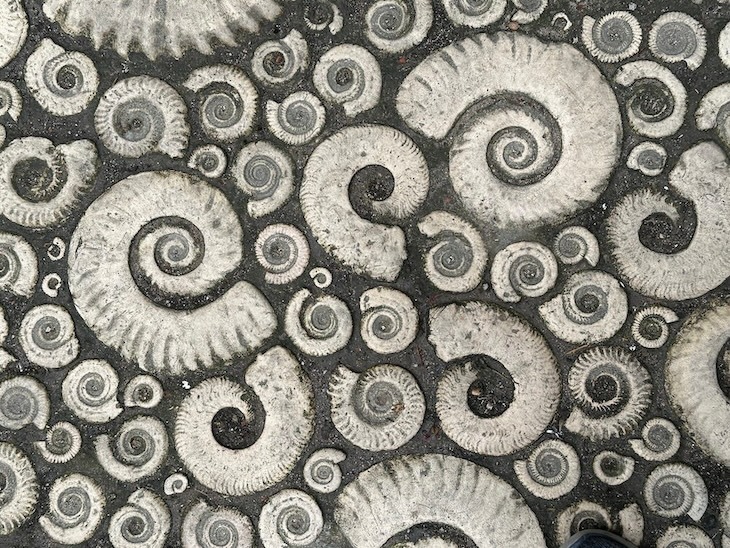
Eleanor Coade (1733-1821) made fake stone. She was really good at it. The curly forms in my photo above are not real ammonites, and nor are they sculpted. These are Coade-stone casts, and they are very convincing.
Coade stone was a revelation in the late 18th century. Others had made artificial stone before, but Eleanor perfected a recipe that was durable and weather-proof. Its chief advantage over real stone was that it could be poured into a mould, then fired until it became hard. Statues and architectural ornaments could now be mass produced without the need for expensive chisel-hours.
Georgian London was awash with Coade stone, and you can still find examples all over the city. The most famous is surely this dazzling white lion who guards Westminster Bridge. I hope I’m looking as robust as this when I approach my 200th birthday:
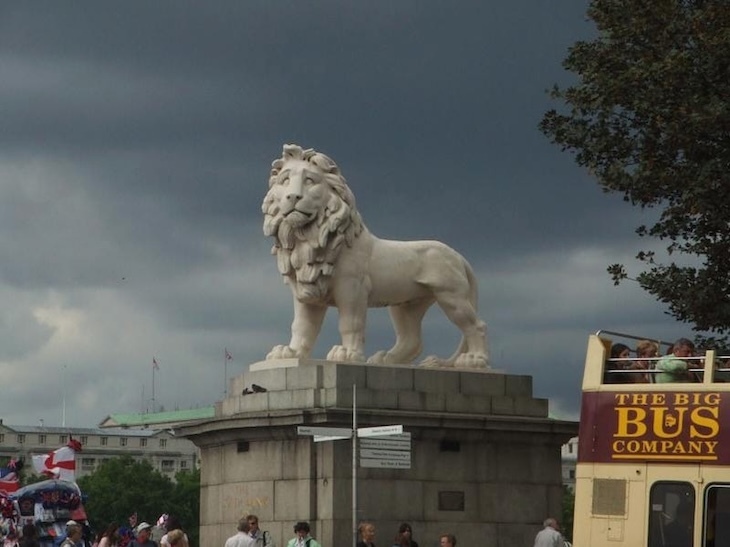
Eleanor Coade was a serial entrepreneur. By the mid-1760s (still in her early 30s) she was running a linen drapers in the City of London. By the 1770s, she was directly managing the artificial stone factory in Lambeth. You don’t need me to tell you how rare it was for a woman to run a business in the 18th century, let alone a highly successful firm with royal warrants to both George III and the Prince Regent. Coade must have been exceptionally skilful to overcome the male gatekeepers of the time, even with wealth on her side.
Incidentally, the ‘recipe’ and firing technique for Coade stone were lost in the 1840s after the factory closed down. Only in recent years has it been revived. The ammonite pavement at Lyme Regis Museum is one such modern example.
The museum didn’t choose Coade stone arbitrarily. Eleanor Coade had strong links to the area. She was born a little to the west in Exeter, into a wealthy Devon/Dorset family. She would later move to London, but also maintained an enviable bolt-hole in Lyme Regis. Here it is:
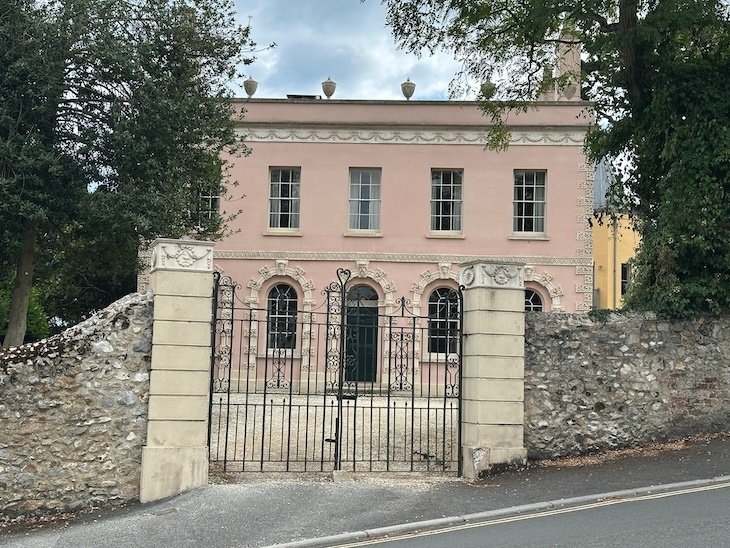
It’s called Belmont because it’s beautiful (bel-) and practically on a mountain (-mont)… or, at least, the biggest hill in the exceptionally hilly Lyme Regis. It also happens to be adjacent to the long-stay car park, for those of weaker leg.
Coade was given the recently built house by her uncle in 1784, to be used as a holiday villa. The various urns, quoins, swags and rustications you see in my photo are all made of Coade stone. Belmont was as much a product showroom as a seaside retreat.
Belmont had another celebrity occupant in more recent times. It was here that the novelist (and former Londoner) John Fowles lived from 1968 until his death in 2005. And it was here that he finished writing The French Lieutenant’s Woman, which includes Belmont as a setting.
Eleanor Coade’s wider story is well told inside the museum, and numerous accounts can be found online (Katie’s is particularly good, and gives many examples of where to spot Coade stone in London; meanwhile, Historic England has a map of Coade across the country). But Eleanor Coade is just one famous Londoner to have links with this part of the Jurassic Coast. Let’s meet another.
The foundling father
Recognise this fellow?
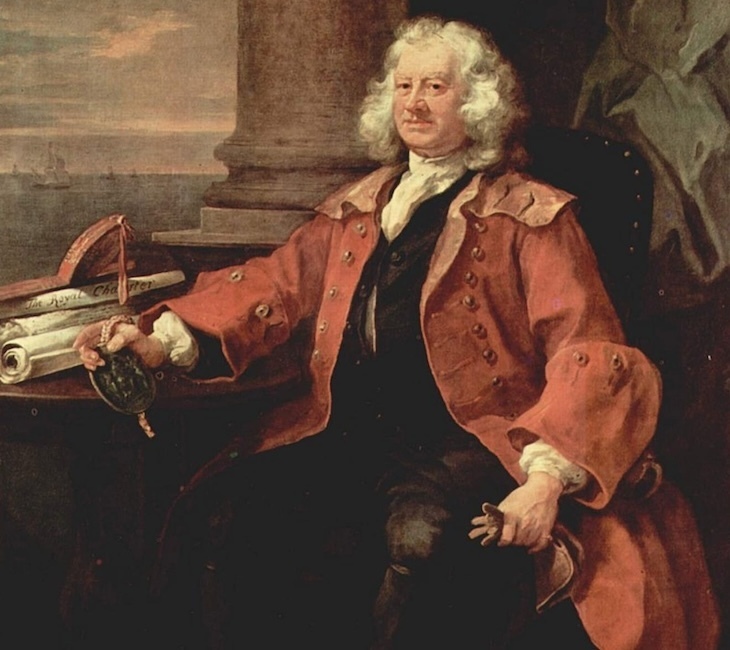
This is Thomas Coram (1668-1751), as painted by his friend William Hogarth. Coram may have saved the lives of more Londoners than anyone outside the medical professions. It was he who, in 1739, set up the Foundling Hospital in Bloomsbury. This charitable institution took in, cared for, and educated an estimated 25,000 vulnerable children over its two centuries of operation. Most were orphans, or came from families unable to cope with another child. Without Coram’s charity, many would have died.
Coram’s own early childhood was spent in Lyme Regis, and also involved parental loss. His mother died in 1671, when the boy was just three. His father, probably a master mariner, packed him off to sea aged 11. He eventually washed up in Massachusetts, where he pursued various maritime trades for the next two decades. He did not arrive in London until 1704, but thereafter became a dogged campaigner for children’s welfare. Coram poured everything into his foundling project, often at personal expense.
“Dear old Coram died in 1751 a complete pauper,” wrote our old friend John Fowles, more than two centuries later. “Every penny of his fortune had been ‘lost’ in the hospital. Lyme has more famous names attached to it, but none of kinder memory”.
Coram’s links with Lyme are limited to his early childhood, but his formative years, tinged with the tragedy of his mother’s death, must have been important in the shaping of his character. The museum devotes a small display to the good captain, including these buttons and dolls from the Foundling Hospital.
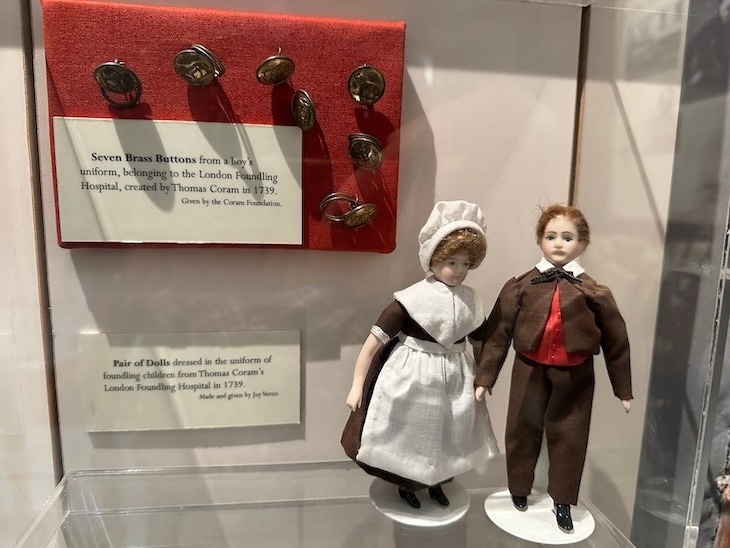
The Foundling Hospital moved out of London in the 1920s, and eventually closed in the 1950s. The original site in Bloomsbury is, however, still devoted to child welfare. Here you’ll find the Coram charity, which serves as an adoption agency and advisory centre. Next door is the Foundling Museum, which tells the story of Coram and his young charges. It also displays important works of art, including the March to Finchley painting that was the subject of a recent newsletter. A large open space is now the Coram’s Fields Playground, which adults can only enter ‘if accompanied by a child’.
Henry Fielding’s despicable behaviour
Our third noted Londoner is perhaps the most famous. Henry Fielding (1707-1754) was a prominent judge who set up the Bow Street Runners, London’s first attempt at a professional police force. He was also a playwright and novelist, best known for the highly influential Tom Jones (1749), though I’d give him more credit for writing a parody of Samuel Richardson’s Pamela, puntastically called Shamela.
The grown-up Fielding was a leading light of both judiciary and proto-constabulary, but the youthful Fielding seems also to have dabbled in villainy. How else to explain this Lyme Regis plaque?
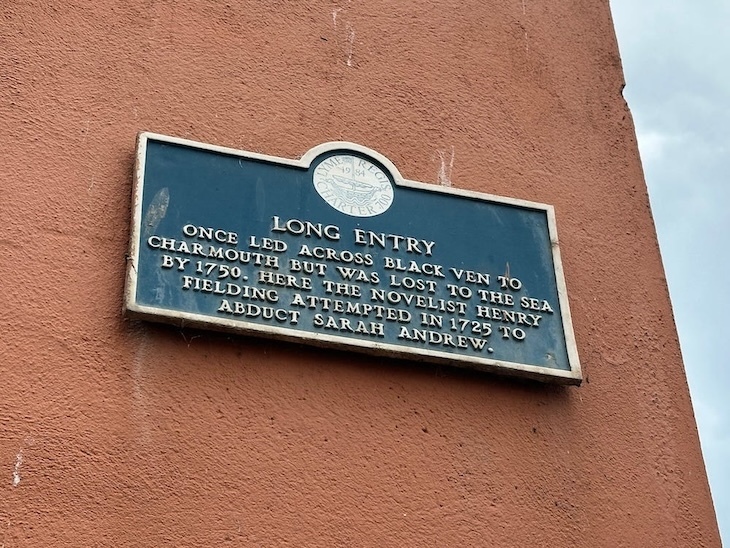
The plaque marks a narrow path called Long Entry, and records that here, in 1725, the novelist Henry Fielding attempted to abduct Sarah Andrew. What gives?
Fielding, aged 19, was spending the summer in Lyme Regis where he met distant cousin Sarah Andrew (then aged 15). She was an elegant young heiress on the cusp of a vast inheritance. He had a profile like a bottle-opener, and a wallet that was more accustomed to crumbs than currency.
Later accounts relate how Fielding had fallen desperately in love with the heiress. His attempts to woo her, though, were thwarted. Sarah was under the guardianship of her uncle Andrew Tucker, who hoped to see her married to his own son John Tucker. Fielding was an annoying rival.
Things came to a head one Sunday in November 1725. Sarah and the Tucker family were on their way to church (the same one, incidentally, where Mary Anning would be buried in the following century). One street away, Fielding and his servant grabbed the young lady and attempted to spirit her away. Mr Tucker was having none of it, and fought off the attempt on his niece.
Tucker went to the Mayor with his grievance. A surviving record states that Fielding and his man were “bound over to keep the peace, as he [Mr Tucker'] was in fear of his life or some bodily hurt to be done or to be procured to be done to him by H. Fielding and his man. Mr A. Tucker feared that the man would beat, maim, or kill him.”
Fielding fled town to avoid prosecution. As a parting shot, he posted a sour public notice, which still survives in Lyme Regis Museum:
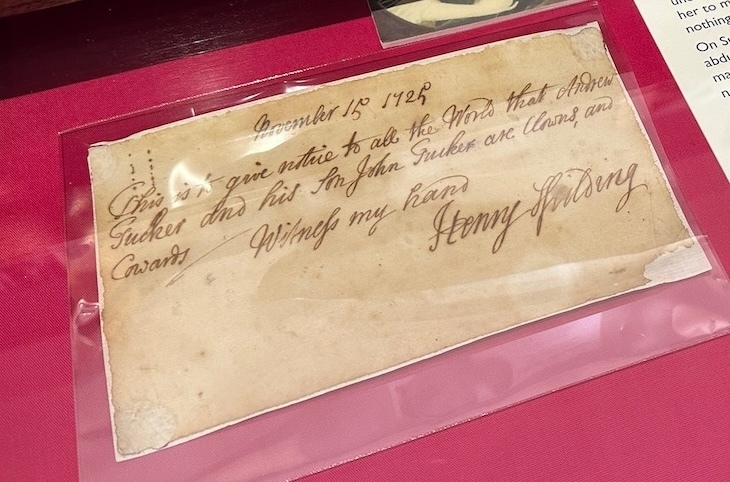
The note reads: “November 15 1725. This is to give notice to all the World that Andrew Tucker and his son John Tucker are Clowns and Cowards. Witness my hand Henry Feilding [sic].”Clearly, there’s more to this episode than the scraps of documentation disclose. Was Fielding really trying to abduct Sarah, or was that Tucker’s spin on a more orthodox street confrontation? What was Sarah’s side of the story? Why did Fielding view Tucker as cowardly?
We may never know. The experience — whatever its true nature — certainly left a lasting impression on Fielding. His novels and plays are littered with kidnappings. As a judge, meanwhile, Fielding would go on to preside over many cases of abduction, including the famous mystery of Elizabeth Canning. Lyme Regis had left its mark on Georgian London’s pre-eminent judge and novelist.
I began with Mary Anning and I’ll finish with Mary Anning. The great fossil hunter had only tenuous connections with London (though many of her best fossil discoveries now hang in the Natural History Museum). As a woman of the early 19th century, she was barred from joining the learned societies of the capital, though she did correspond with many of the leading lights. Anning spent almost all of her time in Dorset, contributing much to our understanding of ancient life and the vastness of geological time. Tragically, her own time was to be short. Anning died of breast cancer aged just 47. Had she lived another 12 years, she would, I’m sure, have been utterly thrilled to see the publication of Darwin’s On the Origin of Species, which finally made sense of the “endless forms most beautiful” that she had chiselled from the rocks.
Thanks to a campaign by locals, she now has a statue on the Lyme Regis seafront. Lovely though this is, her real tribute is down in the ammonite beds of low tide. To paraphrase Christopher Wren’s tomb in St Paul’s “If you seek her monument, look around you”.