This feature first appeared in February 2025 on Londonist: Time Machine, our much-praised history newsletter. To be the first to read new history features like this, sign up for free here.
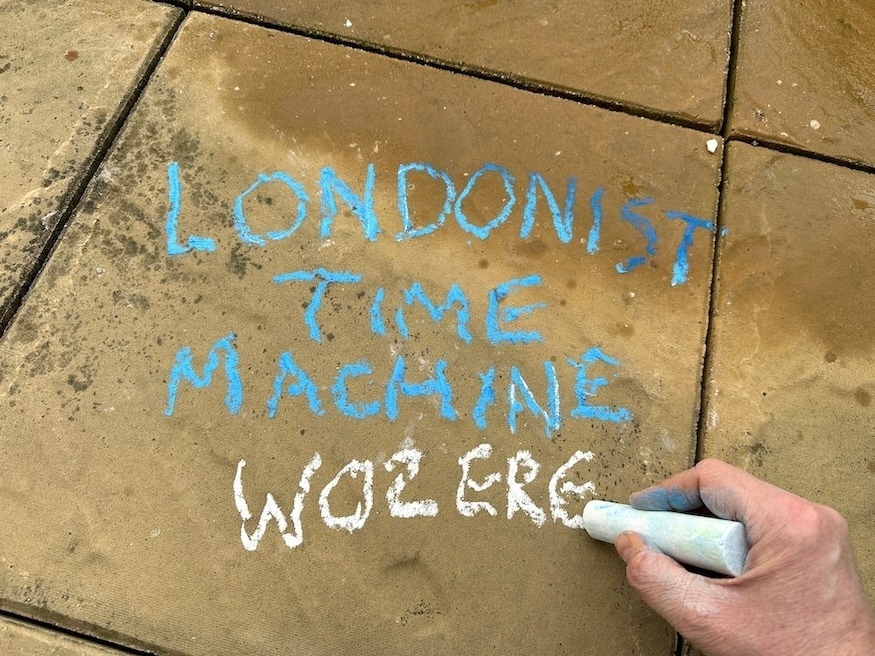
Graffiti is often dismissed as an eyesore; mindless vandalism; something to be expunged or prevented in the first place. But today’s “criminal damage” can become tomorrow’s historical curiosity. Graffiti from another era can tell us much about the fears, the dreams and the sense of humour that prevailed in previous generations. In some cases, graffiti preserves the names of Londoners who appear nowhere else in the historical record.
Here, I’ve pulled together a compilation of the most interesting graffiti from different centuries. Some of this is fairly well-known, other examples are drawn from long-forgotten newspaper accounts.
I’m concerning myself here with graffiti in the form of meaningful words, written or scratched onto walls. I’m not considering the (equally fascinating) realm of street art, nor the ubiquitous graffiti ‘tag’ commonly found on railway sidings.
Ye olde graffiti
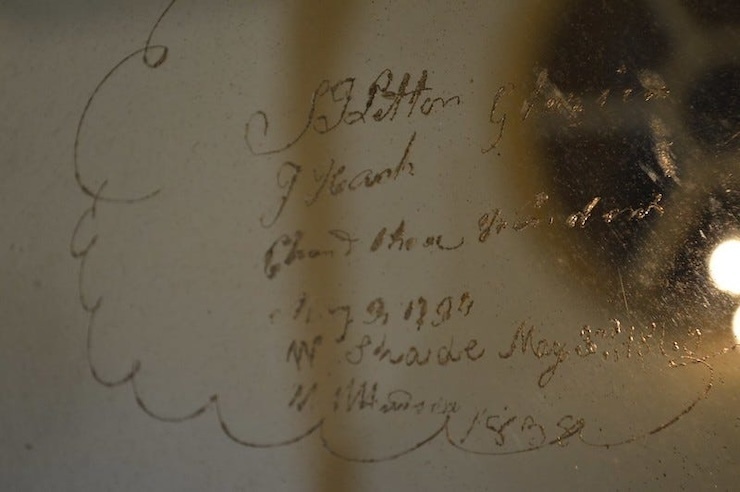
Most of London’s historic buildings contain graffiti. By age-old tradition — still observed today — stone masons and joiners will leave their marks within the fabric of the building, for discovery by future generations. In some cases, these hidden initials or surnames are the only record of these long-deceased craftsmen. I’ve been shown such marks in numerous Christopher Wren buildings. Here, for example, are some names scratched into glass inside the Old Naval College, Greenwich. They date from 1794, 1860 and 1838 (I think).
The oldest I’ve encountered is the date 1411, scratched into a door at Headstone Manor, Harrow. If genuine, these numerals were carved by a contemporary of Chaucer. Sadly, the medieval door vandal neglected to leave a name.
We can be more certain of the identities of the stone-chisellers in the Tower of London. Here, prisoners had months or years to contemplate their existence, and few outlets for creativity other than chipping away at their cell walls. Exceptional examples, carved by earls, priests and courtiers, can be found inside the Beauchamp Tower, and have been well-documented by the Gentle Author. You can even explore some of it in 3-D.
19th century scratchmarks
We might think of the Victorians as a prim and proper bunch, but graffiti was rife in a city with so many dark corners. Graffiti of a religious nature was common, as were political statements. A possibly antisemitic graffito was one of the key pieces of evidence in the Jack the Ripper case.
But writing on walls was not just a working-class pursuit. It could be found in the most rarified places. The Fourth Common Room at Harrow School, for example, is famous for its scratched panelling. The young Byron wrote his name here, as did Churchill and three other future Prime Ministers.
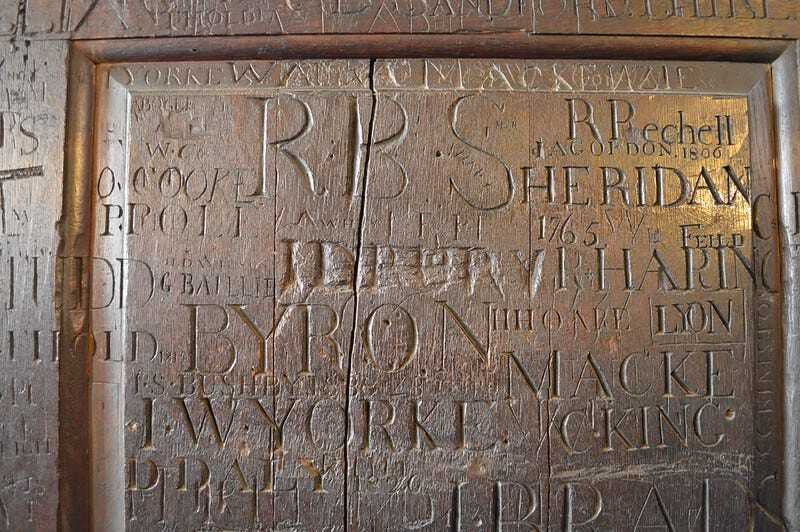
Churchill was a serial name tagger. His autograph is also scratched into the windows of the oldest house in the Square Mile, on Cloth Fair. It’s long been the tradition for celebrity visitors to add their names to the panes. Neighbour John Betjeman’s shaky signature is there, just below that of cartoonist Osbert Lancaster. Even the Queen Mum’s august etchings are reputedly up there, although the current owner of the building tells me he’s never yet spotted it.
Even the police had a go. If you look closely at the long wall in Myddleton Passage, Clerkenwell, you’ll find a series of names and initials scratched into the bricks. These are the handiwork of officers from the Finsbury division of the Metropolitan Police, who carved their names here as part of a tradition.
The first graffiti on the Underground
Remember this name: Mr Aquila John Williams. You won’t find him in any history book, but he deserves some kind of recognition as the first known person to graffiti the London underground.
In 1864, just 14 months after the opening of the Metropolitan Railway, Mr Williams was up before the magistrate accused of writing "obscene words... calculated to pollute the minds of the passengers on that railway" [Cork Examiner, 10 March 1864]. History does not record his selection of phrase. For the sake of argument, let’s assume it was some lewd wordplay involving Lord Palmerston.
Mr Williams, of 21 Harcourt Street, Marylebone, pleaded guilty and expressed his deep regret. The pioneering vandal was ordered to pay 40 shillings plus costs. In summing up, the judge said he was confident that the case's publicity "would be effectual in preventing such conduct in future." And no one ever wrote a naughty word on the tube ever again.
1930s political graffiti
After personal “I woz ere”-style messaging, the commonest form of graffiti is probably the political statement. These have always been with us, but grew more common through the 30s and 40s for obvious reasons.
After the Nazis swept to power in 1933, the words “Hitler, murderer, release prisoners” were daubed in bright red paint, two-feet high, outside the German Embassy (Carlton House Terrace). Around the same time, a model of Hitler at Madame Tussauds was doused in red paint. Other protestors painted swastikas outside the homes of perceived Nazi sympathisers.
Pro-Hitler and fascist graffiti was also common. The phrase “Mind Britain’s Business”, a slogan of far-right politician Oswald Moseley, was endemic across south and west London, commonly written in black charcoal.
1950s: Supersonic bombers and the price of butter
Political graffiti was also rampant in the 1950s. A particular spate occurred in May 1958, when important walls in Westminster and Lambeth were daubed with messaging. “Stop foreign butter dumping: help New Zealand; Empire Loyalists,” read one learnedly punctuated request on Whitehall’s Board of Trade building (now the Cabinet Office). The same hand could be found on Northumberland Avenue, where “Royal Scuttle Society: Colonies for Sale: L.E.L.” had been written. Both are references to a trade dispute involving New Zealand butter — not exactly a topic I expected to encounter when searching the archives for examples of graffiti.
On the same night, Lambeth Palace, London home of the Archbishop of Canterbury, was graffitied with “Doctor Fischer [sic] patron of Cypriot terrorism L.E.L.”. Geoffrey Fisher was the Archbishop from 1945 to 1961. He’d waded into the debate over the future of Cyprus, then a British Protectorate, but riven by violence between Greek and Turkish Cypriots over the future of the island.
Meanwhile, the Air Ministry in Whitehall was daubed with the largest message of all — 30 yards (27 metres) long — reading “Empire Loyalists demand Barnes Wallis’s super bomber (Swallow)”. The Vickers Swallow was a conceptual supersonic bomber that never got off the drawing board. The government had ditched funding a few months before the graffito.
1960s: The Clapton musical meme
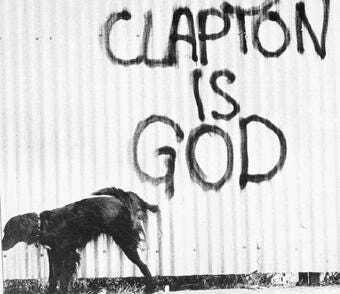
Eric Clapton is unquestionably one of the most gifted guitar players of all time, but raising him to a divinity is perhaps pushing things. That, however, was the gist of this crude graffito, which appeared on a fence in Islington in the mid-60s. The picture went viral (as they definitely didn’t say back then), and appeared on many further walls across town. Nobody knows who was behind it, but it helped propel Clapton, then with the Yardbirds, to much greater fame.
One place that encouraged graffiti in the 1960s was the Dirty Dicks pub on Bishopsgate. The place was noted for its scruffy appearance and its collection of mummified animals. Amid the grime and desiccated cats, lay the graffiti. According to one report, “all the walls and the bars, in fact every corner that promises some little immortality, are covered with names which visitors from all corners of the globe seemed to have scratched with some deliberation and care.” The pub is still trading, and retains a deliberately dingy feel (with a few mummified animals hidden in a cabinet), but no sign of the graffiti of yesteryear.
1970s: London’s most famous graffito?
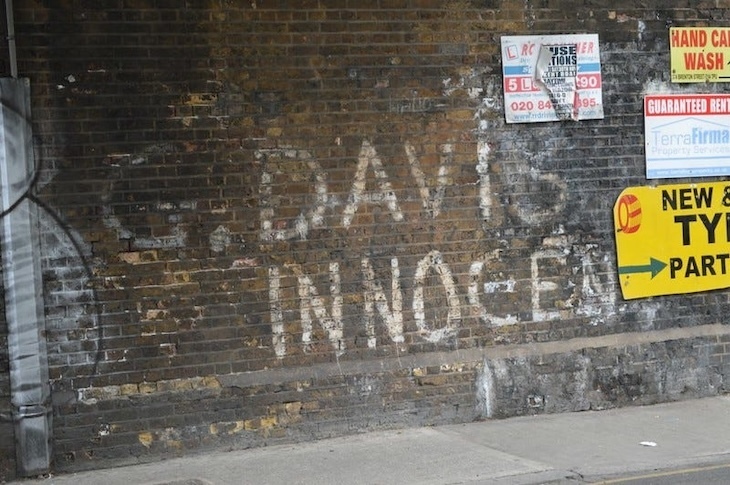
In March 1975, George Davis was convicted of armed robbery; wrongfully, as it turned out. A high-profile campaign to clear his name ensued. 'G. Davis is innocent' became a familiar phrase on the walls of east London. High-profile press coverage ensured that the plea was known to just about everyone in the country. It is still much-remembered today. Indeed, the graffiti survives in several locations, half a century on. I took the photo above under a bridge in Limehouse, and there’s another one nearby. Davis — still alive at the time of writing — would later return to jail on more secure convictions for armed robbery.
1970s: Toilet graffiti
The unobserved seclusion of a toilet cubicle is the natural home of witty graffiti. In this hidden, locked-away arena, the pithy one-liner can become a thing of amusement, accepted and even cherished in a way we seldom treat outdoor graffiti. Toilet humour has always been a ‘thing’, but the art-form really took off in the 1970s, with the growing availability of marker pens.
In 1976, the Daily Mirror ran a competition for readers to submit the best examples. Entries included: “Keep London Clean: eat a pigeon a day”, “Devolution for Bognor!”, “Free the Indianapolis 500!” and “Dougal has rabies”. The winning entry came from a Mr J.W. Perry of Dartmouth Road, London, who submitted: “If you think the graffiti is bad, try the Shepherd’s Pie”. He won “a velvet toilet seat cover, or a bottle of champagne if you prefer”.
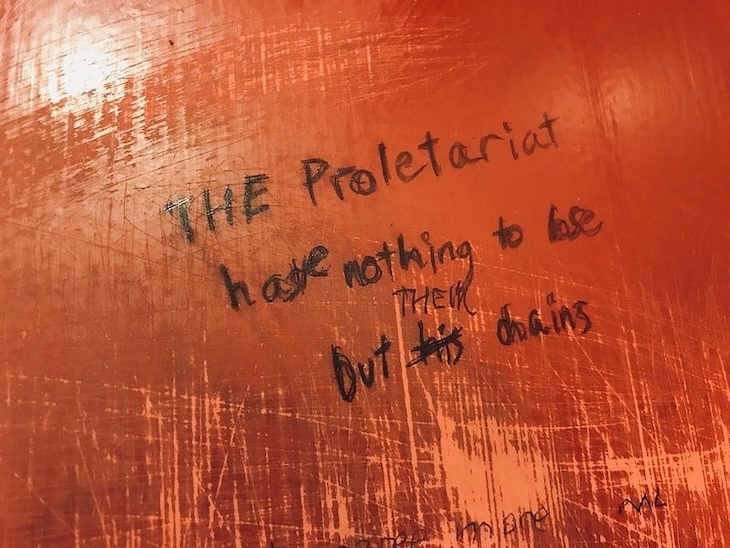
Some pubs, tired of the endless battle against cubicle scribblers, decided to go with the flow, so to speak. In 1975, John Barker, the landlord of the now defunct Royal Oak on Ealing Broadway, actively encouraged graffiti. He painted all the toilet walls black and even provided chalk, inviting patrons to leave their best witticisms.
1990s: A tube wisecrack
Just one quick-fire bit of nonsense from the newspaper archive:
‘Spotted by a random colleague at Hampstead tube station… — one large red metal security door with the legend neatly stencilled across it “Warning. This door is alarmed.” And written in neat black felt-tipped pen underneath: “But stoic!”’ - The Scotsman, 5 April 1994.
2000s: Peas, Gussets and Alphabets
Come the new Millennium, and graffiti continued to evolve into the artform we now call street art. But the simple act of writing words on walls continued apace.
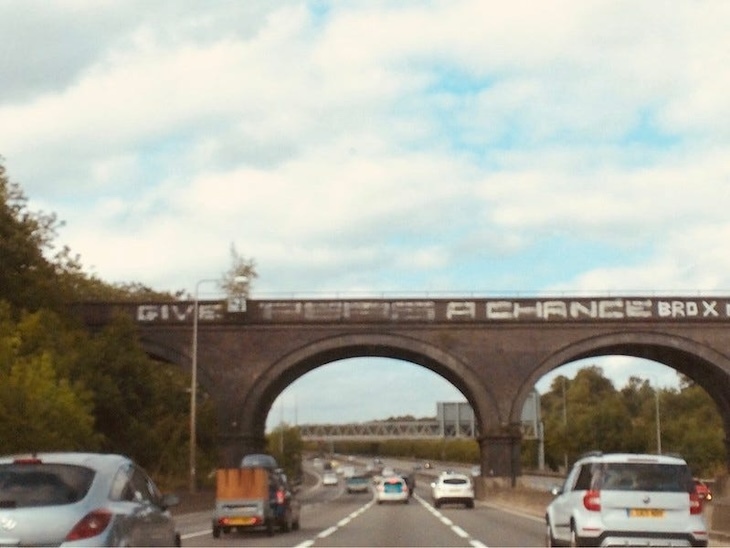
The most famous example is surely the “Give Peas a Chance” legend, written on an M25 motorway bridge to the west of London. It dates back to around 2008, when somebody added extra pun-making words around the pre-existing tag of “PEAS”. The surreal wisecrack was seen by tens of millions of people, before it was written over by omnipresent tagger HELCH a few years back.
My favourite is “Big Daves Gusset”, which appeared on a wall, visible from the railway lines west of London Bridge, around the turn of the Millennium. I’m told that Big Dave was a plus-sized engineer on the Jubilee line extension of the 1990s. He wore distinctive underwear, much to the amusement of co-workers who shared his changing room.
One of the strangest — and still mysterious — episodes concerned the phrase “Brooke Shields Alphabet”, or the variant “Alphabet of Brooke Shields”. The enigmatic epigram appeared across town in 2007. I catalogued over 60 examples, mostly in central London (see my map).
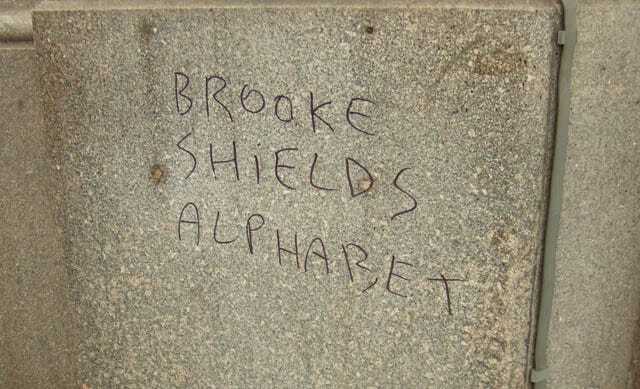
18 years later, and I still have no idea who was behind the phrase, or whether it had any deeper meaning. Please get in touch or leave a comment if you have any clues.
Finally, some unverified gossip that needs some sleuthing. Years ago, I was on a covert pub crawl around the many bars of the Houses of Parliament. My host let slip that somebody had recently carved “Tony Blair is a C***” into the central table of the House of Commons. The letters had gone so deep that a proper repair could not be effected without specialist help. In the meantime, the offending text had to be hidden by a pile of books. I don’t know if it’s true. If you have insider information, please do leave a message… though in the comments box rather than on the wall or oak furnishings.