Adapted from a feature that first appeared in August 2025 on Londonist: Time Machine, our much-praised history newsletter. To be the first to read new history features like this, sign up for free here.
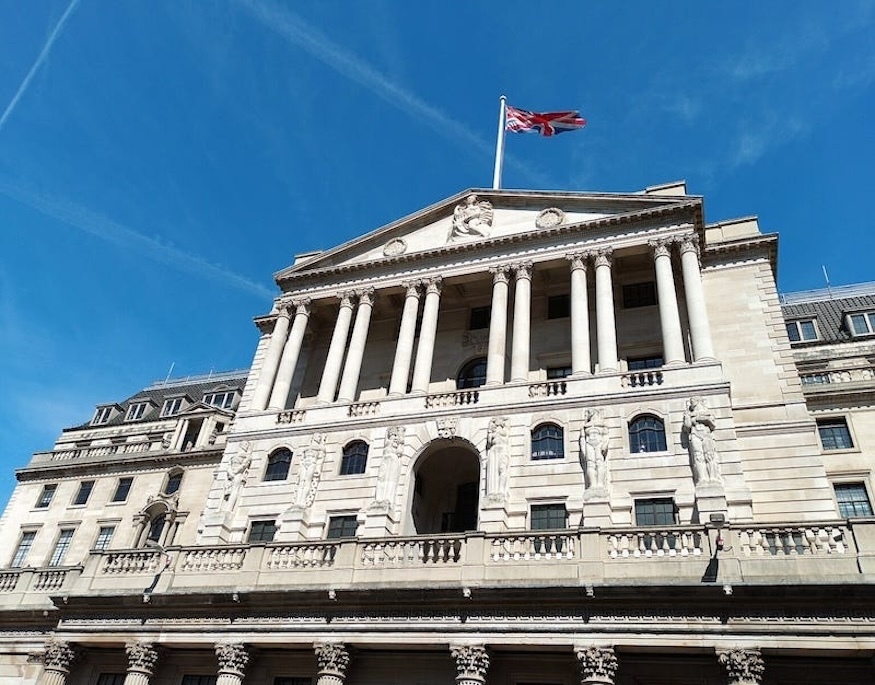
One does not simply walk into the Bank of England.
This titanic treasury is built like a fortress. It stands guard over more than £200 billion worth of gold — enough to run the entire NHS for more than a year. The Bank has other secrets to protect. It oversees payment systems, monitors financial stability, decides interest rates and guards any number of fiscal sensitivities. Its inner sanctums are very much not all over TikTok.
Happily, I’ve been invited in. The Bank’s museum is currently running an exhibition about the building’s architecture, and the curator Jenni Adam is keen to show off the real thing. Even with her generous welcome, I still have to satisfy three different gatekeepers, an ID check and a bag search before I’m allowed past the security gate-line.
I’m in for a treat. The building’s innards are rarely seen by the public. They are an essay in magnificence and embellished solidity — not dissimilar to Gringotts from Harry Potter, though without the ludicrous mine-car ride.
The architectural splendour could, and probably does, fill a book. When faced with such overwhelming riches, it often helps to zoom in on one detail. Five steps beyond the security gates brings me to the perfect candidate:
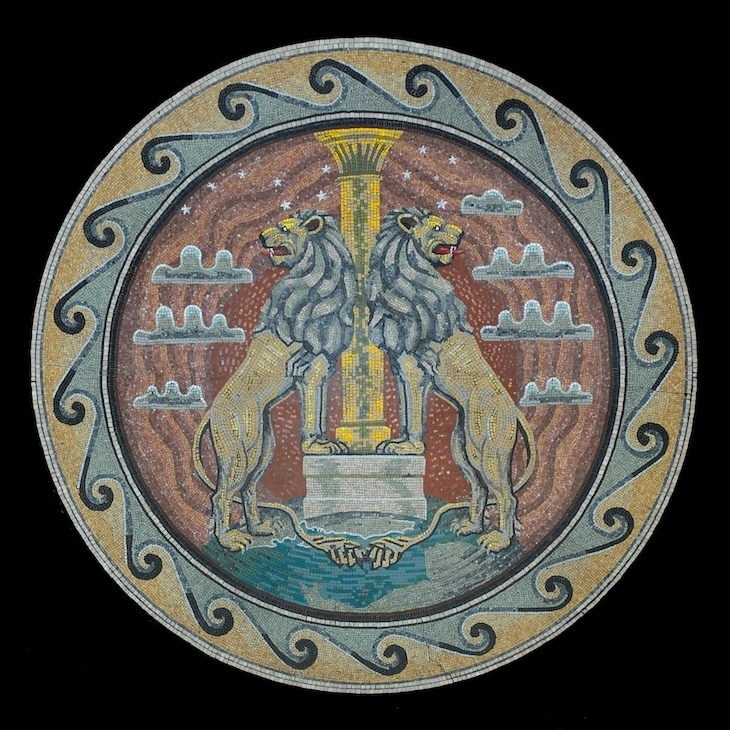
This spectacular floor mosaic is the work of Boris Anrep (1883-1969), whose handiwork you might have seen inside the entrance to the National Gallery. Anrep laid down this mosaic in the 1930s during the Bank’s reconstruction, along with dozens of other ornamentations.
One might easily stride over the mosaic without giving it a second thought. But it holds a world of symbolism. The two lions and classical column are modelled on those of the Lion Gate in Mycenae, Greece, which also guarded a treasure house.
Beneath the stone plinth, the white trace represents the south coast of England. The single red tessera, easily missed, indicates the location of Cobham in Kent, home of the modern Bank’s architect Sir Herbert Baker. Meanwhile, the top of the mosaic features two constellations: The Plough (Big Dipper) and the Southern Cross. If you use the constellations as a navigator would, then they point not to north and south but directly towards the office of the Governor of the Bank of England. I find that enchanting.
Boris Anrep wasn’t the only mosaicist to leave his mark on the Bank. Someone got there 1900 years before him. Three Roman mosaics have been discovered across the site during various phases of expansion. One of these was removed to the British Museum in the early 19th century where it’s been on permanent display ever since. One is in the Bank’s museum. But the third now forms a focal point at the base of a precipitous stairwell:
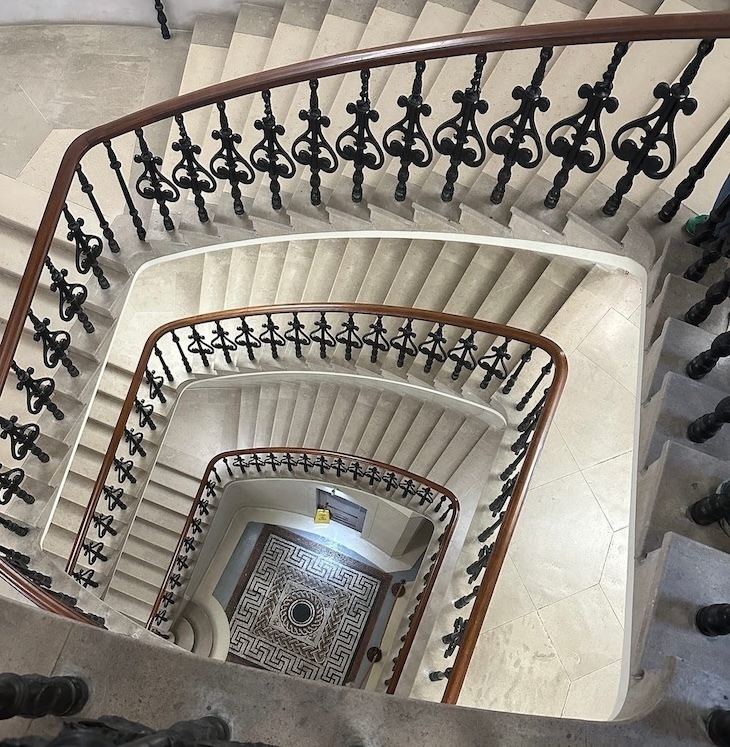
These mosaics once adorned a Roman villa on the banks of the now-buried River Walbrook. Those early Londoners could scarcely have imagined that their floor covering would, two millennia later, decorate the foundations of the world’s most famous Bank. Where will your carpet be in AD 4000?
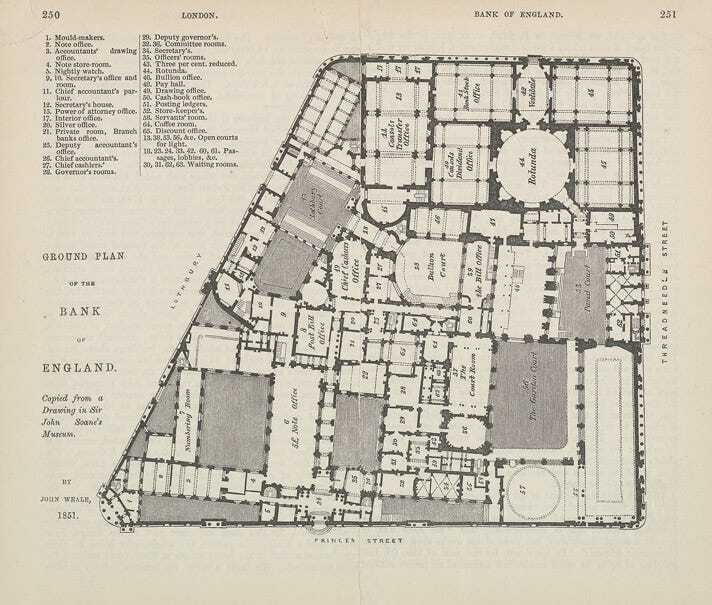
The Bank’s physical evolution is a complicated tale. It was established in 1694, mostly because the government needed a stable source of loans to finance yet another war with France. These were humble beginnings. The early Bank operated out of rented rooms and only got its own site 40 years later when it moved into a purpose-built home on Threadneedle Street in 1734. From this nucleus, the bank expanded to eventually fill the whole block, with additions from architects like George Sampson, Robert Taylor, and especially Sir John Soane. The latter’s plan took decades to reach fruition, and we can get a sense of its scale by looking at its Minotaur-conjuring floor plan:
Soane was mightily proud of his financial fortress. He even had it depicted as a future ruin, as though to suggest it deserved the same reverence as the great buildings of Roman antiquity.
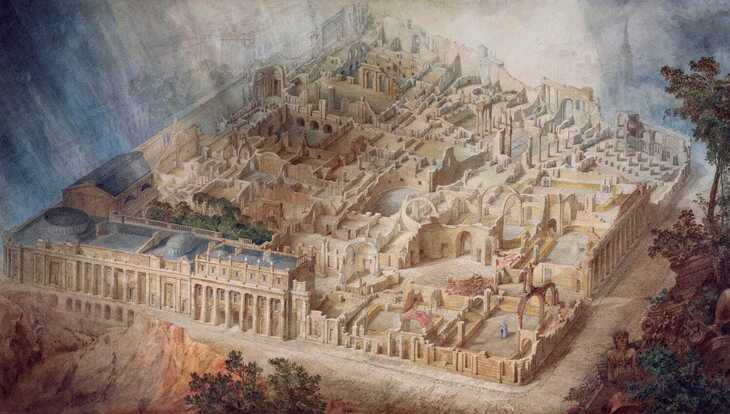
In a prescient twist, artist JF Gandy depicted the ruined Bank on a rise, with a steep gradient to the lower left. This is exactly the spot where Bank Tube station would be hollowed out many decades later (and itself turned into a crater when a high-explosive bomb scored a direct hit in 1941).
Soane’s Bank was much celebrated, with its soaring halls and walls. Unfortunately, it would only last a century. Despite its gigantic footprint, the Bank was running out of space. Modern, taller offices were needed. And so, from 1925 to 1939, Sir Herbert Baker demolished the bewildering congeries and replaced them with the taller, more rational blocks we see today. In so doing, Soane and Gandy’s vision of the Bank of England lying in ruins was realised:
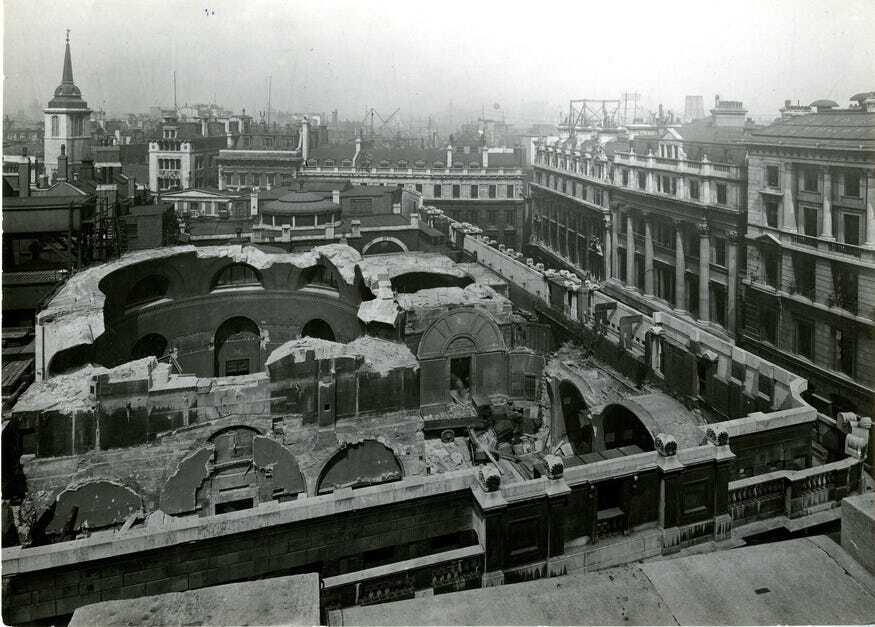
Most of Soane’s work was undone. One exception was the mighty curtain wall, which Baker retained. The Bank of England, then, was a pioneer of ‘facadism’ — the practice of demolishing an interior but keeping the outer walls — which people do so enjoy moaning about today.
Sir Herbert Baker’s rebuild was widely slagged off by the cognoscenti. It still is. Undisputed God of Describing Buildings Sir Nikolaus Pevsner reckoned it “the greatest architectural crime to befall the City of London in the 20th century”. Ian Nairn, the equally lionised if more raffish commentator of the built environment, decried Baker’s “evil superstructure”, and thought its architect should be “indicted".
Bit harsh. A radical redesign had to happen if the Bank were to take on the challenges of the 20th century. Soane’s oldie just didn’t have the floorspace the modern Bank needed. Besides, is the replacement really that bad? I mean, look:
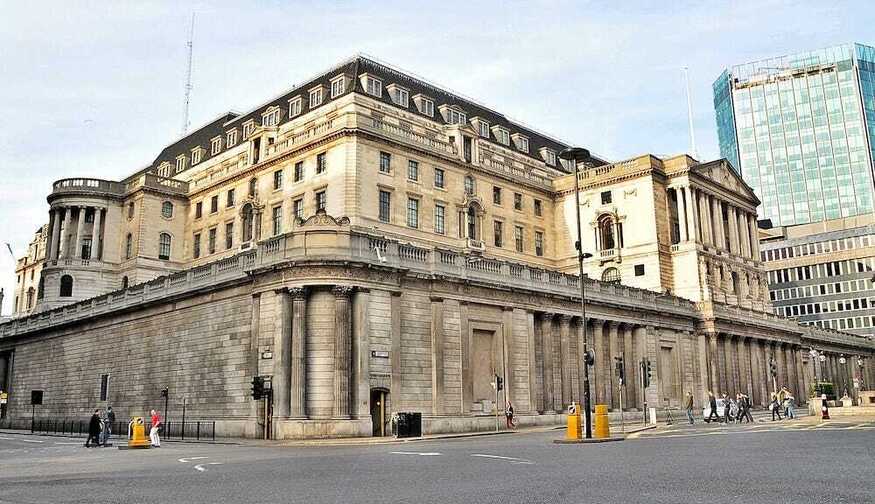
You can pompously argue about proportions and harmony and stuff, but I reckon nine out of every 10 people who look at the building will find it impressive. I still do, and I’ve passed it a thousand times. It can’t be all that bad because Historic England have given the modern Bank a Grade I listing, on par with St Paul’s and the Palace of Westminster.
The real architectural crime which, to be fair, the critics also called out, is not so much the external appearance but what was lost within. Soane’s banking halls and Rotunda were genuine marvels, all chopped down in the name of progress.
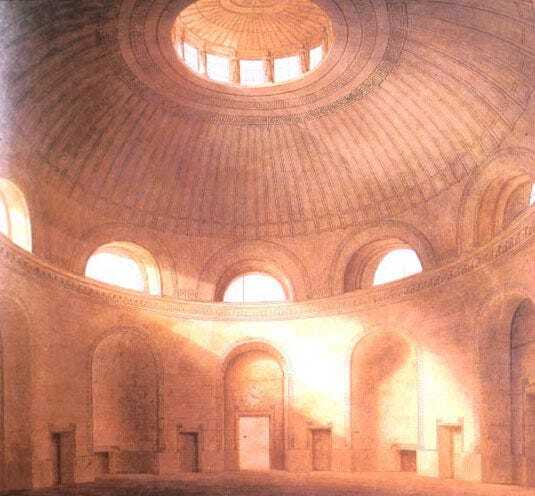
Even then, all was not lost. Some of the banking halls were rebuilt in facsimile, albeit with steel frame. What’s more, you can go see them. The Bank of England Museum, along the site’s eastern edge, nestles within these replica spaces. Though not the original Soaneian articles, these are still eye-popping chambers, and almost a century old themselves.
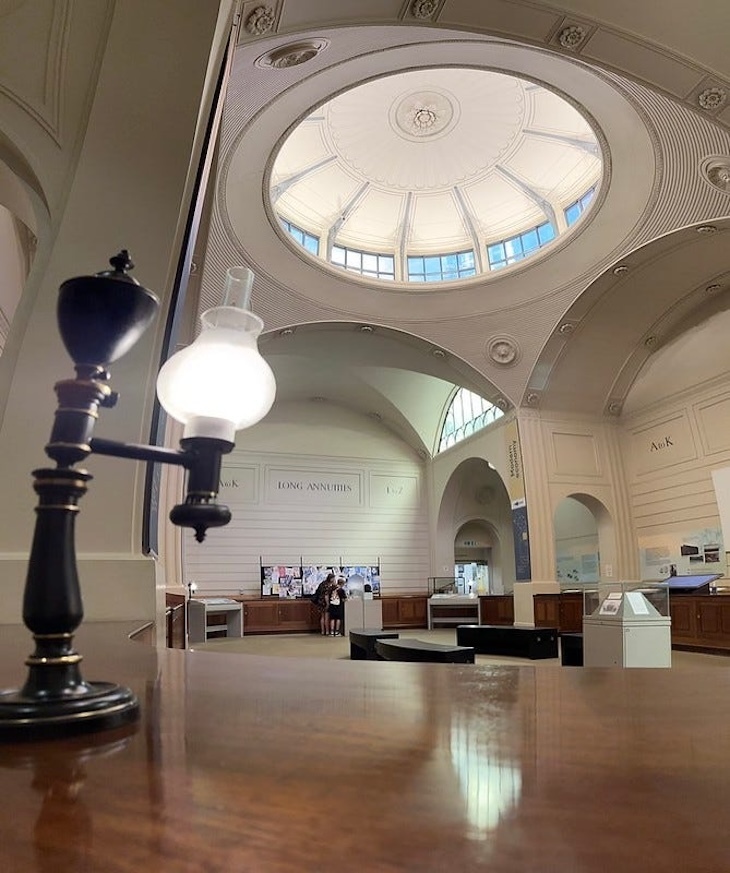
But what of the rest of the Bank — the bits the public can’t normally view? These, too, have a magnificence to them. A series of grand corridors wrap around the inner perimeter, all richly marbled and embellished. Anrep’s mosaics are a constant companion as we make a clockwise circuit. They offer a monetary migration back through the ages. Each successive floor-picture depicts a coin of the realm from a different reign. Henry VIII, I learn, was the first to allow a date in Arabic numerals rather than Roman.
(I’m not allowed to take photographs of these details. Strict rules. Even the official photographer, whose images follow below, operates under restrictions.)
The corridor leads to a grand staircase up to first-floor level. Here, I’m introduced to a sequence of rooms that can only be described as ‘palatial’. These are the famous Parlours, the ornate rooms where the Bank’s most high-profile work takes place. Grandest of all is the Court Room. It’s actually a glorified meeting room where the Court of Directors hold their elevated chinwags.
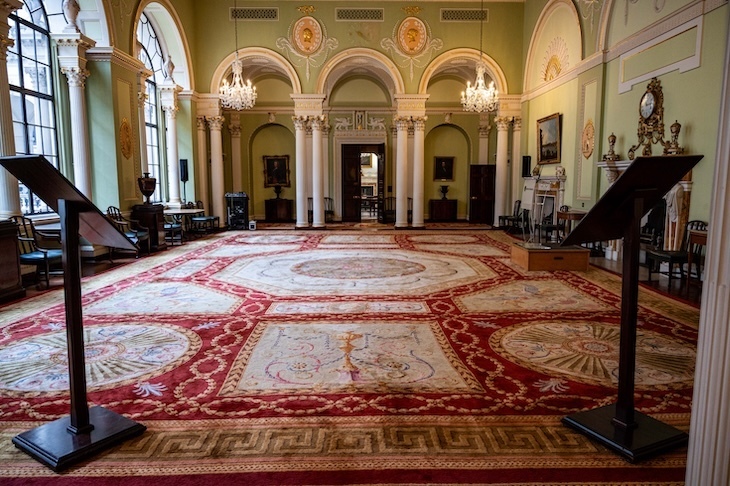
The Court Room is one of the oldest spaces in this temporal gallimaufry. It was originally constructed in 1774 and would look very familiar to banking bigwigs of the Georgian era. During Herbert Baker’s rebuilding in the 1920s-30s, the room was carefully disassembled, then rebuilt a floor higher.
The columns, swags and chandeliers are impressive, but nothing unusual for an 18th century grand room. What is unique is the wind dial (centre top in the image above, and zoomed-in below), connected to a weather vane on the roof:
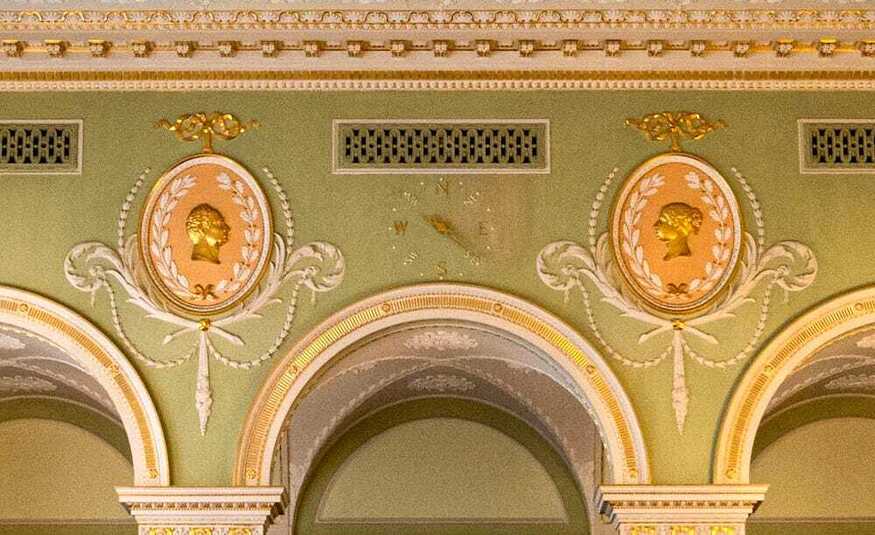
This feature was installed in 1805 to show the Bank’s Directors which way the wind was blowing. This was no metaphor. In the early 19th century, London was the busiest port in the world, and every ship was powered by the wind. The Bank factored the weather into its monetary policy. If the wind was blowing from the east, then more ships would be making their way along the Thames into London. The docks would soon be flooded with imports, and so the Bank released more money into the economy to take advantage. A westerly wind betokened the opposite course of action. The dial has no practical function today, other than to wear out the wallpaper, but its preservation is a joy for the historically minded.
Behind the dial wall stands the First Floor Committee Room. It’s a beauty:
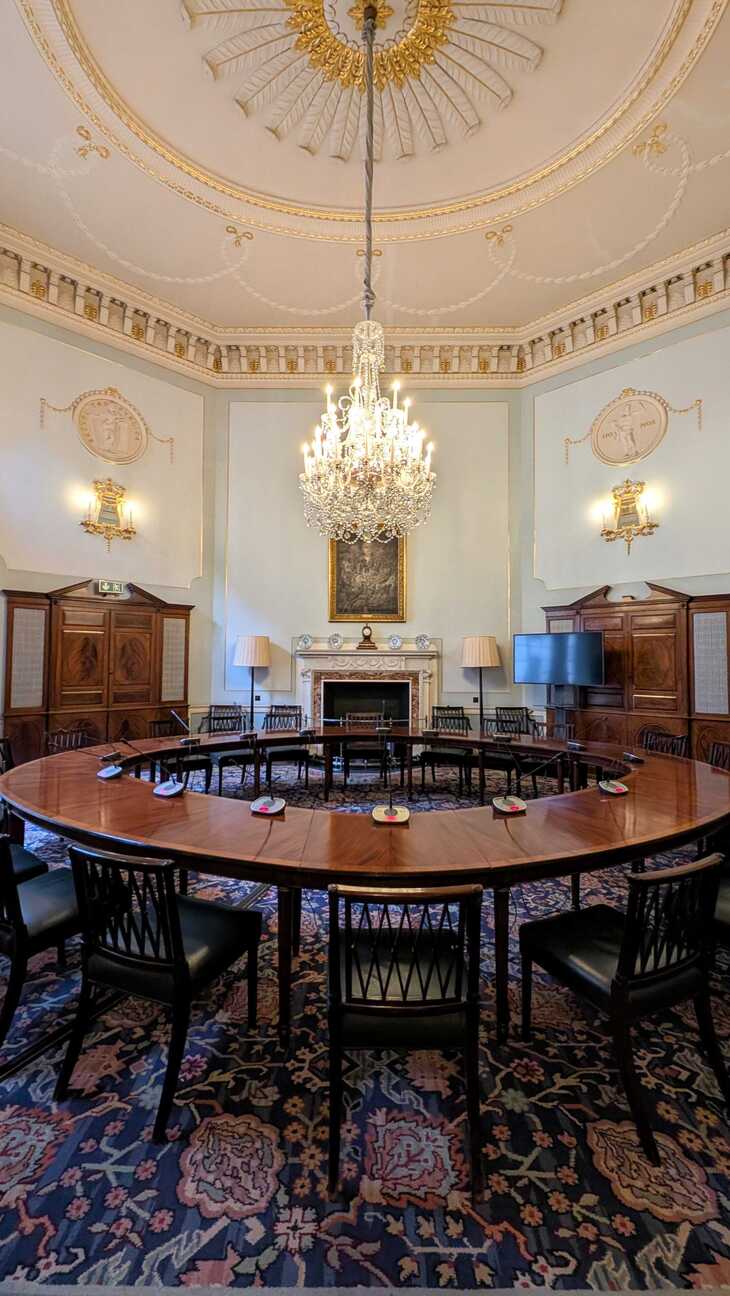
This is the space where the Monetary Policy Committee, chaired by the Governor, make decisions that affect every one of us, not least the setting of interest rates. Discussions in this room are top secret. The entrance is via two sets of doors, which dissuade eavesdroppers. Note also the panelled ‘cabinet’ on the left of the photo. It’s actually a concealed fire escape.
North of the Committee Room stands something more snug. This anteroom is yet another survival from before the 20th century rebuild.
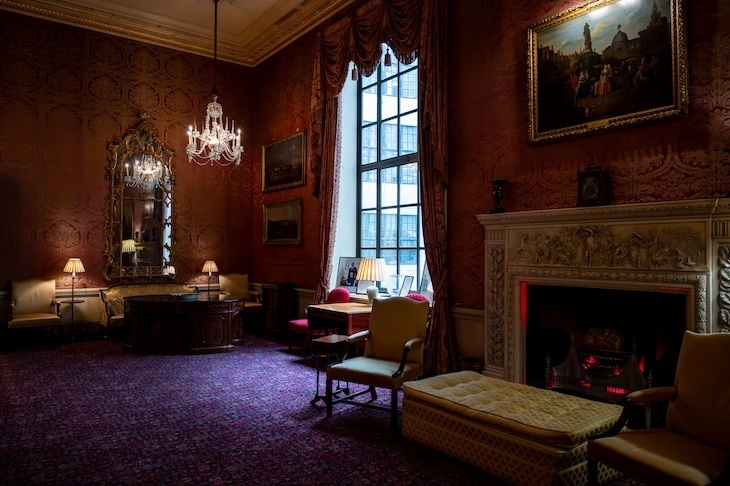
Here, my eye is drawn to the paintings of historical London scenes. The one you can see above the fireplace shows the old Stocks Market, on the site of what is now the Mansion House across the road. It’s an image of which I’ve long been fond, and I’ll probably make it the subject of a future ‘Anatomy of a Painting’ article. Wonderful to encounter the original.
Having seen the Parlours, my tour ends. It’s been an unforgettable experience to admire these chambers of fiscal brawn. I’ve only seen a fraction of the building, however. We didn’t pop into the Governor’s office. I was not allowed to set foot in the Garden Court, an old churchyard once connected to St Christopher-le-stocks, which was demolished during one of the Bank’s extensions. Nor could I see the fabled bullion rooms, where all that auric treasure is stored.
There is one final stop on the itinerary, however. Down we go into the bowels; not to see gold bars, but bold guards. We’d been allowed to take photographs in just two locations, and these had to be checked by security. Meanwhile, clocking-off bankers walk past in lycra, for London’s most secure bicycle store is also in the basement.
It’s one of two basements, actually, beneath seven floors of office, ranging over a full block. My final question to my guide is: do you still need all this space?
The answer is yes. The Bank employs over 5,000 people and remains central to the British and world economy. None of this vast building is in mothballs. It will not end up as a Soaneian ruin anytime soon. In an age of digital currencies and virtual meetings, it’s reassuring to see that the Bank of England is as solid as ever. These walls were built to last. (Twice.)
VISIT: The Bank is normally closed to the public (other than a counter for exchanging old banknotes just inside the doors). However, very occasional tours are arranged usually as part of Open House weekend.
MUSEUM: The public can, however, get a splendid taster of the wider banquet by visiting the Bank of England Museum along Bartholomew Lane. (Free, Mon-Fri)
EXHIBITION: Visit the museum in the next few months and you can view the Building the Bank exhibition. This explores the demolition of Soane’s bank and construction of Baker’s replacement. You’ll also be able to see Roman artefacts discovered on site.