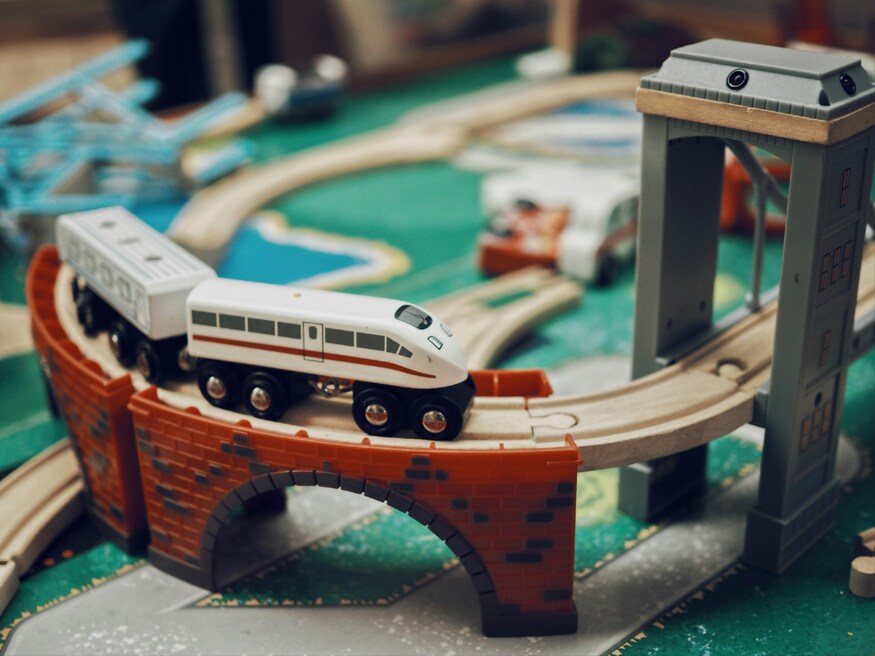
"Screeeeeeeeeeeee!"
The toe-curling squeal of steel alloy wheels grinding on Tube tracks is enough to make you leap up from your moquette seat and yell: "ARE WE SURE WE'VE TRIED EVERYTHING, PEOPLE?!"
Londoners in 1930 were going through the same frustrations. By this time, cast iron wheels had been ditched in favour of steel, but the grinding of metal on metal often remained insufferable.
And then an inventor by the initial-heavy name of A. A. D. Lang suggested he might have the solution: wooden wheels.
Lang was no crackpot. A successful inventor, he'd created a laminated wooden propellor built up via layers of thin wood. After five years of tinkering, his company, Lang Wheels, introduced a similar design for wooden wheels, created by layering discs of wood on top of one another, and cementing them firmly together. "Each layer," explained the Herald of Wales, "is composed of six sectors of specialy [sic] chosen spruce, so arranged that the grain of each sector runs in a different direction. The layers are placed on top of one another in such a way that the joints between the sectors of one do not coincide with those of the other."
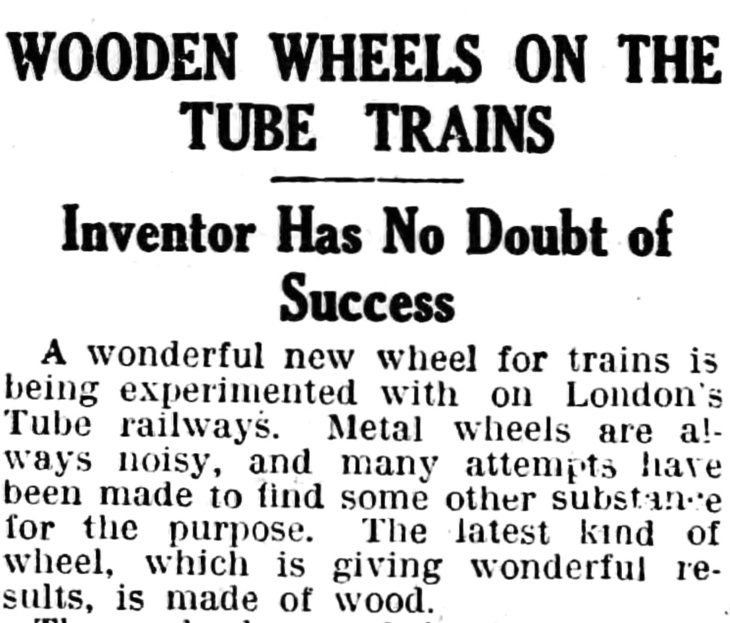
As well as being lighter and less noisy than steel, the wheels were supposedly 'immune to moisture or heat', plus there was a suggestion they were actually more resilient than steel. Lang had already shown off the strength of his wheels during War Office trials for gun carriages, held in Woolwich. The wheels had been run on tracks for a distance of 192 miles, before being subjected to machine gun fire and shelling. After which, they were still fine.
Interest in Lang's wheels was understandably high, and test wheels were made for the London Underground Railway and London Tramways, as well as for the Manchester Corporation. Mr Murray Griffiths, Director of the London District and Underground Railways, hailed the invention as "A wheel that will wear, and that will obviate the terrible noise we now experience in our towns." Griffiths went on to say he was quite satisfied that the wooden wheels would go on to be used on the railways.

Meanwhile, Lang challenged the Central London Railway to stick a mic in one of its carriages to record the noise, before refitting the carriage with one of his wooden wheels and doing the same again.
These were thrilling times for screech-phobes. So what happened with Lang's wooden wheels? Well, we're not entirely sure. The records fall silent about the experiments. Perhaps subsequent tests saw the wheels crack, splinter, catch fire or all of the above. The whole 'machine gun fire' thing did sound incredulous after all. As far as we know, wooden wheels were never properly, well, rolled out on the London Underground.
Lang Wheels carried on regardless; in 1933 they diversified into the fairground and theme park game, quickly trebling its workforce to manufacture roundabouts, dodgems, autodromes and the like. The screeching from those riding on such contraptions would have matched the wheels on any Tube train. But at least in this case, the passengers were having fun.