
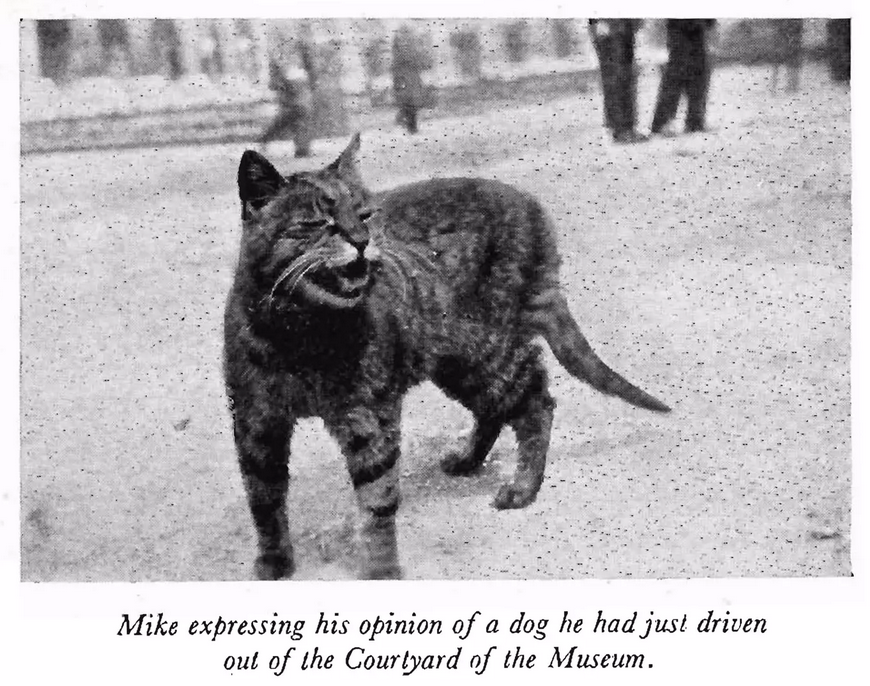
The most cherished of all the British Museum's acquirements was also a living one.
If you were to venture into the off-limits areas of the British Museum, you may come across some curious notices:
IT IS STRICTLY FORBIDDEN TO FEED CATS IN THIS AREA.
A niche caveat, you might think, but it makes sense when you learn that, once upon a time, the British Museum was home to a number of different 'house cats'.
Stories about such felines are many and varied; a newspaper article from 1894 mentions a "huge, grey, beautifully-marked cat" who sashayed up to the porter's quarters by Great Russell Street, and was promptly adopted as a member of 'staff'.
Nick Harris, an employee of the British Museum, explained how, from the late 1950s, the Museum took on a large cohort of stray cats, many of which reeked and were altogether antisocial. At one point, they numbered over 100. The benefit of 'employing' such pets was to stave off rats and mice, although you wonder if nightwatchmen might've also found their company comforting, while patrolling the mummies in the dead of night.
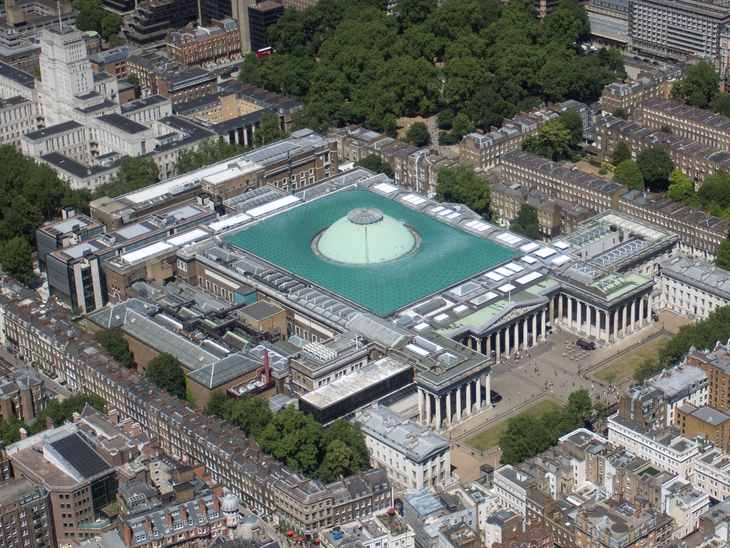
Among the British Museum's countless working cats, one is remembered above all others: Mike. It was early in the spring of 1908 that the on-and-off feline museum visitor, 'Black Jack' — previously expelled for sharpening his claws on the bindings of some newspaper volumes — returned with something in his mouth, depositing it at the feet of the Keeper of Egyptian antiquities, E. A. Wallis Budge. That something was a tabby kitten, soon to be named Mike and it was fitting that Black Jack had chosen Budge, because part of his remit was to take care of the museum's mummified cats.
By February 1909, Mike was earning his crust — or rather, his allotment of mutton and milk — by defending the British Museum from the menace of pigeons out the front of the museum (Mike had quickly made friends with the gatekeeper installed in the lodge here). Wrote Budge:
On Sunday mornings the house cat taught him [Kitten Mike] to stalk pigeons in the colonnade. Mike was set to 'point' like a dog, and the house cat little by little drove the pigeons up into a corner. The pigeons became dazed, and fell down, and then each cat seized a bird and carried it into the house uninjured.
Also known for fearlessly chasing dogs away from the main gate — "swelling himself to twice his normal size, [hurling'] himself on them. On such occasions he was truly a 'savage beast'" — Mike became a fixture of the museum, referred to sometimes as 'Museum Mike'.
According to the Aberdeen Press and Journal, "To frequenters of the Museum he is a natural and living bit of the building." The Star gushed: "In its day no cat has lived so public a life as Mike... If you have a reader's ticket for the Museum Library, and join the little knot of students that wait every morning for the stroke of nine to pass the gate and almost race across the courtyard for the honour of being first in the Reading Room, you find Mike already crouched contentedly there."
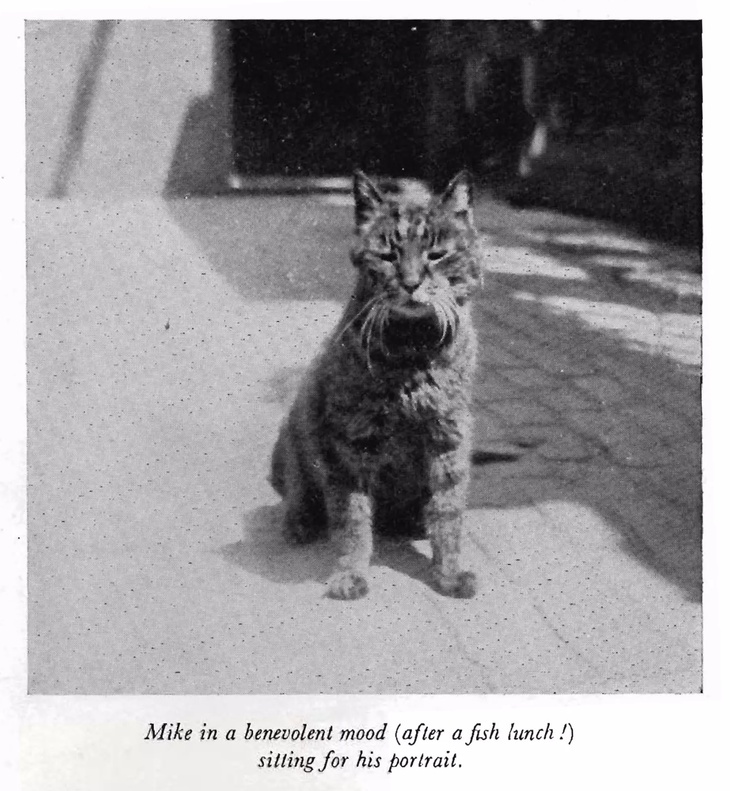
Mike did not view all museum visitors equally; Time magazine noted the cat's predilection for "scratching with savagery at human females who tried to puss-puss him." Indeed, a poem about Mike later recalled:
And if perchance some forward minx
Cared to go up and stroke the Sphinx —
Her hand shot back all marked with scores
From the offended Michael's claws.
When Budge retired from the museum, it's said he provided a weekly 6d maintenance to keep Mike in milk and mutton, and visited him once a week, bearing "a tasty parcel of fish". In 1924, Mike took retirement too, although he remained firmly in situ, one newspaper reporting in 1926: "Mike the venerable British Museum cat spends the greater part of his working day curled up on an almost inaccessible stone ledge high above the door of the porter's lodge." (It's fair to say Mike still led a more active life than his counterpart, Tiddles the 'Fat Cat' of Paddington station.)
On 15 January 1929, Mike died at a ripe old age, not far off 21 . His passing was much documented, Time magazine publishing not one but two pieces on the mourned moggy, claiming him to be "Probably the most famed British feline of the 20th Century, and certainly the most misogynous."
E. A. Wallis Budge himself compiled a pamphlet documenting the life and times of Mike, featuring sundry press clippings — which happily can be read in full online. In it appears an ode to Mike, written by F.C.W. Hiley, M.A., the museum's Assistant Keeper in the Department of Printed Books, and which concludes:
Old Mike! Farewell! We all regret you,
Although, you would not let us pet you;
Of cats the wisest, oldest best cat,
This be your motto — Requiescat!
Mike was not the last British Museum cat; many more followed (here's a lovely photo of three called Maisie, Pippin and Poppet), but by the late 1970s there was concern that the museum had too many, some verging on the feral, and causing damage in storerooms. The British Museum's house cats were gradually phased out altogether.
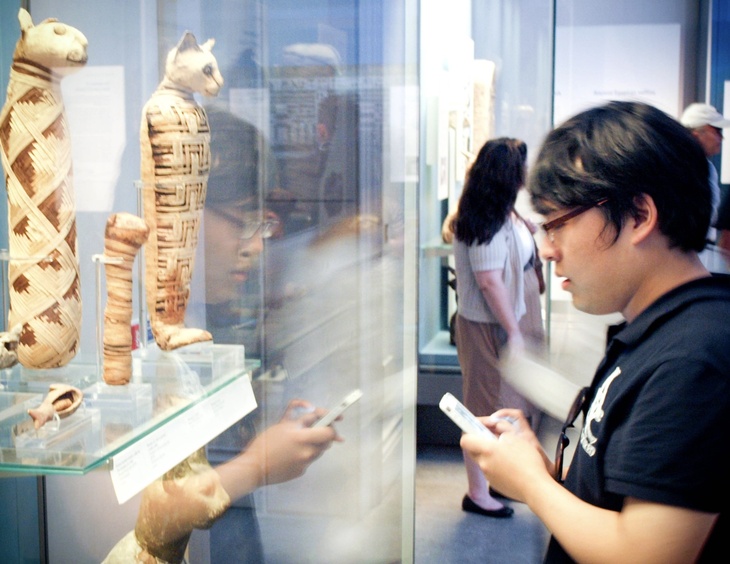
Rumours suggest there was once a small tombstone dedicated to Mike by the British Museum gates, but it's not there today. Whether it was removed or hidden some time ago, or never existed in the first place is not clear. But next time you're ogling the mummified cats in the British Museum, spare a moment to remember Mike, who kept these, and countless other objects, 'safe' for 20 years.

#/media/File:Mike_the_Cat,_Guardian_of_the_British_Museum.png)
.jpg)